Statement of Stockholders’ Equity: Columnar Format and Example

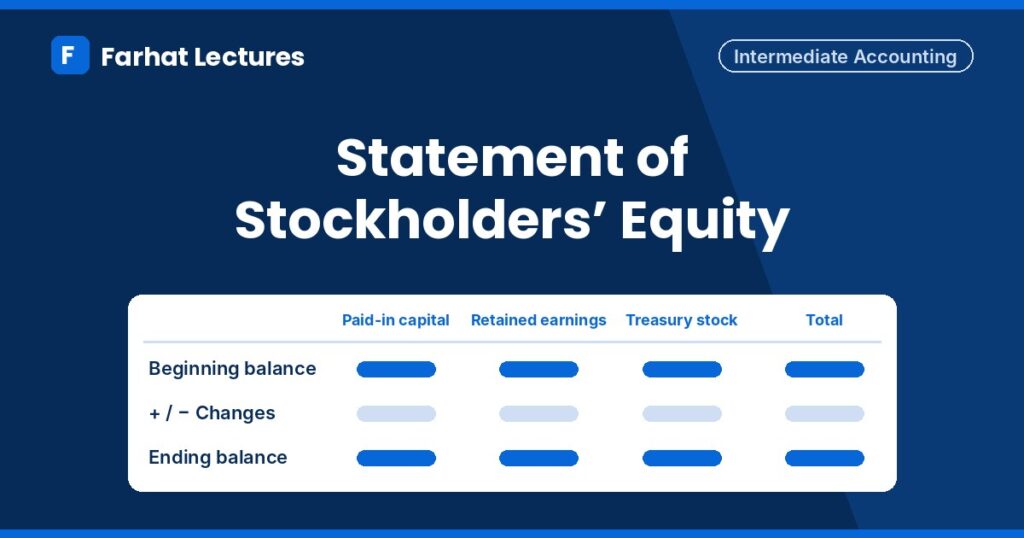
A statement of stockholders’ equity, also called a statement of changes in equity, shows how each equity account changed during the period. It starts with the beginning balances, adds items such as stock issued, net income, and other comprehensive income, subtracts dividends and share buybacks, and ends with the balances reported on the balance sheet. Most companies present it in a columnar format: one column per equity account and one row per type of change.
Why it matters: the balance sheet shows where equity ended up, but not how it got there. This statement shows stock issued, dividends, buybacks, net income, and other comprehensive income in one place, so readers can see what owners put in, what they took out, and what the company earned.
Watch: How to Prepare a Statement of Stockholders’ Equity
This short lesson (about 10 minutes) walks through how each equity transaction flows into the columns of the statement. Watch it first, then use the Cedar Point example below to practice.
The basic format
Every column in the statement follows the same four-part pattern:
- Balance at the beginning of the period
- Additions
- Deductions
- Balance at the end of the period
The columnar layout lines up a separate column for each component, such as preferred stock, common stock, additional paid-in capital (APIC), retained earnings, accumulated other comprehensive income (AOCI), and treasury stock, with a total column at the right. Reading across a row shows how one event affected each account. Reading down a column shows everything that happened to one account.
What other rows and columns can appear?
- Share columns: many public companies add a column for the number of shares next to each stock column, because GAAP also asks for the change in shares.
- Opening balance adjustments: if a company corrects a prior-period error or applies a new accounting principle retrospectively, it shows the adjustment right below the beginning balance, before the year’s other changes.
- Noncontrolling interest: a parent that does not fully own a subsidiary adds a noncontrolling interest column and shows the equity that belongs to the parent and to the noncontrolling interest separately (ASC 810-10-50-1A).
Is the statement of stockholders’ equity required?
When a company presents both a balance sheet and an income statement, U.S. GAAP (ASC 505-10-50-2) requires it to disclose the changes in the separate accounts that make up stockholders’ equity, plus the changes in the number of shares, for at least the most recent year and any later interim period. It can do this in a separate statement, within the basic financial statements, or in the notes.
For public companies, SEC Regulation S-X Rule 3-04 requires a reconciliation of the beginning and ending balance of each caption of stockholders’ equity, in a note or a separate statement, for each period a statement of comprehensive income is filed. In a Form 10-K that is usually three years, or two years for smaller reporting companies. The rule also requires dividends per share and in total for each class of stock. Form 10-Q filers must provide the same analysis for interim periods under Rule 10-01(a)(7).
It is not the same as a statement of retained earnings, which reconciles only one column. The stockholders’ equity section of the balance sheet then reports the ending balances.
What is it called under IFRS?
Under IFRS, the same report is called the statement of changes in equity, and it is a required primary financial statement. A note will not do.
IAS 1 requires it to show total comprehensive income for the period, the effect of any retrospective adjustments, and a reconciliation of each equity component, with profit or loss, other comprehensive income, and transactions with owners shown separately. IFRS 18, which replaces IAS 1 for years beginning on or after January 1, 2027, keeps this statement.
You will also see different labels under IFRS, such as share capital, share premium, and reserves, for many of the same accounts.
Statement of stockholders’ equity example
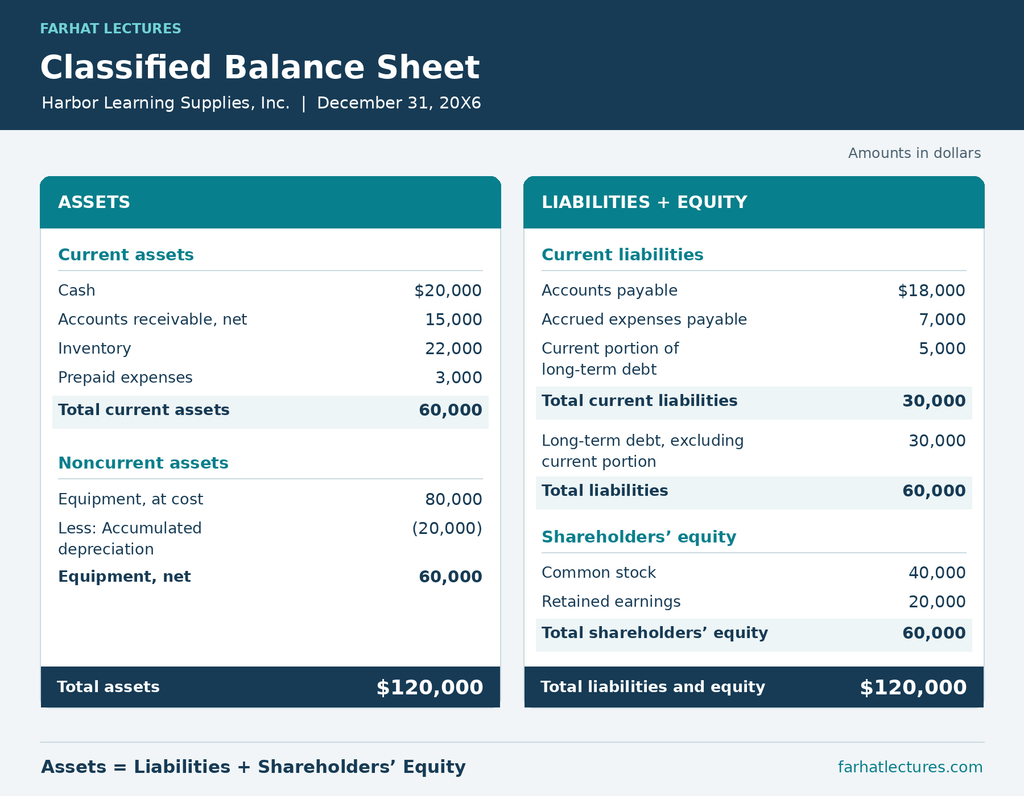
Cedar Point Corporation (hypothetical) had these equity events in 2026. The ending balances match the equity section shown in our balance sheet lesson.
Cedar Point Corporation
Statement of Stockholders’ Equity
For the Year Ended December 31, 2026
| Event | Preferred stock | Common stock | Stock dividend distributable | APIC | Retained earnings | AOCI | Treasury stock | Total |
|---|---|---|---|---|---|---|---|---|
| Balance, Jan. 1, 2026 | $600,000 | $280,000 | $0 | $1,605,000 | $1,376,000 | $15,000 | $(38,000) | $3,838,000 |
| Issued 20,000 common shares at $16 | 20,000 | 300,000 | 320,000 | |||||
| Net income | 520,000 | 520,000 | ||||||
| Other comprehensive income | 25,000 | 25,000 | ||||||
| Dividends on preferred (6%) | (36,000) | (36,000) | ||||||
| Cash dividends on common | (110,000) | (110,000) | ||||||
| Stock dividend declared, 15,000 shares at $18 | 15,000 | 255,000 | (270,000) | 0 | ||||
| Repurchased 3,000 shares at $19 | (57,000) | (57,000) | ||||||
| Balance, Dec. 31, 2026 | $600,000 | $300,000 | $15,000 | $2,160,000 | $1,480,000 | $40,000 | $(95,000) | $4,500,000 |
How to read the key rows:
- Stock issuance: 20,000 shares at $16 bring in $320,000. Common stock gets the $1 par ($20,000) and APIC gets the rest ($300,000).
- Preferred dividends: Cedar Point has 12,000 shares of $50 par, 6% preferred stock, or $600,000 of total par. The annual dividend is 6% × $600,000 = $36,000.
- Stock dividend: this is a small stock dividend (about 5% of the shares outstanding), so it is recorded at the $18 market price. Retained earnings fall by $270,000 (15,000 × $18). Stock dividend distributable, which is part of capital stock (the par value of shares issued or to be issued), gets the $1 par ($15,000), and APIC gets the rest ($255,000). The total column shows zero because a stock dividend only moves equity between accounts.
- Treasury stock: buying back 3,000 shares at $19 reduces total equity by the $57,000 paid. Under the cost method, the full cost goes to the treasury stock column. See treasury stock journal entries for the entry.
- Other comprehensive income for the year goes to AOCI, not to retained earnings. New to OCI? Start with What Is Comprehensive Income?
Check the total: $3,838,000 + $320,000 + $520,000 + $25,000 − $36,000 − $110,000 + $0 − $57,000 = $4,500,000.
How to prepare it in five steps
| Step | What to do | Where the numbers come from |
|---|---|---|
| 1 | Set up one column per equity account, plus a total column | Prior-year balance sheet |
| 2 | Enter the beginning balances | Prior-year ending balances |
| 3 | Record owner transactions: stock issued, dividends, treasury stock | Journal entries and board minutes |
| 4 | Add net income and other comprehensive income | Income statement and statement of comprehensive income |
| 5 | Total each column and agree it to the year-end balance sheet | Current-year balance sheet |
Common mistakes
- Putting unrealized gains or losses from other comprehensive income in retained earnings instead of AOCI.
- Showing a stock dividend as a reduction of total equity. It has no effect on the total.
- Recording a share buyback as an increase in equity. Buying back shares always reduces total equity. Reissuing treasury shares later is what increases it.
- Forgetting preferred dividends when reconciling retained earnings.
- Ending balances that do not agree with the balance sheet. Always tie out each column.
Key takeaways for the CPA exam
- The statement reconciles every equity account from its beginning balance to its ending balance, and the ending balances must agree with the balance sheet.
- Net income goes to retained earnings. Other comprehensive income goes to AOCI.
- Stock dividends and stock splits do not change total equity. Cash dividends and share buybacks reduce it.
- Treasury stock bought under the cost method is shown at cost as a deduction from equity.
Exam tip: the AICPA FAR blueprint covers the statement of changes in equity in Area I, Financial Reporting. In a task-based simulation, you may be asked to prepare one from a trial balance or to correct errors in one. Check the total column first: if a row’s total does not equal the sum of its columns, you have found the problem.
Practice questions
1. Beginning retained earnings are $500,000. Net income is $140,000, cash dividends are $45,000, and a small stock dividend transfers $30,000. What is ending retained earnings?
Answer: $565,000. $500,000 + $140,000 − $45,000 − $30,000.
2. How does a small stock dividend change total stockholders’ equity?
Answer: no change. Retained earnings go down, and common stock (or stock dividend distributable) and APIC go up by the same amount.
3. A company buys back 1,000 of its shares for $25 each. Which columns change?
Answer: the treasury stock column shows $(25,000), and the total column falls by $25,000. No other column changes at the time of purchase.
Interactive statement of stockholders’ equity quiz
Check your understanding with four quick questions on the basic format of the statement, what companies must disclose about changes in equity, where those disclosures can appear, and how a columnar layout works. Pick your answers, then select Check my work to see how each one is solved. If you get stuck, review the basic format and the disclosure rules first.
Frequently asked questions
Is the statement of stockholders’ equity the same as the statement of retained earnings?
No. A statement of retained earnings covers only retained earnings. The statement of stockholders’ equity covers every equity account.
Where does other comprehensive income appear?
In the AOCI column. Net income goes to retained earnings.
Do dividends declared but not yet paid appear?
Yes. Retained earnings drop when a dividend is declared, whether or not cash has been paid.
How is this statement used in analysis?
It supplies the beginning and ending equity balances and dividends used in ratios such as return on common stockholders’ equity and the payout ratio.
What is another name for the statement of stockholders’ equity?
You will also see it called the statement of changes in equity, the statement of shareholders’ equity, or the statement of changes in stockholders’ equity. IFRS uses the name statement of changes in equity. They all describe the same reconciliation.
Does a stock split appear on the statement of stockholders’ equity?
A regular stock split changes the number of shares and the par value per share, but it does not move any dollars between accounts. The dollar columns do not change. If the statement has share columns, the share count goes up. See stock dividend vs. stock split.
Do private companies need a statement of stockholders’ equity?
Under U.S. GAAP, any company that presents both a balance sheet and an income statement must disclose the changes in each equity account. A private company can meet that rule with a separate statement or with a note. The SEC rules apply only to public companies.
Sources
- 17 CFR 210.3-04 (SEC Regulation S-X Rule 3-04): changes in stockholders’ equity
- 17 CFR 210.10-01 (SEC Regulation S-X Rule 10-01): interim financial statements
- Deloitte DART: statement of stockholders’ equity presentation
- SEC: Beginners’ Guide to Financial Statements
- IFRS Foundation: IAS 1 Presentation of Financial Statements
- IFRS Foundation: IFRS 18 Presentation and Disclosure in Financial Statements
About the author: Mansour Farhat, CPA, CIA, DBA, creates the accounting, CPA, CMA, and EA lessons at Farhat Lectures, including the intermediate accounting lessons this article draws from.
Continue learning with Farhat Lectures
Strengthen your accounting understanding with clear explanations and guided practice.
Explore the free sample course