
Fair Value Option for Liabilities: A Simple Guide


The fair value option lets a company choose, instrument by instrument, to measure eligible financial liabilities such as bonds and notes payable at fair value instead of amortized cost. Under U.S. generally accepted accounting principles (GAAP), interest-rate and other market changes go to net income, while changes caused by instrument-specific credit risk go to other comprehensive income (OCI).
Instrument-specific credit risk is the risk that this particular borrower will not repay this particular debt. For the borrower, a decrease in the liability’s fair value is a gain and an increase is a loss. This guide uses original examples to show both the direction and the cause of each change, so you can record the entries correctly.
Watch: The Fair Value Option for Financial Liabilities
Watch this Farhat lesson on YouTube
Prefer to learn by video? Watch this lesson first, then use the examples below to practice the journal entries on your own.
Fair value option versus amortized cost
Most ordinary bonds and notes payable are measured at amortized cost, using the effective interest method. That amount reflects initial proceeds and subsequent amortization of discounts, premiums, and applicable issuance costs. It does not automatically move with the bond’s quoted market price.
With an eligible fair value option election, the liability is remeasured at each reporting date. Fair value is a market-based exit price for transferring the obligation, not simply the principal written in the contract. For a broader comparison, see historical cost vs fair value. The contractual amount owed remains unchanged unless the parties change or settle the agreement.
The election is generally made instrument by instrument at a permitted election date, commonly initial recognition, and is generally irrevocable. A company cannot switch back to amortized cost next year simply because a fair-value adjustment becomes unfavorable. Most recognized financial assets and financial liabilities are eligible. A few items are not, including pension and other postretirement benefit obligations, financial assets and liabilities recognized under leases, bank deposit liabilities payable on demand, investments in subsidiaries or variable interest entities that will be consolidated, and instruments classified wholly or partly as equity. One more detail: under this option, upfront costs and fees such as debt issuance costs are expensed right away instead of being deferred and amortized (ASC 825-10-25-3).
| Question | Amortized cost | Fair value option |
|---|---|---|
| What amount is reported? | Amortized carrying amount | Current fair value |
| Do ordinary market-rate changes remeasure the debt? | Generally no | Yes |
| Does the contract’s principal automatically change? | No | No |
| Is interest still accounted for? | Yes | Yes; distinguish it from remeasurement |
The Financial Accounting Standards Board (FASB) addresses this election in Accounting Standards Codification (ASC) 825-10. Its Accounting Standards Update 2016-01 explains the separate presentation of instrument-specific credit effects and their reclassification when the liability is settled.
Why would a company choose the fair value option?
The main reason is to reduce an accounting mismatch. Suppose a company holds investments measured at fair value and funds them with debt measured at amortized cost. When interest rates move, the investments change in value but the debt does not, so earnings swing even when the position is economically balanced.
Measuring the debt at fair value too lets the two changes offset in earnings, without the extra work of hedge accounting. The tradeoff is more volatility from period to period and more disclosure.
Why can a falling liability create a gain?
Think from the issuer’s perspective. A liability is an obligation. Reducing its measured amount requires a debit to the liability or a related valuation account. The other side is a gain. An increase requires a credit to the liability and a loss.
This is the opposite direction from an investor’s asset: a decrease in an investment’s value is normally unfavorable to the investor. Do not use the lender’s perspective to prepare the borrower’s entry.
For fixed contractual payments, higher market yields generally reduce present value; lower market yields generally increase it. The bond pricing guide shows this present value math step by step. The company’s credit standing can also change the yield demanded by investors. Identify the cause before deciding where to present the adjustment.
Example: market-rate change in net income
Maple Systems issues a $240,000 note at face value and elects the fair value option. At year-end, after recording interest, the note’s fair value is $231,000. Assume the entire $9,000 decrease results from a general increase in market interest rates, with no instrument-specific credit change.
| Account | Debit | Credit |
|---|---|---|
| Notes Payable—Fair Value Adjustment | $9,000 | — |
| Unrealized Holding Gain—Income | — | $9,000 |
The net liability is $240,000 − $9,000 = $231,000, and pretax net income increases by $9,000. A direct debit to Notes Payable is an alternative presentation of the adjustment. Either approach must produce the same net liability.
The entry does not include cash. Maple still owes the contractually required principal and interest. A remeasurement gain is not permission to repay only $231,000 at maturity.
Example: own-credit change in other comprehensive income
Consider an independent alternative with the same beginning balance and ending fair value. Suppose the entire $9,000 decrease instead results from deterioration in the note’s instrument-specific credit risk. The liability still decreases, but the gain belongs in other comprehensive income (OCI).
| Account | Debit | Credit |
|---|---|---|
| Notes Payable—Fair Value Adjustment | $9,000 | — |
| Unrealized Holding Gain—OCI | — | $9,000 |
Net income is unchanged by this remeasurement. OCI increases by $9,000 before tax and accumulates within equity in accumulated other comprehensive income (AOCI). Keeping this gain out of net income stops a company from looking more profitable just because its own credit got worse.
Credit deterioration does not represent an economic success merely because accounting records a gain. It can signal that investors consider repayment less certain. The debt disclosure and solvency analysis guide explains why ratios must be interpreted alongside financing risks.
What if both market rates and credit risk change?
Assume instead that Maple’s note falls by $12,000: a $7,000 decrease is attributable to market-rate changes and a $5,000 decrease to instrument-specific credit risk. Under these stated allocations, debit the valuation account $12,000, credit an income gain $7,000, and credit an OCI gain $5,000.
| Account | Debit | Credit |
|---|---|---|
| Notes Payable Fair Value Adjustment | $12,000 | — |
| Unrealized Holding Gain (Income) | — | $7,000 |
| Unrealized Holding Gain (OCI) | — | $5,000 |
The ending liability is $228,000. The total adjustment must reconcile to the measured fair-value change, but the entire change need not appear in the same performance statement category. Real valuations require a supportable attribution method; the allocations in this example are given facts.
Subsequent adjustments compare the new fair value with the immediately preceding measured amount, after accounting for relevant interest or payments. If a liability measured at $228,000 rises to $234,000 solely from market factors, the new loss is $6,000, not the difference between $234,000 and original face value.
What happens when the liability is settled?
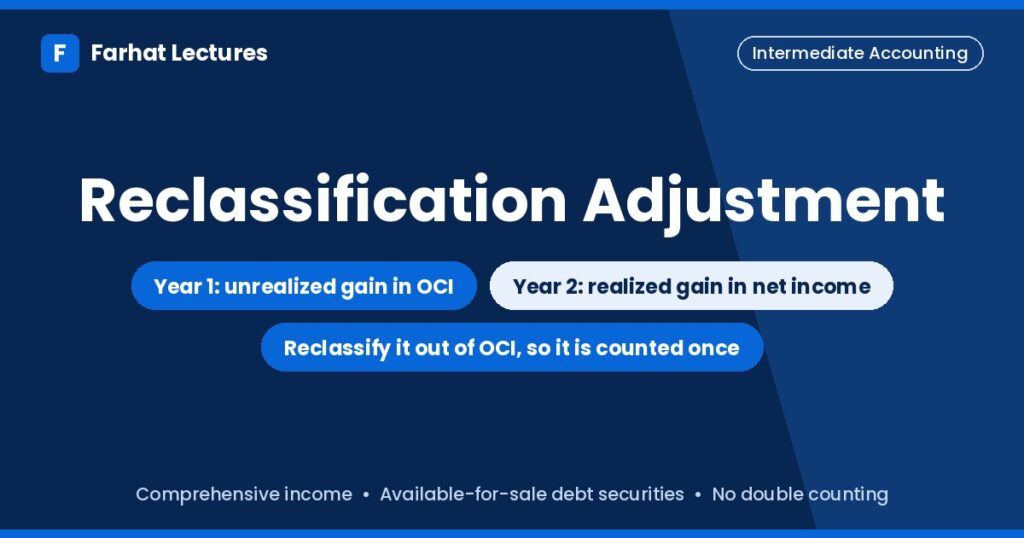
Under U.S. GAAP, accumulated instrument-specific credit gains or losses in AOCI are reclassified into net income when the liability is derecognized. This includes settlement or extinguishment. The existing OCI amount is not left permanently in equity.
Here is how that works with numbers. Go back to the combined example, where Maple’s note is carried at $228,000 and AOCI holds a $5,000 own-credit gain. Right after year-end, before any further change in value, Maple buys back the note for its $228,000 fair value.
| Account | Debit | Credit |
|---|---|---|
| Notes Payable | $240,000 | — |
| Notes Payable Fair Value Adjustment | — | $12,000 |
| Cash | — | $228,000 |
Maple pays exactly the carrying amount ($240,000 − $12,000 = $228,000), so the buyback itself creates no extra gain or loss. Next, move the $5,000 own-credit gain out of AOCI and into net income:
| Account | Debit | Credit |
|---|---|---|
| Other Comprehensive Income, Reclassification Adjustment | $5,000 | — |
| Gain on Settlement of Debt | — | $5,000 |
Over the note’s life, net income now includes the full $12,000 gain: $7,000 in the first year plus $5,000 at settlement. That equals the $240,000 face amount minus the $228,000 Maple paid. For debt that is not under the fair value option, use the ordinary carrying-amount approach in the debt extinguishment guide. These examples ignore income taxes, hedging, and embedded derivatives.
Key takeaways
- The fair value option lets a company measure an eligible liability at fair value instead of amortized cost. The choice is made instrument by instrument and is generally irrevocable.
- For the borrower, a lower liability is a gain and a higher liability is a loss.
- Changes from market interest rates go to net income. Changes from instrument-specific credit risk go to OCI.
- Each new adjustment starts from the last measured amount, not the original face value.
- When the debt is settled, the own-credit amount in AOCI moves into net income.
- Fair value changes never change what the company actually owes under the contract.
Common mistakes
- Recording a loss merely because the issuer’s liability decreased.
- Putting every fair-value change into net income without identifying credit effects.
- Assuming an unrealized gain changes the promised repayment amount.
- Confusing an OCI gain with a cash inflow.
- Remeasuring from original face value each year instead of the current carrying amount.
- Leaving the own-credit balance in AOCI after the debt has been settled.
Practice questions with explanations
1. A liability falls from $150,000 to $144,000 entirely because of market-rate changes. What is recorded?
Answer: A $6,000 debit reducing the liability and a $6,000 gain in income. The issuer’s obligation has a lower measured value.
2. A liability increases by $4,000 solely because the issuer’s credit standing improves. Where does the adjustment go?
Answer: Record a $4,000 loss in OCI and credit the liability. Improved credit can increase the market value of the debt owed.
3. An $8,000 liability decrease contains $3,000 of instrument-specific credit effect. What is the split?
Answer: Assuming the remaining $5,000 is a market-factor change, recognize a $3,000 OCI gain and a $5,000 income gain. Together they reconcile to the $8,000 decrease.
Interactive fair value option quiz
Check your understanding with five quick questions on how the fair value option changes the measurement of bonds and notes payable, how recognized interest relates to the holding gain or loss, and where those gains and losses are reported. Pick your answers, then select Check my work to see how each one is solved.
Frequently asked questions
Are all liabilities eligible for this election?
No. Most financial liabilities, including ordinary bonds and notes payable, are eligible, but a few items such as pension obligations, lease liabilities, and bank deposits payable on demand are excluded (see the full list above).
Does the fair value option eliminate interest expense?
No. The company still owes interest under the contract, and it still reports that cost. In textbooks and on the CPA exam, you usually record interest first and then adjust the liability to fair value, so the holding gain or loss excludes interest. In real financial statements, U.S. GAAP does not require a separate interest expense line for debt under this option, so companies choose a policy and disclose it when it is significant.
Does reporting fair value mean the debt has been retired?
No. Remeasurement changes the reported amount while the obligation continues. Retirement removes the obligation after a qualifying settlement or release.
Can a company undo the fair value option later?
Generally no. The election is irrevocable for that instrument. A new choice is possible only if a new election date occurs, for example when the debt is extinguished and replaced with a new instrument.
Why would a company elect the fair value option for its debt?
Usually to reduce an accounting mismatch, so that interest-rate effects on the debt offset changes in related assets already measured at fair value, without applying hedge accounting.
Where do debt issuance costs go under the fair value option?
They are expensed right away. Under ASC 825-10-25-3, upfront costs and fees for items under the fair value option are recognized in earnings as incurred, not deferred and amortized.
How is this different under IFRS?
IFRS 9 also generally presents own-credit changes on fair value liabilities in OCI. The key difference is that IFRS never reclassifies those amounts to profit or loss when the debt is settled, while U.S. GAAP moves them into net income on derecognition.
Ready to go deeper? Work through the full Fair Value Option for Liabilities lesson in the Intermediate Accounting course, or compare it with the Fair value option for investments. New to Farhat Lectures? Start with the free sample course.
About the author
Mansour Farhat, DBA, CPA, CIA, MAcc, is a veteran accounting educator and the founder of Farhat Lectures and its YouTube channel. He helps accounting students and CPA, CMA, and EA candidates understand accounting through clear explanations, practical examples, and step-by-step instruction. Learn more about Professor Farhat.



Responses