
Bond Refunding: Journal Entries, Gain or Loss, and GASB Rules

Bond refunding means issuing new bonds to retire an existing bond issue, often to get a lower interest rate. Under US GAAP, record the new issue and the old retirement as separate entries, and report the difference between the price paid to retire the old bonds and their net carrying amount as a gain or loss right away.
A lower interest rate can make refinancing attractive even when retiring the old issue causes an accounting loss. This guide explains that distinction through original, hypothetical examples for Intermediate Accounting Section 13.2. It assumes a new issue to outside investors and an ordinary cash retirement of the old bonds. State and local governments follow different GASB rules, which we cover later in this guide.
Watch: Bond Retirement
Bond retirement is the second half of every refunding, so this lesson is a good warm-up before the worked example below.
What does bond refunding accomplish?
A company may replace high-coupon bonds with debt carrying a lower rate, extend its repayment schedule, or change other financing terms. Refunding describes the financing arrangement. Extinguishment describes the removal of the old obligation. New proceeds provide cash; they do not by themselves prove that the old debt has been settled.
The two events can happen on different dates. Until the old bonds are retired, they remain outstanding and continue to incur interest. A temporary overlap between the old and new issues is possible. Keep the issue date, redemption date, interest dates, and amortization records separate. If the new bonds are sold between interest dates, see how to handle accrued interest at issuance.
New to bonds? Start with our bonds payable guide, then come back here.
| Event | Main accounting effect | Does it determine the old debt gain or loss? |
|---|---|---|
| Issue new bonds | Recognize cash, the new payable, and its own discount or premium | No |
| Update the old issue | Record interest and amortization through redemption | It determines the updated carrying amount |
| Retire old bonds | Remove the old debt and record consideration paid | Yes: compare carrying amount with reacquisition price |
How do you measure the retirement result?
You need two numbers for the old bonds on the retirement date.
Reacquisition price: the cash paid to retire them, including any call premium (the extra amount above face value an issuer pays to redeem bonds early).
Net carrying amount: face value plus any unamortized premium, or minus any unamortized discount. Under current GAAP, unamortized debt issuance costs also reduce the carrying amount, so subtract those too.
If the reacquisition price is higher than the net carrying amount, you have a loss. If it is lower, you have a gain.
Do not compare new proceeds with old face value. The amount raised may be larger or smaller than the amount needed to retire the old issue.
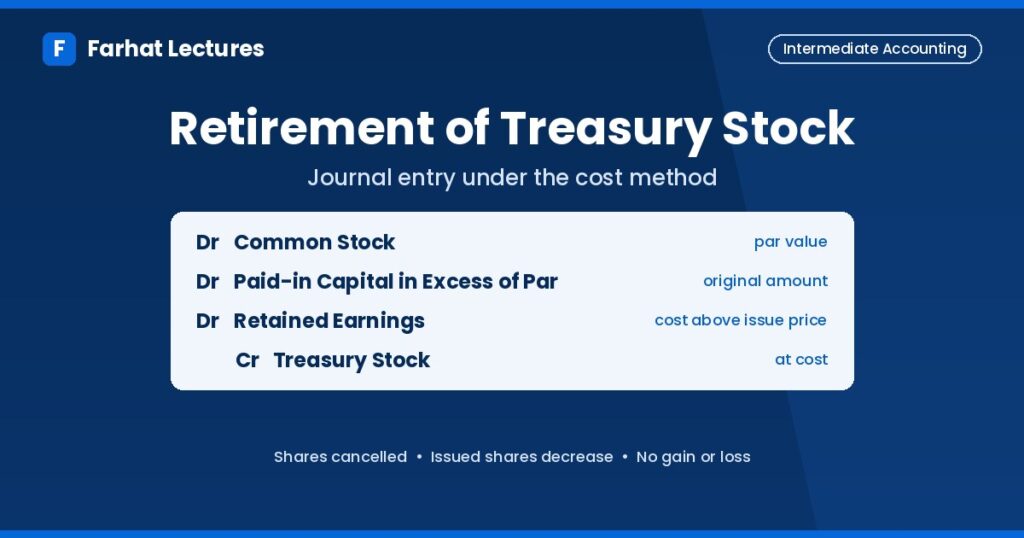
Under ASC 470-50-40-2, the difference is recognized in income in the period the debt is extinguished, identified as a separate item, and never amortized to future periods. ASC means Accounting Standards Codification, the official source of US GAAP maintained by the Financial Accounting Standards Board (FASB). You can read the paragraph itself in the FASB Accounting Standards Codification. See the debt extinguishment guide for both gain and loss cases.
How do you record a bond refunding? A worked example
Cedar Manufacturing has $400,000 of 8% bonds outstanding with $12,000 of unamortized discount on the redemption date. Cedar issues $450,000 of new 6% bonds at 99 and uses part of the proceeds to retire the old bonds at 101.
Assume both events occur immediately after an interest payment, all old amortization is current, and there are no other issuance or reacquisition costs. The new bonds are sold to outside investors; this is not merely a modification with the same lender.
Record the new issue
New cash proceeds are $450,000 × 99% = $445,500. The new discount is $450,000 − $445,500 = $4,500. It relates only to the new bonds.
| Account | Debit | Credit |
|---|---|---|
| Cash | $445,500 | — |
| Discount on New Bonds Payable | 4,500 | — |
| New Bonds Payable | — | $450,000 |
Measure the old debt retirement
The old carrying amount is $400,000 − $12,000 = $388,000. The redemption price is $400,000 × 101% = $404,000. The resulting loss is $404,000 − $388,000 = $16,000.
| Account | Debit | Credit |
|---|---|---|
| Old Bonds Payable | $400,000 | — |
| Loss on Debt Extinguishment | 16,000 | — |
| Discount on Old Bonds Payable | — | $12,000 |
| Cash | — | 404,000 |
The retirement entry balances at $416,000. Cedar removes the old discount completely. It does not add that $12,000 discount or the $16,000 loss to the new bond discount.
Why isn’t the leftover cash a gain?
Cedar receives $445,500 and pays $404,000, leaving $41,500 of cash from these two transactions. This remaining cash is not a gain. It arose because Cedar borrowed more principal than it retired.
The old debt’s $388,000 carrying amount disappears, and the new debt initially has a $445,500 carrying amount. The $57,500 increase in net debt equals the $41,500 cash increase plus the $16,000 loss that reduces equity, ignoring taxes. This reconciliation checks the economic effects without merging the entries.
Annual contractual interest on the old issue was $400,000 × 8% = $32,000. On the new issue it is $450,000 × 6% = $27,000. The annual coupon cash payment falls by $5,000 despite the larger principal amount. However, this is not a complete savings valuation: timing, maturity, fees, taxes, and the additional principal repayment also matter.
Interest expense on discounted new bonds will differ from their coupon payment as the new discount is amortized. Review the effective interest method before preparing the new issue’s interest schedule.
Is refunding the same as modifying existing debt?
A lower rate does not automatically justify extinguishment accounting. If a company changes terms with the same lender, or swaps old bonds for new ones with that lender, ASC 470-50 asks whether the new terms are substantially different.
The usual test compares the present value of the cash flows under the new terms with the present value of the remaining cash flows under the old terms. If they differ by at least 10%, account for it as an extinguishment. If not, treat it as a modification, and no gain or loss is recognized.
If the borrower is in financial difficulty and the lender grants a concession, the troubled debt restructuring rules apply instead. The simple entries above assume a genuine new borrowing from outside investors and a cash retirement of the old bonds.
Likewise, setting cash aside for repayment does not remove the old debt. Under ASC 405-20-40-1, a business removes a liability only when it pays the creditor and is relieved of the obligation, or when it is legally released as the primary obligor. The accounting event in this lesson is that actual discharge of the old bonds.
What is the difference between a current and an advance refunding?
A current refunding retires the old bonds within 90 days after the new bonds are issued, so the two issues overlap only briefly.
An advance refunding issues the new bonds more than 90 days before the old bonds are redeemed. The proceeds usually go into an escrow account, which is a trust run by an independent agent, and the trust pays the old bonds’ interest and principal until they can be called.
For a business following FASB rules, putting money in that trust does not remove the old debt by itself. Unless the bondholders or a court legally release the company, the old bonds stay on the balance sheet. This trust arrangement without a legal release is called an in-substance defeasance.
Tax note for municipal bonds: the 2017 Tax Cuts and Jobs Act ended tax-exempt treatment for advance refunding bonds issued after December 31, 2017. Tax-exempt current refundings are still allowed. Bills to restore tax-exempt advance refundings have been introduced in Congress, so check current law before relying on this point.
How do state and local governments account for a refunding?
This is a favorite CPA FAR exam trap. Governments follow the Governmental Accounting Standards Board (GASB), not FASB, and the result is reported differently.
In government-wide and proprietary fund statements, the difference between the reacquisition price and the net carrying amount of the old debt is not a gain or loss right away. Under GASB Statement No. 65, a loss is reported as a deferred outflow of resources and a gain as a deferred inflow of resources. The amount is then amortized as part of interest expense over the remaining life of the old debt or the life of the new debt, whichever is shorter.
In governmental funds, the new bond proceeds are reported as an other financing source, and the payment to the escrow agent from the refunding proceeds is reported as an other financing use.
Governments can also treat old debt as removed through an in-substance defeasance when the escrow meets GASB requirements. Businesses following FASB cannot.
| Question | Business (FASB) | Government (GASB) |
|---|---|---|
| When is the difference recognized? | In income immediately | Deferred, then amortized into interest expense |
| Amortization period | Not amortized | Shorter of old debt’s remaining life or new debt’s life |
| Does an in-substance defeasance remove the debt? | No | Yes, if GASB requirements are met |
What are the most common bond refunding mistakes?
- Combining the old and new discounts as though they belong to one issue.
- Deferring the old debt’s retirement loss over the new debt’s life. Under FASB rules the loss hits income now. Only state and local governments following GASB defer it.
- Treating unused proceeds as income.
- Assuming a lower coupon rate eliminates an immediate accounting loss.
- Ignoring interest and amortization between the new issue and old retirement dates.
- Forgetting to subtract unamortized debt issuance costs when computing the old bonds’ net carrying amount.
- Under FASB rules, treating cash placed in an escrow trust as if the old bonds were already paid off.
Practice questions with explanations
1. New $600,000 bonds are issued at 98. What are proceeds and discount?
Answer: Proceeds are $588,000 and the discount is $12,000. Neither amount measures the gain or loss on the old issue.
2. Old bonds with a $290,000 carrying amount are retired for $296,000. The new bonds mature in ten years. How much loss is recognized now?
Answer: The entire $6,000 loss. It is not divided into $600 per year over the new debt’s term.
3. New proceeds are $700,000 and old redemption payments are $650,000. Is the $50,000 difference a gain?
Answer: No. It is cash remaining from financing. The gain or loss requires the old debt’s carrying amount, which has not been provided.
4. A city retires old bonds with a $388,000 net carrying amount for $404,000. The old bonds had 8 years left, and the new bonds run 10 years. How does the city report the $16,000 difference?
Answer: The city reports a $16,000 deferred outflow of resources, not an immediate loss. It amortizes that amount into interest expense over 8 years, the shorter of the two lives. Using straight-line amortization, that is $2,000 per year ($16,000 ÷ 8).
Interactive bond refunding quiz
Check your understanding with three quick questions on what bond refunding is, why issuers refinance, and when to report the gain or loss on early redemption. Pick your answers, then select Check my work to see how each one is solved.
Frequently asked questions
Can refunding produce both future interest savings and a current loss?
Yes. The loss measures the present settlement of the old debt. Potential savings concern future financing cash flows.
Must the new and old face amounts match?
No. New borrowing may also fund other needs. Record each obligation using its own terms.
Is bond refunding the same as a refund to a customer?
No. Here, refunding means replacing debt financing. It is unrelated to returning a customer’s purchase payment.
What is the difference between a current refunding and an advance refunding?
A current refunding retires the old bonds within 90 days after the new bonds are issued. An advance refunding issues the new bonds more than 90 days before the old bonds are redeemed, usually with the proceeds held in an escrow trust.
Do governments recognize a refunding loss right away?
No. Under GASB Statement No. 65, a state or local government reports the difference as a deferred outflow (loss) or deferred inflow (gain) and amortizes it into interest expense over the shorter of the old debt’s remaining life or the new debt’s life.
Is a loss on bond refunding an extraordinary item?
No. FASB eliminated the extraordinary item category with ASU 2015-01, so the gain or loss is simply reported in income for the period the old bonds are retired. Older textbooks may still show it as extraordinary.
Want more practice like this? Bond refunding is covered step by step in the Intermediate Accounting course, and you can try the Farhat Lectures free sample course first.

Responses