
Full Disclosure Principle: 3 Reporting Areas Made Simple


The full disclosure principle is the accounting principle that financial reports must include material information that could influence users’ decisions. A useful teaching framework groups financial reporting information into three areas: the financial statements, the notes to the financial statements, and supplementary information. The requirements and assurance associated with supplementary information depend on the applicable reporting rules; not all such information is required by U.S. GAAP. It calls for judgment about what is useful, not a copy of every internal record.
This matters because a number can be accurate yet incomplete without context. A reader may need to know which measurement policy produced an amount, what uncertainty surrounds it, or what conditions affect its interpretation. Disclosure helps users understand the financial position and performance that the statements describe.
Watch: Full disclosure principle explained
In this Farhat Lectures video, Professor Farhat explains how financial statements, notes, and supplementary information help readers understand a company’s reporting. Watch the lecture, then use the examples below to distinguish disclosure from recognition and explore the cost constraint.
Review the key chapters on YouTube:
- 0:00 — Introduction and the full disclosure principle
- 3:37 — Basic financial statements
- 3:54 — Notes to the financial statements
- 4:31 — Supplementary information
- 4:50 — Other reporting: 10-K, MD&A, and sustainability reports
- 6:45 — The accounting policies note
- 7:58 — Inventory and property, plant, and equipment disclosures
- 9:37 — Commitments, contingencies, and fair value disclosures
Full disclosure principle: 3 reporting areas
| Location | Main role | Illustrative information |
|---|---|---|
| Financial statements | Present recognized amounts in a structured form | Inventory, liabilities, revenue, and expenses |
| Notes to financial statements | Explain amounts, policies, and relevant circumstances | Accounting methods and significant uncertainties |
| Supplementary information | Provide additional relevant perspectives | Management’s discussion or certain industry-specific information |
The main financial statements include the balance sheet, statements presenting net income and comprehensive income, statement of cash flows, and statement of stockholders’ equity. Net income and other comprehensive income may be presented in one continuous statement or in two separate consecutive statements. A line item gives a concise amount. Notes to the financial statements are explanations and detail that accompany the statements and are considered an integral part of them. They can be narrative, numerical, or both. Supplementary information is context provided outside the statements and notes, such as management’s discussion and analysis or certain industry-specific data, and it carries its own reporting requirements.
The SEC’s beginner guide to financial statements explains how the statements, footnotes, and management discussion help users interpret a company’s reports. Their placement and requirements depend on the applicable reporting rules.
Why do notes to financial statements matter?
Notes help a reader interpret the amounts already presented and understand relevant matters that may not be recognized as separate line items. They can explain measurement policies, describe contingencies (possible losses or gains that depend on a future event, such as a lawsuit), or provide detail that would overwhelm the face of a statement.
Hypothetical example: Oak Furniture reports equipment with a carrying amount of $48,000 (its cost minus accumulated depreciation). That figure alone does not explain how the company allocates equipment cost. A note describing its depreciation method and relevant useful-life information gives the reader context for interpreting the amount and expense.
The note is not a second equipment asset. It explains the accounting behind the recognized balance. To understand why the amount may differ from a current selling price, review historical cost versus fair value.
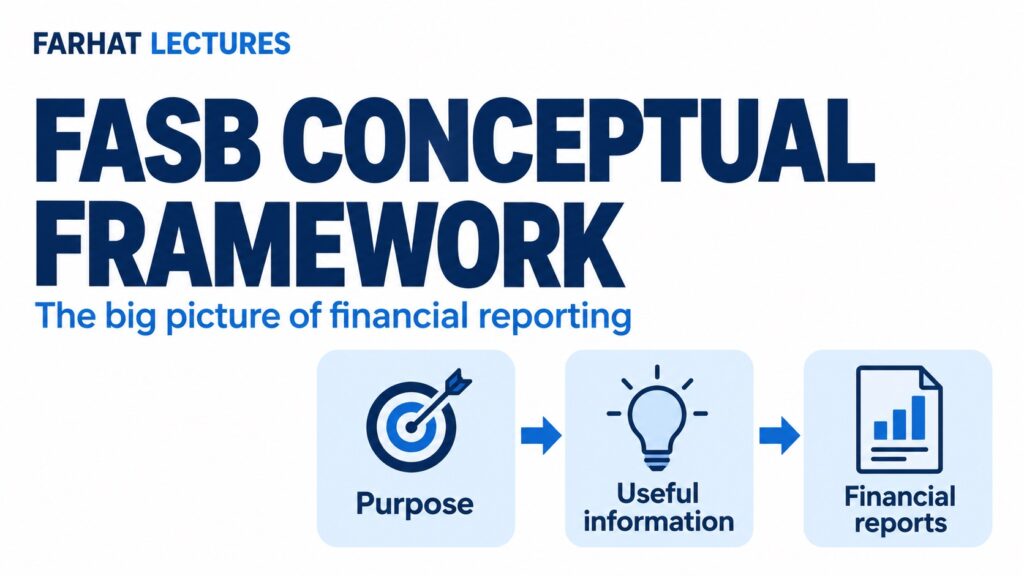
The FASB’s conceptual framework includes concepts for notes in Chapter 8. Those concepts help the Board develop standards; they are not a substitute for applying authoritative disclosure requirements to a specific transaction. For the full picture of how the chapters fit together, see our FASB Conceptual Framework guide, and for how ASC citations are structured, see FASB Codification: 4 Essential Levels Made Easy.
What does the full disclosure principle require a company to disclose?
There is no single master list. Each topic in the FASB Accounting Standards Codification (ASC) sets its own disclosure requirements, and a company applies the ones that are material to it. Information is material if leaving it out or misstating it could influence the decisions users make based on that company’s financial information (Concepts Statement 8, Chapter 3, paragraph QC11). Examples of disclosure topics include:
- Significant accounting policies (ASC 235). Generally presented in a separate summary preceding the notes or in the initial note, it describes significant accounting principles and methods used to prepare the financial statements. Examples include inventory cost-flow and depreciation methods; its scope is broader than choices among acceptable alternatives.
- Loss contingencies (ASC 450). A loss contingency involves uncertainty about a possible loss, such as a pending lawsuit. Accrual is required when it is probable that a liability has been incurred or an asset impaired at the financial statement date and the loss can be reasonably estimated (ASC 450-20-25-2). If a probable loss cannot be reasonably estimated, disclosure is generally required even though no amount is accrued. When an unaccrued loss or additional loss is at least reasonably possible, disclose the nature of the contingency and an estimate of the possible loss or range, or state that an estimate cannot be made (ASC 450-20-50-3 through 50-4). Remote losses generally do not require disclosure, subject to specific exceptions.
- Subsequent events (ASC 855). Events occurring after the balance sheet date but before the financial statements are issued or available to be issued, as applicable. Recognized subsequent events provide additional evidence about conditions existing at the balance sheet date and may require adjustments (ASC 855-10-25-1). Nonrecognized events relate to conditions arising after that date; material events may require disclosure of their nature and estimated financial effect, or a statement that the effect cannot be estimated (ASC 855-10-25-3 and 50-2). Not every later event requires disclosure.
- Related-party transactions (ASC 850). The nature of the relationship, a description of the transactions, and the dollar amounts involved.
- Risks and uncertainties (ASC 275). The nature of the company’s operations, the fact that estimates are used, significant estimates, and concentrations, such as one customer that provides most of the revenue.
One more place to look: parenthetical disclosure. A company can put short explanations directly on the face of a statement in parentheses, for example the number of shares authorized and issued next to the common stock line.
Recognition vs disclosure: what is the difference?
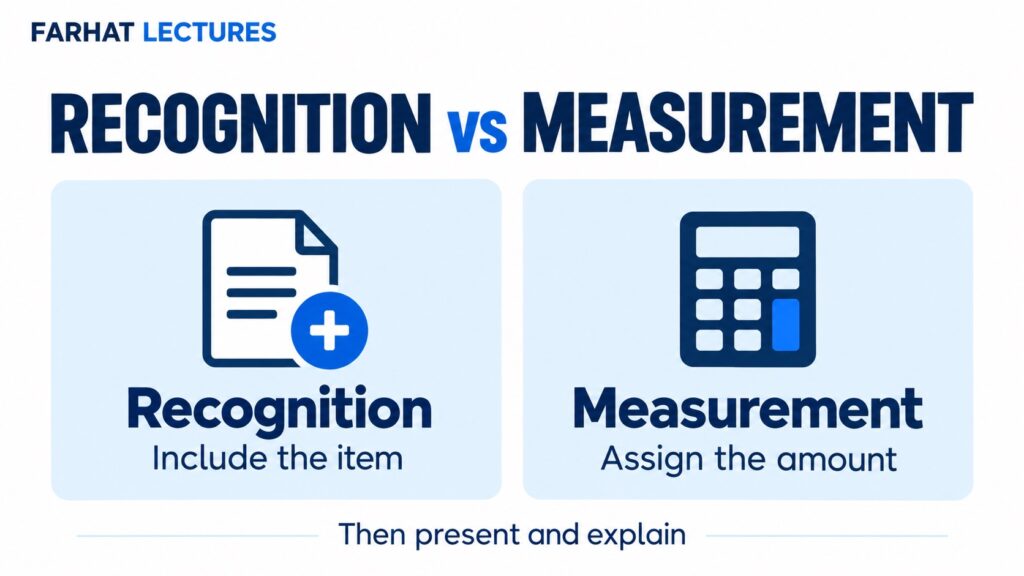
Recognition places an item and its amount in the financial statements, affecting the relevant totals. An item is recognized only if it meets the definition of an element of the financial statements and the recognition criteria. Disclosure supplies information that helps readers understand the statements or relevant circumstances. An item can require recognition and related disclosure; these are not mutually exclusive alternatives.
Hypothetical example: Oak has incurred a $4,000 administrative expense that must be recognized under the applicable rules. Management leaves it out of expenses and liabilities but mentions the unpaid bill in a note. The note does not correct the missing expense or liability.
The proper response is to correct the accounting and provide any required explanation. Otherwise, reported profit and liabilities remain wrong even if a diligent reader could reconstruct them. The same lesson applies when studying revenue and expense recognition timing.
Similarly, lack of a recognized number does not prove a matter is irrelevant. Some uncertainties call for explanatory information under the applicable standards. Do not assume every disclosed uncertainty automatically qualifies for recognition as a liability.
Exam tip: When solving a financial reporting question, compare the notes with the recognized amounts and check for inconsistencies. Avoid treating a footnote as a substitute for a required accrual. Correct the recognition first, then provide any required disclosure.
What is the cost constraint in financial reporting?
The cost constraint asks whether the expected benefits of financial information justify the costs of providing and using it. The Financial Accounting Standards Board (FASB) considers that relationship when developing requirements. See Chapter 3 of the FASB framework, paragraphs QC35–QC39.
Costs include collecting and processing data, preparing reports, verifying the information, and the time users spend analyzing it. Potential litigation and information reaching competitors are a different matter. The FASB treats those as possible adverse consequences of a disclosure, which it weighs separately from the cost constraint (Chapter 8, paragraphs D28 and D32). Benefits can include better lending and investment decisions, improved internal information, and better access to capital.
Benefits are often harder to quantify than preparation costs. A clearer explanation might prevent a poor decision, but that improvement may not have an obvious invoice or measurable dollar amount.
Hypothetical example: A proposed disclosure would require companies to build a new data-collection process. A standard setter evaluates whether the resulting information would meaningfully improve users’ decisions, considers implementation feedback, and weighs ways to achieve that benefit efficiently. This is broader than asking whether one company likes the added work.
The cost constraint is not a general permission for a company to omit a required disclosure because preparation is inconvenient. Companies apply the relevant requirements, including any specific exemptions or materiality provisions that actually apply.
The same constraint applies to the notes. Chapter 8 of the framework (paragraph D22) says the benefits of information in the notes should justify the costs of providing and using it, and that this is one of the limits the FASB applies when it decides what to require in notes.
What makes a disclosure clear and useful?
Start with the reader’s question. Identify what the reported amount does not explain, then provide relevant context in a form the reader can understand. A concise table can communicate a numerical breakdown; a short paragraph may better explain a policy or uncertainty.
- Keep the statement amount and explanation consistent. A note should clarify the accounting, not contradict it.
- Explain the relevant matter specifically. Generic wording can hide the fact that users still lack the information they need.
- Balance detail and readability. More pages do not automatically mean more useful disclosure.
- Keep entity and period boundaries clear. The accounting assumptions still matter when explaining whose activity and which period are covered.
For student questions, distinguish three tasks: determine the proper accounting, decide what additional information is required, and communicate that information clearly. Do not jump directly to writing a note before checking whether the underlying amount is correct.
Key takeaways
- The full disclosure principle requires reporting material information that could influence users’ decisions.
- Financial statements and their integral notes should be distinguished from supplementary information, which has its own reporting and assurance requirements.
- Notes to the financial statements explain the amounts, the policies behind them, and matters that are not recognized as line items.
- Recognition puts an amount into the statements and their totals. Disclosure explains. A note never replaces a required accrual.
- Assess materiality in the context of the entity, considering the nature and magnitude of the information and applicable disclosure requirements.
- The cost constraint is applied by the FASB when it sets standards. It is not a company’s excuse to skip a required disclosure.
Practice questions and explained answers
1. A note explains the depreciation method applied to equipment. What is the note’s main purpose?
Answer: It helps users understand the measurement and expense allocation behind the reported amounts. It does not create another asset.
2. A company omits a required liability but describes the obligation in a footnote. Has full disclosure fixed the accounting?
Answer: No. Disclosure does not replace required recognition. The liability and related accounting must be corrected.
3. A required disclosure takes time to prepare. Can management automatically omit it under the cost constraint?
Answer: No. The cost constraint informs standard-setting judgments. It does not create a blanket exemption from applicable reporting requirements.
Frequently asked questions
Does full disclosure require every business detail?
No. The principle covers material information: information that could influence a user’s decision if it were left out or misstated (Concepts Statement 8, Chapter 3, paragraph QC11). It does not require reproducing every internal record. Apply the relevant disclosure requirements and assess materiality using both the nature and magnitude of the information.
Must notes contain only dollar amounts?
No. Notes may be narrative, numerical, or a combination. Policies and uncertainties often need words as well as numbers.
Are supplementary information and notes identical?
No. Notes explain and supplement the basic statements. Supplementary information can provide other perspectives or context, with its own reporting requirements.
What are examples of full disclosure in financial statements?
Common examples are the summary of significant accounting policies (ASC 235), loss contingencies such as pending lawsuits (ASC 450), subsequent events (ASC 855), related-party transactions (ASC 850), and risks and uncertainties such as a heavy reliance on one customer (ASC 275).
What is the difference between recognition and disclosure?
Recognition records an item and its amount in the financial statements so it is included in the totals. Disclosure explains amounts or describes matters in the notes. An item can need both. A note never substitutes for a required accrual.
Is the full disclosure principle tested on the CPA exam?
Disclosure is relevant to CPA financial reporting study, including contingencies, subsequent events, and the relationship between notes and statement amounts. Consult the current official CPA Exam Blueprints for the applicable examination period.
Where does management’s discussion and analysis (MD&A) fit?
MD&A is management commentary outside the audited financial statements and their notes. SEC reporting requirements call for MD&A in applicable filings; it is not a U.S. GAAP note requirement. It explains management’s perspective on financial condition, results, liquidity, and relevant trends.
About the author
Mansour Farhat, CPA, CIA, DBA, teaches the Farhat Lectures video lessons used on this site, covering intermediate accounting and CPA, CMA, and EA exam preparation. The examples and exam tips on this page come from those lessons and from questions students ask most often.
Learn with Farhat Lectures.
Build confidence with clear explanations and guided accounting practice. Explore the free sample course and keep your study momentum going.
Studying intermediate accounting? Explore the Intermediate Accounting course for guided study. Preparing for FAR? Continue with lectures and practice in the supplemental course. Explore the CPA FAR course.
Try the free sample course →


Responses