
Qualitative Characteristics of Accounting Information: 6 Qualities Explained

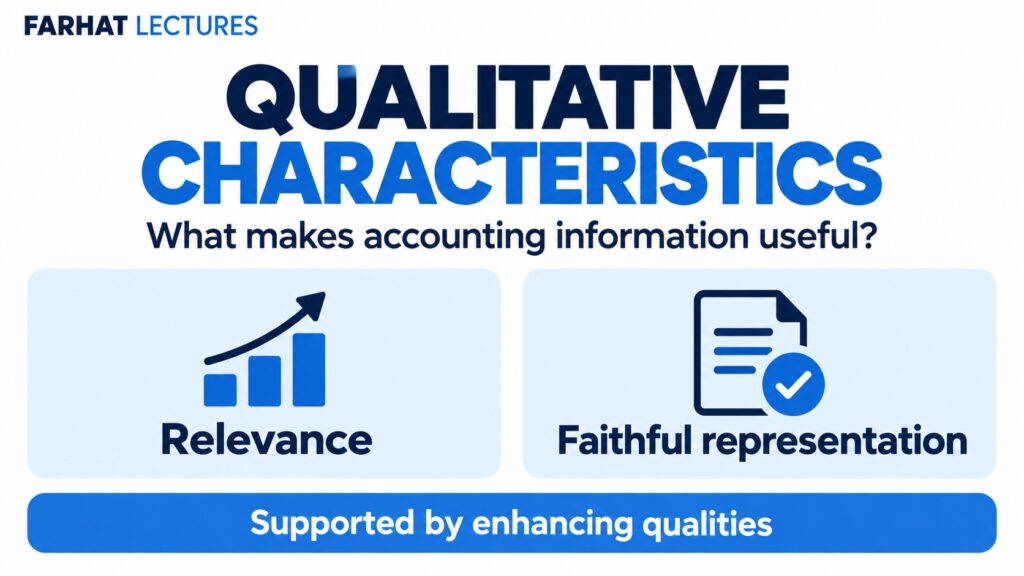
The qualitative characteristics of useful accounting information, defined in FASB Concepts Statement 8, Chapter 3, are two fundamental qualities, relevance and faithful representation, plus four enhancing qualities: comparability, verifiability, timeliness, and understandability. Information must be both relevant and faithfully represented to be useful. The enhancing qualities make useful information more useful; they cannot make irrelevant or misleading information useful.
A report needs more than accurate arithmetic to help investors and lenders make decisions. This is a foundation topic in intermediate accounting courses and a common source of conceptual questions for CPA FAR and CMA candidates.
Watch: qualitative characteristics explained
In this Farhat Lectures video, Professor Farhat explains relevance, faithful representation, and the four enhancing qualities, then works through a relevance practice question. Watch the lesson, then use the comparison table and examples below to check your understanding.
Watch this lesson on YouTube · Farhat Lectures
Jump to a topic on YouTube:
- 4:41 Faithful representation and relevance
- 5:45 Neutrality
- 7:00 Completeness
- 7:20 Free from error and estimates
- 8:26 Predictive and confirmatory value
- 9:34 Materiality
- 11:22 The four enhancing qualities
- 12:03 Verifiability
- 12:16 Timeliness
- 12:45 Understandability
- 12:55 The cost constraint
- 13:18 Relevance practice question
Study note: The video’s description clarifies the conservatism discussion at 7:42–8:05: uncertainty alone is not a reason to expense an item. Apply the relevant GAAP requirements. As explained below, neutrality avoids deliberate bias, and an appropriately developed estimate can faithfully represent an uncertain amount.
Fundamental vs enhancing qualitative characteristics: what is the difference?
The FASB Concepts Statement 8, Chapter 3 supplies the underlying concepts. Improving an enhancing quality cannot rescue information that is irrelevant or fundamentally misleading.
| Level | Quality | Ingredients or test |
|---|---|---|
| Fundamental | Relevance | Predictive value and/or confirmatory value; materiality is an entity-specific aspect |
| Fundamental | Faithful representation | Completeness, neutrality, freedom from error |
| Enhancing | Comparability | Like things look alike, different things look different; supported by consistency |
| Enhancing | Verifiability | Independent observers could agree the depiction is faithful |
| Enhancing | Timeliness | Available in time to influence a decision |
| Enhancing | Understandability | Classified, described, and presented clearly |
| Constraint | Cost | Benefits of the information should justify the cost of providing and using it |
1. Relevance: information that can make a difference
Relevance means the information is capable of making a difference in a user’s decision.
Relevant information has predictive value, confirmatory value, or both. Predictive value helps users develop expectations. Confirmatory value helps them assess or revise earlier expectations.
Hypothetical example: Harbor Design reports annual service revenue of $480,000. A lender uses the figure as an input when forecasting future collections. That is predictive value. If the lender previously expected $450,000, the actual result also provides feedback. That is confirmatory value.
The report does not need to contain a management forecast to have predictive value. Historical information can help users make their own forecasts. Nor does confirmatory value require the original prediction to be correct: learning that it was wrong is valuable feedback.
Materiality connects relevance to a particular entity and its circumstances. Under FASB Concepts Statement 8, Chapter 3, as amended in 2018, an omission or misstatement is material if, given the surrounding circumstances, the item is large enough that a reasonable person relying on the report would probably have changed their judgment because of it. Assess the amount, nature, and surrounding circumstances together; no single numerical threshold resolves every materiality judgment. A small amount can be material if it turns a loss into a profit or breaks a loan covenant.
Exam note: Some textbook diagrams group materiality with predictive value and confirmatory value under relevance. More precisely, materiality is an entity-specific aspect of relevance. On an exam, identify the framework and answer the specific question rather than treating the labels as interchangeable.
2. Faithful representation: depicting the economic reality
Faithful representation means the words and numbers depict the economic event they claim to depict.
Faithful representation calls for completeness, neutrality, and freedom from error to the greatest extent possible. Completeness includes the explanations needed to understand what the numbers represent. Neutrality means avoiding a slant designed to produce a preferred reaction.
Freedom from error does not mean every estimate must predict the future exactly. An estimate can be useful when the method is appropriate, the inputs and calculation are sound, and uncertainty is explained. Calling all estimates unreliable would remove much useful information from reporting.
Suppose Harbor deliberately omits important information about amounts customers owe because management fears a lender’s reaction. That threatens completeness and neutrality even if the amounts shown add correctly.
The four enhancing qualities
3. Comparability
Comparability means users can identify and understand real similarities and differences among items.
Comparisons may be across companies or periods. Similar economic events should be depicted comparably while real differences remain visible.
Consistency means using the same methods for similar items across time or entities. It supports comparability but is not the same idea. Using the same method every year is the tool. Letting readers compare fairly is the goal. Consistency also does not prohibit every justified accounting change.
4. Verifiability
Verifiability means different knowledgeable and independent observers could agree that a depiction is faithfully represented.
Observers do not need identical opinions on every estimate; a reasonable consensus is sufficient.
Counting cash is direct verification. Checking quantities and unit costs, then recalculating a total using the stated method, is indirect verification. Neither task by itself answers whether the information is relevant to a particular decision.
5. Timeliness
Timeliness means information reaches decision makers in time to influence their decisions.
An excellent report delivered after a lending decision may be less useful for that decision. Timeliness is not a justification for issuing careless figures.
6. Understandability
Understandability means information is classified, described, and presented clearly and concisely.
Clear labels, logical grouping, and concise explanations help reasonably informed readers interpret information. Complexity alone does not justify leaving out relevant information. Readers may need to study a difficult matter or seek assistance.
Enhancing qualities can pull against each other. Reporting faster improves timeliness but may force the use of estimates that are harder to verify. Concepts Statement 8 describes applying the enhancing qualities as an iterative process with no fixed order, and it accepts that one enhancing quality may sometimes be reduced to maximize another.
Example: applying all six qualities to one report
Hypothetical example: Pine Services sends a lender a report with current figures, prior-year comparisons, and explanations of its methods. An independent reviewer can reproduce the calculations. However, management has excluded a substantial unfavorable obligation.
The figures have relevance because they can help the lender assess repayment prospects, and the omitted obligation could influence the lending decision. The current timing supports timeliness. Prior-year figures may support comparability. Reproducible calculations support verifiability. Clear explanations help understandability. Yet the missing obligation threatens faithful representation. Four strengths do not cancel that central weakness.
This is why the FASB conceptual framework treats the qualities as a connected system. A student should identify both the strongest clue in the question and any limitation in the surrounding facts.
Common mistakes and the cost constraint
Do not confuse “predictive” with “certain,” “neutral” with “favorable,” or “verifiable” with “perfectly precise.” Do not describe comparability as forcing every business to look identical. Real economic differences should remain visible.
Watch for the word reliability. FASB Concepts Statement 2, issued in 1980, named relevance and reliability as the two primary qualities. Concepts Statement 8, issued in 2010, replaced reliability with faithful representation. For an older practice question, identify the framework being tested and apply its terminology. Reliability in the earlier framework should not automatically be substituted with faithful representation.
Reporting also has a cost constraint: the benefits of information should justify the resources needed to provide and use it. Cost is not a seventh qualitative characteristic. It constrains reporting choices and informs standards; it does not give management a general right to disregard GAAP.
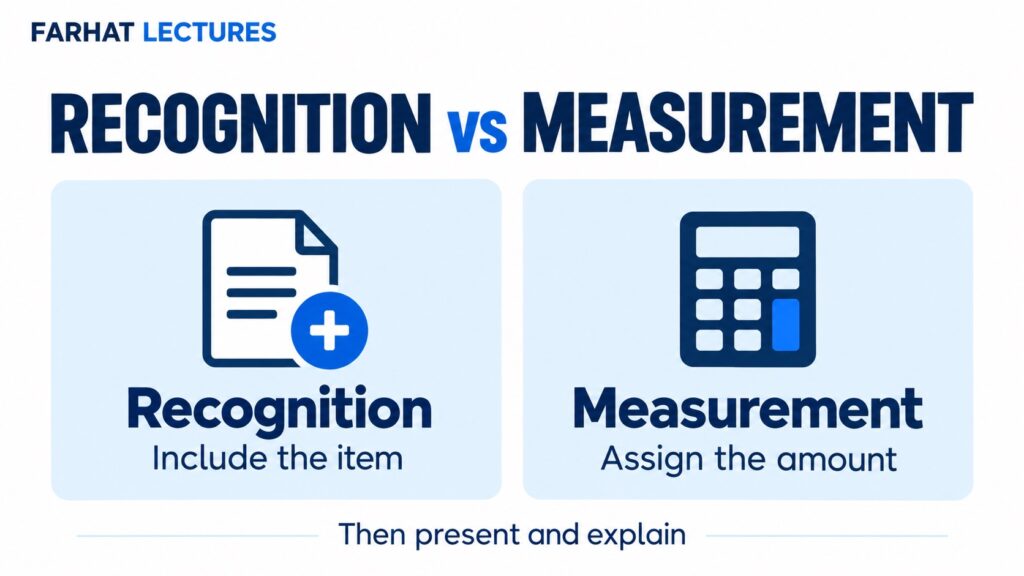
The same qualities matter when deciding whether and at what amount to recognize an item.
Are the qualitative characteristics the same under IFRS?
Mostly, yes. The IASB Conceptual Framework for Financial Reporting uses the same two fundamental qualities, relevance and faithful representation, and the same four enhancing qualities. Students preparing for the CMA exam or working with IFRS statements can use this lesson for both frameworks.
One difference matters on exams. The IASB framework states that neutrality is supported by the exercise of prudence, meaning caution when making judgments under uncertainty. Prudence supports neutrality under IFRS and does not permit deliberate understatement or overstatement. The FASB framework does not list prudence or conservatism as a qualitative characteristic. For more differences, see the lesson on FASB vs IASB.
Key takeaways
- Useful information must be both relevant and faithfully represented. Missing either one means the information is not useful.
- Relevance has predictive value, confirmatory value, or both. Materiality is relevance applied to a specific company.
- Faithful representation means complete, neutral, and free from error. Estimates can be faithfully represented when the method is sound and uncertainty is explained.
- Comparability, verifiability, timeliness, and understandability improve useful information. They cannot fix irrelevant or misleading information.
- Consistency supports comparability; it is not the same thing, and it does not forbid justified changes in method.
- Cost is a constraint on reporting, not a seventh quality.
- Qualities describe the information. The items being reported, such as assets and liabilities, are the elements of financial statements.
Interactive quiz: relevance (5 questions)
Want more practice like this? The Intermediate Accounting course walks through the full conceptual framework with lectures, quizzes, and worked problems, and the FAR CPA exam course covers how these concepts are tested.
Practice questions with explanations
1. A reader compares actual results with an earlier forecast. Which quality is illustrated?
Answer: Confirmatory value within relevance. The information provides feedback that can confirm or change an earlier expectation.
2. Two reviewers check the same inputs and reproduce a calculation. Which enhancing quality is strongest?
Answer: Verifiability. They independently support the result using the stated method. This does not automatically prove every disclosure is complete.
3. Can an estimate faithfully represent an amount?
Answer: Yes. A suitable, correctly applied estimation process with adequate explanations can faithfully depict an uncertain amount. Later differences do not automatically establish an original error.
Frequently asked questions
Are there two qualities or six?
There are two fundamental qualities and four enhancing qualities. “Six” counts both groups together.
Is materiality an enhancing characteristic?
No. It is an entity-specific relevance judgment, not one of the four enhancing qualities.
Does consistency mean methods never change?
No. An appropriate change may be permitted or required under applicable standards. A change needs proper accounting and explanation, not an automatic accusation of inconsistency.
What is the difference between relevance and faithful representation?
Relevance asks whether the information can change a decision, through predictive value, confirmatory value, or both. Faithful representation asks whether the words and numbers depict what they claim to depict: complete, neutral, and free from error. Useful information needs both.
What is the difference between comparability and consistency?
Comparability is the goal: users can spot real similarities and differences across companies or periods. Consistency is one way to get there: using the same methods for the same items period after period. FASB Concepts Statement 8 says consistency is related to comparability but is not the same thing.
Is the cost constraint a qualitative characteristic?
No. Cost is a pervasive constraint on financial reporting. The benefits of information should justify the cost of providing and using it. The constraint limits what standard setters require; it is not a seventh quality, and it does not let a company ignore GAAP.
Are the qualitative characteristics the same under IFRS?
Both frameworks use the same two fundamental and four enhancing characteristics. See the IFRS comparison above for the distinction concerning prudence.
What replaced reliability in the conceptual framework?
Faithful representation. FASB Concepts Statement 2, from 1980, listed relevance and reliability as the two primary qualities. Concepts Statement 8, issued in 2010, replaced reliability with faithful representation. For historical questions, apply the framework and terminology specified; do not automatically substitute one term for the other.
Learn with Farhat Lectures
Build your understanding with clear explanations and guided practice. Explore the free sample course, then continue studying at your own pace.
Try the free sample course →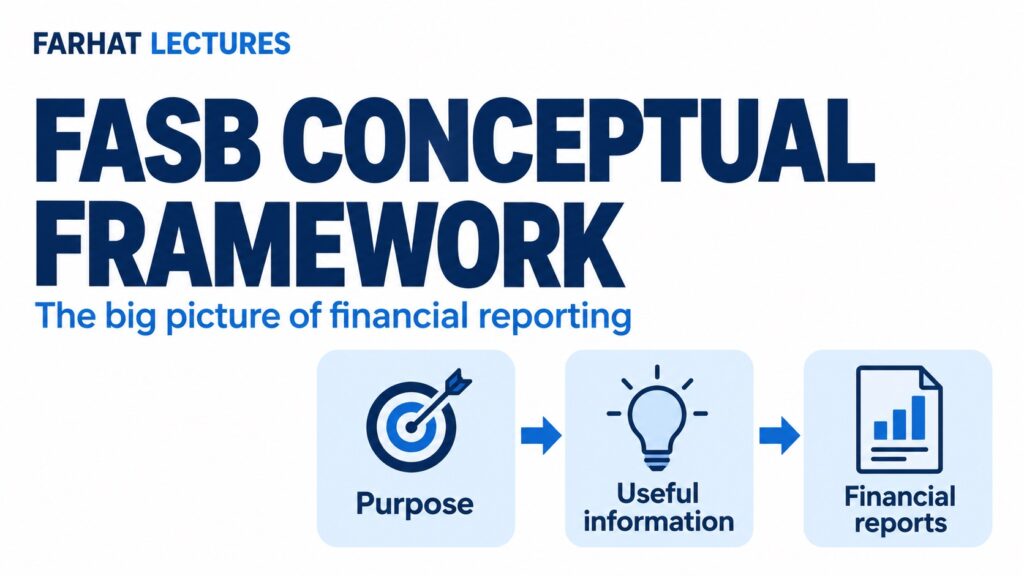


Responses