
Operating Lease vs. Finance Lease: How the Lessee’s Numbers Differ

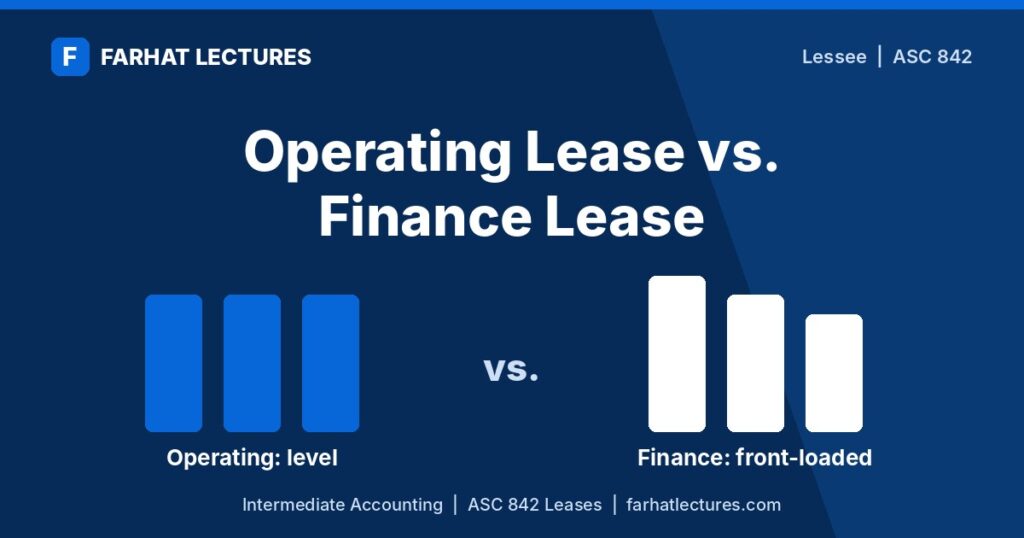
Operating lease vs finance lease: under ASC 842, a lessee records a right-of-use (ROU) asset and a lease liability for both. The difference is expense. An operating lease shows one level lease expense. A finance lease shows interest plus amortization, so expense starts higher and falls. Total expense usually matches over the lease term.
Why it matters: classification changes operating income, interest expense, and cash flow categories, even though the total cost does not change. On the CPA exam’s FAR section, questions often give one set of facts and ask for both results.
Watch Professor Farhat: At 3:13, Professor Farhat contrasts a finance lease (treated like a financed purchase) with an operating lease (treated like a rental) and reviews the five classification criteria.
Watch “Operating lease Versus a Finance Lease. CPA Exam FAR” on YouTube
Operating lease vs finance lease at a glance
| Feature | Operating lease | Finance lease |
|---|---|---|
| When it applies | No finance lease test is met | At least one of the five tests is met |
| At commencement | ROU asset and lease liability at present value | Same |
| Income statement | One lease expense | Interest expense and amortization expense, shown separately |
| Expense pattern | Level (straight-line) | Higher early, lower later |
| ROU asset amortization | Plug: lease expense − interest | Usually straight-line |
| Cash flow statement | Payments in operating activities | Principal in financing; interest usually operating |
How a lessee decides
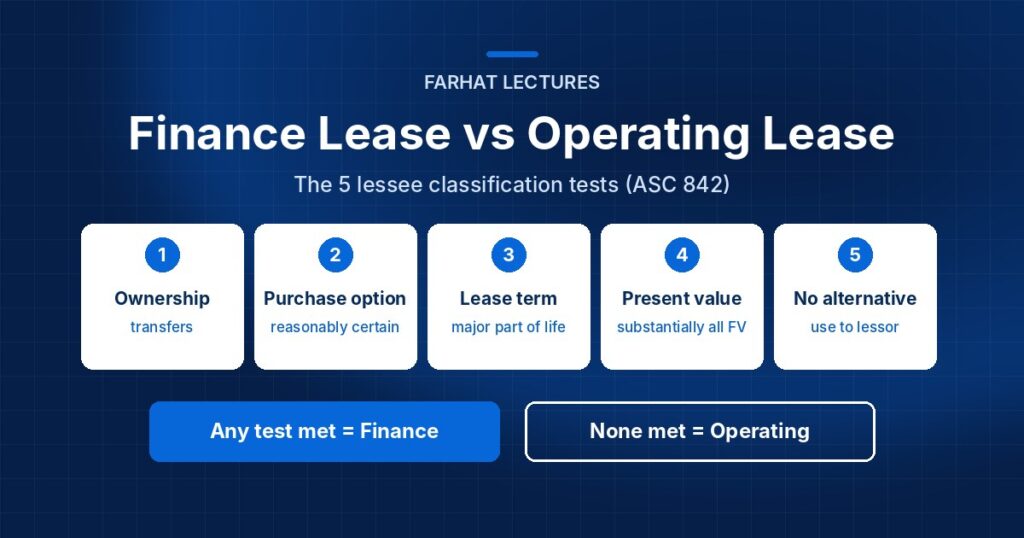
A lease is a finance lease if it meets any one of these tests: (1) ownership transfers, (2) a purchase option the lessee is reasonably certain to exercise, (3) the term is a major part of the remaining economic life, (4) the present value of payments is substantially all of the fair value, or (5) the asset is so specialized that it has no alternative use to the lessor. A common rule of thumb is 75% or more for test 3 and 90% or more for test 4. If no test is met, the lease is an operating lease. Then the lessee follows operating lease accounting.
Two details trip students up. First, the economic life test does not apply when the lease starts at or near the end of the asset’s economic life. A common benchmark is the last 25% of that life. Second, the present value test adds any residual value the lessee guarantees, if it is not already included in the lease payments. The 75% and 90% figures are one reasonable approach from ASC 842’s implementation guidance, not bright-line rules.
One more shortcut: a lease of 12 months or less, with no purchase option the lessee is reasonably certain to exercise, is a short-term lease. If the lessee elects the short-term lease exemption, it skips the ROU asset and lease liability and simply expenses the payments straight-line.
Finance vs. Operating Leases: Lessee Classification Exercise
Apply ASC 842 to six independent noncancelable leases, each with a term longer than 12 months. Select the classification and the reason supported by the facts.
One lease, two treatments
Hypothetical example. Harbor Bakery’s three-year oven lease from the operating lease example has $10,000 year-end payments, a 5% rate, and a present value of $27,232.48. As written, it is an operating lease. To isolate the accounting effect, suppose instead that the oven were built only for Harbor, with no alternative use to the lessor. That would make it a finance lease, and Harbor would amortize the ROU asset straight-line over the three-year term: $27,232.48 ÷ 3 = $9,077.49 per year.
| Year | Operating: lease expense | Finance: interest | Finance: amortization | Finance: total expense |
|---|---|---|---|---|
| 2027 | $10,000.00 | $1,361.62 | $9,077.49 | $10,439.11 |
| 2028 | $10,000.00 | $929.71 | $9,077.49 | $10,007.20 |
| 2029 | $10,000.00 | $476.19 | $9,077.50 | $9,553.69 |
| Total | $30,000.00 | $2,767.52 | $27,232.48 | $30,000.00 |
The finance lease reports $439.11 more expense in 2027 and $446.31 less in 2029. Both columns total $30,000. The interest on the liability is identical because the lease liability is the same under both methods. The operating lease simply folds that interest into its single lease expense. Only the ROU asset amortization differs.
Year-1 journal entries side by side
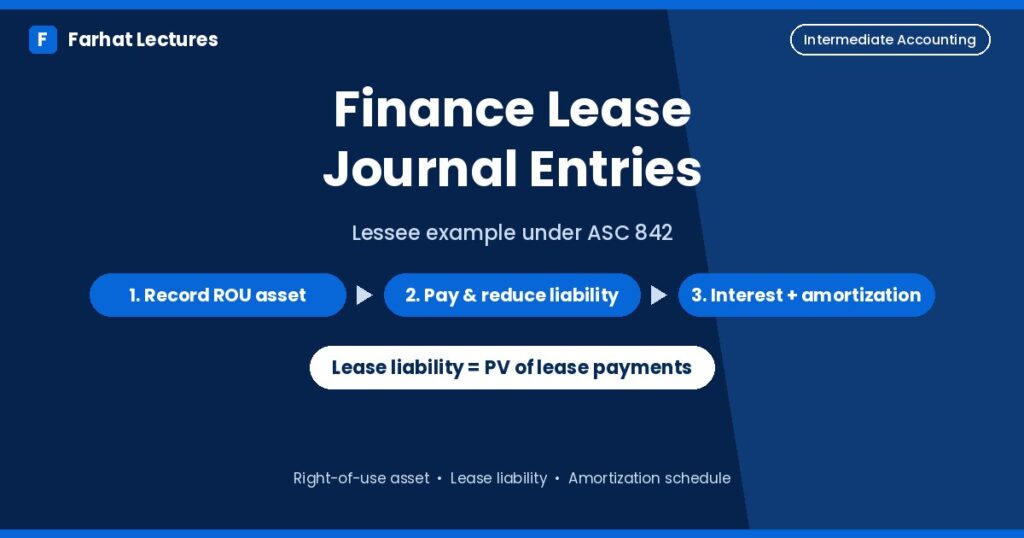
At commencement, both methods record the same entry: debit ROU asset $27,232.48 and credit lease liability $27,232.48.
At the end of 2027, the entries split:
| Account | Debit | Credit |
|---|---|---|
| Record the payment | ||
| Lease liability | $10,000.00 | |
| Cash | $10,000.00 | |
| Recognize the year’s lease expense | ||
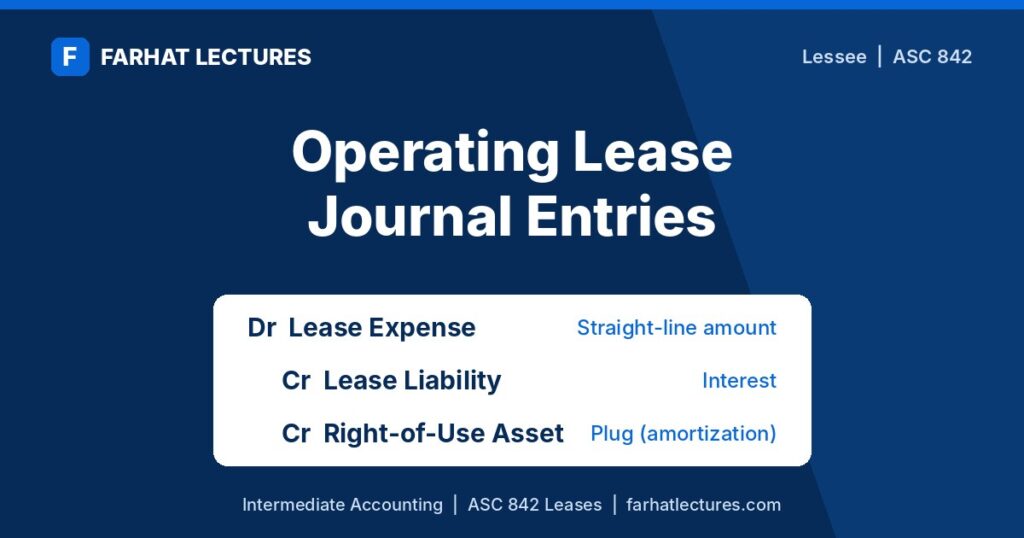
| Lease expense | $10,000.00 | |
| Lease liability | $1,361.62 | |
| ROU asset | $8,638.38 | |
| Account | Debit | Credit |
|---|---|---|
| Interest expense | $1,361.62 | |
| Lease liability | $8,638.38 | |
| Cash | $10,000.00 | |
| Amortization expense | $9,077.49 | |
| ROU asset | $9,077.49 |
The lease liability drops by the same $8,638.38 either way. The difference is the ROU asset: the operating lease reduces it by the $8,638.38 plug, while the finance lease reduces it by $9,077.49 of straight-line amortization. For every entry across all three years, see operating lease journal entries.
Balance sheet difference
Here are Harbor’s balances at the end of 2027, right after the first payment.
| Balance | Operating lease | Finance lease |
|---|---|---|
| Lease liability | $18,594.10 | $18,594.10 |
| ROU asset | $18,594.10 | $18,154.99 |
The lease liability does not depend on classification. The ROU asset is lower under the finance lease because straight-line amortization is faster than the operating lease plug in the early years.
Cash flow difference
Harbor pays $10,000 either way. As an operating lease, the full $10,000 is an operating cash outflow. As a finance lease, the 2027 payment splits into $1,361.62 of interest (usually operating) and $8,638.38 of principal (financing). That is why finance leases make operating cash flow look larger.
For the lessor side of an operating lease, see lessor accounting for operating leases.
Common mistakes
- Thinking only finance leases go on the balance sheet. Both do under ASC 842.
- Expecting different totals. When the ROU asset is amortized over the lease term, total expense equals total payments under both methods.
- Using the finance lease amortization for an operating lease. Operating lease amortization is the plug.
- Calling operating lease expense rent expense with nothing on the balance sheet. That was ASC 840, not ASC 842.
Practice questions with answers
Question 1: First-year expense under each method
A two-year lease requires $20,000 payments at the end of each year. The present value at 8% is $35,665.29. What is year-1 expense as an operating lease and as a finance lease (straight-line amortization over 2 years)?
Answer: Operating: $40,000 ÷ 2 = $20,000. Finance: interest 8% × $35,665.29 = $2,853.22, plus amortization $35,665.29 ÷ 2 = $17,832.65 (rounded), for $20,685.87.
Question 2: Year 2 and totals
Continue Question 1. What is year-2 finance lease expense, and do the totals match?
Answer: The liability after the first payment is $35,665.29 + $2,853.22 − $20,000 = $18,518.51. Year-2 interest is 8% × $18,518.51 = $1,481.48, adjusted by 1 cent to $1,481.49 so the liability ends at exactly zero ($18,518.51 + $1,481.49 = $20,000). Year-2 amortization is $35,665.29 − $17,832.65 = $17,832.64. Finance expense = $1,481.49 + $17,832.64 = $19,314.13. Totals: $20,685.87 + $19,314.13 = $40,000, the same as the operating lease.
Question 3: Income statement lines
Which lease type reports interest expense on the income statement?
Answer: Only the finance lease. An operating lease includes the interest inside a single lease expense.
Question 4: When ownership transfers
Use Harbor’s oven facts: a $27,232.48 present value, a 5% rate, and three $10,000 year-end payments. This time, assume ownership transfers to Harbor at the end of the lease and the oven has a five-year useful life. What is the 2027 finance lease expense?
Answer: Because ownership transfers, Harbor amortizes the ROU asset over the oven’s five-year useful life, not the three-year lease term: $27,232.48 ÷ 5 = $5,446.50 (rounded). Interest is still $1,361.62. Total 2027 expense = $1,361.62 + $5,446.50 = $6,808.12. Over the three-year lease term, total expense is now less than $30,000, because amortization continues in years 4 and 5.
Frequently asked questions
Is total expense higher for a finance lease than an operating lease?
Usually not. When the ROU asset is amortized over the lease term, total expense is the same under both: the sum of the lease payments, plus any initial direct costs. A finance lease only shifts more of that expense into the early years. The exception is a finance lease that transfers ownership or has a purchase option the lessee is reasonably certain to exercise. Then the ROU asset is amortized over the asset’s useful life, so some expense continues after the lease ends.
Do both operating and finance leases appear on the balance sheet?
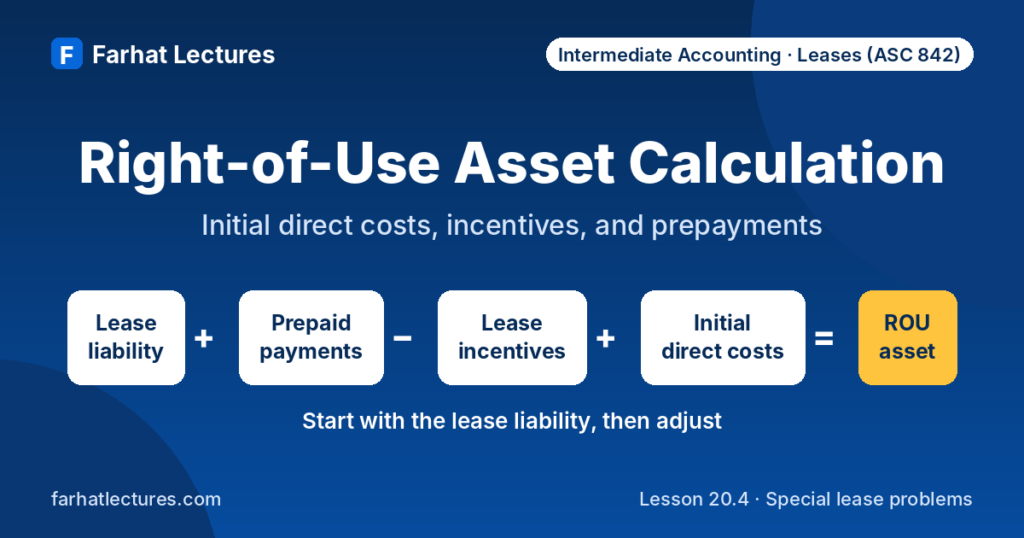
Yes. Under ASC 842, a lessee generally recognizes a right-of-use (ROU) asset and a lease liability for both operating and finance leases. In Harbor’s example, the ROU asset and lease liability both start at $27,232.48. In other leases, payments made at or before commencement, initial direct costs, and lease incentives can cause the opening balances to differ.
Why does a finance lease front-load expense?
Interest is computed on a liability that is largest at the start, while ROU amortization is usually straight-line. Adding a falling interest amount to a level amortization amount gives a total that declines over time.
How are lease payments shown in the cash flow statement?
Operating lease payments are operating activities. For a finance lease, the principal portion is a financing activity and the interest portion follows the rules for interest paid, which is usually an operating activity.
Does IFRS have operating leases for lessees?
Not for most lessee leases. IFRS 16 uses a single lessee model that works like a finance lease, with optional exemptions for short-term and low-value leases. See IFRS 16 lease accounting for a worked example.
Is a finance lease the same as a capital lease?
Mostly, yes. ASC 842 replaced the old ASC 840 term capital lease with finance lease. The classification tests are similar, but ASC 842 added the specialized asset test and dropped the old bright-line percentages. The bigger change is that operating leases now go on the balance sheet too.
Over what period is a finance lease ROU asset amortized?
Usually the shorter of the lease term and the asset’s useful life, using the straight-line method. If ownership transfers or the lessee is reasonably certain to exercise a purchase option, the lessee amortizes over the asset’s useful life instead.
Do short-term leases go on the balance sheet?
Not if the lessee elects the short-term lease exemption. A short-term lease has a term of 12 months or less and no purchase option the lessee is reasonably certain to exercise. The lessee then expenses the payments on a straight-line basis over the lease term.
How does lease classification affect EBITDA?
EBITDA means earnings before interest, taxes, depreciation, and amortization. A finance lease usually produces higher EBITDA, because its costs are interest and amortization, which EBITDA leaves out. Operating lease expense is usually an operating expense, so it reduces EBITDA.
Which discount rate does a lessee use?
The rate implicit in the lease, if it is readily determinable. Otherwise, the lessee uses its incremental borrowing rate, which is the rate it would pay to borrow a similar amount on similar terms. A lessee that is not a public business entity can elect a risk-free rate by class of underlying asset.
Sources: FASB Accounting Standards Codification, Topic 842 (Leases), including ASC 842-10-25-2 (classification), ASC 842-20-25-5 and 25-6 (finance and operating lease recognition), and ASC 842-20-45-5 (cash flows); Deloitte Roadmap: Leases, 14.2 Lessee presentation; IFRS Foundation, IFRS 16 Leases.
About the author
Mansour Farhat, CPA, CIA, DBA, teaches accounting and creates the Farhat Lectures courses and YouTube lessons for CPA, CMA, and EA candidates and accounting students. His lessons focus on worked examples and the traps that show up on exam questions.
Last updated: November 24, 2026
Continue learning with Farhat Lectures
Strengthen your lease accounting skills with clear explanations and guided practice.
Want the full lesson sequence? Explore the Intermediate Accounting course, or browse our FAR CPA exam courses.
Explore the free sample course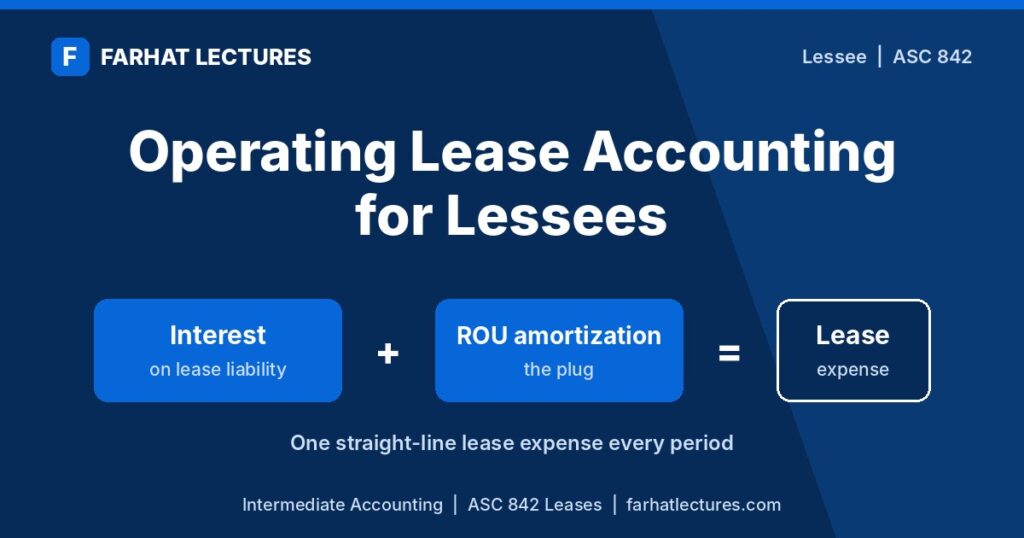
Responses