
Finance Lease Journal Entries: Lessee Example With Amortization Schedule

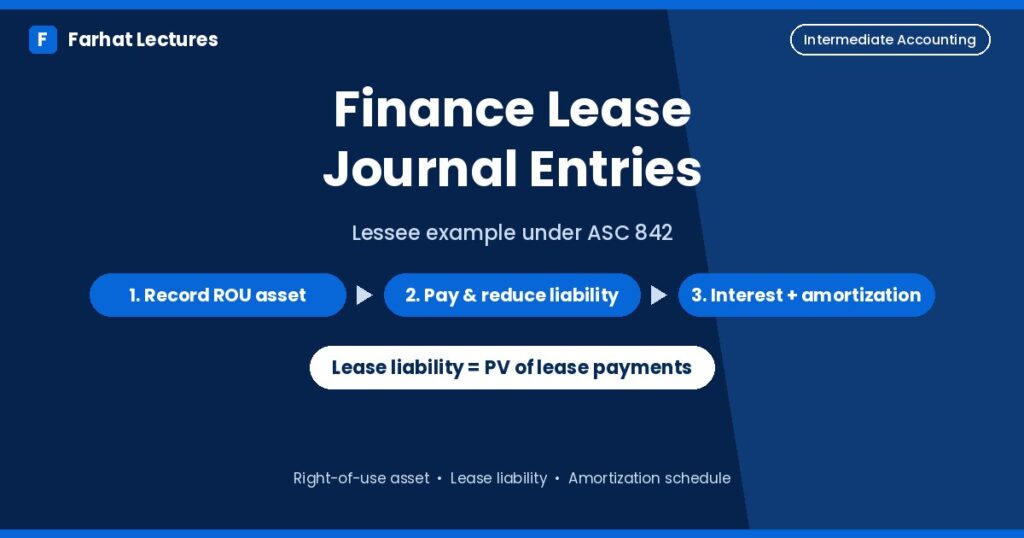
Harbor’s example illustrates the lessee’s finance lease journal entries under ASC 842 when payments are due at the beginning of each year. Immediately before recording the first payment, debit Right-of-Use (ROU) Asset and credit Lease Liability for the present value of all four payments. Each payment debits Lease Liability and credits Cash. At year-end, debit Interest Expense and credit Lease Liability, then debit Amortization Expense and credit the ROU Asset.
This guide works through a full example under U.S. GAAP (FASB ASC 842). The ROU asset is usually amortized straight-line.
Why it matters: a finance lease puts an asset and a debt-like liability on the lessee’s balance sheet and creates two expenses each year instead of one rent expense. Before current lease standards, many leases were a classic form of off-balance-sheet financing. Today, getting these entries right affects total assets, total liabilities, and the expense pattern students are tested on.
Watch: Finance lease journal entries, lessee example
In this 14-minute video, Mansour walks through the lessee’s finance lease entries under ASC 842: the right-of-use asset, the lease liability, interest, and amortization.
When is a lease a finance lease?
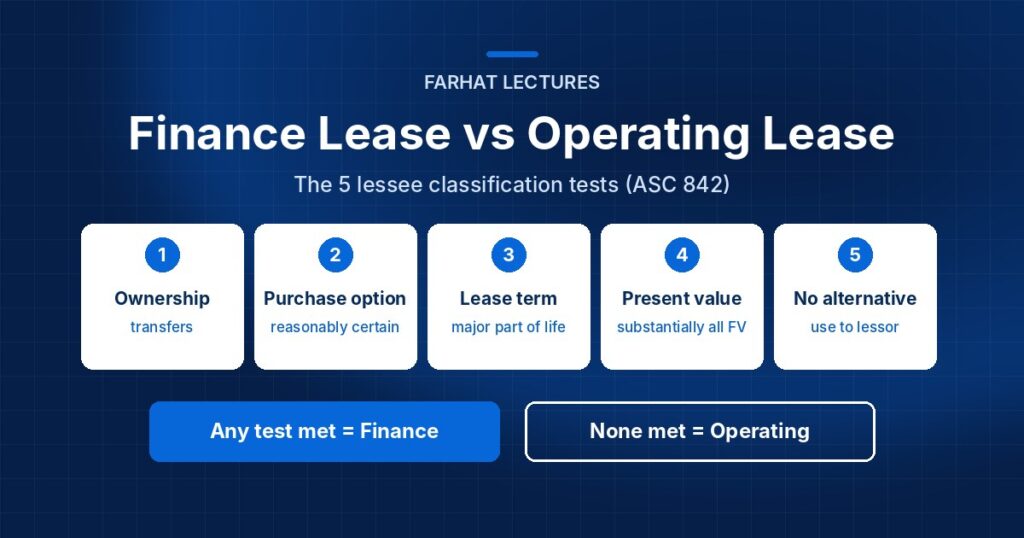
A lessee classifies a lease as a finance lease if it meets any one of five tests at commencement. If it meets none, the lease is an operating lease.
| Test | Question to ask |
|---|---|
| 1. Transfer of ownership | Does ownership pass to the lessee by the end of the lease? |
| 2. Purchase option | Is the lessee reasonably certain to exercise an option to buy the asset? |
| 3. Lease term | Does the lease cover the major part of the asset’s remaining economic life? (75% or more is a common benchmark.) |
| 4. Present value | Is the present value of the lease payments (plus any residual value the lessee guarantees) substantially all of the asset’s fair value? (90% or more is a common benchmark.) |
| 5. Alternative use | Is the asset so specialized that the lessor has no alternative use for it after the lease? |
The lessor applies the same five tests. A lease that is a finance lease for the lessee is usually a sales-type lease for the lessor.
One exception: if the lease starts at or near the end of the asset’s economic life, skip test 3. A common benchmark is a lease that begins after 75% or more of the asset’s economic life has passed.
How do you measure the lease liability and ROU asset?
At commencement, the lease liability equals the present value of the lease payments not yet paid. In a simple lease with no initial direct costs, prepaid rent, or incentives, the right-of-use asset equals the same amount. Payments due at the start of each period form an annuity due, so you use a present value of an annuity due factor.
After Harbor makes the first $30,000 payment, its lease liability is $80,190.36. If Harbor also pays a qualifying $2,000 commission, its ROU asset increases from $110,190.36 to $112,190.36. The liability remains $80,190.36.
The discount rate is the rate implicit in the lease (the lessor’s rate) if the lessee can readily determine it. Otherwise, the lessee uses its incremental borrowing rate, the rate it would pay to borrow a similar amount on similar terms. The lessee includes in the lease liability the amount it is probable the lessee will owe under a residual value guarantee. The guaranteed residual value lesson explains that rule.
Finance lease journal entries example
This example is hypothetical. On January 1, 2026, Harbor Print Co. (the lessee) leases a printing press from Delta Equipment Corp. (the lessor).
| Lease term | Detail |
|---|---|
| Lease term | 4 years, non-cancelable, no renewal or purchase option |
| Payments | $30,000 at the beginning of each year (January 1) |
| Economic life of the press | 4 years, with no expected residual value |
| Rate implicit in the lease | 6%, known to Harbor (Harbor’s incremental borrowing rate is 7%) |
| Fair value of the press | $110,190 |
Classification: the lease term equals 100% of the economic life, and the present value of the payments equals the press’s fair value. Harbor has a finance lease.
Measurement: $30,000 × 3.673012 (present value of an annuity due, 4 periods, 6%) = $110,190.36. If you use a 5-decimal table factor of 3.67301, you get $110,190.30, a 6-cent rounding difference. This example uses the exact present value of $110,190.36, which is what Excel or a financial calculator gives. Harbor uses 6% because the implicit rate is known.
Entry 1: Record the lease at commencement
| January 1, 2026 | Debit | Credit |
|---|---|---|
| Right-of-Use Asset | 110,190.36 | |
| Lease Liability | 110,190.36 |
Entry 2: Make the first payment
The first payment is due on day one, so no time has passed and no interest is included.
| January 1, 2026 | Debit | Credit |
|---|---|---|
| Lease Liability | 30,000.00 | |
| Cash | 30,000.00 |
Textbook note: many textbooks record the full $110,190.36 first and then the day-one payment, as shown here. ASC 842 defines the lease liability as the present value of payments not yet paid, so some companies record one combined entry instead: debit Right-of-Use Asset $110,190.36, credit Lease Liability $80,190.36, and credit Cash $30,000. The balances after January 1 are the same either way.
Try it yourself: the practice below uses a different lease, so you can test the commencement entry with fresh numbers.
How do you build a finance lease amortization schedule?
The schedule splits each payment into interest and principal using the effective-interest method: interest equals 6% of the liability balance outstanding during the year.
| Date | Payment | Interest (6%) | Reduction of liability | Lease liability |
|---|---|---|---|---|
| 1/1/2026 | $110,190.36 | |||
| 1/1/2026 | $30,000.00 | $0.00 | $30,000.00 | 80,190.36 |
| 1/1/2027 | 30,000.00 | 4,811.42 | 25,188.58 | 55,001.78 |
| 1/1/2028 | 30,000.00 | 3,300.11 | 26,699.89 | 28,301.89 |
| 1/1/2029 | 30,000.00 | 1,698.11 | 28,301.89 | 0.00 |
| Total | $120,000.00 | $9,809.64 | $110,190.36 |
Total interest of $9,809.64 is the difference between the cash paid ($120,000) and the present value recorded ($110,190.36). Interest shrinks each year because the balance it is computed on shrinks.
What are the year-end journal entries for a finance lease?
Entry 3: Accrue interest expense
The interest for 2026 is owed on January 1, 2027, one day after year-end, so Harbor accrues it by increasing the lease liability: $80,190.36 × 6% = $4,811.42.
| December 31, 2026 | Debit | Credit |
|---|---|---|
| Interest Expense | 4,811.42 | |
| Lease Liability | 4,811.42 |
Entry 4: Amortize the right-of-use asset
Harbor amortizes the ROU asset straight-line over the 4-year lease term: $110,190.36 ÷ 4 = $27,547.59. The term “amortization” separates a leased right from equipment the company owns. Some companies credit an accumulated amortization account instead of the asset itself.
| December 31, 2026 | Debit | Credit |
|---|---|---|
| Amortization Expense | 27,547.59 | |
| Right-of-Use Asset | 27,547.59 |
Entry 5: Make the second payment
The January 1, 2027 payment removes the accrued interest and reduces principal. No new interest expense is recorded on this date.
| January 1, 2027 | Debit | Credit |
|---|---|---|
| Lease Liability | 30,000.00 | |
| Cash | 30,000.00 |
Harbor pays off the lease liability on January 1, 2029. It continues using the press throughout 2029 and records the final ROU asset amortization on December 31, 2029.
How does a finance lease appear on the financial statements?
At December 31, 2026, the liability balance is $85,001.78 ($80,190.36 + $4,811.42). The part due within one year is current; the rest is noncurrent.
| Harbor Print Co., December 31, 2026 | Amount |
|---|---|
| Noncurrent assets: Right-of-use asset ($110,190.36 − $27,547.59) | $82,642.77 |
| Current liabilities: Lease liability ($4,811.42 interest + $25,188.58 principal) | $30,000.00 |
| Noncurrent liabilities: Lease liability | $55,001.78 |
| Income statement: Interest expense | $4,811.42 |
| Income statement: Amortization expense | $27,547.59 |
Finance lease expense is front-loaded: interest falls each year while amortization stays level.
| Year | Interest expense | Amortization expense | Total expense |
|---|---|---|---|
| 2026 | $4,811.42 | $27,547.59 | $32,359.01 |
| 2027 | 3,300.11 | 27,547.59 | 30,847.70 |
| 2028 | 1,698.11 | 27,547.59 | 29,245.70 |
| 2029 | 0.00 | 27,547.59 | 27,547.59 |
| Total | $9,809.64 | $110,190.36 | $120,000.00 |
Where do finance lease payments go on the cash flow statement?
The principal part of each finance lease payment is a financing cash outflow. The interest part follows the interest rules in ASC 230, which usually means operating activities.
For Harbor, the January 1, 2027 payment of $30,000 splits into $4,811.42 of interest (operating) and $25,188.58 of principal (financing). The January 1, 2026 payment is all principal, so the full $30,000 is financing.
Recording the ROU asset and lease liability at commencement involves no cash, so it is disclosed as a noncash transaction instead of appearing in the cash flow statement.
What happens at the end of the lease?
After the 2029 amortization entry, both the ROU asset and the lease liability are zero. Harbor returns the press and makes no further entry.
Leases with a purchase option work differently. If the lessee is reasonably certain to exercise the option, the option price is already part of the lease liability, and the ROU asset is amortized over the asset’s useful life. When the lessee pays the option price, it debits Lease Liability and credits Cash, and it typically moves the ROU asset’s carrying amount to Equipment and keeps depreciating it.
If the purchase was not built into the lease, ASC 842-20-40-2 applies. Any difference between the purchase price and the carrying amount of the lease liability just before the purchase adjusts the carrying amount of the asset. It does not go to profit or loss.
Common mistakes
- Charging interest on the first payment. In an annuity due, the first payment is all principal.
- Computing interest on the original liability. Use the balance after the previous payment: $80,190.36, not $110,190.36.
- Putting the whole liability in current or noncurrent. In this example, with payments due January 1, the current portion is the next payment, which includes the accrued interest. With year-end payments, the current portion is the principal reduction due in the next 12 months.
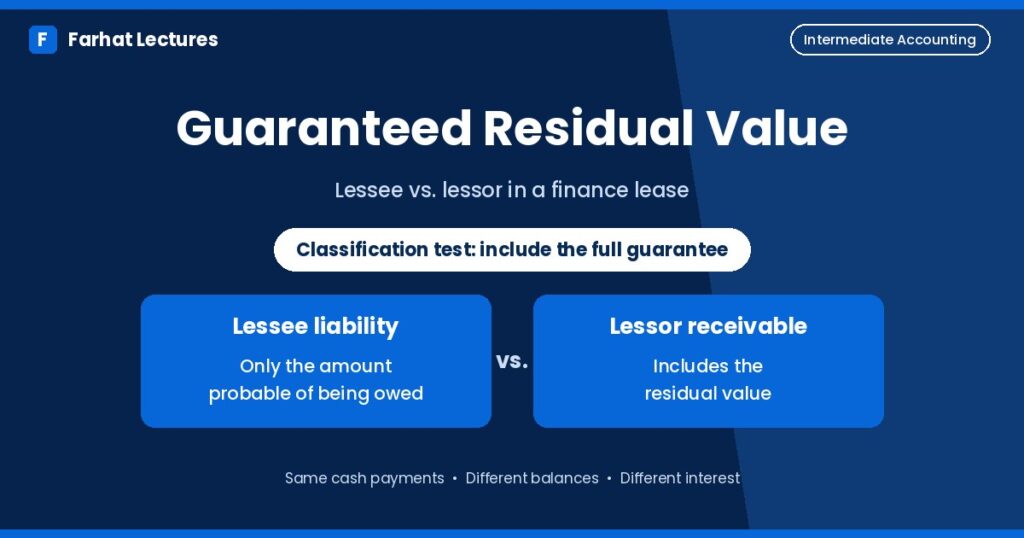
- Adding a guaranteed residual value the lessee does not expect to pay. It counts for classification but not always for measurement. See guaranteed residual value: lessee vs. lessor.
- Amortizing over the asset’s economic life by default. Use the shorter of the lease term and useful life, unless ownership transfers or a purchase option is reasonably certain.
Practice questions
Question 1
On January 1, a lessee signs a 3-year finance lease with payments of $10,000 due at the beginning of each year. The implicit rate is 5% and is known to the lessee. Using the two-entry approach shown above, what amount does the lessee credit to Lease Liability immediately before recording the first $10,000 payment?
Answer: $10,000 × 2.85941 (annuity due, 3 periods, 5%) = $28,594.10. Debit Right-of-Use Asset and credit Lease Liability for $28,594.10, then record the first $10,000 payment as a debit to Lease Liability and a credit to Cash.
Question 2
Continuing Question 1, what are interest expense and amortization expense for the first year? The lease term equals the asset’s useful life.
Answer: The balance after the first payment is $18,594.10, so interest is $18,594.10 × 5% = $929.71. Amortization is $28,594.10 ÷ 3 = $9,531.37. Total first-year expense is $10,461.08.
Question 3
In the Harbor example, why is the entire lease liability current at December 31, 2028?
Answer: After the 2028 interest accrual, the balance is $28,301.89 + $1,698.11 = $30,000, which is the final payment due January 1, 2029. Because the whole balance is due within one year, all of it is current.
Key takeaways
- A lease that meets any one of the five classification tests is a finance lease for the lessee.
- Record the ROU asset and lease liability at the present value of the lease payments, using the implicit rate if it is readily determinable.
- Payments at the start of each period carry no interest on day one.
- Each year-end, accrue interest on the outstanding liability and amortize the ROU asset, usually straight-line.
- Total expense over the lease equals the total cash paid, but it is higher in the early years.
Frequently asked questions
Why is there no interest in the first lease payment?
When payments are due at the beginning of each period, the first payment happens at commencement. No time has passed, so no interest has built up and the whole payment reduces principal.
Should the lessee use the implicit rate or its incremental borrowing rate?
Use the rate implicit in the lease when it is readily determinable. If it is not, use the incremental borrowing rate. ASC 842 also lets companies that are not public business entities elect a risk-free rate, by class of asset.
Is amortization of the ROU asset the same as depreciation?
The method is similar, usually straight-line, but the asset is a right to use property rather than owned equipment, so it is called amortization. The period is the shorter of the lease term and the asset’s useful life unless ownership transfers or a purchase option is reasonably certain to be exercised.
How is an operating lease different for the lessee?
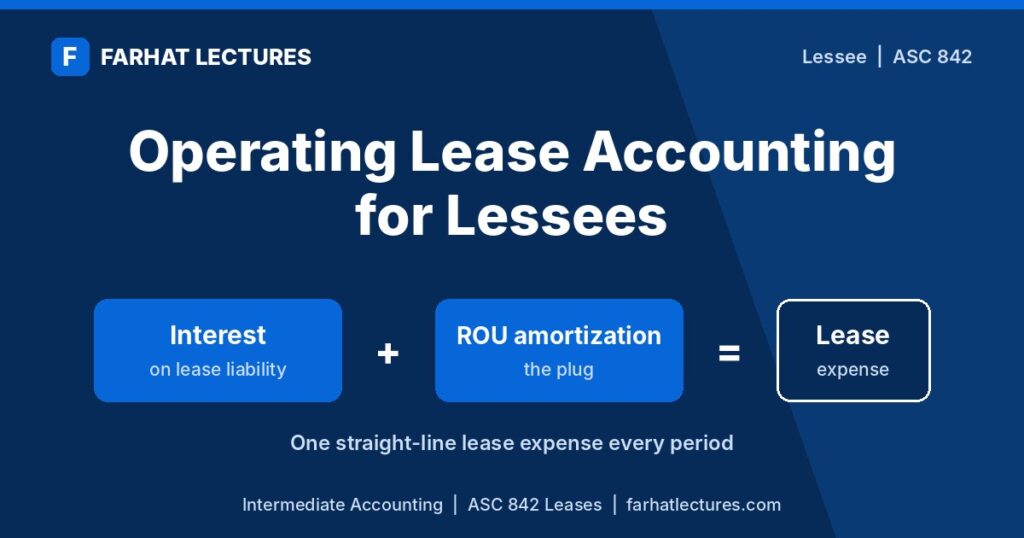
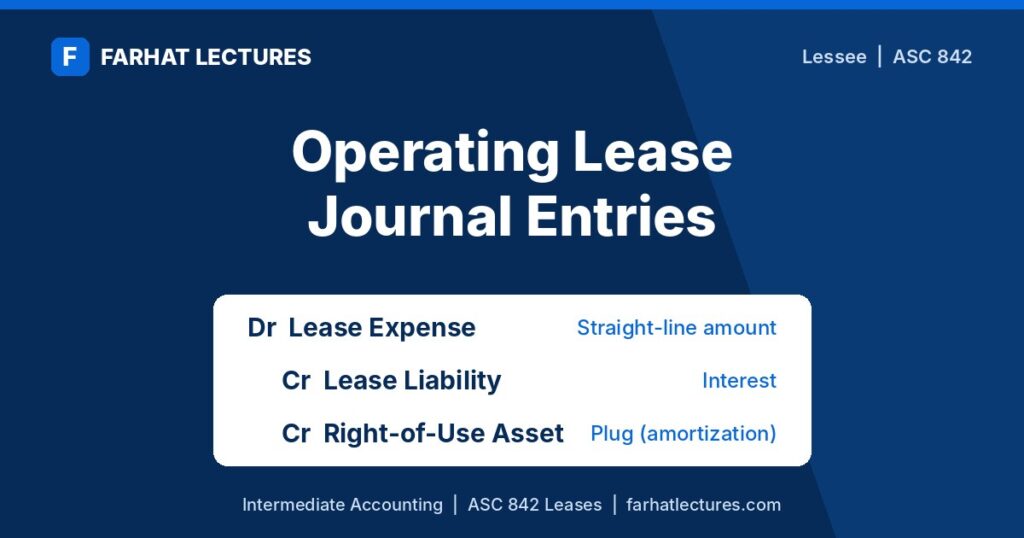
Both lease types put an ROU asset and a lease liability on the balance sheet. An operating lease reports a single, generally straight-line lease cost instead of separate interest and amortization. See operating lease vs. finance lease for a side-by-side comparison, and operating lease journal entries for the full set of entries.
Does IFRS use finance leases for lessees?
IFRS 16 uses one lessee model that works like a U.S. GAAP finance lease. See IFRS 16 lease accounting for examples.
Is a finance lease the same as a capital lease?
Mostly, yes. ASC 842 replaced the old ASC 840 term “capital lease” with “finance lease.” The classification tests are similar, but ASC 842 no longer uses bright-line percentage cutoffs as rules, and it adds the specialized asset test.
Where do finance lease payments go on the cash flow statement?
Principal payments are financing activities. Interest payments are usually operating activities, following ASC 230.
What entry does the lessee make if it buys the leased asset?
The lessee pays off the lease liability with cash. Any difference between the purchase price and the lease liability’s carrying amount just before the purchase adjusts the asset’s carrying amount, not profit or loss (ASC 842-20-40-2).
Sources
- Deloitte Roadmap: Leasing, 8.3 Lease Classification (reproduces ASC 842-10-25-2 classification criteria)
- Deloitte Roadmap: Leasing, 8.4 Lessee Recognition and Measurement (ASC 842-20-30 and 842-20-35, including the discount rate and ROU asset amortization period)
- Deloitte Roadmap: Leasing, 14.2 Lessee Presentation (ASC 842-20-45)
Prepared by Farhat Lectures for intermediate accounting students and accounting exam candidates. The company names and numbers in the examples are hypothetical. If you are preparing for the CPA exam, leases are tested in the FAR section, so check the current AICPA FAR blueprint to see how they are tested, and practice lease questions in the Farhat Lectures CPA FAR test bank.
About the author: Mansour Farhat, CPA, CIA, DBA, teaches intermediate accounting and accounting exam prep through Farhat Lectures. Learn more about Mansour.
Continue learning with Farhat Lectures
Strengthen your lease accounting skills with clear explanations and guided practice.
Explore the free sample course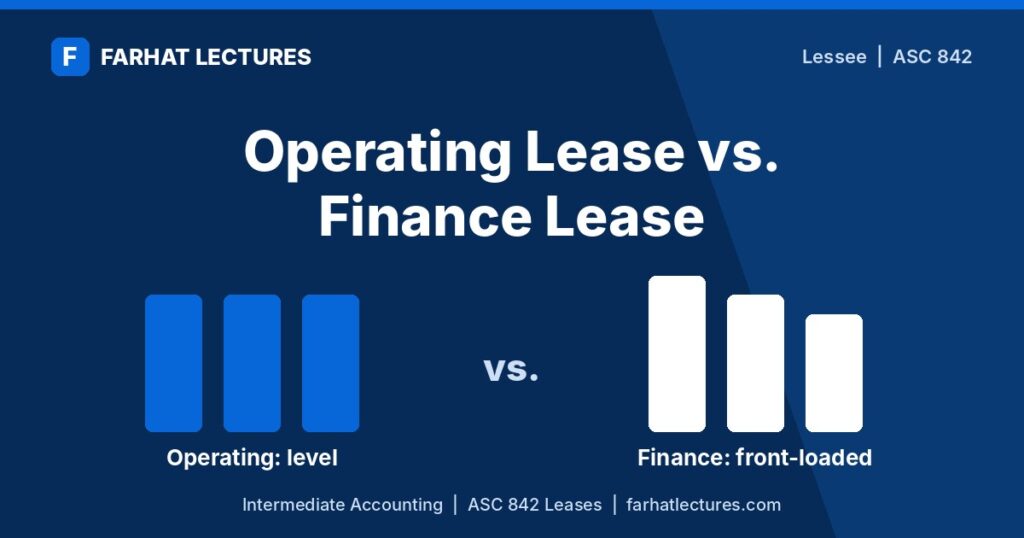
Responses