
Right-of-Use Asset Calculation: Initial Direct Costs, Incentives, and Prepayments

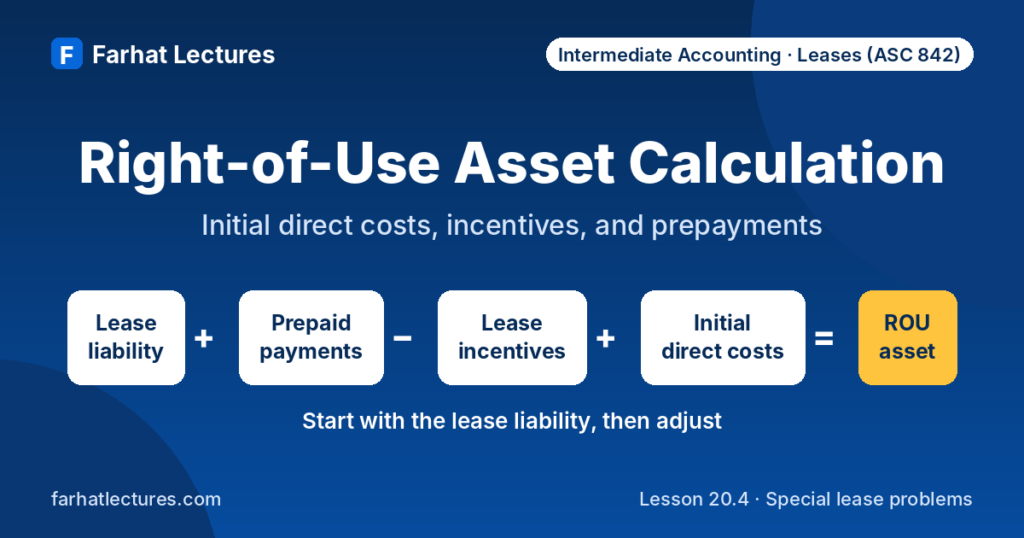
Under ASC 842, a lessee calculates the right-of-use (ROU) asset at commencement by starting with the lease liability, which is the present value of lease payments not yet paid. Then it adds lease payments made at or before commencement, subtracts lease incentives received, and adds initial direct costs.
Right-of-use asset = lease liability + prepaid lease payments − lease incentives + initial direct costs.
This matters because the right-of-use (ROU) asset often differs from the lease liability on day one. Exam problems hide incentives, commissions, and advance rent in the facts, and each one moves the asset in a different direction.
This guide walks through each adjustment (prepayments, incentives, and initial direct costs), shows how to calculate the lease liability you start from, and explains how property taxes and insurance (often called executory costs) affect the numbers. Residual values and purchase options have their own lessons on guaranteed residual value and bargain purchase option.
Watch Professor Farhat: This lecture reviews what belongs in the right-of-use asset and the lease liability. In the video, Professor Farhat walks through which lease terms, payment types, purchase options, and residual value guarantees belong in each measurement, so you can see the full picture behind the formula below.
Watch “ROU Asset vs. Lease Liability: What to Include | ASC 842” on YouTube
How do you calculate a right-of-use asset?
| Adjustment | Effect on ROU asset | Why |
|---|---|---|
| Initial measurement of the lease liability | Starting point | Present value of the lease payments |
| Lease payments made at or before commencement | Add | Cash already paid for the right of use |
| Lease incentives received from the lessor | Subtract | Lowers the net cost of the lease |
| Initial direct costs paid by the lessee | Add | Costs of getting the lease that would not exist otherwise |
One timing note: the incentive you subtract here is one received at or before commencement. If the lessor will pay an incentive after commencement, it reduces the lease payments instead, so it is already built into the lease liability.
What counts as an initial direct cost?
Initial direct costs are incremental costs of a lease that would not have been incurred if the lease had not been obtained. The test is simple: would the cost exist if the deal had fallen through? If yes, it is not an initial direct cost.
| Usually included | Usually excluded |
|---|---|
| Commissions owed only because the lease is signed, including commissions paid to employees | Salaries of employees and internal engineering costs |
| Payments to an existing tenant to move out | Legal and negotiation costs incurred whether or not the lease is signed |
| Any other cost the company owes only because the lease was signed | Advertising, depreciation, and costs of idle assets |
Internal costs, such as allocated legal staff time, supervision, and administration, are expensed as incurred, because the company would pay them anyway.
ASC 842 is stricter here than the older lease standard, ASC 840. Under ASC 842-10-30-9, the examples of initial direct costs are commissions and payments to an existing tenant to end its lease. If a textbook or an older review source lists other items, apply the incremental test before you capitalize anything.
Example: right-of-use asset calculation
Hypothetical example: Maple Clinic leases imaging equipment from Northline Medical Leasing on January 1, 2027. The lease liability is measured at $250,000. Before commencement, Maple prepaid $8,000 of rent. Northline paid Maple a $12,000 cash incentive for signing. Maple paid a $3,000 commission to a leasing broker and spent $1,200 of in-house staff time reviewing the contract.
| Item | Amount |
|---|---|
| Lease liability | 250,000 |
| Add: prepaid lease payments | 8,000 |
| Less: lease incentive received | (12,000) |
| Add: initial direct costs (broker commission) | 3,000 |
| Right-of-use asset | 249,000 |
The $1,200 of in-house staff time is not an initial direct cost. Maple would pay its staff whether or not the lease was signed, so it is expensed.
| Account | Debit | Credit |
|---|---|---|
| Right-of-Use Asset | 249,000.00 | |
| Cash (incentive received) | 12,000.00 | |
| Lease Liability | 250,000.00 | |
| Prepaid Rent | 8,000.00 | |
| Cash (broker commission) | 3,000.00 |
Full example: from lease payments to the ROU asset
In the first example, the lease liability was given. On exams and in practice, you usually have to calculate it first.
Hypothetical example: Cedar Dental signs a five-year office lease that starts on January 1, 2027. Rent is $20,000 a year, due every January 1, and Cedar pays the first $20,000 on the commencement date. The rate implicit in the lease is not readily determinable, so Cedar uses its incremental borrowing rate of 6%. (The incremental borrowing rate is the rate Cedar would pay to borrow a similar amount, on a secured basis, over a similar term.) Cedar also pays a $1,500 broker commission, and the landlord gives Cedar a $3,000 cash incentive at signing.
Step 1: Calculate the lease liability
The lease liability includes only the payments Cedar still owes. The first $20,000 is paid on day one, so four payments remain, due one, two, three, and four years from commencement.
Present value of 4 payments of $20,000 at 6% = $20,000 × [1 − (1.06)⁻⁴] ÷ 0.06 ≈ $69,302.11
Step 2: Adjust to get the ROU asset
| Item | Amount |
|---|---|
| Lease liability | 69,302.11 |
| Add: payment made at commencement | 20,000.00 |
| Add: initial direct costs (broker commission) | 1,500.00 |
| Less: lease incentive received | (3,000.00) |
| Right-of-use asset | 87,802.11 |
Step 3: Record the entry
January 1, 2027
| Account | Debit | Credit |
|---|---|---|
| Right-of-Use Asset | 87,802.11 | |
| Cash (incentive received) | 3,000.00 | |
| Lease Liability | 69,302.11 | |
| Cash (first lease payment) | 20,000.00 | |
| Cash (broker commission) | 1,500.00 |
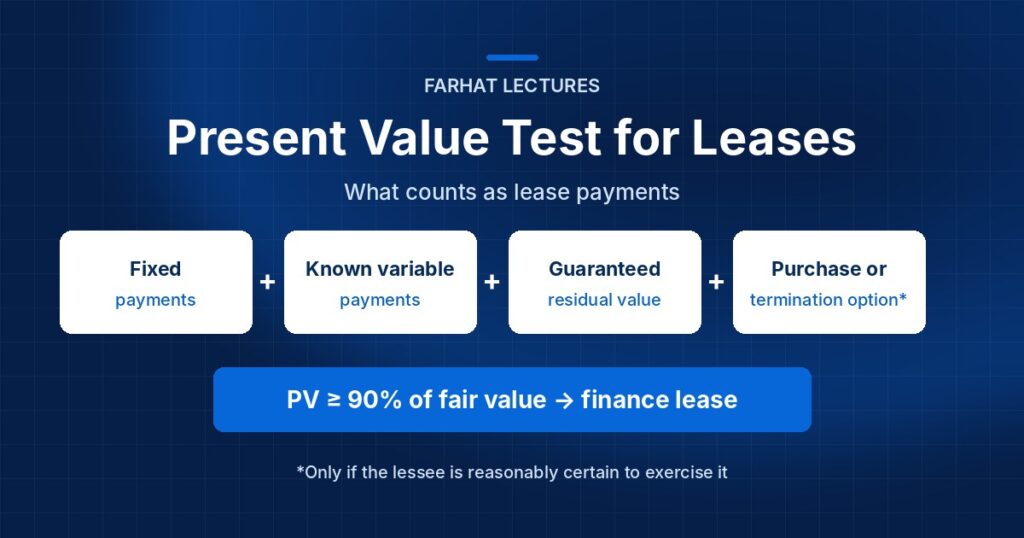
Exam tip: $69,302.11 + $20,000 = $89,302.11, which is the present value of all five payments as an annuity due (factor 4.46511). Exam questions often hand you the annuity-due factor. That works for the payments part of the asset, but the lease liability only includes the four payments still owed. The same present value math drives the 90% classification test, covered in the present value test for leases lesson.
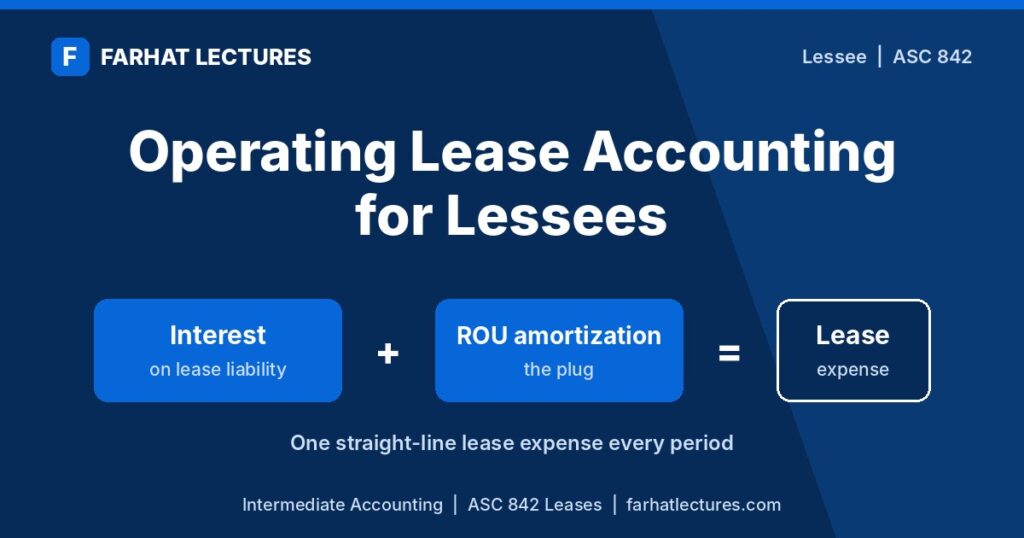
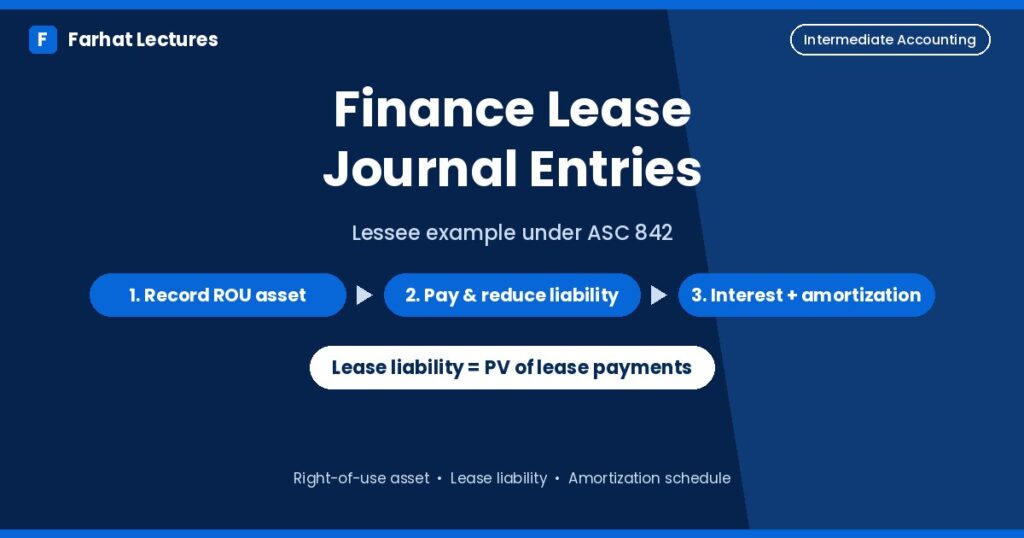
Want to see what happens after day one? Follow the asset and the liability through the lease term in operating lease accounting and finance lease journal entries, or compare the two in operating lease vs. finance lease.
Right-of-Use Asset Formula Practice
How does a lessee measure the initial right-of-use (ROU) asset at lease commencement? Practice using the initial lease liability, lease prepayments, lease incentives, and initial direct costs. Select one answer for each question.
How do lessors treat initial direct costs?
Lessors often pay more initial direct costs than lessees, because they solicit customers and pay commissions and legal fees to close deals. Their treatment depends on the lease type.
| Lessor lease type | Treatment of initial direct costs |
|---|---|
| Operating lease | Defer and expense over the lease term |
| Sales-type lease with a selling profit or loss | Expense at commencement, when the profit is recognized |
| Sales-type lease with no selling profit or loss | Defer and include in the net investment in the lease, so they are recognized over the lease term through interest income |
| Direct financing lease | Defer and include in the net investment in the lease |
Lessors expense the costs they would pay anyway, such as advertising, servicing existing leases, and credit monitoring. If none of the sales-type lease criteria are met, the lessor tests for a direct financing lease. The present value of the lease payments plus any residual value guaranteed by the lessee or by a third party unrelated to the lessor must equal or exceed substantially all of the asset’s fair value. Count only the guaranteed amount that the lease payments do not already include. The lessor must also expect that collection of both the lease payments and any amount due under the residual value guarantee is probable. For how a lessor reports revenue in a sales-type lease, see unguaranteed residual value.
Do property taxes and insurance go in the ROU asset? (Gross vs. net leases)
Executory costs are the normal costs of owning an asset, such as property taxes and insurance. ASC 842 no longer uses that term, but textbooks and exam questions still do. Under ASC 842, taxes and insurance are not separate components of the lease. What matters is whether the lessee’s payment for them is fixed or variable.
| Gross lease | Net lease, fixed amount | Net lease, variable amount | |
|---|---|---|---|
| Who pays taxes and insurance? | Lessor, built into fixed rent | Lessee pays a set amount each month | Lessee pays the actual bills, which change |
| In the lease liability? | Yes | Yes | No |
| Expense treatment | Part of the lease cost | Part of the lease cost | Expensed as incurred |
Hypothetical example: Pine Street Books rents store space. Under Option A, rent is a fixed $6,000 a month, and the landlord pays taxes and insurance. Under Option B, rent is $5,400 a month, and Pine Street pays taxes and insurance directly, which vary each year. Under Option A, the full $6,000 is a lease payment, assuming no services such as maintenance are bundled into the rent. Under Option B, only the $5,400 is a lease payment. The taxes and insurance change each year, so they are expensed when incurred. If Pine Street instead paid the landlord a fixed $600 a month for taxes and insurance, that $600 would be a lease payment too, because it is fixed.
Key takeaways
- ROU asset = lease liability + payments made at or before commencement − lease incentives received + initial direct costs.
- The lease liability is the present value of payments not yet paid, discounted at the rate implicit in the lease or, if that rate is not readily determinable, the lessee’s incremental borrowing rate.
- Under ASC 842, only incremental costs count as initial direct costs, mainly commissions and payments to an existing tenant to leave.
- Fixed payments for taxes and insurance are lease payments. Reimbursements based on the landlord’s actual tax or insurance bills are expensed as incurred.
- Initial direct costs never go in the lease liability.
Common mistakes
- Adding initial direct costs to the lease liability instead of the ROU asset.
- Adding lease incentives instead of subtracting them.
- Capitalizing salaries or internal legal time as initial direct costs.
- Including variable taxes and insurance paid directly by the lessee in the lease liability.
- Assuming every net lease payment for taxes and insurance is variable. A fixed monthly reimbursement belongs in the lease liability.
- Including a payment made on the commencement date in the lease liability. It is already paid, so it goes in the ROU asset instead.
Practice questions with answers
Question 1
A lease liability is $120,000. The lessee received a $5,000 incentive and paid a $2,000 broker commission. There were no prepayments. What is the right-of-use asset?
Show answer
Answer: $117,000.
$120,000 − $5,000 + $2,000 = $117,000.
Question 2
Which of these is an initial direct cost for the lessee: (a) a commission paid to a leasing agent, (b) salary of the in-house real estate manager, (c) advertising for the new location?
Show answer
Answer: Only (a).
The commission exists only because the lease was signed. Salaries and advertising would be incurred anyway, so they are expensed.
Question 3
Under a net lease, a lessee pays the property taxes directly to the county. The bill changes every year with the assessed value and works out to about $700 a month this year. Is that amount included in the lease liability?
Show answer
Answer: No.
These taxes change with the assessed value, so they are variable payments. They are expensed as incurred and stay out of the lease liability and ROU asset.
Frequently asked questions
Are initial direct costs included in the lease liability?
No. A lessee adds its initial direct costs to the right-of-use asset only. The lease liability is the present value of the lease payments not yet paid at commencement.
Why do lease incentives reduce the right-of-use asset?
An incentive is cash or value the lessor gives the lessee for signing. It lowers the net cost of the right to use the asset, so it is subtracted.
Do lessors and lessees treat initial direct costs the same way?
No. A lessee capitalizes them in the right-of-use asset. A lessor defers them for an operating lease and expenses them at commencement for a sales-type lease that has a selling profit or loss. For a sales-type lease with no selling profit or loss, or a direct financing lease, the lessor includes them in the net investment in the lease.
What is the difference between a gross lease and a net lease?
In a gross lease, property taxes and insurance are built into the fixed rent, so they are part of the lease payments. In a net lease, the lessee pays those costs separately. If those payments are fixed, they go in the lease liability. If they vary, they are expensed as incurred.
Is the right-of-use asset always equal to the lease liability?
At commencement, the ROU asset equals the lease liability when the adjustments net to zero. For example, a $3,000 prepayment and a $3,000 incentive offset each other if there are no initial direct costs.
What if the first lease payment is made on the commencement date?
That payment is not part of the lease liability, because it is already paid. Add it to the right-of-use asset instead.
What discount rate is used to calculate the lease liability?
The rate implicit in the lease, if it is readily determinable. If not, the lessee uses its incremental borrowing rate. Lessees that are not public business entities may elect to use a risk-free rate, by class of underlying asset.
Is the ROU asset calculated differently for operating and finance leases?
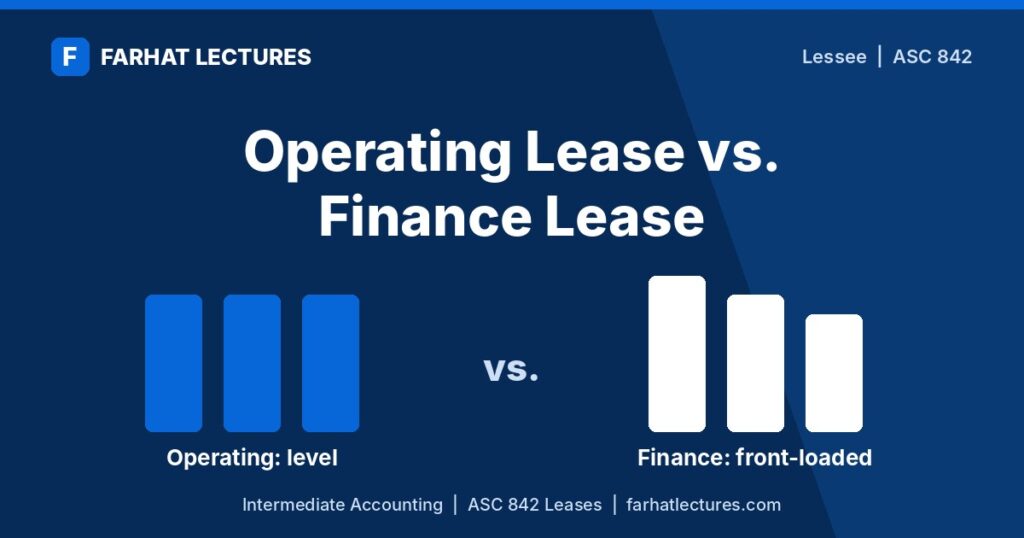
Not on day one. The initial measurement is the same. The difference shows up afterward, in how the asset is amortized and how the expense is reported.
Does IFRS 16 use the same calculation?
Mostly. IFRS 16 also includes the lessee’s estimated costs to dismantle, remove, or restore the asset in the ROU asset’s initial cost. ASC 842’s formula does not list those costs. Under US GAAP, they fall under the asset retirement obligation guidance in ASC 410.
Sources
- FASB Accounting Standards Codification, Topic 842 (Leases): ASC 842-20-30-5 (ROU asset), ASC 842-10-30-9 and 30-10 (initial direct costs), ASC 842-10-15-30 (taxes and insurance), ASC 842-30 (lessor accounting)
- Deloitte Roadmap: Lessee recognition and measurement
- Deloitte Roadmap: Initial direct costs
- Deloitte Roadmap: Lessor recognition and measurement
Mansour Farhat, CPA, CIA, DBA, teaches accounting through Farhat Lectures, an online platform for CPA, CMA, and EA candidates and accounting students, and on the Farhat Lectures YouTube channel. Read more about Professor Farhat.
Continue learning with Farhat Lectures
Strengthen your accounting understanding with clear explanations and guided practice.
Explore the free sample course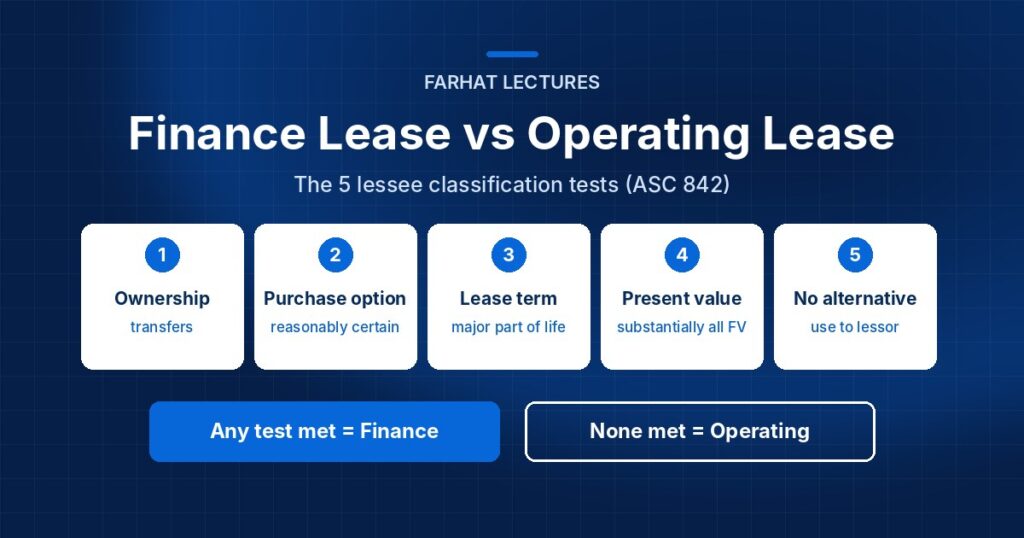
Responses