
Lessor Accounting for Operating Leases: Revenue, Depreciation, and Entries

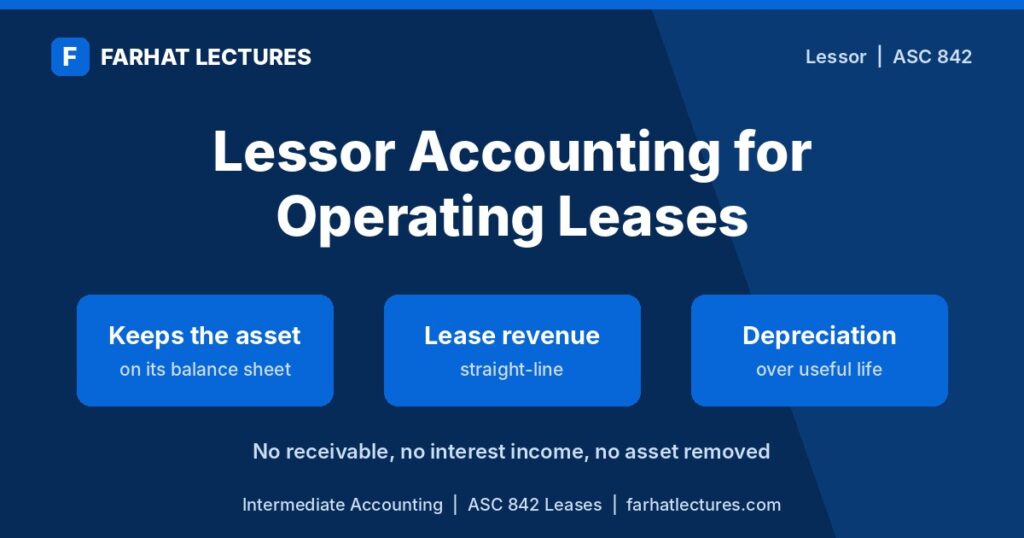
Under ASC 842, a lessor accounting for an operating lease keeps the leased asset on its balance sheet, keeps depreciating it over its useful life, and recognizes lease revenue, generally on a straight-line basis over the lease term. The lessor records no net investment in the lease at commencement. An accrued rent receivable can arise later when recognized lease revenue exceeds rent billed.
Why it matters: students often apply the lessee’s right-of-use asset entries to the lessor. The lessor side is simpler. It works like owning a rental property: rent comes in, and the asset wears out. For the other side of the same lease, see operating lease journal entries for the lessee.
Watch Professor Farhat: At 2:13, Professor Farhat records the lessor’s asset, moves unearned revenue into lease revenue, and records straight-line depreciation.
Watch “Operating Lease: CPA Exam Simulation. Intermediate Accounting” on YouTube
Lessor accounting for operating leases in brief
| Item | Lessor treatment |
|---|---|
| Underlying asset | Stays on the balance sheet as leased equipment (or property) |
| Revenue | Lease revenue, generally straight-line over the lease term |
| Depreciation | Continues over the asset’s useful life using the lessor’s normal method |
| Other costs | Insurance, maintenance, and property taxes are expensed as incurred |
| Cash collected early | Unearned Lease Revenue until earned |
How does a lessor classify an operating lease?
The lessor applies the same five tests the lessee uses: ownership transfer, a purchase option reasonably certain to be exercised, a major part of the economic life, a present value equal to substantially all of the fair value, and a specialized asset. If any test is met, the lessor has a sales-type lease. If none of the five tests is met, the lessor next checks the direct financing criteria. The present value of lease payments and qualifying residual value guarantees must equal or exceed substantially all of the asset’s fair value, and collection of the payments and guaranteed amounts must be probable. Qualifying guarantees may come from the lessee or a third party unrelated to the lessor. If either criterion fails, the lease is an operating lease. For how the lessee reports the same lease, see operating lease accounting for lessees. If the lease turns out to be a sales-type lease instead, see accounting for a sales-type lease by the lessor. For the less common case, see the direct financing lease lesson.
Example: the lessor’s entries
Hypothetical example. Brightline Equipment Leasing owns a digital X-ray system that cost $80,000. It has an 8-year useful life, no residual value, and Brightline uses straight-line depreciation. On January 1, 2027, Brightline leases it to Ridgeview Dental for 4 years at $15,000 due each January 1. The system’s fair value at commencement is also $80,000, and it returns to Brightline at the end of the lease. Here is the quick test check. There is no ownership transfer or purchase option, and an X-ray system is not specialized. The 4-year term is 50% of the 8-year life, below the common 75% benchmark for a major part. Even before discounting, the payments total $60,000 ($15,000 × 4), which is 75% of fair value, below the common 90% benchmark for substantially all. Assume no party guarantees the residual value. Even before discounting, the $60,000 in payments falls below the $72,000 benchmark (90% of $80,000), so the direct financing test also fails. Brightline therefore classifies the lease as operating.
January 1 each year: collect the rent
| Account | Debit | Credit |
|---|---|---|
| Cash | $15,000 | |
| Unearned Lease Revenue | $15,000 |
December 31 each year: earn the revenue
| Account | Debit | Credit |
|---|---|---|
| Unearned Lease Revenue | $15,000 | |
| Lease Revenue | $15,000 |
December 31 each year: record depreciation
Depreciation = $80,000 ÷ 8 years = $10,000.
| Account | Debit | Credit |
|---|---|---|
| Depreciation Expense | $10,000 | |
| Accumulated Depreciation, Leased Equipment | $10,000 |
Each year, Brightline reports $15,000 of lease revenue and $10,000 of depreciation, or $5,000 of profit before other costs. If Brightline prepared monthly statements, it would move $1,250 from unearned revenue to lease revenue each month.
How does the lessor present an operating lease in its financial statements?
| Date | Leased equipment | Accumulated depreciation | Carrying amount |
|---|---|---|---|
| Dec. 31, 2027 | $80,000 | $10,000 | $70,000 |
| Dec. 31, 2028 | $80,000 | $20,000 | $60,000 |
| Dec. 31, 2029 | $80,000 | $30,000 | $50,000 |
| Dec. 31, 2030 | $80,000 | $40,000 | $40,000 |
Brightline keeps reporting the system under its normal property, plant, and equipment rules (ASC 360). ASC 842 also asks lessors to disclose assets under operating leases separately from the assets they use themselves, so Brightline labels this as leased equipment, either on the balance sheet or in the notes. When the lease ends, the system comes back with a $40,000 carrying amount and four more years of depreciation. Cash received from operating leases is reported in operating activities.
Who acts as lessor? Banks, captive finance companies set up by manufacturers, and equipment rental businesses are common lessors. Many report large pools of assets under operating leases while recording lease income and depreciation, exactly as shown here.
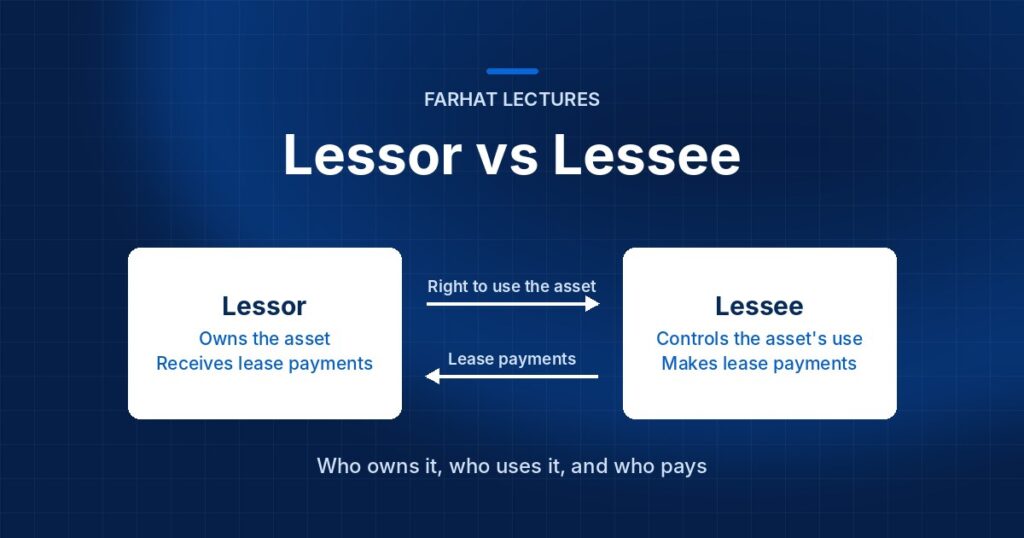
Lessor vs. lessee in an operating lease
| Item | Lessee (Ridgeview) | Lessor (Brightline) |
|---|---|---|
| Balance sheet | ROU asset and lease liability | Keeps the equipment; no lease receivable |
| Income statement | Lease expense of $15,000 per year | Lease revenue of $15,000 and depreciation of $10,000 per year |
| Interest | Computed inside lease expense | None |
| January 1 payment | Debit Lease Liability (the first payment, made at commencement, becomes part of the ROU asset instead) | Credit Unearned Lease Revenue |
Common mistakes
- Removing the asset. In an operating lease, the lessor keeps the underlying asset on its balance sheet and continues to depreciate it (see sales-type vs. direct financing vs. operating leases).
- Recording a lease receivable and interest income. Those belong to sales-type and direct financing leases.
- Depreciating over the lease term only. The lessor keeps the asset, so it uses the asset’s useful life.
- Recording cash collected in advance as revenue. Revenue is earned over time; advance cash is unearned first.
Exam tip: When a simulation gives you the lessor’s numbers, start with the five sales-type tests. If all five fail, check the direct financing criteria, including any qualifying residual value guarantee and whether collection is probable. If the lease qualifies as operating, keep the leased asset on the books, recognize lease revenue, and continue depreciating the asset.
Three details the CPA exam likes to test
Initial direct costs. These are costs the lessor would not have paid if the lease had not been signed, such as a broker’s commission. In an operating lease, the lessor defers them and expenses them over the lease term on the same basis as lease revenue. If Brightline had paid a $2,000 commission to sign Ridgeview, it would expense $500 a year for 4 years ($2,000 ÷ 4).
Variable lease payments. Some payments depend on usage or sales, for example $5 for every X-ray taken. These are not straight-lined. The lessor records them as lease revenue in the period the usage or sales happen.
Collectibility. If, at commencement, it is not probable that the lessor will collect the lease payments, lease revenue is limited to the lesser of straight-line revenue or the cash actually collected, until collection becomes probable.
Interactive lessor operating lease exercise
Work through four questions on leased equipment, straight-line lease revenue, advance rent, and routine operating costs before trying the calculations below.
Practice questions with answers
Question 1: Annual income
A lessor owns equipment costing $120,000 with a 10-year life and no residual value (straight-line). It leases the equipment under an operating lease for $20,000 per year. What is the lessor’s annual pretax income from the lease, ignoring other costs?
Answer: Lease revenue $20,000 − depreciation $12,000 ($120,000 ÷ 10) = $8,000.
Question 2: Uneven rent
A three-year operating lease calls for year-end rent of $9,000, $10,000, and $11,000. How much lease revenue does the lessor report in year 1, and what is the difference from cash?
Answer: Revenue = $30,000 ÷ 3 = $10,000. Cash is $9,000, so the lessor debits Cash $9,000 and Accrued Rent Receivable $1,000, and credits Lease Revenue $10,000. This accrued rent receivable (often called a straight-line rent receivable) is only the timing gap between cash and revenue. It is not the lease receivable recorded in a sales-type lease.
Question 3: Advance rent at year-end
A lessor with a December 31 year-end collects one year of rent, $24,000, on October 1. How much is lease revenue for the year, and how much is unearned?
Answer: Three months have passed, so revenue is $24,000 × 3/12 = $6,000, and $18,000 remains in Unearned Lease Revenue.
Frequently asked questions
Does the lessor remove the asset in an operating lease?
No. In an operating lease, the lessor keeps the underlying asset on its balance sheet and continues to depreciate it.
Why does the lessor credit Unearned Lease Revenue?
When rent is collected at the start of the year, the lessor has not yet provided the use of the asset. The cash creates a liability, which becomes lease revenue as time passes. For the general concept, see our guide to unearned revenue.
Does the lessor recognize interest in an operating lease?
No. An operating lease produces lease revenue, generally on a straight-line basis. Interest income arises in sales-type and direct financing leases, not operating leases.
What happens if rent payments increase each year?
The lessor still recognizes the same revenue each period: total lease payments divided by the lease term, unless another systematic basis better reflects the pattern of benefit. The difference between cash and revenue is recorded as an accrued rent receivable (when revenue runs ahead of cash) or as unearned lease revenue (when cash runs ahead of revenue).
Over what period does the lessor depreciate the leased asset?
Over the asset’s useful life under the lessor’s normal depreciation policy, not just over the lease term, because the lessor keeps the asset after the lease ends.
How does a lessor handle initial direct costs in an operating lease?
The lessor defers them and expenses them over the lease term on the same basis as lease revenue, which is usually straight-line.
Are variable lease payments straight-lined by the lessor?
No. Variable payments tied to usage or sales are recognized as lease revenue in the period the usage or sales happen.
Is lessor accounting for operating leases different under IFRS 16?
The basic model is the same. Under IFRS 16, the lessor keeps the asset, keeps depreciating it, and recognizes operating lease income on a straight-line basis or another systematic basis. For more, see IFRS 16 lease accounting.
Sources: FASB Accounting Standards Codification, Topic 842 (Leases), including ASC 842-30-25-11 (operating lease income); Deloitte Roadmap: Leases, 9.3 Lessor Recognition and Measurement; KPMG, ASC 842 for lessors.
Continue learning with Farhat Lectures
Strengthen your lease accounting skills with clear explanations and guided practice. Ready for the full lessor chapter? The Intermediate Accounting course walks through sales-type, direct financing, and operating leases from the lessor’s side, with videos and exercises.
Explore the free sample course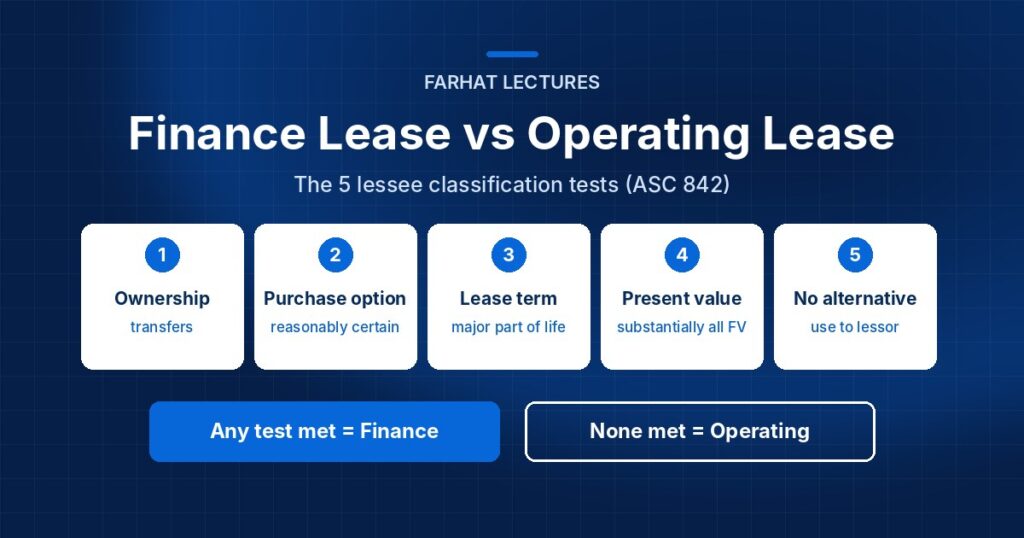
Responses