
Operating Lease Accounting for Lessees: ROU Asset, Lease Liability, and Straight-Line Expense

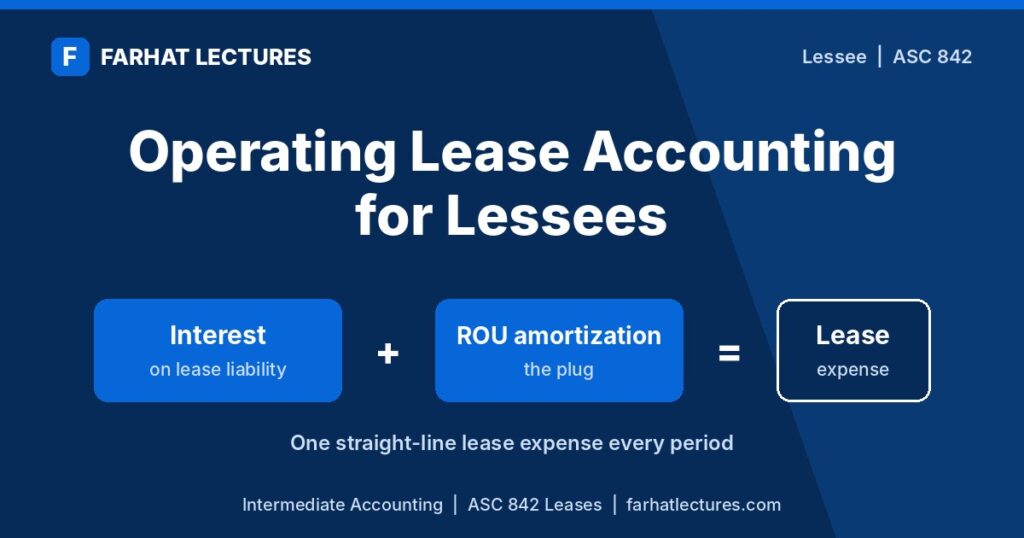
Operating lease accounting under ASC 842 means the lessee records a right-of-use (ROU) asset and a lease liability at commencement, then reports one straight-line lease expense each period. For a basic lease with no initial direct costs or lease incentives, that expense equals total lease payments divided by the lease term. Interest on the liability is computed first, and ROU asset amortization is the difference.
Why it matters: a lease is an operating lease whenever it fails every finance lease test, so many office, store, and equipment leases fall here. Exam questions ask for the yearly lease expense, the ending balances, and the journal entries. All three come from the same two-step calculation.
Watch Professor Farhat: At 2:38, Professor Farhat explains the right-of-use asset, the lease liability, and the single lease expense before working a three-year example.
Watch “Operating Lease Journal Entries: Lessee & Lessor | ASC 842” on YouTube
What is an operating lease for a lessee?
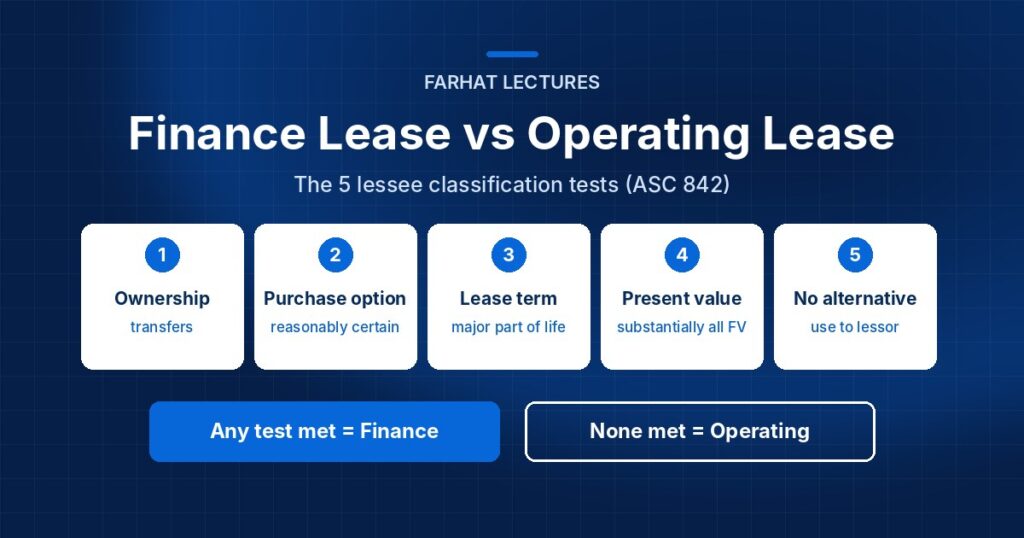
Under U.S. GAAP (ASC 842, Leases), a lessee classifies a lease as a finance lease if it meets any one of five tests in ASC 842-10-25-2:
- Ownership of the asset transfers to the lessee by the end of the lease term.
- The lessee has a purchase option it is reasonably certain to exercise.
- The lease term covers a major part of the asset’s remaining economic life.
- The present value of the lease payments, plus any residual value the lessee guarantees that is not already in those payments, equals or exceeds substantially all of the asset’s fair value.
- The asset is so specialized that the lessor is expected to have no other use for it when the lease ends.
If none of these tests is met, the lease is an operating lease. To see how the two types differ, read operating lease vs. finance lease.
Think of an operating lease as a rental that is still reported on the balance sheet. The lessee gets the right to use the asset, but the accounting spreads the cost evenly, like rent.
How do you record an operating lease at commencement?
At the commencement date, the lessee measures the lease liability at the present value of the lease payments not yet paid. It discounts them at the rate implicit in the lease (the interest rate built into the lessor’s pricing of the lease) if that rate is readily determinable. If not, it uses its incremental borrowing rate, which is the rate it would pay to borrow a similar amount, on a secured basis, over a similar term. A lessee that is not a public business entity, such as a private company, can instead elect a risk-free rate for a class of underlying assets when the implicit rate is not readily determinable. In the basic case, the ROU asset equals the lease liability. This first step is the same for operating and finance leases. The finance lease side is covered in operating lease vs. finance lease.
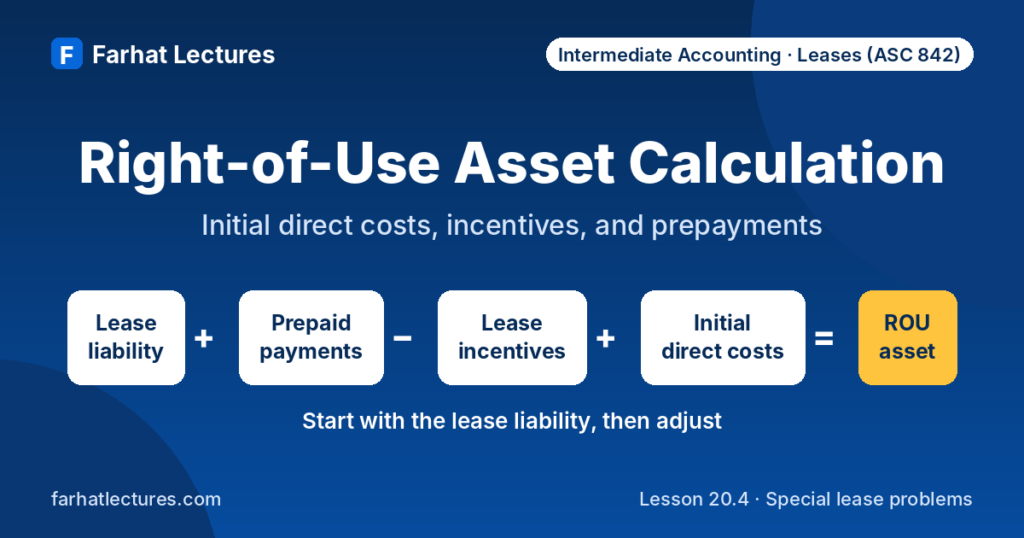
When is the ROU asset different from the lease liability? Use this formula:
ROU asset = lease liability + lease payments made at or before commencement + initial direct costs − lease incentives received
Initial direct costs are costs the lessee would not have paid if it had not signed the lease, such as a broker’s commission. For example, if Harbor Bakery (below) had paid a $600 commission to arrange its lease, the ROU asset would start at $27,832.48 while the lease liability stays at $27,232.48. That $600 is also spread evenly through the single lease expense, so yearly lease expense would be $10,200 ($30,600 ÷ 3).
How do you calculate operating lease expense?
After commencement, the lessee follows the same steps every period:
| Step | What to do | Formula |
|---|---|---|
| 1 | Find the straight-line lease expense | Total lease payments ÷ lease term (basic lease with no initial direct costs or lease incentives) |
| 2 | Compute interest on the lease liability | Discount rate × lease liability balance at the start of the period (the effective-interest method) |
| 3 | Find the ROU asset amortization (the “plug”: whatever amount keeps the total expense level) | Straight-line lease expense − interest |
| 4 | Update both balances | Liability: + interest − payment. ROU asset: − amortization |
The key idea is step 3. Interest is calculated first, and the ROU asset amortization is whatever amount keeps total lease expense level. Early in the lease, interest is larger, so amortization is smaller. Late in the lease, the reverse is true.
Exam tip: If a question gives you the lease expense and the interest, the ROU asset amortization is simply the difference. If it asks for the ROU asset balance, don’t assume it equals the lease liability. They match only when there is no prepaid rent, initial direct cost, or lease incentive, and payments are level.
Example: a three-year operating lease
Hypothetical example. On January 1, 2027, Harbor Bakery leases a commercial oven for three years. It pays $10,000 at the end of each year (December 31). The oven has a 10-year economic life, ownership does not transfer, there is no purchase option, and the oven is not specialized. Assume the oven’s fair value at commencement is $40,000 and Harbor provides no residual value guarantee. The present value of the payments is $27,232.48, or 68.1% of fair value. The lease meets none of the five finance lease tests, so Harbor classifies it as an operating lease. Harbor’s incremental borrowing rate is 5%.
Step 1: Measure the lease liability and ROU asset
Present value = $10,000 × 2.723248 (present value of an ordinary annuity, 3 periods, 5%) = $27,232.48. Harbor records a ROU asset and a lease liability of $27,232.48.
| Account | Debit | Credit |
|---|---|---|
| Right-of-Use Asset | $27,232.48 | |
| Lease Liability | $27,232.48 |
Step 2: Split the first year’s lease expense
Straight-line lease expense = $30,000 ÷ 3 years = $10,000. Interest = 5% × $27,232.48 = $1,361.62. ROU amortization = $10,000 − $1,361.62 = $8,638.38.
| Account | Debit | Credit |
|---|---|---|
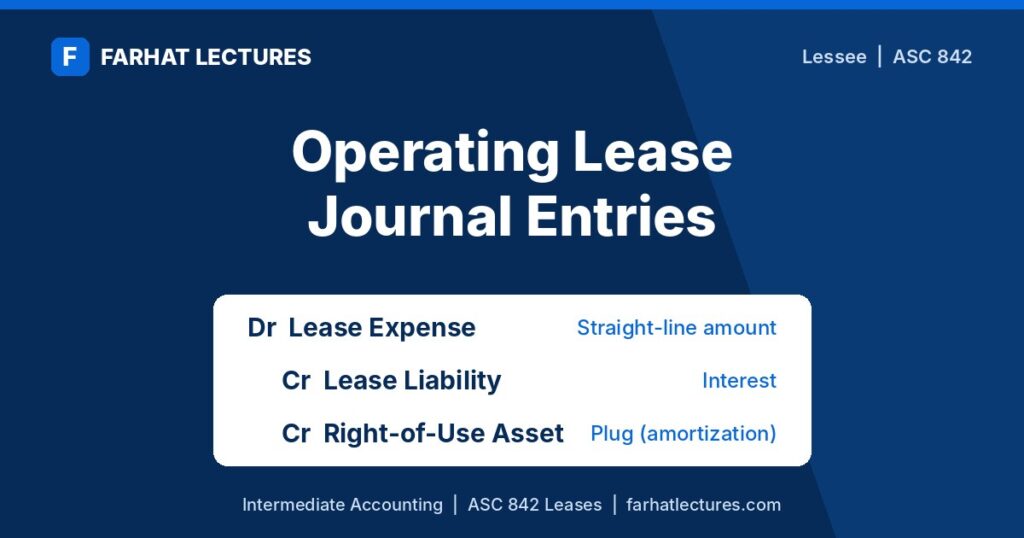
| Lease Expense | $10,000.00 | |
| Right-of-Use Asset | $8,638.38 | |
| Lease Liability | $1,361.62 |
| Account | Debit | Credit |
|---|---|---|
| Lease Liability | $10,000.00 | |
| Cash | $10,000.00 |
Step 3: Follow the full schedule
| Year | Lease expense | Interest (5%) | ROU amortization | Lease liability, Dec. 31 | ROU asset, Dec. 31 |
|---|---|---|---|---|---|
| Start | $27,232.48 | $27,232.48 | |||
| 2027 | $10,000.00 | $1,361.62 | $8,638.38 | $18,594.10 | $18,594.10 |
| 2028 | $10,000.00 | $929.71 | $9,070.29 | $9,523.81 | $9,523.81 |
| 2029 | $10,000.00 | $476.19 | $9,523.81 | $0.00 | $0.00 |
| Total | $30,000.00 | $2,767.52 | $27,232.48 |
Lease expense is $10,000 every year. Total interest of $2,767.52 plus total amortization of $27,232.48 equals the $30,000 of payments. For a full set of entries when payments are due at the start of each year, see operating lease journal entries.
Where does an operating lease appear in the financial statements?
| Statement | What the lessee reports |
|---|---|
| Balance sheet | ROU asset and lease liability, presented separately from finance lease balances or disclosed in the notes |
| Income statement | One lease expense within income from continuing operations, usually in operating expenses |
| Cash flow statement | Operating lease payments in operating activities (except payments to get another asset ready for its intended use, which go in investing activities) |
How is operating lease accounting different under IFRS 16?
The FASB kept two lessee models. It concluded that many leases are not economically the same as buying an asset with borrowed money, so a single, level expense better reflects how a lessee uses those leases. The IASB took a different path. Under IFRS 16, lessees use one model for nearly all leases, with separate depreciation and interest. For the IFRS approach, see IFRS 16 lease accounting.
Common mistakes
- Reporting interest expense. For an operating lease, interest is part of the single lease expense.
- Amortizing the ROU asset straight-line. That is the finance lease method. For an operating lease, amortization is the plug.
- Leaving the lease off the balance sheet. That was the old rule (ASC 840). ASC 842 requires the ROU asset and lease liability.
- Using the payment as expense when payments change. For a basic lease with uneven payments and no initial direct costs or lease incentives, divide total payments by the lease term to find straight-line expense.
Key takeaways
- At commencement, the lease liability equals the present value of unpaid lease payments. To measure the ROU asset, start with the liability, add payments made at or before commencement and initial direct costs, and subtract lease incentives received.
- For a basic lease with no initial direct costs or lease incentives, straight-line lease expense = total lease payments ÷ lease term.
- Interest = discount rate × opening lease liability. ROU asset amortization = lease expense − interest.
- The income statement shows one lease expense, not separate interest and amortization.
- Cash payments on an operating lease are generally classified as operating activities.
- With level payments and no prepaid rent, initial direct costs, or incentives, the ROU asset and lease liability stay equal and both reach zero at the end of the lease.
ASC 842 Operating Lease Accounting Practice
Operating Lease Accounting for Lessees
Apply the ASC 842 lessee model to a two-year equipment lease. Classify the lease, identify the right-of-use (ROU) asset and lease liability recognized at commencement, and calculate first-year interest and ROU asset amortization. Select one answer per question. Use whole dollars.
Practice questions with answers
Question 1: First-year expense split
A lessee signs a four-year operating lease with payments of $8,000 at the end of each year. The present value at 6% is $27,720.84. How much of the first year’s lease expense is interest, and how much is ROU amortization?
Answer: Lease expense = $32,000 ÷ 4 = $8,000. Interest = 6% × $27,720.84 = $1,663.25. ROU amortization = $8,000 − $1,663.25 = $6,336.75.
Question 2: Uneven payments
A three-year operating lease requires payments of $9,000, $10,000, and $11,000. What lease expense does the lessee report each year?
Answer: Total payments are $30,000, so straight-line lease expense is $10,000 per year, even though the cash paid changes.
Question 3: Income statement line
In Harbor Bakery’s example, what does the 2028 income statement show for the lease?
Answer: A single lease expense of $10,000. The $929.71 of interest and $9,070.29 of amortization are not shown as separate lines.
Frequently asked questions
Does an operating lease go on the balance sheet under ASC 842?
Yes. Under ASC 842, a lessee records a right-of-use asset and a lease liability for an operating lease at commencement, just as it does for a finance lease. The main exception is a short-term lease: a lease term of 12 months or less with no purchase option the lessee is reasonably certain to exercise. A lessee can elect, by class of underlying asset, to keep these leases off the balance sheet and expense the payments on a straight-line basis.
Is operating lease expense the same as the cash payment?
In a basic lease with no initial direct costs or lease incentives, straight-line lease expense equals total lease payments divided by the lease term. If payments are level, annual expense equals the annual payment. If payments vary, annual expense stays level while cash paid changes.
Why is right-of-use asset amortization called a plug?
The amortization is not calculated on its own. It is the amount left after subtracting interest on the lease liability from the straight-line lease expense, so the two parts always add up to the same expense each year.
Does a lessee report interest expense for an operating lease?
No. The lessee still computes interest on the lease liability, but it reports that amount inside the single lease expense line, not as interest expense.
Which discount rate does the lessee use?
The lessee uses the rate implicit in the lease when that rate is readily determinable. Otherwise, it uses its incremental borrowing rate. A lessee that is not a public business entity can instead elect, by class of underlying asset, a risk-free rate for a period similar to the lease term. Even then, it must use the implicit rate whenever that rate is readily determinable.
What changes when lease payments are due at the start of each year?
The first payment is made at commencement, so it reduces the lease liability right away. If Harbor Bakery paid its $10,000 every January 1 instead, the ROU asset would start at $28,594.10 and the lease liability would be $18,594.10 after the first payment. Lease expense is still $10,000 a year. For 2027, interest is $929.71 and ROU asset amortization is $9,070.29.
Is operating lease expense always straight-line?
Not after an impairment. If the ROU asset is impaired, the lessee writes it down and then amortizes the remaining balance straight-line over the remaining lease term. Interest on the liability keeps falling, so total lease cost is higher early and lower later. The lessee still reports it as a single lease cost.
How is an operating lease different from a finance lease for the lessee?
Both put a ROU asset and a lease liability on the balance sheet. An operating lease shows one straight-line lease expense. A finance lease shows amortization expense and interest expense separately, so total expense is higher in the early years.
Sources: FASB Accounting Standards Codification, Topic 842 (Leases), including ASC 842-10-25-2 (classification), ASC 842-20-30-1, 30-3, and 30-5 (initial measurement and discount rate), ASC 842-20-25-6 (single lease cost), and ASC 842-20-45-1, 45-4, and 45-5 (presentation); FASB ASU 2021-09 (discount rate for lessees that are not public business entities); Deloitte Roadmap: Leases, 8.4 Recognition and Measurement; Deloitte Roadmap: Leases, 14.2 Lessee presentation; IFRS Foundation, IFRS 16 Leases.
About the author
Mansour Farhat, CPA, CIA, DBA, is the professor behind Farhat Lectures. He teaches accounting and CPA exam topics through video lectures, worked examples, and practice exercises like the ones on this page.
Continue learning with Farhat Lectures
Strengthen your lease accounting skills with clear explanations and guided practice. When you’re ready for the complete topic, the Farhat Lectures Intermediate Accounting course covers leases along with the rest of financial reporting.
Explore the free sample course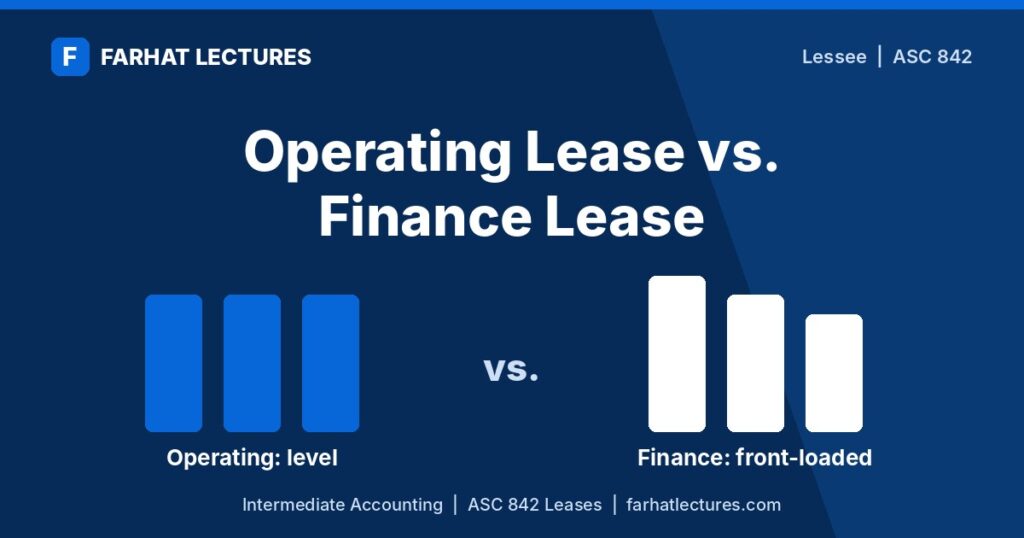
Responses