
Present Value Test for Leases: What Counts as Lease Payments

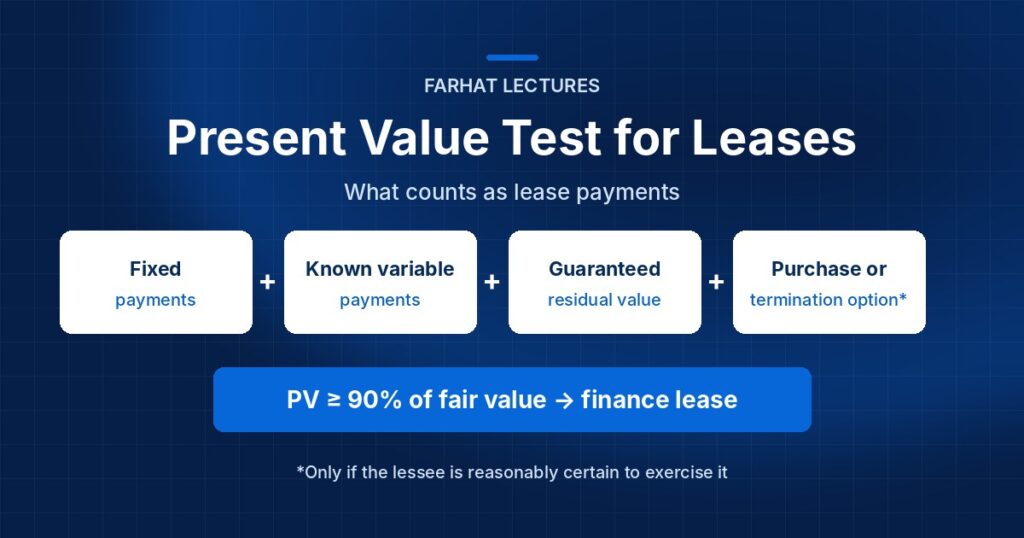
The present value test for leases (ASC 842-10-25-2(d)) compares the present value of the lease cash flows with the asset’s fair value at commencement. Include the full residual value guaranteed by the lessee exactly once. The test is met when the total present value represents substantially all of fair value. A common guideline is 90% or more. If the test is met, the lessee classifies the lease as a finance lease.
The test is the fourth of the five finance lease vs operating lease tests, and it’s where a lot of students slip. The math is simple discounting. The hard part is deciding which payments go in and which rate to use.
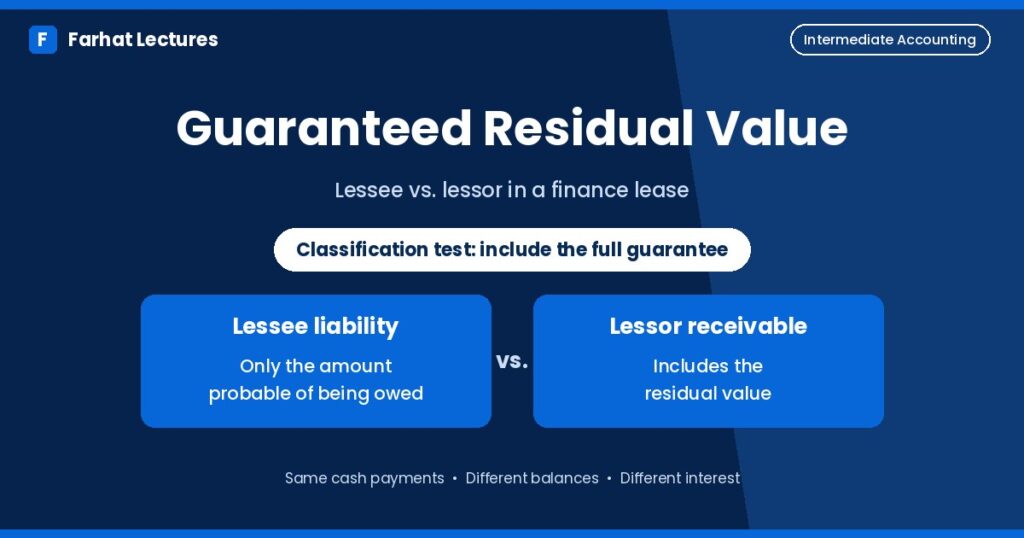
Watch: Guaranteed Residual Value: Lessee Liability vs Classification (shows why a guaranteed residual is treated differently for classification and for the lease liability)
What counts as lease payments for the present value test?
For classification, the lessee adds up these amounts, then subtracts any lease incentives the lessor pays or owes to the lessee:
Fixed and in-substance fixed payments + Index- or rate-based payments (at the commencement rate) + Guaranteed residual value + Purchase option price or termination penalty, if applicable* − Lease incentives = Cash flows to discount
*Include the purchase price if the lessee is reasonably certain to exercise the purchase option. Include a termination penalty if the lease term assumes the lessee exercises the termination option.
Discount the included cash flows to commencement, counting the lessee’s residual value guarantee once. Divide the total present value by the asset’s fair value at commencement.
| Item | Included? | Example |
|---|---|---|
| Fixed payments | Yes | Rent specified in the contract, such as $5,000 per month |
| Fixed escalations | Yes | Rent that rises by a set $1,000 each year |
| In-substance fixed payments | Yes | The $3,000 minimum in rent of “the greater of $3,000 or 5% of sales” |
| Variable payments based on an index or rate | Yes, at the commencement-date index or rate | Rent adjusted for the Consumer Price Index (CPI) |
| Variable payments based on sales or usage | No | Extra rent equal to 2% of store sales |
| Residual value guaranteed by the lessee | Yes, the full guaranteed amount | Lessee guarantees the asset will be worth $8,000 |
| Unguaranteed residual value | No | Lessor’s own estimate of the asset’s value at the end |
| Purchase option price | Only if reasonably certain to be exercised | A $1 purchase option |
| Termination penalty | Include if the lease term assumes the lessee exercises the termination option | $20,000 to end the lease after year 2 |
| Lease incentives paid or payable to the lessee | Subtracted | The lessor pays $2,000 of the lessee’s moving costs |
Variable lease payments
Start by separating fixed payments from variable ones. Rent that rises by a set amount each year, such as $10,000, then $10,500, then $11,000, is simply a fixed payment, because every amount is written into the contract.
In-substance fixed payments are different. They look variable on paper but can’t be avoided. If rent is the greater of $3,000 or 5% of sales, the $3,000 minimum is in-substance fixed, so it goes in. Anything above $3,000 depends on sales, so it stays out.
Payments that depend on an index or rate, such as the CPI, are included using the index or rate at commencement. Do not forecast future changes. Hypothetical example: rent is $20,000 per year, adjusted for the CPI, which is 100 at commencement. Measure every payment at $20,000. If the CPI rises to 103, the next payment becomes $20,600. The extra $600 is recognized as variable lease cost in the period the obligation is incurred, and the lessee does not remeasure the lease liability for it.
Guaranteed vs unguaranteed residual value
The residual value is the asset’s expected value at the end of the lease. With a guaranteed residual value, the lessee promises the lessor the asset will be worth at least a stated amount and pays any shortfall. With an unguaranteed residual value, the lessee only returns the asset and owes nothing more.
| Residual value | Present value test (classification) | Lease liability (measurement) |
|---|---|---|
| Guaranteed by the lessee | Include the full guaranteed amount | Include only the amount the lessee will probably owe under the guarantee |
| Unguaranteed | Exclude | Exclude |
That difference is the point of this lesson’s video. Using the full guarantee for classification but only the probable payment for measurement trips up many students. You can review why lessors care so much about residuals in the advantages of leasing.
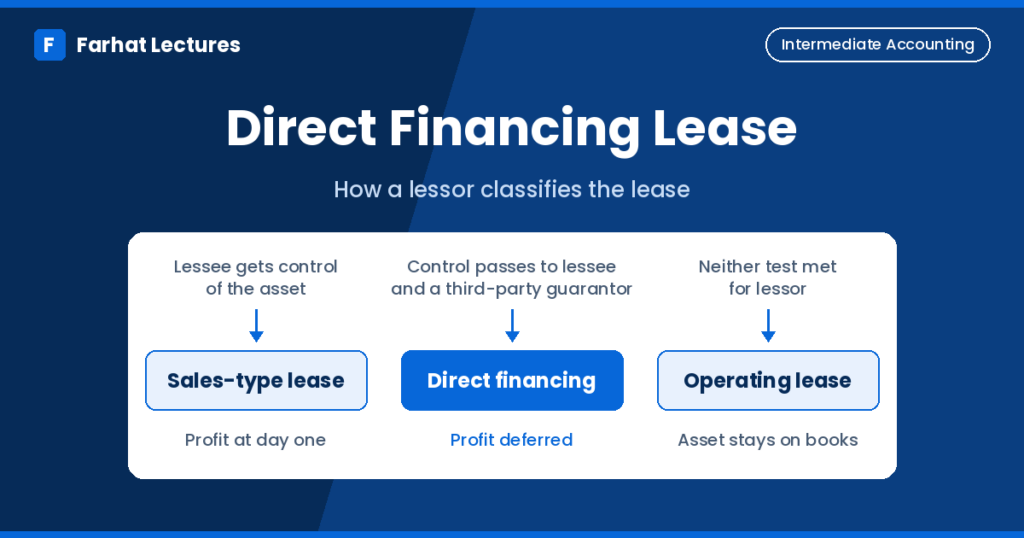
Lessors look at one extra item. When a lessor tests whether a lease that isn’t sales-type is a direct financing lease, it also counts residual value guaranteed by an unrelated third party, such as an insurer (ASC 842-10-25-3). The lessee never counts a third-party guarantee, only its own. See how the two sides differ in lessor vs lessee.
Purchase and termination options
Include the price of a purchase option only if the lessee is reasonably certain to exercise it, such as a bargain purchase option. Exam tip: if a purchase option is reasonably certain to be exercised, the second classification test is already met, so the lease is a finance lease before you even run the present value numbers. For a termination option, first determine the lease term. If that term assumes the lessee exercises the option, include the penalty and the rent payable through the termination date.
Implicit rate vs incremental borrowing rate
Under ASC 842, the lessee discounts at the rate implicit in the lease if that rate is readily determinable. The implicit rate is the rate that makes the present value of the lease payments and the lessor’s expected residual value equal to the asset’s fair value plus any deferred initial direct costs of the lessor.
If the implicit rate is not readily determinable, the lessee uses its incremental borrowing rate (IBR). This is the rate it would pay to borrow, on a collateralized basis over a similar term, an amount equal to the lease payments. In practice, most lessees use the IBR because they do not know the lessor’s residual value estimate or its initial direct costs.
Private companies get one more option. A lessee that isn’t a public business entity can elect to use a risk-free rate, by class of underlying asset, instead of its IBR (ASC 842-20-30-3). If the implicit rate is readily determinable, the lessee still uses that. Watch the effect: a risk-free rate is lower than a borrowing rate, so it raises the present value and makes the 90% test easier to meet.
The payment timing matters too. Many leases require payment at the start of each period, which is an annuity due. Review the factor in our lesson on the present value of an annuity due.
Worked example: the present value test for leases
Hypothetical example. Brightside Printing leases a press with a fair value of $50,000. It pays $12,000 at the start of each of 4 years and guarantees a $5,000 residual value at the end. The implicit rate is unknown, so Brightside uses its 6% incremental borrowing rate.
| Item | Calculation | Present value |
|---|---|---|
| Annual payments (annuity due) | $12,000 × 3.67301 | $44,076 |
| Guaranteed residual value | $5,000 × 0.79209 | $3,960 |
| Total present value | $48,036 | |
| Percentage of fair value | $48,036 ÷ $50,000 | 96.1% |
Because 96.1% is at least 90%, the present value test is met and Brightside has a finance lease. If the $5,000 residual were unguaranteed, the present value would be only $44,076, or 88.2% of fair value. The test would fail, and Brightside would need to check the other four tests.
Practice the 90% present value test
For this exercise, “substantially all” means 90% or more of the equipment’s fair value at commencement. Use the present values of the scheduled payments and the lessee’s residual value guarantee to calculate the percentage and classify the lease.
Common mistakes with the present value test for leases
- Including the unguaranteed residual. The lessee leaves it out of the test.
- Using only the probable payment on a guarantee for classification. The test uses the full guaranteed amount. The smaller amount the lessee will probably owe goes only into the lease liability.
- Forecasting CPI increases. Use the index at commencement and expense later changes when they occur.
- Using the implicit rate when it is not readily determinable. If the lessee does not know the lessor’s inputs, use the IBR.
- Using ordinary annuity factors for payments made in advance. Payments at the start of each period need annuity-due factors.
- Treating fixed step-ups as variable. Rent that rises by a set amount each year is a fixed payment, so include every step.
Practice questions
Question 1
A 5-year lease requires $3,000 per month. The lessee can terminate after 3 years by paying $15,000 and is reasonably certain it will. What are the lease payments for the present value test (before discounting)?
Show answer
The lease term is 3 years because termination is reasonably certain. Lease payments are 36 × $3,000 = $108,000 plus the $15,000 penalty, for $123,000 in total before discounting.
Question 2
Rent starts at $10,000 per year and increases by $500 each year for a 3-year lease. Which amounts are included?
Show answer
All three: $10,000, $10,500, and $11,000, for $31,500 before discounting. The increases are written into the contract, so these are fixed payments with scheduled step-ups. Nothing here is variable.
Question 3
A public business entity is leasing equipment. It cannot readily determine the implicit rate because it lacks the lessor’s residual value estimate and initial direct costs. Which discount rate should it use for the present value test?
Show answer
Its incremental borrowing rate. Without those lessor inputs, the implicit rate is not readily determinable.
Frequently asked questions
What is the 90% test for leases?
Under the 90% guideline, divide the present value of the included lease cash flows by the asset’s fair value at commencement. Count the full residual value guaranteed by the lessee once. A ratio of 90% or more meets the test and results in finance lease classification for the lessee.
Is 90% a bright line under ASC 842?
No. ASC 842-10-55-2 calls 90% one reasonable approach to judging “substantially all.” Many companies adopt it as an accounting policy and apply it consistently, and exam questions typically use 90%.
Is an unguaranteed residual value included in the present value test?
No. The lessee has no obligation for an unguaranteed residual value beyond returning the asset, so it is left out of the lessee’s present value test.
Which discount rate does a lessee use?
Use the rate implicit in the lease if it is readily determinable. Otherwise, use the lessee’s incremental borrowing rate unless an eligible lessee has elected the risk-free rate for that class of underlying asset. A lessee that is not a public business entity may make that election and use a risk-free rate for a period comparable to the lease term.
Can a private company use a risk-free rate for the present value test?
Yes. A lessee that isn’t a public business entity can elect a risk-free rate, by class of underlying asset, when the implicit rate isn’t readily determinable. Because a risk-free rate is lower, the present value is higher.
Does the lessee include a residual value guaranteed by a third party?
No. The lessee includes only the residual value it guarantees itself. Lessors count unrelated third-party guarantees when testing for a direct financing lease.
Are variable lease payments included in lease payments?
Only some. In-substance fixed payments and payments that depend on an index or rate are included, the latter measured at the commencement-date index or rate. Payments based on sales or usage are excluded.
Sources
- FASB Accounting Standards Codification, Topic 842: Leases (ASC 842-10-25-2, 842-10-25-3, 842-10-30-5, 842-10-55-2, and 842-20-30-3)
- Deloitte DART, Leasing Roadmap 6.2: Fixed payments (including in-substance fixed payments)
- Deloitte DART, Leasing Roadmap 6.3: Variable payments that depend on an index or rate
- Deloitte DART, Leasing Roadmap 7.2: Discount rate for lessees
- Deloitte DART, Leasing Roadmap 8.3: Lease classification
About the author
Mansour Farhat, CPA, CIA, DBA, teaches accounting and CPA exam topics through Farhat Lectures and its YouTube lessons. Read more about Professor Farhat.
Continue learning with Farhat Lectures
The present value test connects time value of money to lease classification. Practice it in a full lesson with worked problems before you move on.
Explore the free sample course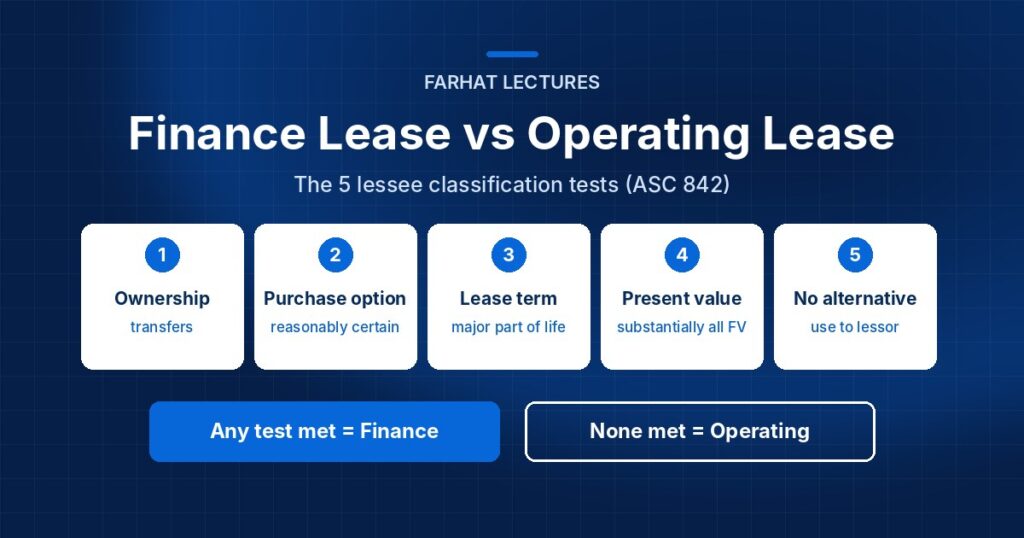
Responses