
Direct Financing Lease: Definition, Classification, and Third-Party Guarantees

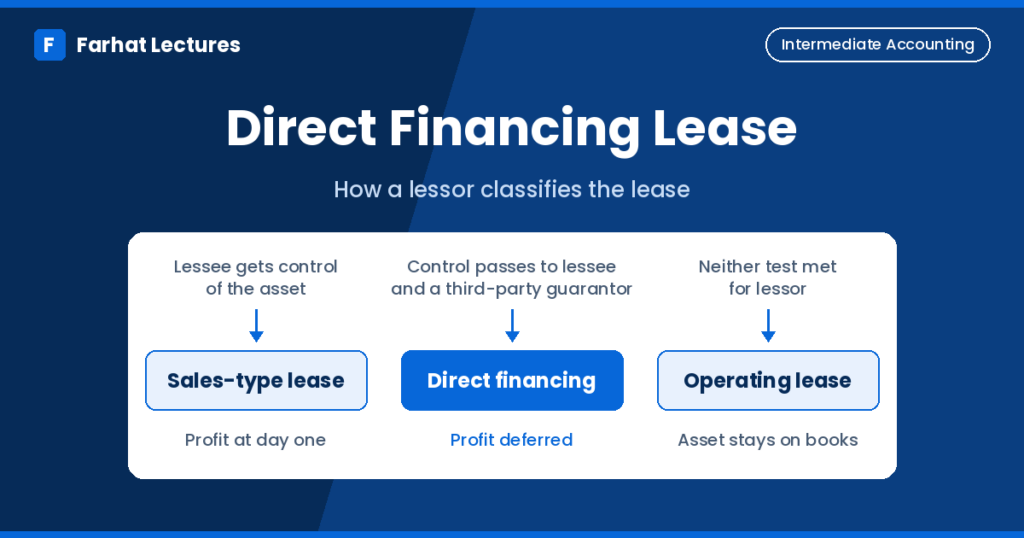
A direct financing lease is a lessor lease classification under ASC 842 (the FASB’s lease standard). It applies when a lease fails all five sales-type tests, but the combined present value of the lease payments and the residual value guaranteed by an unrelated third party equals or exceeds substantially all of the asset’s fair value, and collection is probable. The lessor defers any selling profit.
In practice, the lessor removes the asset from its books and records a lease receivable. The selling profit is earned over the lease term instead of on day one. ASC 842 is the FASB Accounting Standards Codification Topic 842, Leases.
Why it matters: the classification decides when the lessor reports profit. Two leases with identical cash flows can produce different income in year one simply because a different party guarantees the residual value. Exam questions love this twist, so you need to know exactly which guarantee counts in which test.
On the CPA exam: lessor lease classification, including direct financing leases, is tested in BAR (Business Analysis and Reporting). FAR focuses on lessee accounting. If you are in an intermediate accounting class, you will see this topic in the leases chapter next to sales-type and operating leases. Browse our BAR CPA exam courses for more lessor practice.
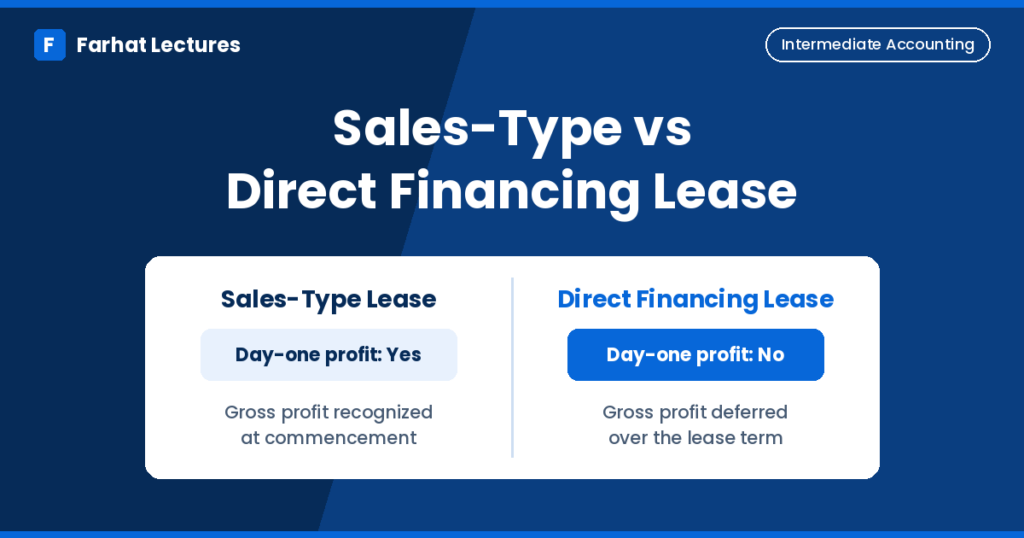
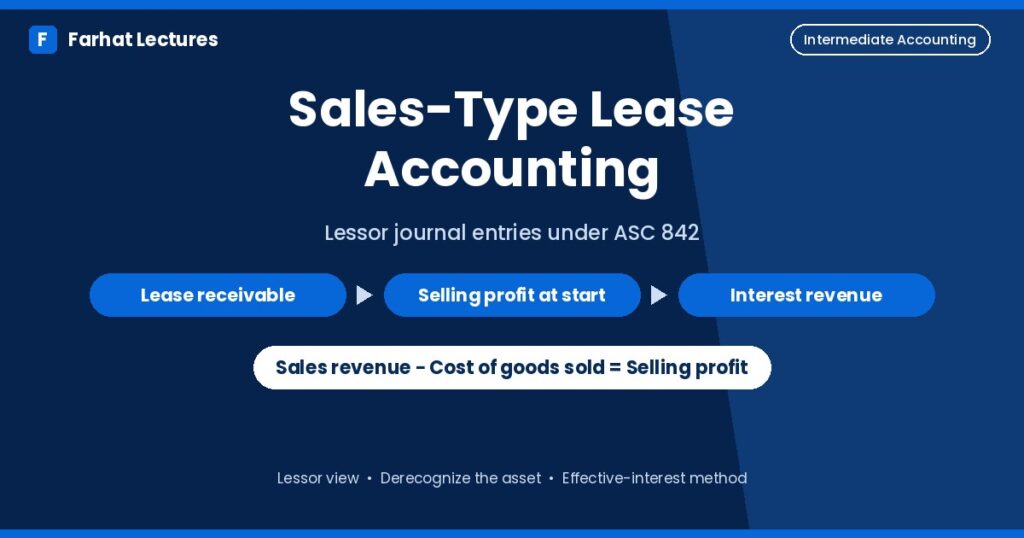
This lesson covers the definition and the classification decision. To see the accounting side by side, read sales-type vs direct financing lease. For the full schedule and entries, read direct financing lease journal entries. All company names and numbers below are hypothetical.
Watch: Direct Financing Lease: Classification & Journal Entries
Professor Farhat walks through how a third-party residual value guarantee turns a lease into a direct financing lease and why the lessor defers its profit.
What is a direct financing lease?
When a lease ends, the asset goes back to the lessor worth whatever it is worth at that point. That leftover value is the residual value, and it is a risk for the lessor. A residual value guarantee removes the risk: someone promises the lessor a minimum value and pays any shortfall (see guaranteed residual value for how lessees treat their own guarantees). Who makes that promise is the heart of this topic.
| Term | Plain-English meaning |
|---|---|
| Residual value | The asset’s expected value when the lease ends. |
| Residual value guarantee | A promise that the returned asset will be worth at least a set amount. |
| Third-party guarantor | A party unrelated to the lessor, such as a residual value insurer, that makes the guarantee. |
| Deferred gross profit | The selling profit the lessor postpones in a direct financing lease. ASC 842 calls it deferred selling profit. |
| Net lease receivable | The lease receivable minus deferred gross profit. ASC 842 calls it the net investment in the lease. |
| Carrying amount | The amount the asset is recorded at on the lessor’s books before the lease starts. |
| Implicit rate | The interest rate built into the lease. It makes the present value of the payments and the expected residual value equal the asset’s fair value. |
| Probable | Likely to occur. ASC 842 uses this word for the collection test. |
The three lessor lease classifications
Under ASC 842 a lessor sorts every lease into one of three groups. The direct financing lease sits between the other two.
| Classification | When it applies | Selling profit at commencement | Asset on the lessor’s books? |
|---|---|---|---|
| Sales-type lease | The lease meets at least one of the five transfer tests, so the lessee obtains control. | Recognized at commencement if collection is probable. If collection is not probable, the lessor defers recognition. | If collection is probable, the lessor removes the asset and records its net investment. If collection is not probable, the lessor keeps the asset and initially records payments received as a deposit liability. |
| Direct financing lease | No transfer test is met, but lease payments plus a third-party residual guarantee cover substantially all of fair value, and collection is probable. | Deferred and earned over the lease term | No, replaced by a lease receivable |
| Operating lease | Neither the sales-type nor the direct financing criteria are met. | None | Yes, the lessor keeps and depreciates it |
How to classify a direct financing lease
Work through the tests in this order. Stop as soon as you reach a classification.
Step 1: Run the five sales-type tests
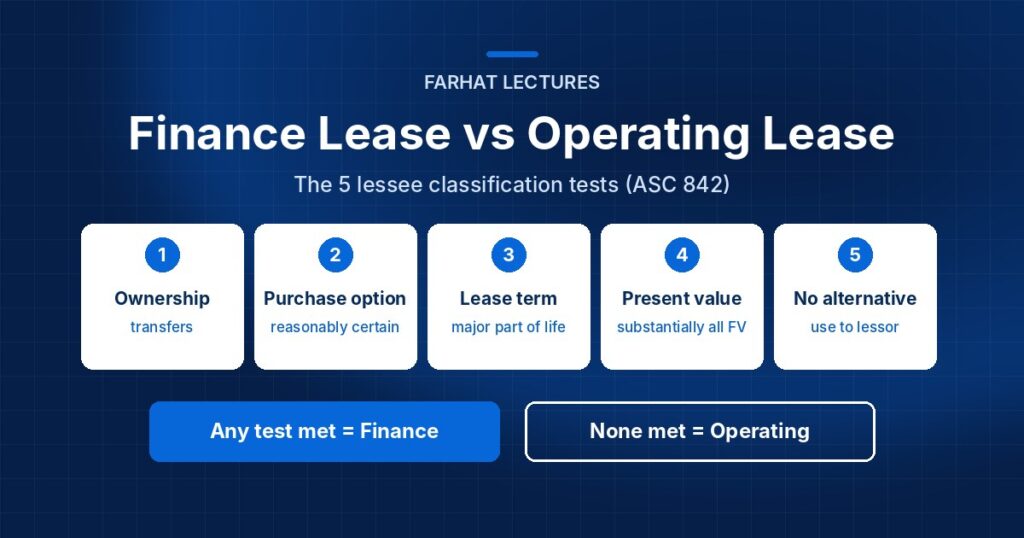
A lease is a sales-type lease if it meets any of these:
- Transfer of ownership: title passes to the lessee by the end of the lease.
- Purchase option: the lessee has an option to buy that it is reasonably certain to exercise.
- Lease term: the term is for the major part of the asset’s remaining economic life. A common benchmark is 75% or more.
- Present value: the present value test asks whether the present value of the lease payments, plus any residual value guaranteed by the lessee, equals or exceeds substantially all of fair value (a common benchmark is 90% or more).
- Specialized asset: the asset is so specialized that it has no alternative use to the lessor afterward.
Notice the present value test counts only a guarantee made by the lessee. A guarantee from a third party is ignored here.
Step 2: If no test is met, check the direct financing criteria
The lease is a direct financing lease only if both of these are true:
- The present value of the lease payments plus any residual value guaranteed by the lessee or an unrelated third party equals or exceeds substantially all of the asset’s fair value.
- It is probable that the lessor will collect the lease payments plus any amount needed to satisfy the residual value guarantee.
Step 3: Otherwise, it is an operating lease
If the lease fails Step 1 and Step 2, the lessor keeps the asset on its balance sheet and records lease income as it is earned, as explained in lessor accounting for operating leases.
One exception to watch: under ASU 2021-05, if a lease has variable payments that do not depend on an index or rate, and classifying it as sales-type or direct financing would create a selling loss on day one, the lessor must classify it as an operating lease instead (ASC 842-10-25-3A).
Why a third-party guarantee changes the answer
In the Northline Equipment example below, the machine has a fair value of $60,000. The lease payments have a present value of $52,371, or 87.3% of fair value. The guaranteed residual has a present value of $7,629. If the lessee guarantees the residual, Northline includes that $7,629 in the sales-type present value test. The total reaches $60,000, or 100% of fair value, so the lease qualifies as sales-type.
If an unrelated insurer provides the same guarantee, the sales-type test counts only the $52,371 of lease payments. The resulting 87.3% falls below the 90% benchmark used in this example. With the other four sales-type tests unmet, Northline applies the direct financing test. That test includes the insurer’s guarantee, bringing the total to 100% of fair value. Because collection is probable, Northline classifies the lease as direct financing and earns the deferred selling profit over the lease term.
Example: one lease, four outcomes
Hypothetical example. Northline Equipment leases an industrial floor scrubber to Brightway Logistics on January 1, Year 1.
- Fair value $60,000; Northline’s carrying amount $58,000
- Four-year lease; six-year economic life; no ownership transfer, no purchase option, not specialized
- Four annual payments of $15,461.40 at each year-end; Northline’s implicit rate is 7%
- Expected residual value at the end of the lease: $10,000
Present value of the payments: $15,461.40 × 3.38721 = $52,371 (rounded). Present value of a $10,000 residual: $10,000 × 0.76290 = $7,629. The lease term covers 4 ÷ 6 = 66.7% of the asset’s life, which is below 75%, so the lease term test fails in every scenario.
| Scenario | Who guarantees the $10,000 residual? | Sales-type present value test | Direct financing test | Classification |
|---|---|---|---|---|
| A | No one | $52,371 ÷ $60,000 = 87.3%: not met | 87.3%: not met | Operating lease |
| B | Brightway (the lessee) | ($52,371 + $7,629) ÷ $60,000 = 100%: met | Not needed | Sales-type lease |
| C | An unrelated residual value insurer; collection probable | 87.3%: not met | ($52,371 + $7,629) ÷ $60,000 = 100%: met | Direct financing lease |
| D | The same insurer, but collection is not probable | 87.3%: not met | Collection criterion fails | Operating lease |
Scenarios B and C have identical cash flows. The only difference is who signs the guarantee, and that alone moves Northline’s $2,000 profit ($60,000 − $58,000) from day one in Scenario B to spread across four years in Scenario C.
What the lessor records at commencement
In Scenario C, Northline removes the scrubber at its carrying amount, records a receivable for the full fair value, and parks the profit in a contra account.
| Account | Debit | Credit |
|---|---|---|
| Lease Receivable | 60,000 | |
| Deferred Gross Profit | 2,000 | |
| Equipment (or Inventory) | 58,000 |
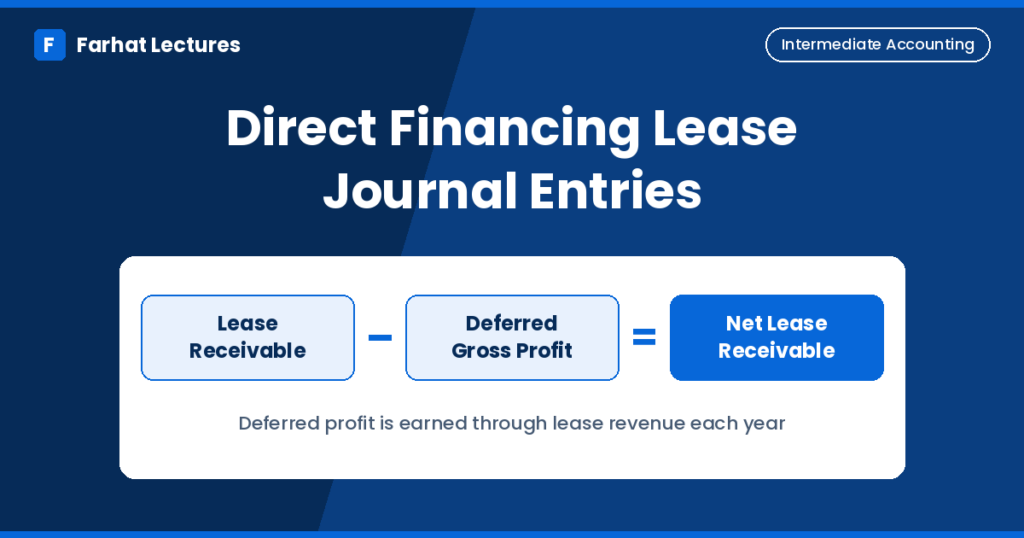
The net lease receivable is $60,000 − $2,000 = $58,000, which equals the asset’s carrying amount, so no profit hits income on day one. If the carrying amount had been higher than fair value, Northline would recognize that selling loss immediately instead of deferring it. The direct financing lease journal entries lesson shows every entry after this one.
How the deferred profit gets earned. Northline doesn’t book the $2,000 as a separate line later. Instead, it earns lease income on the $58,000 net lease receivable at a higher rate: about 8.40% instead of the 7% rate built into the lease. That is the rate that discounts the four payments and the $10,000 guaranteed residual back to $58,000.
Under direct financing, Northline earns approximately $4,872 of interest income in Year 1 and defers the selling profit at commencement. Under sales-type accounting, Northline earns $4,200 of Year 1 interest income (7% × $60,000) and recognizes $2,000 of selling profit at commencement. Total Year 1 income is therefore $6,200 under the sales-type lease and approximately $4,872 under the direct financing lease. Over all four years, total income is $13,845.60 under either classification.
Common mistakes
- Using the old ASC 840 rule. Under ASC 840, a lessor lease that met the capital lease criteria and produced no dealer’s profit (fair value equal to carrying amount) was a direct financing lease. Many study sources still teach this. Under ASC 842, the test turns on a third-party residual guarantee and collectibility, not on whether profit exists.
- Counting a third-party guarantee in the sales-type test. Only a guarantee by the lessee belongs in the sales-type present value test. The third-party guarantee enters at Step 2.
- Deferring a loss. Only selling profit is deferred. A selling loss is recognized at commencement.
- Skipping collectibility. Assess collectibility at the right step. If all five sales-type tests fail and collection is not probable, the lessor classifies the lease as operating even if the direct financing present value test is met. For a sales-type lease, doubtful collection affects recognition: the lessor keeps the asset and initially records cash received as a deposit liability.
- Applying it to the lessee. Direct financing is a lessor classification only. The lessee classifies the same lease as finance or operating using the same five tests, and it ignores any residual value guarantee made by a third party.
Practice questions
Practice question 1
Coastal Rentals leases a machine with a fair value of $80,000 for 5 years. The machine’s economic life is 8 years. There is no ownership transfer, no purchase option, and the machine is not specialized. The present value of the lessee’s payments is $70,000. An unrelated insurer guarantees the residual value, and the present value of that guarantee is $9,000. Collection is probable. How should Coastal classify the lease?
Show answer and explanation
Direct financing lease. The lease term test fails (5 ÷ 8 = 62.5%). The sales-type present value test uses only the lessee’s payments: $70,000 ÷ $80,000 = 87.5%, below 90%. So no sales-type test is met. Adding the third-party guarantee gives ($70,000 + $9,000) ÷ $80,000 = 98.75%, and collection is probable, so both direct financing criteria are met.
Practice question 2
Use the same facts, except the lessee, not an insurer, guarantees the residual value. How does the classification change?
Show answer and explanation
Sales-type lease. A lessee guarantee counts in the sales-type present value test: ($70,000 + $9,000) ÷ $80,000 = 98.75%, which meets the test. Coastal recognizes any selling profit at commencement.
Practice question 3
Return to the original facts with the insurer’s guarantee, but Coastal concludes it is not probable that it will collect the payments and the guaranteed amount. What is the classification?
Show answer and explanation
Operating lease. A direct financing lease requires both the substantially-all test and probable collection. With collection not probable, the second criterion fails, so Coastal keeps the machine on its books.
Direct Financing Lease Accounting: Lease Payments and Selling Profit
Apply ASC 842 lessor accounting in this interactive exercise. Use present value to calculate the annual payment on a direct financing lease with a third-party residual value guarantee, then compare the timing of selling profit with a sales-type lease.
Key takeaways
- A direct financing lease is a lessor classification under ASC 842. Lessees never use it.
- Run the five sales-type tests first. They count only a guarantee made by the lessee.
- If none is met, add any third-party residual guarantee. If the total covers substantially all of fair value and collection is probable, it is a direct financing lease.
- Selling profit is deferred and earned through a higher rate over the lease term. A selling loss is recognized right away.
- After all five sales-type tests fail, classify the lease as operating if the direct financing present value test fails or collection is not probable. For a sales-type lease, collectibility affects when the lessor recognizes the sale. See the side-by-side accounting in sales-type vs direct financing lease.
FAQ
Is a direct financing lease the same as a finance lease?
No. Finance lease is a lessee classification. Lessors use three classifications instead: sales-type, direct financing, and operating. A lease can be a direct financing lease for the lessor and an operating lease for the lessee, because the lessee does not count a residual value guarantee that a third party provides.
Does IFRS have a direct financing lease?
No. Under IFRS 16 a lessor classifies each lease as either a finance lease or an operating lease, with no separate direct financing category. The direct financing lease is a U.S. GAAP (ASC 842) classification.
Who can be the third-party guarantor?
Any party unrelated to the lessor that promises the lessor a minimum value for the asset at the end of the lease, for example a residual value insurer or an equipment dealer that agrees to buy the asset back. A guarantee from the lessee itself counts in the sales-type test instead.
Can a direct financing lease have a loss?
Yes. If the asset’s carrying amount is higher than its fair value, the lessor has a selling loss. Only profit is deferred. A selling loss is recognized immediately at the commencement date. The one exception is a lease with variable payments that do not depend on an index or rate: if direct financing treatment would create a day-one loss, ASU 2021-05 requires operating lease treatment instead.
Which CPA exam section tests direct financing leases?
BAR (Business Analysis and Reporting). Lessor lease classification, including sales-type, direct financing, and operating leases, is tested in BAR. FAR focuses on lessee accounting.
How does the lessor earn the deferred profit in a direct financing lease?
Through a higher interest rate. The lessor measures its net investment after subtracting the deferred profit, then earns lease income at the rate that discounts the remaining payments and residual back to that lower amount. In the Northline example, the rate rises from 7% to about 8.40%.
What if only part of the residual value is guaranteed?
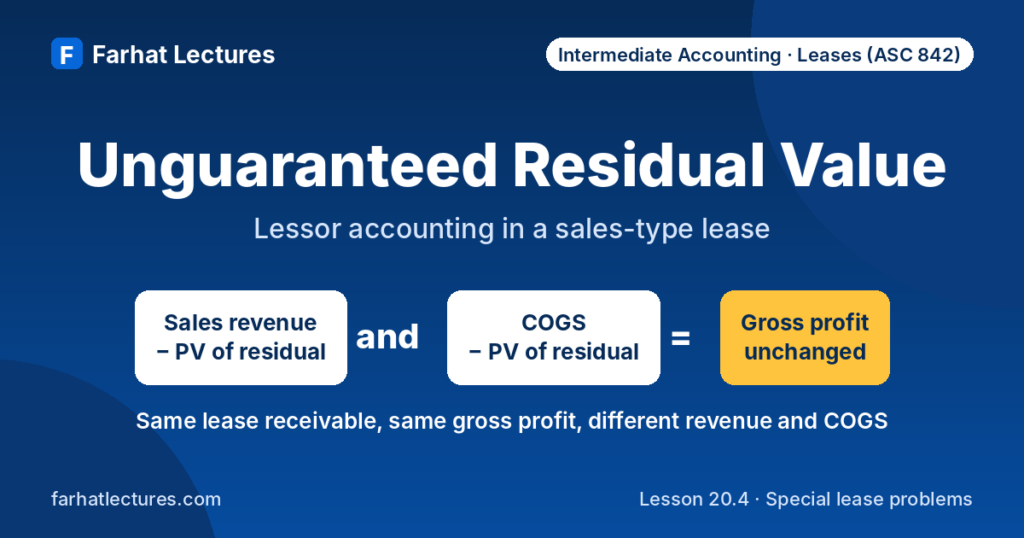
Only the guaranteed portion counts in the classification tests. The unguaranteed part still goes into the lessor’s net investment as an unguaranteed residual asset, but it cannot help the lease pass the substantially-all test.
Sources
The classification criteria and the deferral of selling profit come from FASB ASC 842-10-25-2, 842-10-25-3, and 842-30-25-7 through 25-8. The 75% and 90% figures are common benchmarks described in the implementation guidance, not bright-line rules.
Continue learning with Farhat Lectures
Lease accounting clicks faster when you see it worked live. Start with clear video explanations and guided practice in the free sample course.
Responses