
Direct Financing Lease Journal Entries and Amortization Schedule

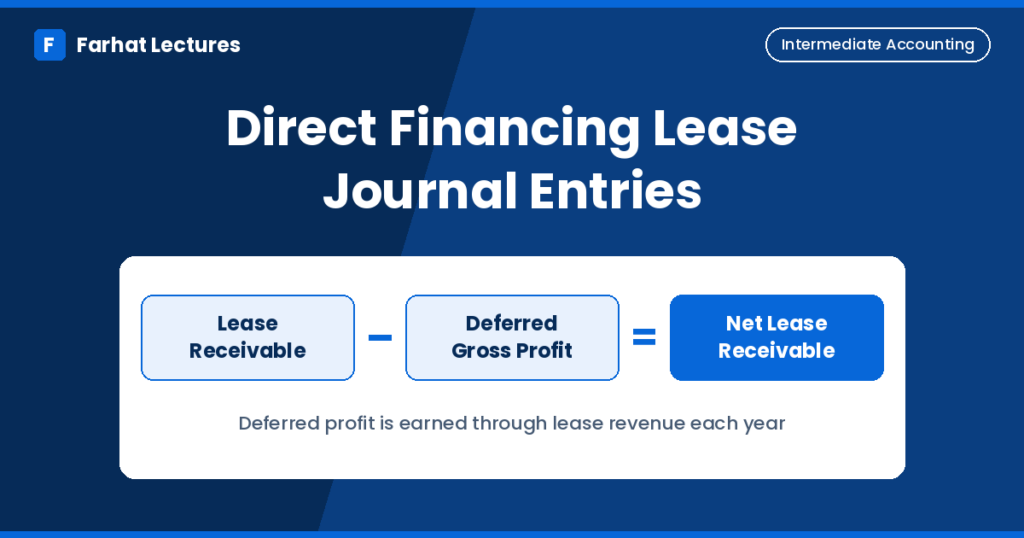
Direct financing lease journal entries defer the lessor’s selling profit. At commencement, debit Lease Receivable, credit the asset at carrying amount, and credit Deferred Gross Profit for the difference. At each payment, debit Cash and Deferred Gross Profit, credit Lease Receivable, and credit Lease Revenue: the net receivable times a rate above the rate implicit in the lease.
In the example below, the residual value is fully guaranteed and there are no initial direct costs, so Lease Receivable equals the asset’s fair value at commencement.
Why it matters: this is where students lose points. The entries look like a sales-type lease, but one extra line, the Deferred Gross Profit debit, changes every year’s income. Getting the rate and that line right is the whole skill.
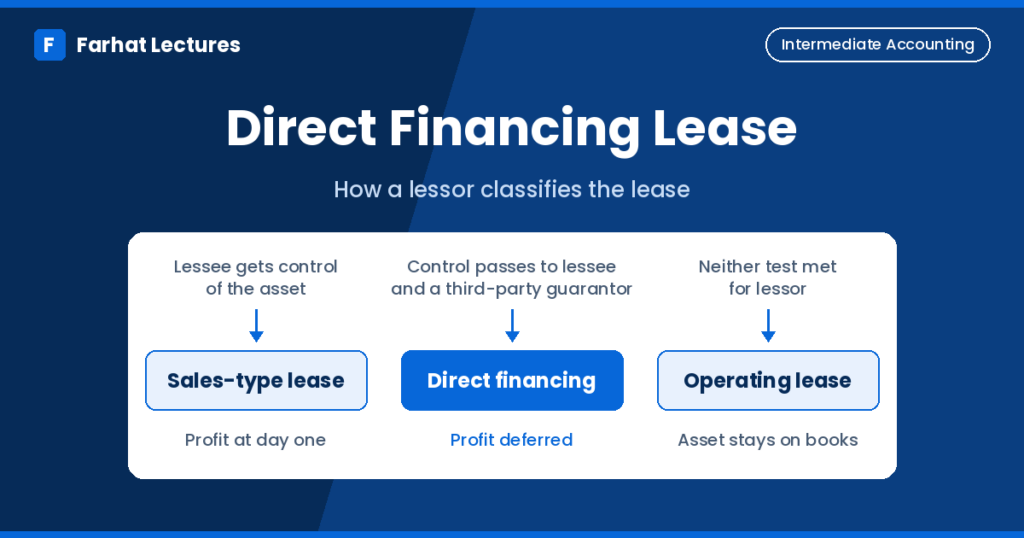
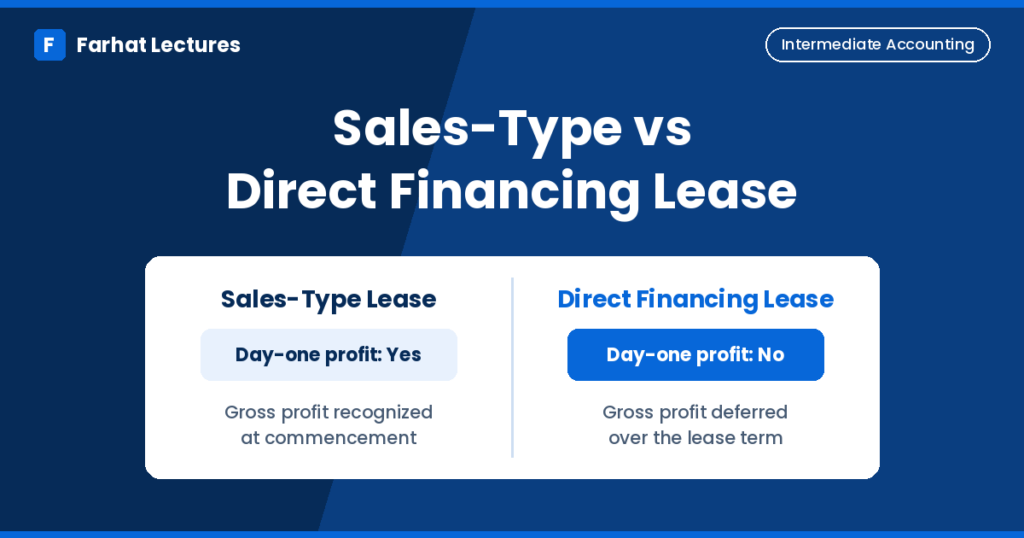
This lesson assumes you already know why a lease is a direct financing lease. If not, review what a direct financing lease is and how it compares in sales-type vs direct financing lease. All amounts are hypothetical.
Watch: Direct financing lease explained (25-minute lecture)
Professor Farhat records the lease receivable and deferred profit, then shows how the deferred profit is earned over the lease term.
Which accounts does a direct financing lease use?
| Account | Type | What it tracks |
|---|---|---|
| Lease Receivable | Asset | The present value of the lease payments plus the guaranteed residual, measured at the rate implicit in the lease. |
| Deferred Gross Profit | Contra asset | Selling profit not yet earned. ASC 842 calls it deferred selling profit. |
| Net lease receivable | Reported amount | Lease Receivable minus Deferred Gross Profit, plus any unguaranteed residual asset. ASC 842 calls it the net investment in the lease. |
| Lease Revenue | Revenue | Interest on the receivable plus the deferred profit earned this period. |
How do you record a direct financing lease? Six steps
Hypothetical example. Northline Equipment leases a floor scrubber to Brightway Logistics on January 1, Year 1. Fair value is $60,000, carrying amount $58,000, lease term four years, payments at each year-end, rate implicit in the lease 7%. An unrelated insurer guarantees a $10,000 residual value, and collection is probable.
| Step | What you do | Northline’s numbers |
|---|---|---|
| 1. Compute the payment | Subtract the present value of the guaranteed residual from fair value, then divide by the annuity factor. | ($60,000 − $10,000 × 0.76290) ÷ 3.38721 = $15,461.40 |
| 2. Record commencement | Debit Lease Receivable at fair value, credit the asset at carrying amount, credit Deferred Gross Profit. | $60,000; $58,000; $2,000 |
| 3. Find the new rate | Solve for the rate that discounts the payments and the guaranteed residual to the net receivable. | Approximately 8.3999%, displayed as 8.4%. |
| 4. Build the schedule | Apply the new rate to the net lease receivable each year. | See the schedule below |
| 5. Record each payment | Split lease revenue into interest at 7% and deferred profit earned. | See the entries below |
| 6. Record the return | Take the asset back at the guaranteed amount and close the receivable. | $10,000 |
For Step 3, enter N = 4, PV = −58,000, PMT = 15,461.40, FV = 10,000 on a financial calculator and compute I/Y. In Excel, =RATE(4,15461.40,-58000,10000) returns the same 8.4%.
The amortization schedule
Lease revenue each year is 8.4% of the opening net lease receivable. The rest of the payment reduces the balance until only the $10,000 guaranteed residual remains.
| Date | Payment | Lease revenue (8.4%) | Reduction of net receivable | Net lease receivable |
|---|---|---|---|---|
| Jan 1, Year 1 | $58,000.00 | |||
| Dec 31, Year 1 | $15,461.40 | $4,872.00 | $10,589.40 | 47,410.60 |
| Dec 31, Year 2 | 15,461.40 | 3,982.49 | 11,478.91 | 35,931.69 |
| Dec 31, Year 3 | 15,461.40 | 3,018.26 | 12,443.14 | 23,488.55 |
| Dec 31, Year 4 | 15,461.40 | 1,972.85* | 13,488.55 | 10,000.00 |
| Total | $61,845.60 | $13,845.60 | $48,000.00 |
*Year 4 lease revenue is rounded by $0.19 so the balance lands exactly on the $10,000 guaranteed residual.
Splitting lease revenue into interest and deferred profit
To write the entries, you need to know how much of each year’s lease revenue is ordinary interest and how much is deferred profit being earned. Interest is 7% of the gross Lease Receivable, which is the same schedule a sales-type lease would use. The difference is the Deferred Gross Profit to release.
| Year | Interest at 7% on Lease Receivable | Lease revenue at 8.4% | Deferred profit earned | Deferred Gross Profit balance | Lease Receivable balance |
|---|---|---|---|---|---|
| Start | $2,000.00 | $60,000.00 | |||
| 1 | $4,200.00 | $4,872.00 | $672.00 | 1,328.00 | 48,738.60 |
| 2 | 3,411.70 | 3,982.49 | 570.79 | 757.21 | 36,688.90 |
| 3 | 2,568.22 | 3,018.26 | 450.04 | 307.17 | 23,795.72 |
| 4 | 1,665.68* | 1,972.85 | 307.17 | 0.00 | 10,000.00 |
| Total | $11,845.60 | $13,845.60 | $2,000.00 |
*Year 4 interest is rounded by $0.02 (7% of $23,795.72 is $1,665.70) so Lease Receivable lands exactly on the $10,000 guaranteed residual.
Check the link between the two schedules: Lease Receivable minus Deferred Gross Profit equals the net lease receivable every year. At the end of Year 1, $48,738.60 − $1,328.00 = $47,410.60.
Direct financing lease journal entries for every year
January 1, Year 1: commencement
| Account | Debit | Credit |
|---|---|---|
| Lease Receivable | 60,000.00 | |
| Deferred Gross Profit | 2,000.00 | |
| Equipment (or Inventory) | 58,000.00 |
December 31, Year 1
| Account | Debit | Credit |
|---|---|---|
| Cash | 15,461.40 | |
| Deferred Gross Profit | 672.00 | |
| Lease Revenue | 4,872.00 | |
| Lease Receivable | 11,261.40 |
December 31, Year 2
| Account | Debit | Credit |
|---|---|---|
| Cash | 15,461.40 | |
| Deferred Gross Profit | 570.79 | |
| Lease Revenue | 3,982.49 | |
| Lease Receivable | 12,049.70 |
December 31, Year 3
| Account | Debit | Credit |
|---|---|---|
| Cash | 15,461.40 | |
| Deferred Gross Profit | 450.04 | |
| Lease Revenue | 3,018.26 | |
| Lease Receivable | 12,893.18 |
December 31, Year 4
| Account | Debit | Credit |
|---|---|---|
| Cash | 15,461.40 | |
| Deferred Gross Profit | 307.17 | |
| Lease Revenue | 1,972.85 | |
| Lease Receivable | 13,795.72 |
The credit to Lease Receivable is always the payment minus 7% interest. The debit to Deferred Gross Profit is lease revenue minus 7% interest.
Balance sheet at the end of Year 1
| Lease assets | Amount |
|---|---|
| Lease receivable | $48,738.60 |
| Less: Deferred gross profit | (1,328.00) |
| Net lease receivable | $47,410.60 |
What entry does the lessor make when the asset is returned?
After the Year 4 payment, Lease Receivable equals the $10,000 guaranteed residual and Deferred Gross Profit is zero. If the scrubber is worth at least $10,000 when returned:
| Account | Debit | Credit |
|---|---|---|
| Equipment (or Inventory) | 10,000.00 | |
| Lease Receivable | 10,000.00 |
If it is worth only $7,500, the insurer pays the $2,500 shortfall:
| Account | Debit | Credit |
|---|---|---|
| Equipment (or Inventory) | 7,500.00 | |
| Cash (from the guarantor) | 2,500.00 | |
| Lease Receivable | 10,000.00 |
If it is worth more than $10,000, the lessor still records it at $10,000. Under ASC 842-30-35-5, the lessor moves the net investment in the lease into the right asset account at its carrying amount, so any gain waits until the asset is sold.
Curious how the lessee sees the same guarantee? Read guaranteed residual value in a finance lease: lessee vs. lessor.
Common mistakes in direct financing lease journal entries
- Applying the 7% rate to the net receivable. That leaves deferred profit stranded on the books. Use the higher rate on the net balance.
- Crediting only $4,200 of income in Year 1. The lessor earns $4,872 on its $58,000 opening net investment at 8.4%. Crediting only the interest on the gross receivable omits the $672 of deferred selling profit recognized this year.
- Reducing Lease Receivable by the net reduction. Lease Receivable falls by payment minus 7% interest ($11,261.40 in Year 1), not by the $10,589.40 net reduction. Deferred Gross Profit covers the gap.
- Forgetting the final-year rounding. Force the last year so the balance ends exactly at the guaranteed residual.
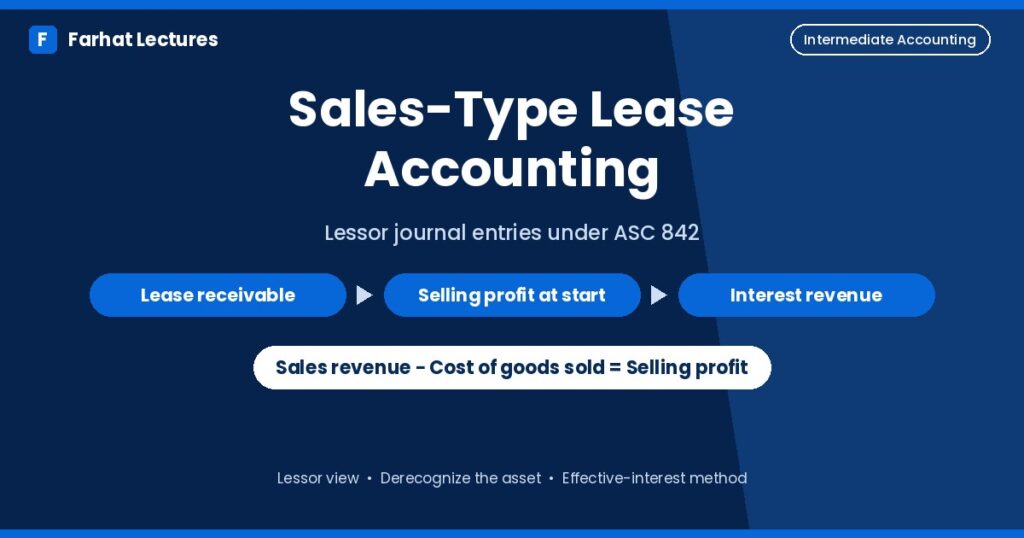
- Recording Sales Revenue and Cost of Goods Sold. Those belong to a sales-type lease, not a direct financing lease.
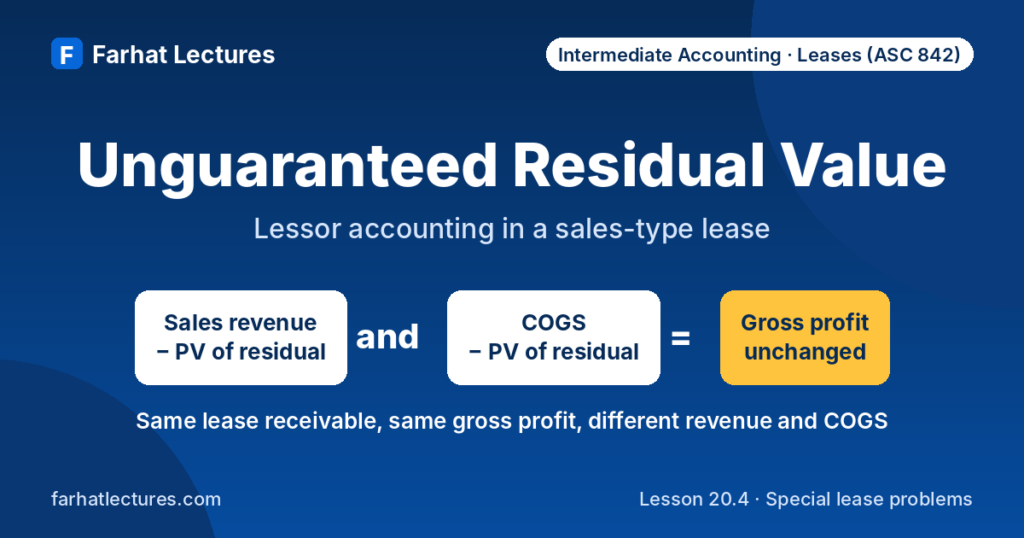
Want to see those sales-type entries worked out? Read sales-type lease accounting: lessor journal entries and example. If part of the residual is not guaranteed, see unguaranteed residual value in a sales-type lease.
Key takeaways
- At commencement, the lessor debits Lease Receivable, credits the asset at its carrying amount, and puts the difference in Deferred Gross Profit. Northline defers the $2,000 selling profit at commencement.
- Lease revenue each year equals the net lease receivable times a rate higher than the rate implicit in the lease (8.4% instead of 7% in this example).
- Each payment credits Lease Receivable for the payment minus interest at the implicit rate, and debits Deferred Gross Profit for lease revenue minus that interest.
- By the end of the lease, Deferred Gross Profit is zero and Lease Receivable equals the guaranteed residual.
- When the asset comes back, the lessor moves the remaining balance into an asset account and collects any shortfall from the guarantor.
Practice questions
Use these facts for all three questions. A lessor leases equipment with a fair value of $40,000 and a carrying amount of $38,000 for three years. The lessee pays $13,393.85 at each year-end, the rate implicit in the lease is 6%, and an unrelated insurer guarantees a $5,000 residual. The lease is a direct financing lease, and the rate on the net lease receivable is 8.67%.
Practice question 1
Prepare the journal entry for the first payment.
Show answer and explanation
Interest at 6% on $40,000 = $2,400.00. Lease revenue at 8.67% on $38,000 = $3,294.60. Deferred profit earned = $3,294.60 − $2,400.00 = $894.60. Lease Receivable falls by $13,393.85 − $2,400.00 = $10,993.85.
| Account | Debit | Credit |
|---|---|---|
| Cash | 13,393.85 | |
| Deferred Gross Profit | 894.60 | |
| Lease Revenue | 3,294.60 | |
| Lease Receivable | 10,993.85 |
Practice question 2
What does the lessor report for this lease at the end of Year 1?
Show answer and explanation
Lease receivable $40,000.00 − $10,993.85 = $29,006.15. Deferred gross profit $2,000.00 − $894.60 = $1,105.40. Net lease receivable = $27,900.75, which also equals $38,000 − ($13,393.85 − $3,294.60).
Practice question 3
At the end of the lease, the equipment is returned with a fair value of $3,800. Prepare the entry.
Show answer and explanation
The insurer guaranteed $5,000, so it pays the $1,200 shortfall.
| Account | Debit | Credit |
|---|---|---|
| Equipment | 3,800.00 | |
| Cash (from the guarantor) | 1,200.00 | |
| Lease Receivable | 5,000.00 |
Sales-Type vs. Direct Financing Leases: Lessor Accounting Exercise
Apply ASC 842 lessor accounting in four questions. Compare selling profit at lease commencement and see how deferred gross profit affects the initial net lease receivable and the yield recognized over the lease term.
FAQ
How much interest income does the lessor credit to Lease Revenue in Year 1?
ASC 842-30-35-1 describes the full return on the net investment as interest income. In Year 1, Northline earns $4,872 on its $58,000 opening net investment at 8.4%. The journal entry credits that amount to Lease Revenue. It includes $4,200 of interest on the gross receivable and $672 of previously deferred selling profit.
How do I find the direct financing lease rate?
Solve for the rate that makes the present value of the lease payments plus the guaranteed residual equal the net lease receivable. Use a financial calculator (N, PV as a negative, PMT, FV, then compute I/Y) or the Excel RATE function. Trial and error also works.
Where does Deferred Gross Profit appear on the balance sheet?
It is a contra account. The lessor shows it as a deduction from Lease Receivable, either on the face of the balance sheet or in the notes, so the reported amount is the net lease receivable.
What if the returned asset is worth more than the guaranteed amount?
The lessor records the returned asset at the carrying amount of the net investment in the lease, which here is the $10,000 guaranteed residual. ASC 842-30-35-5 requires this, so no gain is recorded until the asset is sold.
What happens to initial direct costs in a direct financing lease?
They are deferred, included in the net investment in the lease, and recognized over the lease term rather than expensed at commencement.
Why is the direct financing lease rate higher than the rate implicit in the lease?
The cash flows are the same, but the starting balance is smaller because the deferred profit is subtracted: $58,000 instead of $60,000 in this example. A smaller present value for the same payments means a higher rate, 8.4% instead of 7%. That higher rate is what moves the $2,000 deferred profit into income over the lease term.
Is a direct financing lease the same as a finance lease?
No. A finance lease is a lessee classification. A direct financing lease is a lessor classification under ASC 842. The lessee and the lessor each classify the same contract on their own, so they can reach different answers.
Sources
ASC 842-30-25-8 requires the lessor to defer selling profit and initial direct costs in the net investment in the lease, and ASC 842-30-35-1 requires interest income that produces a constant periodic rate on the remaining net investment, which is why the rate on the net receivable is higher.
- FASB Accounting Standards Update 2016-02, Leases (Topic 842)
- PwC Viewpoint: Leases Guide, 4.3.2 Direct financing lease
- Deloitte Roadmap: Leasing, Section 9.3 Recognition and Measurement
- KPMG: ASC 842 for Lessors
About the author
Mansour Farhat, CPA, CIA, DBA, teaches accounting and CPA exam topics through Farhat Lectures and the Farhat Lectures YouTube channel. Read more about Professor Farhat.
Continue learning with Farhat Lectures
Lease accounting clicks faster when you see it worked live. Start with clear video explanations and guided practice in the free sample course.
Responses