
Revenue Recognition Issues: 7 Special Situations Under ASC 606

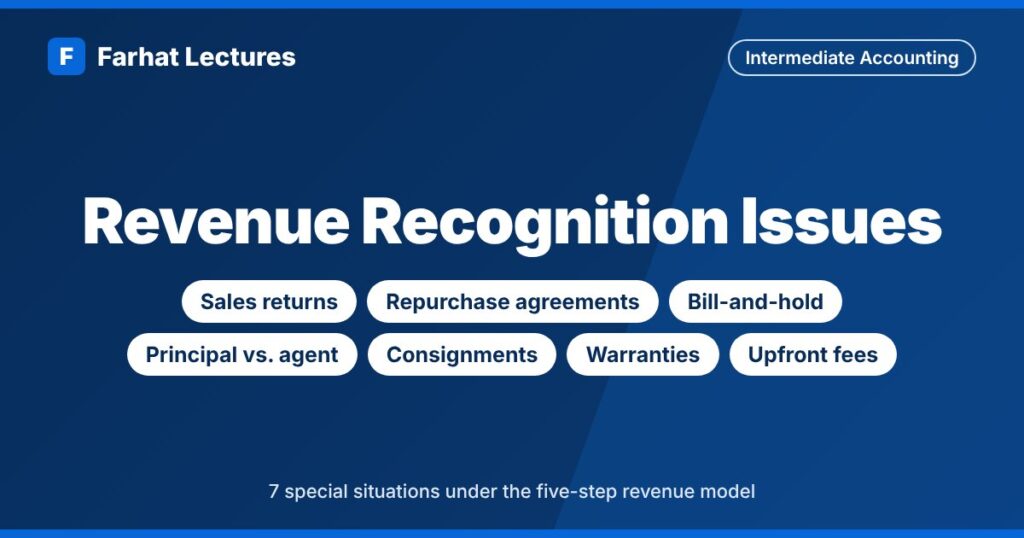
Revenue recognition issues are seven situations where ASC 606’s five-step model needs extra judgment: sales returns, repurchase agreements, bill-and-hold, principal versus agent, consignments, warranties, and nonrefundable upfront fees. Each one turns on the same two questions: how much consideration the seller expects to keep (Step 3) and when control transfers to the customer (Step 5).
Why does this matter? These situations are where revenue is most often recorded too early or at the wrong amount. A company that books a sale it must buy back, or reports a travel booking at the full fare instead of its commission, overstates revenue even though the cash looks the same. Intermediate accounting exams and the FAR section of the CPA exam test these cases because they show whether you understand control, not just the journal entries.
This guide supports lesson 17.3 (Accounting for Revenue Recognition Issues) in most intermediate accounting textbooks. It gives you the big picture of all seven issues and points you to a detailed lesson on each. For a review of the five steps, including how to identify performance obligations and determine the transaction price, start with revenue recognition under ASC 606 and IFRS 15. It also helps to be comfortable with determining the transaction price (Step 3) and identifying performance obligations (Step 2) before you work through the seven situations below.
Watch: Refund Liabilities and the Right of Return
Watch this Farhat lesson on YouTube
Sales returns are the most common of the seven issues, so start here. In this 11-minute lesson, Professor Farhat records revenue net of expected returns, the refund liability, and the asset for goods expected to come back.
The 7 revenue recognition issues at a glance
| Issue | Key question | Typical treatment |
|---|---|---|
| Sales returns and allowances | How much of the sale will the seller keep? | Revenue net of expected returns; a refund liability and an asset for goods expected back |
| Repurchase agreements | Did control really pass if the seller must or may buy the asset back? | Usually a financing (or a lease), not a sale |
| Bill-and-hold | Has the customer obtained control of goods the seller still holds? | Revenue at billing only if four extra criteria are met |
| Principal-agent | Does the company control the good or service, or only arrange it? | Principal reports gross revenue; agent reports its commission |
| Consignments | Has the dealer bought the goods, or is it selling them for the owner? | Consignor keeps the inventory and recognizes revenue when the goods are sold |
| Warranties | Is the warranty a quality promise or an extra service? | Assurance-type: expense and liability. Service-type: separate performance obligation |
| Nonrefundable upfront fees | Does the fee transfer a good or service now? | Usually deferred and recognized over the periods benefited |
Where each rule lives in the Codification
If you want to read the source, or cite it in a memo, here is where the FASB puts each one. All references are inside ASC 606-10.
| Issue | ASC 606-10 paragraphs |
|---|---|
| Sales returns and allowances | 55-22 to 55-29, plus 32-10 on the refund liability |
| Warranties | 55-30 to 55-35 |
| Principal versus agent | 55-36 to 55-40 |
| Nonrefundable upfront fees | 55-50 to 55-51 |
| Repurchase agreements | 55-66 to 55-78 |
| Consignments | 55-79 to 55-80 |
| Bill-and-hold arrangements | 55-81 to 55-84 |
| Definition of control | 25-25 |
1. Sales returns and allowances
When customers can return goods, the seller recognizes revenue only for the amount it expects to keep. It records a refund liability for expected refunds and an asset (with a reduction of cost of goods sold) for the inventory it expects to get back.
Example (hypothetical). Pinecrest Supply sells 50 desk lamps at $80 each (cost $30) and expects 4 to be returned. Net sales are (50 − 4) × $80 = $3,680, the refund liability is 4 × $80 = $320, and the estimated inventory returns asset is 4 × $30 = $120. Many textbooks record the gross sale first and adjust for expected returns at period end, which gives the same reported amounts.
Here are the two entries at the date of sale, using the Pinecrest numbers above:
| Account | Debit | Credit |
|---|---|---|
| Accounts Receivable | 4,000 | |
| Sales Revenue | 3,680 | |
| Refund Liability | 320 | |
| Cost of Goods Sold | 1,380 | |
| Estimated Inventory Returns | 120 | |
| Inventory | 1,500 |
Check the cross-foot: 3,680 plus 320 equals the 4,000 billed, and 1,380 plus 120 equals the 1,500 of inventory that left the warehouse. At each reporting date, update the refund liability and the asset for the right to recover products using the latest return estimates. Changes in the refund liability adjust revenue, and changes in the recovery asset adjust cost of goods sold. Transfer goods actually recovered back to inventory. Once the return window closes, release any refund liability for returns that can no longer be claimed and write off any remaining recovery asset for goods that will no longer be recovered.
The full set of entries is in refund liability journal entries, and PwC’s guide on rights of return explains the rule.
2. Repurchase agreements
In a repurchase agreement, the seller transfers an asset but keeps a repurchase feature. That feature is either an obligation to buy the asset back, called a forward, or a right to buy it back, called a call option. Either way the customer cannot freely use or sell the asset, so control has not passed (ASC 606-10-55-68).
Which treatment you use depends on the repurchase price:
- Repurchase price at or above the original selling price: this is a financing arrangement (ASC 606-10-55-70). The seller keeps the asset on its books, records a liability for the cash received, and recognizes interest for the difference.
- Repurchase price below the original selling price: this is a lease under ASC 842, as long as the contract is not part of a sale and leaseback.
One detail that catches people out: you compare the two prices after allowing for the time value of money (ASC 606-10-55-69). A repurchase price that looks higher in nominal terms can be lower in present value terms, which flips the answer from financing to lease.
Example (hypothetical). A company transfers equipment for $50,000 and must buy it back in one year for $55,000. Assume 3% is the annual rate used to compare the prices. The present value of the repurchase price is $55,000 ÷ 1.03, or approximately $53,398. Because that exceeds the $50,000 selling price, the company records a financing liability for the $50,000 received and recognizes $5,000 of interest expense over the year. When the customer holds a put option instead, the answer depends on whether the customer has a significant economic incentive to exercise it. See repurchase agreements under ASC 606 for every case.
3. Bill-and-hold arrangements
In a bill-and-hold arrangement, the seller bills the customer but keeps the goods until the customer is ready for delivery. Revenue at billing is allowed only if the customer has obtained control and four extra criteria are met: a substantive reason, goods identified as the customer’s, goods ready for transfer, and no ability for the seller to use or redirect them. Details and an example are in bill-and-hold arrangements.
One more step people skip. Even when all four criteria are met, ask whether you are now storing the goods as a service for the customer. If you are, the contract may have two performance obligations, producing and storing, and you allocate the transaction price between them (ASC 606-10-55-84). A common exam trap is recognizing the whole amount at billing when part of it belongs to the storage service.
4. Principal-agent relationships
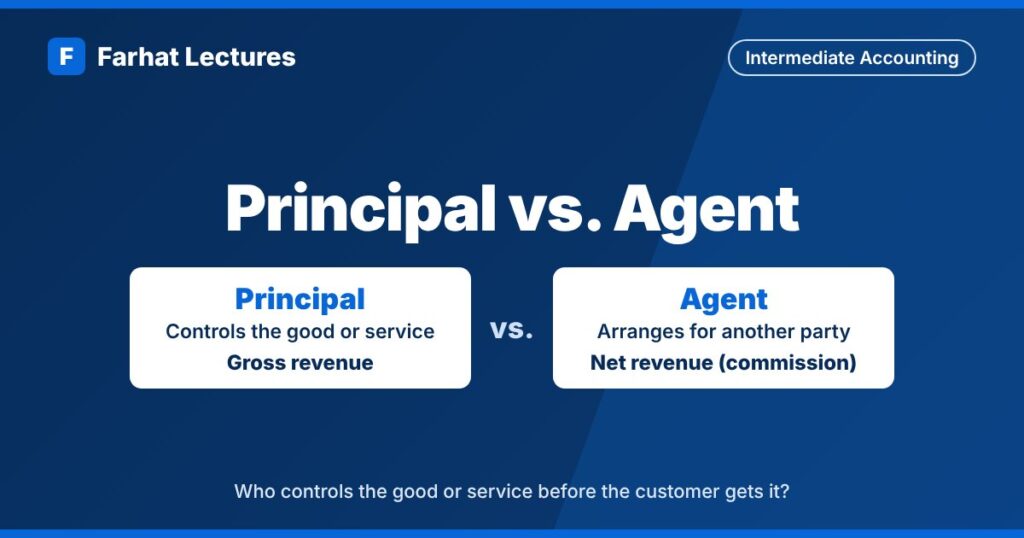
A principal promises to provide the good or service itself. An agent only arranges for another party to provide it. The principal reports revenue at the gross amount the customer pays; the agent reports only its fee or commission (net). A travel site that earns a 10% commission on a $600 hotel stay has $60 of revenue, not $600.
When the answer is not obvious, ASC 606-10-55-39 gives three indicators that you control the good or service and are therefore the principal:
- You are primarily responsible for fulfilling the promise to the customer.
- You carry inventory risk, either before the good reaches the customer or afterwards if the customer can return it.
- You have discretion in setting the price.
These are indicators, not a scorecard. Tick two of three and you still have to conclude on control itself.
See principal vs. agent: gross vs. net revenue.
5. Consignments
A consignment is a common principal-agent arrangement. The consignor (the owner) ships goods to a consignee (the dealer), who sells them for a commission. Shipping the goods is not a sale. The consignor keeps them in inventory and recognizes revenue when they are sold to end customers, while the consignee records only commission revenue. Both sides’ entries are in consignment accounting.
Example (hypothetical). Grainline Mills ships 20 units that cost $400 each to a dealer on consignment. The dealer sells 12 of them for $700 each and keeps a 10% commission.
- Grainline recognizes revenue of 12 times $700, which is $8,400, when the dealer sells to end customers, not when the goods shipped.
- Grainline’s cost of goods sold is 12 times $400, which is $4,800.
- The commission is 10% of $8,400, which is $840, so the dealer remits $7,560 in cash.
- Grainline still reports the 8 unsold units, 8 times $400, which is $3,200, as inventory on consignment.
- The dealer does not record the consigned goods as inventory. When it collects the customer payments, it debits Cash for $8,400, credits Payable to Consignor for $7,560, and credits Commission Revenue for $840.
6. Warranties
An assurance-type warranty promises that the product works as specified. It is part of the product, not a separate performance obligation, so the seller records warranty expense and a warranty liability. A service-type warranty, such as an extended warranty sold separately, provides an extra service. It is a separate performance obligation: the seller allocates part of the price to it, records unearned warranty revenue, and recognizes that revenue over the coverage period. See warranty accounting: assurance vs. service warranties.
Example (hypothetical). A company sells a printer bundled with a two-year service-type warranty for $900. Sold separately, the printer goes for $850 and the warranty for $150, so the standalone selling prices total $1,000. You allocate the $900 in that ratio:
- Printer: $900 times 850 divided by 1,000, which is $765, recognized at delivery.
- Warranty: $900 times 150 divided by 1,000, which is $135, recorded as unearned warranty revenue and recognized over the two years.
The two add back to the $900 collected. The quick test for which kind of warranty you have: if the customer could buy it separately, it is service-type.
7. Nonrefundable upfront fees
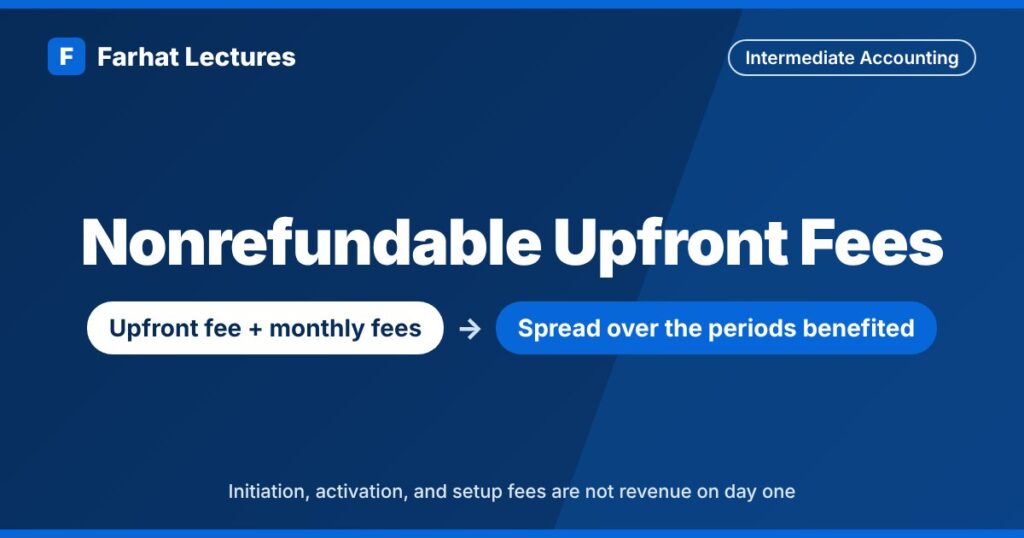
Gym initiation fees, phone activation fees, and setup fees are often paid before any service is delivered. Being nonrefundable does not make them revenue. If the fee does not transfer a promised good or service, it is an advance payment that is recognized as the related goods or services are transferred. The recognition period extends beyond the initial contract term when the customer has a renewal option that provides a material right. See nonrefundable upfront fees.
Example (hypothetical). A gym charges a $180 nonrefundable initiation fee plus $40 a month. The fee transfers no separate service when collected. Members can renew at $40 a month without paying another initiation fee, and the gym concludes that this option provides a material right. Assume the gym expects to provide 36 months of substantially identical services and uses the practical alternative in ASC 606-10-55-45 to allocate consideration based on the services and payments it expects. Expected consideration is $180 + ($40 × 36), or $1,620. The gym recognizes $45 for each month of service, consisting of the $40 dues plus $5 of the initiation fee. Recognizing the full initiation fee in month one would overstate that month’s revenue by $175.
For guided practice, see the Sales Returns and Allowances lesson in the Farhat Lectures Intermediate Accounting course.
Key takeaways on revenue recognition issues
- Most revenue recognition issues turn on the transaction price (Step 3) or the transfer of control (Step 5).
- Expected returns reduce revenue and create a refund liability.
- A repurchase obligation or call option at or above the selling price makes the deal a financing. Below the selling price it is a lease, and you compare the prices in present value terms.
- Bill-and-hold revenue at billing needs control plus four extra criteria.
- Agents, including consignees, report only their commission.
- Service-type warranties and most upfront fees are recognized over time.
Common mistakes
- Recognizing the full sale price when returns are expected.
- Treating a sale with a required buyback as revenue.
- Recording revenue when goods are shipped to a consignee.
- Reporting an agent’s gross receipts as revenue.
- Recognizing a nonrefundable fee as revenue just because it cannot be refunded.
Expected returns are a form of variable consideration, so the constraint on variable consideration applies to them as well. And watch the difference between a refund liability and a contract liability, because they are presented separately even when they arise from the same contract.
Review the estimation methods in the five-step revenue recognition guide and see how advance payments are presented in the unearned revenue guide.
Practice questions with answers
ASC 606 Revenue Recognition Practice Quiz
Practice seven CPA FAR scenarios covering sales returns and allowances, repurchase agreements, bill-and-hold arrangements, principal-agent relationships, consignments, warranties, and nonrefundable upfront fees.
1. A manufacturer transfers inventory for $200,000 and must buy it back in 18 months for $212,000. Assume a 3% annual discount rate for comparing the prices. How should it account for the transaction?
Answer: As a financing. The present value of $212,000 due in 18 months at 3% annually is approximately $202,806, which exceeds the $200,000 selling price. The repurchase obligation prevents control from transferring. The manufacturer keeps the inventory on its books, records a $200,000 financing liability, and recognizes $12,000 of interest over the 18 months.
2. An online marketplace collects $10,000 from customers for products shipped directly by independent sellers who set their own prices. The marketplace keeps 8%. How much revenue does it report?
Answer: $800. The sellers control the products and set the prices, so the marketplace is an agent and reports only its commission ($10,000 × 8%).
3. A company sells a laptop for $1,200 and an optional two-year extended warranty for $150. How much revenue is recognized at the sale date?
Answer: $1,200. The extended warranty is a service-type warranty and a separate performance obligation, so the $150 is recorded as unearned warranty revenue and recognized over the coverage period.
Frequently asked questions
What are the main revenue recognition issues?
The issues covered in most intermediate accounting textbooks are sales returns and allowances, repurchase agreements, bill-and-hold arrangements, principal-agent relationships, consignments, warranties, and nonrefundable upfront fees.
Which steps of the revenue model do these issues affect?
Mostly Step 3, determining the transaction price (for example, expected returns), and Step 5, recognizing revenue when the customer obtains control (for example, repurchase agreements, bill-and-hold, and consignments).
What does control mean in revenue recognition?
Control is the customer’s ability to direct the use of an asset and obtain substantially all of its remaining benefits. Revenue is recognized when (or as) control transfers to the customer.
Are these issues treated the same under IFRS?
Largely yes. IFRS 15 and ASC 606 were issued together and use the same control-based model for returns, repurchases, bill-and-hold, principal-agent, consignments, warranties, and upfront fees.
Where can I read the official guidance?
The rules are in FASB ASC Topic 606 and IFRS 15. The specific paragraphs are ASC 606-10-55-22 to 55-29 for returns, 55-30 to 55-35 for warranties, 55-36 to 55-40 for principal versus agent, 55-50 to 55-51 for upfront fees, 55-66 to 55-78 for repurchases, 55-79 to 55-80 for consignments, and 55-81 to 55-84 for bill-and-hold. Deloitte’s free revenue recognition roadmap summarizes Step 5 and the indicators of transfer of control.
Is a repurchase agreement ever a lease instead of a financing?
Yes. For a seller’s forward or call option, compare the repurchase price with the original selling price after accounting for the time value of money. A lower repurchase price generally results in a lease under ASC 842. If the contract is part of a sale and leaseback, account for it as financing. A repurchase price at or above the original selling price results in financing.
What journal entry records expected sales returns?
Debit Accounts Receivable for the gross amount, credit Sales Revenue for the amount you expect to keep, and credit Refund Liability for the expected refund. Then debit Cost of Goods Sold and Estimated Inventory Returns, and credit Inventory for the full cost of the goods shipped.
Does a consignee ever record the consigned inventory?
No. The consignor keeps title and reports the goods as inventory on consignment. The consignee recognizes its commission when it sells the goods. If it collects the sale proceeds, it records the cash and a payable for the amount due to the consignor.
How do I tell an assurance-type warranty from a service-type warranty?
If the customer can buy the warranty separately, it is service-type and a separate performance obligation. If it only promises the product meets its stated specifications, it is assurance-type, so you record warranty expense and a warranty liability instead.
What happens to the refund liability when the return window closes?
Update the refund liability and the asset for the right to recover products at each reporting date, including before the window closes. When the right of return expires, release any remaining liability for returns that can no longer be claimed to revenue. Record items actually recovered in inventory and charge any remaining recovery asset for goods that will no longer be recovered to cost of goods sold.
About the author
Mansour Farhat is a CPA, CIA and DBA who has taught accounting and auditing at university level and has coached thousands of CPA, CMA and EA candidates through the material on this site. He writes every lesson here and records the accompanying video himself. The examples on this page are his own, built from the mistakes he sees students make most often.
Continue learning with Farhat Lectures
Sitting FAR? Revenue recognition shows up in Area III of the CPA exam blueprint, which is 25 to 35 percent of the section. The CPA FAR course walks through all seven of these situations with full journal entries, and the CPA Test Bank has the multiple choice and task-based simulations to drill them. If you would rather try before you buy, the free sample course is a good place to start.
Explore the free sample course

Responses