
Contract Asset vs Contract Liability vs Receivable: ASC 606 Guide

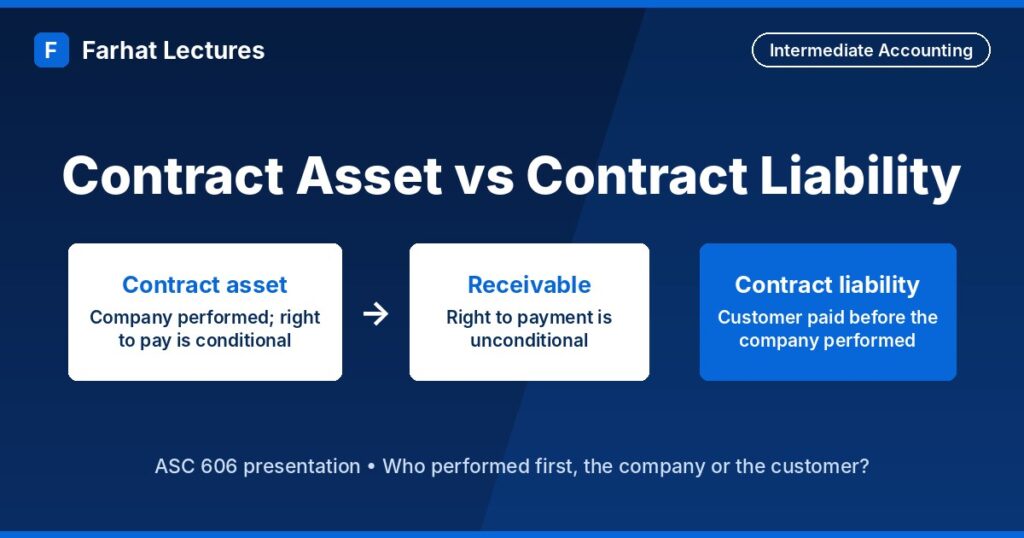
A contract asset is a conditional right to payment for goods or services already transferred. A contract liability is an obligation to transfer goods or services for which payment has been received or is due. When only time must pass before payment is due, the right is unconditional and the company presents it as a receivable.
Why does this matter? ASC 606 (the FASB’s revenue standard, Topic 606) uses an asset-liability approach. Every contract with a customer is a bundle of rights and obligations, and once either side performs, that contract shows up on the balance sheet. Students often mix up contract assets and receivables because both mean “the customer owes us.” The difference is whether the company still has to do something before it can bill.
Where this shows up on the CPA exam: revenue recognition is tested in the FAR section under Area III, Select Transactions, which carries 25 to 35 percent of the FAR score in the AICPA blueprint. Classification questions like the ones below are a favorite, so get in the habit of naming the balance before you write the entry.
This guide supports lesson 17.4, Presentation and Disclosure, in the Farhat Lectures intermediate accounting series. It builds on performance obligations and standalone selling price allocation, the two topics that come just before it.
Watch: Contract Asset vs Liability vs Receivable | Journal Entry Example
Watch this Farhat lesson on YouTube
In this 11-minute lesson, Professor Farhat follows a $500,000 equipment contract from a $100,000 customer advance (a contract liability) to a $20,000 contract asset, and then shows when that asset becomes a receivable.
What is a contract asset?
A contract asset is a company’s right to consideration in exchange for goods or services it has already transferred, when that right is conditional on something other than the passage of time (ASC 606-10-45-3). The most common condition is future performance: the contract says the company cannot bill until it delivers another item.
Think of it as revenue the company has already recognized but cannot invoice yet. The company recognizes revenue because it satisfied a performance obligation, but it records a contract asset instead of a receivable because the customer does not owe the money yet.
What is a contract liability?
A contract liability is a company’s obligation to transfer goods or services to a customer when payment has been received or is due before the company transfers the related goods or services (ASC 606-10-45-2). A customer deposit on a product that ships next month is a classic example.
Common balance sheet labels for contract liabilities include unearned revenue, deferred revenue, and customer deposits. ASC 606-10-45-5 allows companies to use alternative descriptions. For the full set of entries for prepayments, see unearned revenue journal entries.
Contract asset vs receivable
A receivable is a right to consideration that is unconditional. A right is unconditional when only the passage of time is required before payment is due (ASC 606-10-45-4). If the invoice has gone out and the customer just needs to pay within 30 days, that is a receivable.
The test is one question: Does the company have to do anything else before it can bill? If yes, it is a contract asset. If no, it is a receivable. The standard keeps them apart because they carry different risks. A receivable carries only credit risk, while a contract asset also carries performance risk, the risk that the company never finishes the work that unlocks the bill.
Contract asset vs contract liability vs receivable: comparison table
| Feature | Contract asset | Receivable | Contract liability |
|---|---|---|---|
| When does the balance arise? | The company transfers goods or services and its right to payment is conditional. | The company has an unconditional right to payment. | Payment is received or due before the company transfers goods or services. |
| Right or obligation | Conditional right to payment | Unconditional right to payment | Obligation to deliver goods or services |
| What must happen next | Company must perform more (or meet another condition) | Only time must pass | Company must deliver |
| Common account names | Contract asset, unbilled receivable | Accounts receivable | Unearned or deferred revenue, customer deposits |
| Balance sheet side | Asset | Asset | Liability |
Journal entry examples
The two examples below are hypothetical. They ignore cost of goods sold unless the cost is given.
Example 1: A contract asset that becomes a receivable
On April 1, Lakeview Office Supply signs a $40,000 contract to deliver desks and chairs to a customer. The standalone selling prices are $24,000 for the desks and $16,000 for the chairs, so no reallocation is needed. The contract says the customer pays only after both items arrive. Lakeview delivers the desks on April 3 and the chairs on April 20.
April 1: no entry, because neither party has performed.
April 3: desks delivered
| Account | Debit | Credit |
|---|---|---|
| Contract Asset | 24,000 | |
| Sales Revenue | 24,000 |
Lakeview earned $24,000 of revenue by delivering the desks, but it cannot bill yet. The right is conditional on delivering the chairs, so it is a contract asset.
April 20: chairs delivered
| Account | Debit | Credit |
|---|---|---|
| Accounts Receivable | 40,000 | |
| Contract Asset | 24,000 | |
| Sales Revenue | 16,000 |
Once the chairs arrive, nothing stands between Lakeview and the bill except time, so the entire $40,000 becomes a receivable and the contract asset is cleared.
Example 2: A contract liability from a customer deposit
On September 10, a customer pays Brightline Bikes $3,200 in advance for a custom e-bike that Brightline delivers on October 15. The bike cost Brightline $2,100.
September 10: deposit received
| Account | Debit | Credit |
|---|---|---|
| Cash | 3,200 | |
| Contract Liability (Unearned Sales Revenue) | 3,200 |
October 15: e-bike delivered
| Account | Debit | Credit |
|---|---|---|
| Contract Liability (Unearned Sales Revenue) | 3,200 | |
| Sales Revenue | 3,200 | |
| Cost of Goods Sold | 2,100 | |
| Inventory | 2,100 |
How contract balances are presented on the balance sheet
- One net amount per contract. ASC 606-10-45-1 says that when either party has performed, the contract itself is what gets presented, as either a net contract asset or a net contract liability, never both at once. Accountants call the contract the unit of account, which just means the contract is the thing being measured and reported. Deloitte’s roadmap section on presentation walks through the same point.
- No netting across contracts. A contract asset on one customer’s contract is not offset against a contract liability on a different contract.
- Receivables stay separate. Unconditional rights are shown as receivables, apart from contract assets, so readers can tell which amounts are ready to bill.
- Labels can vary, the distinction cannot. Any account title is fine as long as users can tell conditional rights from unconditional ones.
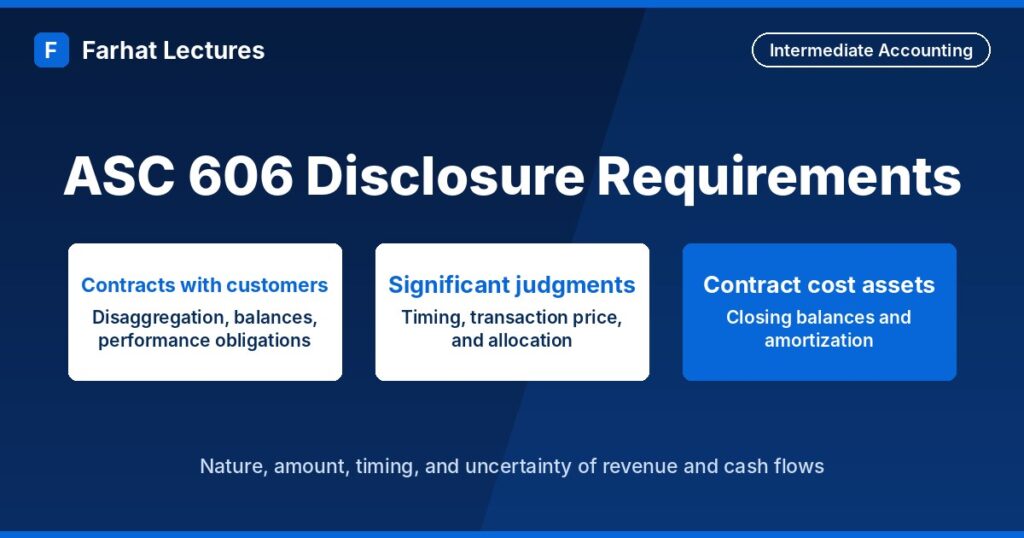
The same model applies under IFRS 15, the IASB’s revenue standard. IFRS reporters often use the labels accrued income and deferred income for these balances, which mean the same thing as contract asset and contract liability. Companies must also explain how these balances changed during the year, which is covered in ASC 606 disclosure requirements. Contract balances can also change when a deal is renegotiated; see contract modification under ASC 606.
Common mistakes
- Recording a receivable too early. If billing depends on another delivery, the right is still a contract asset.
- Thinking a contract asset means revenue is deferred. Revenue is already recognized. Only the billing right is delayed.
- Showing both a contract asset and a contract liability for one contract. Net them into a single amount.
- Confusing a performance obligation with a contract liability. The obligation is the promise; the contract liability is the balance that exists when payment comes first.
- Mixing up contract assets with capitalized contract costs. Sales commissions capitalized under ASC 340-40 are a separate asset, covered in costs to obtain and fulfill a contract.
How contract assets work when a contract is billed over time
Not every contract asset comes from a two-item delivery. Many build up on longer contracts, where a company performs steadily over several months but bills on a fixed schedule. In those cases the balance is a running total rather than a single entry.
When billed amounts are unconditionally due and there are no separate advance payments, subtract cumulative billings from cumulative revenue. A positive difference is a contract asset. A negative difference is a contract liability.
Worked example
All amounts in this example are in thousands of dollars. A company recognizes revenue over time on a design contract priced at 600. At March 31, compare two independent scenarios and assume the customer owes all amounts billed.
- Contract asset. Cumulative revenue is 250 and cumulative billings are 180. The difference of 70 is a contract asset for work the company has performed and cannot yet bill.
- Contract liability. Cumulative revenue is 180 and cumulative billings are 250. The difference of 70 is a contract liability for consideration due ahead of performance. Any unpaid billed amount is reported separately as a receivable.
Can a contract asset go bad?
Yes. A contract asset is tested for expected credit losses under ASC 326, the standard behind the current expected credit loss model, which is the same model used for ordinary trade receivables. So a company estimates what it may not collect and records an allowance, even though it has not billed anything yet.
Are contract balances current or noncurrent?
The current classification period is generally one year or the company’s normal operating cycle, whichever is longer. Classify a contract asset based on when the company expects to realize it and a contract liability based on when the company expects to transfer the related goods or services. A single contract balance can have both current and noncurrent portions.
Interactive contract balance exercise
Receivables, Contract Assets, and Contract Liabilities
Classify three customer contract balances under ASC 606. From the seller’s perspective, identify who performed first and whether the seller’s right to payment depends on further performance. Choose one balance sheet classification per scenario.
Practice questions
1. Delta Tools signs a $15,000 contract for equipment (standalone selling price $9,000) and a separate installation service ($6,000). Delta may bill only after installation is finished next month. What does Delta record when it delivers the equipment?
Answer: Debit Contract Asset $9,000; credit Sales Revenue $9,000. The equipment performance obligation is satisfied, but billing depends on the installation, so the right is conditional.
2. A customer prepays $12,000 for a 12-month software subscription on January 1. What is the contract liability on March 31 if revenue is earned evenly?
Answer: $9,000. Three months ($3,000) have been earned, leaving nine months ($12,000 × 9/12) still owed to the customer.
3. A company has a $5,000 contract asset on Contract A and a $3,000 contract liability on Contract B with a different customer. What does it present?
Answer: A $5,000 contract asset and a separate $3,000 contract liability. Netting happens within a contract, not across unrelated contracts.
Key takeaways
- A contract asset is a conditional right to payment for goods or services already transferred.
- A contract liability is an obligation to transfer goods or services for which payment has been received or is due.
- A receivable is unconditional. Only time has to pass before payment is due.
- Each contract is presented as one net balance. Balances from different contracts are never netted together.
- When billings are unconditionally due and there are no separate advances, compare cumulative revenue with cumulative billings to determine the contract balance.
Frequently asked questions
What is the difference between a contract asset and a contract liability?
A contract asset is a conditional right to payment for goods or services already transferred. A contract liability is an obligation to transfer goods or services for which payment has been received or is due.
Is a contract asset the same as accounts receivable?
No. A receivable is unconditional, meaning only time must pass before payment is due. A contract asset is conditional on something else, usually more performance by the company.
Is unearned revenue a contract liability?
Yes. Unearned or deferred revenue is a contract liability. ASC 606 lets companies use those more descriptive titles on the balance sheet.
Can one contract show both a contract asset and a contract liability?
No. Each contract is presented as a single net contract asset or net contract liability. Balances from different contracts are not netted against each other.
Does IFRS 15 use contract assets and contract liabilities too?
Yes. IFRS 15 uses the same contract asset, contract liability, and receivable distinctions as ASC 606.
How do you calculate a contract asset?
If billings are unconditionally due and there are no separate advances, subtract cumulative billings from cumulative revenue. A positive difference is a contract asset. A negative difference is a contract liability.
Is a contract asset a current asset?
A contract asset is current to the extent the company expects to realize it within one year or its normal operating cycle, whichever is longer. Portions expected to be realized later are noncurrent.
Can a contract asset be impaired?
Yes. Contract assets are tested for expected credit losses under ASC 326, the same credit loss model used for trade receivables, so a company records an allowance even before it bills.
Is a contract asset the same as an unbilled receivable?
They often describe the same balance. Unbilled receivable is an informal label, and ASC 606-10-45-5 allows alternative titles as long as readers can still tell conditional rights from unconditional receivables.
What is the journal entry for a contract asset?
Debit Contract Asset and credit Sales Revenue when the performance obligation is satisfied. When the right to payment becomes unconditional, debit Accounts Receivable and credit Contract Asset.
Continue learning with Farhat Lectures
Strengthen your accounting understanding with clear explanations and guided practice.
Explore the free sample course

Responses