
Standalone Selling Price: How to Allocate the Transaction Price

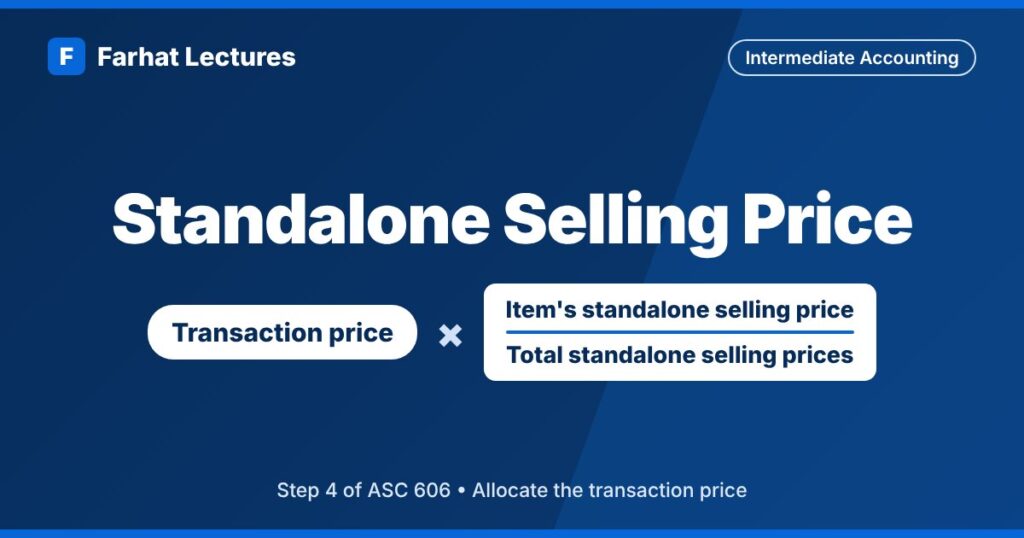
The standalone selling price is the price at which a company would sell a promised good or service separately to a customer. When a contract has more than one performance obligation, the FASB’s ASC 606 generally requires the company to allocate the transaction price to each one in proportion to its standalone selling price. This is called the relative standalone selling price method.
Why does this matter? Bundles are usually discounted, and the discount has to land somewhere. Under the general rule, allocating by relative standalone selling price spreads the discount across the performance obligations in proportion to their standalone selling prices. This is Step 4 of the five-step model, and it directly changes how much revenue is recognized in each period. Two terms do a lot of work here. A performance obligation is a promise to transfer a distinct good or service, a distinct bundle, or a qualifying series of substantially similar distinct goods or services that transfer in the same pattern. The transaction price is the consideration the seller expects to be entitled to for transferring the promised goods or services, excluding amounts it collects for third parties, such as certain sales taxes. Allocating the transaction price is a tested topic in the FAR section of the CPA exam, so expect both calculations and journal entries.
This guide supports lesson 17.1 (Fundamentals of Revenue Recognition) in Kieso, Weygandt, and Warfield’s Intermediate Accounting, 18th edition. If you are using the 16th or 17th edition, it is lesson 18.1. Allocation follows identification of the contract’s performance obligations. For a refresher on that step, read about performance obligations.
Watch: Step 4: Allocate the Transaction Price to Performance Obligations
Watch this Farhat lesson on YouTube
In this 12-minute lesson, Professor Farhat shows how the transaction price in a contract with several performance obligations is allocated based on each item’s relative standalone selling price.
Jump to the part you need: the standalone selling price definition at 1:40, the relative allocation calculation at 2:01, and the worked bundle example at 7:20.
What is the standalone selling price?
The standalone selling price (SSP) is what the company would charge for one promised good or service if it sold it by itself. The best evidence is an observable price: the price the company actually charges when it sells that item separately to similar customers. A list price or the price written in the contract may be the standalone selling price, but it is not automatically so.
If an item is never sold on its own, the company must estimate its standalone selling price. ASC 606-10-32-32 gives the definition and the observable price rule, ASC 606-10-32-33 requires an estimate when no observable price exists, and ASC 606-10-32-34 lists the approaches you can use, and Deloitte’s roadmap section on determining stand-alone selling prices describes the estimation approaches that later textbook lessons cover in detail.
The relative standalone selling price method in 3 steps
ASC 606-10-32-29 requires allocation on a relative standalone selling price basis (see Deloitte’s stand-alone selling price overview).
| Step | What you do |
|---|---|
| 1. List the standalone selling prices | Find the standalone selling price of each performance obligation and add them up. |
| 2. Compute each item’s percentage | Divide each standalone selling price by the total standalone selling prices. |
| 3. Allocate the transaction price | Multiply the transaction price determined in Step 3 by each percentage. |
In formula form: allocated amount = transaction price × (item’s standalone selling price ÷ total standalone selling prices). The allocations always add up to the transaction price.
When the formula has exceptions. Under ASC 606-10-32-37, a discount is allocated to specific performance obligations when the required observable evidence shows that the discount relates to those obligations. Under ASC 606-10-32-39 through 32-41, a variable payment is allocated entirely to a specific performance obligation or a distinct good or service in a qualifying series if the payment terms relate specifically to that performance or its outcome and the allocation reflects the consideration the seller expects for those goods or services.
If you want to read the rule in the original, the FASB publishes the Accounting Standards Codification free of charge at fasb.org, where ASC 606-10-32-29 through 32-34 cover allocation and standalone selling prices.
How to estimate a standalone selling price when none is observable
Sometimes an item is never sold on its own, so there is no observable price to start from. ASC 606-10-32-33 says you still have to come up with a standalone selling price. You must use as much observable information as you can get, and you must use the same estimation method consistently in similar situations.
ASC 606-10-32-34 lists three suitable approaches.
| Approach | What the company does | When it fits |
|---|---|---|
| Adjusted market assessment | Look at what customers in that market would pay, including what competitors charge for similar items, then adjust those prices for the company’s own costs and margins. | There is market data for similar goods or services. |
| Expected cost plus a margin | Forecast the cost of satisfying the performance obligation, then add a margin the market would accept. | Cost data is reliable, which is common for services and installation work. |
| Residual | Take the total transaction price and subtract the observable standalone selling prices of the other promises. Whatever is left is the estimate. | Only in the limited cases allowed by ASC 606-10-32-34(c). |
The residual approach is the restricted one, and the exam likes to test that. ASC 606-10-32-34(c) allows it only when the selling price is highly variable, meaning the company sells the same item to different customers for a broad range of amounts, or when the price is uncertain because the company has not set a price yet and has never sold that item separately.
Here is a quick example. A contract has a transaction price of $40,000 and three separate performance obligations. Two of them have observable standalone selling prices of $22,000 and $10,000. The third one has a highly variable price, so the company uses the residual approach: $40,000 minus $32,000 leaves $8,000 as the estimated standalone selling price for the third promise. Once you have that estimate, you allocate the transaction price the same way as always, in proportion to the three standalone selling prices.
Example: a three-item fitness bundle
Example (hypothetical). On January 1, Lakeside Fitness sells a “Get Started” bundle for $800 cash. It includes a 12-month gym membership, a package of 10 personal training sessions, and a fitness tracker handed to the customer at sign-up. Lakeside sells each item separately and has decided they are three separate performance obligations.
If you would rather see this worked out loud, the video above runs through the same kind of three-item split.
| Performance obligation | Standalone selling price | Percentage | Allocated amount |
|---|---|---|---|
| 12-month membership | $600 | 60% ($600 ÷ $1,000) | $480 ($800 × 60%) |
| 10 training sessions | 300 | 30% ($300 ÷ $1,000) | 240 ($800 × 30%) |
| Fitness tracker | 100 | 10% ($100 ÷ $1,000) | 80 ($800 × 10%) |
| Total | $1,000 | 100% | $800 |
Each allocated amount is recognized when that promise is satisfied. The tracker is handed over at sign-up, so its $80 is revenue on January 1. The other $720 is a liability until Lakeside performs:
ASC 606 calls that liability a contract liability. Most textbooks still label the account Unearned Revenue, and both names describe the same thing.
| January 1 | Debit | Credit |
|---|---|---|
| Cash | 800 | |
| Sales Revenue (fitness tracker) | 80 | |
| Unearned Revenue | 720 |
Each month, $40 of membership revenue ($480 ÷ 12) is earned, and each training session earns $24 ($240 ÷ 10). See unearned revenue for how that liability is reduced over time.
Example: where the bundle discount goes
Example (hypothetical). Pinecrest Software sells a software license (standalone selling price $9,000) and installation services (standalone selling price $3,000) together for $10,800, a $1,200 discount.
| Performance obligation | Standalone selling price | Allocated amount | Share of the discount |
|---|---|---|---|
| Software license | $9,000 | $8,100 ($10,800 × 75%) | $900 |
| Installation | 3,000 | 2,700 ($10,800 × 25%) | 300 |
| Total | $12,000 | $10,800 | $1,200 |
The discount is shared in the same 75/25 proportion. Pinecrest cannot simply decide that the whole discount belongs to the installation. ASC 606-10-32-37 allows a discount to be assigned to only some of the items, but only when the company has observable evidence that the discount really does relate to just those promises. That is the exception, not the rule.
When no allocation is needed
- One performance obligation. Generally, the whole transaction price belongs to it. A variable payment can still be allocated to a distinct good or service in a qualifying series if the specific allocation criteria are met.
- Each item priced at its standalone selling price. If a bike ($640) and a helmet ($60) are sold for $700 at their normal prices, the relative method gives the same answer as the stated prices.
For more worked examples with journal entries, see revenue recognition examples: ASC 606 allocation, and for guided practice, the Allocate Transaction Price lesson in the Intermediate Accounting course.
Key takeaways on standalone selling price
- The standalone selling price is what the item would sell for on its own.
- Allocate the transaction price in proportion to standalone selling prices, not contract prices.
- A bundle discount is generally spread across all items in the same proportion.
- Revenue for each piece is recognized when (or as) that performance obligation is satisfied, which is covered in transfer of control.
- When no observable price exists, estimate it using one of the three approaches in ASC 606-10-32-34, and save the residual approach for the limited cases it is allowed in.
Common mistakes
- Computing percentages from the transaction price instead of from total standalone selling prices.
- Allocating each item its full standalone selling price in a discounted bundle, so the amounts allocated exceed the transaction price.
- Assigning the entire discount to the item that was “on sale” in the advertisement.
- Recognizing the whole bundle as revenue on day one when some promises are satisfied later.
Practice questions with answers
1. A bundle sells for $540. Item A has a standalone selling price of $400 and item B has one of $200. How much is allocated to each?
Answer: Total standalone selling prices are $600. Item A: $540 × ($400 ÷ $600) = $360. Item B: $540 × ($200 ÷ $600) = $180. Check: $360 + $180 = $540.
2. A contract price is $2,850. The standalone selling prices are X $1,800, Y $900, and Z $300. Allocate the price.
Answer: Total standalone selling prices are $3,000, so the percentages are 60%, 30%, and 10%. X: $1,710; Y: $855; Z: $285. The total is $2,850.
3. A shop sells a $50 item and a $30 item together for $80, their usual separate prices. Is allocation needed?
Answer: No reallocation is needed. With no discount, the relative method gives $50 and $30, the same as the stated prices.
Interactive practice: allocate the transaction price
Under ASC 606, companies generally allocate the transaction price to separate performance obligations in proportion to their standalone selling prices. When a standalone selling price cannot be observed, the company estimates it. Use this four-question exercise to calculate an allocation and practice the adjusted market assessment, expected cost plus a margin, and residual approaches.
Frequently asked questions
What is the standalone selling price?
It is the price at which a company would sell a promised good or service separately to a customer. An observable price from separate sales to similar customers is the best evidence.
How do you allocate the transaction price?
Under the general rule, divide each performance obligation’s standalone selling price by the total of all standalone selling prices, then multiply that percentage by the transaction price.
Is the contract price the same as the standalone selling price?
Not necessarily. A contract or list price may equal the standalone selling price, but in a discounted bundle the contract prices usually differ from what each item would sell for alone.
What if a standalone selling price is not observable?
The company must estimate it in a way that meets the allocation objective. Intermediate accounting textbooks cover the estimation approaches in the lessons that follow the five-step overview.
Is allocation the same under IFRS 15?
Yes. IFRS 15 also allocates the transaction price on a relative standalone selling price basis.
How do you estimate a standalone selling price?
ASC 606-10-32-34 lists three approaches: adjusted market assessment, expected cost plus a margin, and the residual approach. Whichever one you use, you have to lean on observable information as much as possible and apply the same method consistently in similar situations.
When can a company use the residual approach?
Only in limited cases. ASC 606-10-32-34(c) allows it when the selling price is highly variable, meaning the same item sells to different customers for a broad range of amounts, or when the price is uncertain because the company has never set one and has never sold the item on its own.
What is the difference between the transaction price and the standalone selling price?
The transaction price is the consideration the seller expects to be entitled to for the promised goods or services under the contract, excluding amounts collected for third parties. A standalone selling price is what the seller would charge for one promised good or service sold separately. Relative standalone selling prices are generally the basis for allocating the transaction price.
Is standalone selling price tested on the CPA exam?
Yes. Allocating the transaction price is part of revenue recognition, which is a tested topic in the FAR section. Expect both calculation questions and journal entries.
About the author
Mansour Farhat, CPA, CIA, DBA, teaches accounting and auditing and has spent years walking CPA, CMA, and EA candidates through revenue recognition in the classroom and on video. The examples on this page come from that teaching, including the mistakes students make most often on Step 4.
Continue learning with Farhat Lectures
Strengthen your accounting understanding with clear explanations and guided practice.
Explore the free sample course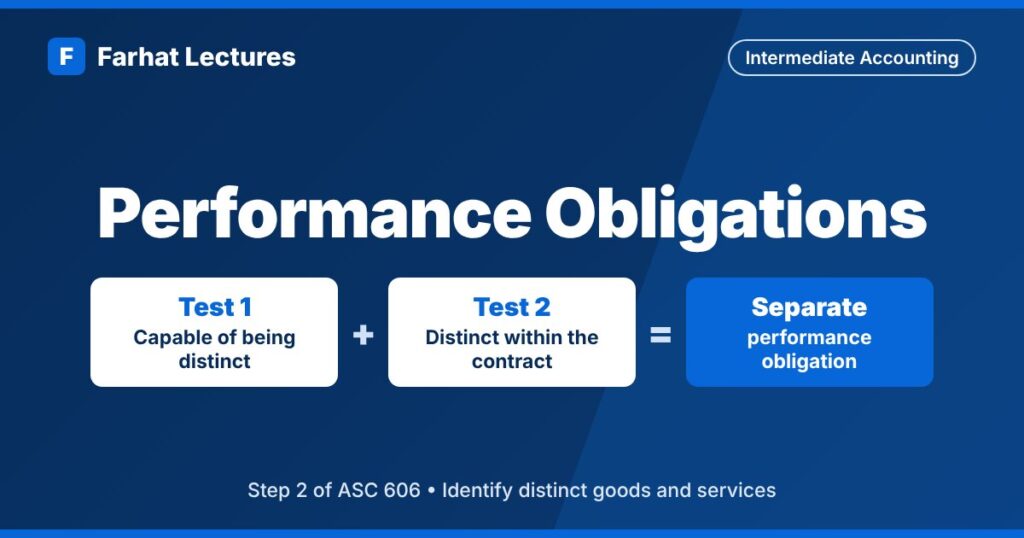
Responses