
Trade vs Nontrade Receivables: A Simple Guide

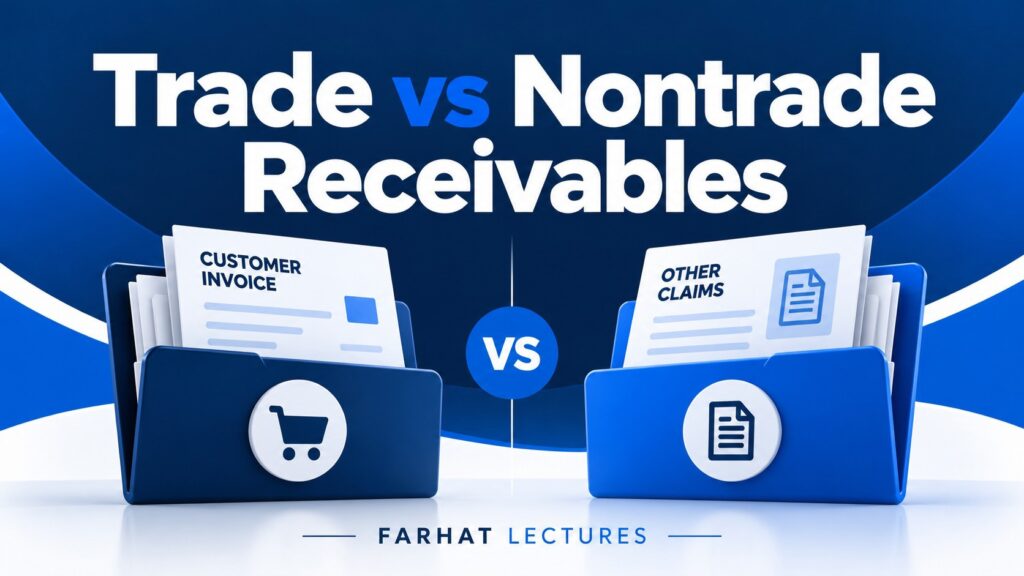
Trade receivables are amounts customers owe a business for goods or services sold in its normal operations, such as unpaid invoices. Nontrade receivables are amounts owed from other sources, such as employee loans, tax refunds, interest, or insurance claims. The source of the claim decides the label, not its form or due date.
This guide helps Intermediate Accounting students and CPA candidates studying the Financial Accounting and Reporting (FAR) section classify receivables correctly. You will see how the label connects to recognition, measurement, and the journal entries behind each balance.
Watch: Accounts Receivables Introduction: Gross or Net?
Short on time? Trade vs nontrade receivables are covered from 0:23 to 6:22. Trade discounts start at 7:05, and sales discounts start at 9:28.
Trade vs Nontrade Receivables: What Creates the Claim?
A receivable is an amount another party owes to a business. Classify it by the transaction that created the claim. Trade receivables arise from selling goods or providing services to customers. Nontrade receivables, also written non-trade receivables or called other receivables, arise from other activities, such as an employee loan or a refundable deposit.
This distinction matters because a balance sheet should show where amounts owed come from. A large employee advance tells a different story from unpaid customer invoices. In fact, the Financial Accounting Standards Board (FASB) Accounting Standards Codification (ASC) calls for receivables from officers, employees, or affiliated companies to be shown separately, not folded into a general accounts receivable line (ASC 310-10-45-13).
| Question | Trade receivable | Nontrade receivable |
|---|---|---|
| Why does the other party owe money? | An ordinary sale of goods or services | Another transaction or claim |
| Typical examples for a retailer | Customer invoices; a customer note from a merchandise sale | Employee loan; refundable security deposit; tax refund receivable |
| Does it have to be current? | No; assess collection timing separately | No; assess collection timing separately |
| Can a written note support it? | Yes | Yes |
What Are Examples of Nontrade Receivables?
These examples assume a retailer or manufacturer.
| Example | Why it is nontrade |
|---|---|
| Employee loan or advance | The company lent money to a worker. Nothing was sold. |
| Interest receivable | It comes from lending money or holding a note. |
| Dividends receivable | It comes from an investment, not a customer sale. |
| Income tax refund | A tax authority owes the money. |
| Insurance claim | It comes from a covered loss, not a customer sale. |
| Note from selling used equipment | Selling old equipment is not the ordinary sale of goods or services. |
| Refundable deposit | The company expects its own money back. |
| Advance to an affiliate | It is financing between related companies. |
Classification depends on the business. Lending is an ordinary operating activity for a bank. Do not automatically describe a bank’s customer loans as incidental nontrade claims merely because no merchandise was sold. Also, not every possible claim is a receivable. A lawsuit a company hopes to win, for example, is not recorded as an asset just because the company expects a good outcome.
Accounts Receivable vs Notes Receivable
Accounts receivable usually arise through open-account credit sales documented by invoices and normal payment terms. A separate promissory note is not required. For a broader introduction, review what accounts receivable means and how collections work.
Notes receivable are supported by formal written promises to pay specified amounts at specified dates. They commonly include interest. A note can be short-term or long-term and can arise from a sale or from a loan.
These labels answer different questions. “Trade” describes the source of the claim. “Note” describes its form. A note accepted from a customer for merchandise can therefore be both a trade receivable and a note receivable.
Are Receivables Current or Noncurrent?
Trade receivables are current if you expect to collect them within one year or the normal operating cycle, whichever is longer. The operating cycle is the time a business needs to acquire inventory, sell it, and collect the cash. Installment receivables that fit normal trade terms can also be current.
Nontrade receivables get a stricter test. Amounts due from officers, employees, affiliates, and others are current only if they are collectible within one year, even when the operating cycle runs longer (ASC 210-10-45-1). Receivables that do not meet these tests are noncurrent.
Hypothetical example: Maple Office Supply has a normal operating cycle shorter than one year, and the 18-month customer note below is not part of its normal trade terms. At its reporting date, it has the following balances:
| Balance | Source and form | Classification |
|---|---|---|
| $24,000 customer invoices, due in 45 days | Trade accounts receivable | Current |
| $9,000 customer note from a sale, due in 18 months | Trade note receivable | Noncurrent |
| $2,400 employee loan, due in six months | Nontrade receivable | Current |
| $5,000 refundable deposit, recoverable in 30 months | Nontrade deposit receivable | Noncurrent |
Maple has $26,400 of current receivables ($24,000 + $2,400) and $14,000 of noncurrent receivables ($9,000 + $5,000), for a total of $40,400 before any valuation adjustments. Only $33,000 of that total came from customers ($24,000 + $9,000). The other $7,400 is nontrade ($2,400 + $5,000), so Maple should not describe the full $40,400 as customer accounts receivable.
Receivables Classification: Interactive Exercise
Practice identifying current and noncurrent receivables, trade and nontrade receivables, accounts receivable, and notes receivable.
Select one answer for each question, then choose Check answers. Each question is worth one point. Use the study guide below whenever you need help.
When Is a Trade Receivable Recognized?
For an ordinary credit sale, revenue is recognized when the seller satisfies its performance obligation by transferring control of the goods or services. A receivable is recognized when the right to payment is unconditional: only the passage of time is required before payment becomes due.
Indicators of control include a present right to payment, legal title, possession, significant risks and rewards of ownership, and customer acceptance. Consider the contract and the facts together. Issuing an invoice alone does not establish that revenue has been earned.
Hypothetical example: Maple receives an order for $3,600 on September 28. The customer obtains control on October 2 and must pay in 30 days. Assume no discounts, returns, financing adjustment, or collection concerns. No sale is recorded merely for receiving the order. On October 2, Maple debits Accounts Receivable $3,600 and credits Sales Revenue $3,600.
When the customer pays, Maple debits Cash and credits Accounts Receivable for $3,600. Collection does not create another sale. If payment still depends on additional performance, the right may be a contract asset rather than a receivable.
Trade vs Nontrade Journal Entries
Here is Maple’s $3,600 credit sale next to a $2,400 employee loan. Interest is ignored to keep the loan simple.
| Transaction | Debit | Credit |
|---|---|---|
| Credit sale to a customer | Accounts Receivable $3,600 | Sales Revenue $3,600 |
| Customer pays | Cash $3,600 | Accounts Receivable $3,600 |
| Loan to an employee | Employee Loan Receivable $2,400 | Cash $2,400 |
| Employee repays | Cash $2,400 | Employee Loan Receivable $2,400 |
Notice the pattern. The trade receivable comes with revenue. The employee loan does not, because nothing was sold.
What Changes the Amount Recorded?
The transaction price reflects the consideration the seller expects to be entitled to receive. A fixed trade discount reduces the agreed selling price. Early-payment discounts and expected returns can also affect revenue. Study the entries in sales discounts under the gross and net methods and sales returns and allowances on credit sales.
Payment timing is a separate measurement issue. As a mathematical illustration, $5,150 due in six months has a present value of $5,000 if the applicable six-month rate is 3%: $5,150 ÷ 1.03. The difference represents the time value of money.
That calculation does not mean every routine invoice must be discounted. ASC 606 permits a practical expedient, which is an allowed shortcut, when the seller expects at the start of the contract that one year or less will pass between transferring the goods or services and getting paid. Ordinary short-term trade terms therefore commonly produce no separate financing adjustment. Maple’s $9,000 note from the earlier example runs 18 months, so this expedient does not apply to it. Maple would need to assess whether that sale includes a significant financing component. Keep two ideas separate: financing is about when the customer pays, while discounts and returns are about how much the customer pays.
Credit losses are a different question. A customer’s inability to pay does not reduce the transaction price. Instead, the seller records expected credit losses under ASC 326.
Hypothetical example: Maple has no existing allowance and expects $600 of its $24,000 customer invoices to go uncollected. It debits Credit Loss Expense $600 and credits Allowance for Credit Losses $600. Maple then reports those invoices at a net $23,400.
Why Does the Trade vs Nontrade Label Matter?
The label changes more than an account name.
- Balance sheet presentation: Amounts due from officers, employees, or affiliated companies should be shown separately from customer receivables.
- Current or noncurrent: Trade receivables can use an operating cycle longer than one year. These nontrade receivables use one year.
- Accounts receivable turnover: This ratio compares net credit sales with average net trade receivables. Hypothetical example: with net credit sales of $240,000 and average trade receivables of $24,000, turnover is 10 times. Assume average nontrade receivables are $7,400 for this illustration. Adding them to the denominator produces $240,000 ÷ ($24,000 + $7,400), or about 7.6 times, even though customers pay just as quickly.
- Cash flows: Collections from customers are operating cash flows (ASC 230-10-45-16). Collections on loans a company made are generally investing cash flows (ASC 230-10-45-12).
- Credit losses: ASU 2025-05 lets companies assume current conditions stay the same when estimating losses on current accounts receivable and current contract assets from ASC 606 transactions. It applies to annual periods beginning after December 15, 2025. An employee loan is outside that relief.
Common Receivables Mistakes
- Assuming every receivable is current because it is an asset.
- Using the operating cycle test for a nontrade receivable, such as a 14-month employee loan at a business with a 15-month cycle.
- Treating every written note as nontrade or long-term.
- Confusing a reduction in the transaction price with a customer’s inability to pay.
- Recording revenue when cash is collected even though the credit sale was already recognized.
How Is This Tested on the CPA Exam?
The AICPA’s 2026 blueprint for the FAR section lists trade receivables under Area II, Select Balance Sheet Accounts, which makes up 30% to 40% of the section. Representative tasks include calculating trade receivables and allowances, recording transfers such as factoring, preparing a rollforward of the account, and reconciling the subledger to the general ledger. Accounts receivable turnover also appears among the blueprint’s liquidity ratios.
Nontrade receivables are not a separate blueprint topic, so treat classification as step one. When a question gives you a list of balances, pull out the customer amounts before you calculate anything.
Preparing for FAR? Work through trade receivables, notes receivable, and pledging and factoring in our FAR course. You can also check what is changing on the CPA Exam in 2027.
Practice Questions and Explanations
1. Classify a customer note
A retailer accepts a six-month promissory note for goods sold. Is it trade or nontrade?
Answer: Trade. The sale created the claim. The written promise makes it a note receivable, and its six-month maturity makes it current under an ordinary short operating cycle.
2. Apply the operating-cycle rule
A business has a normal 15-month operating cycle. A trade receivable will be collected within that cycle, 14 months after the reporting date. Is it current?
Answer: Yes. A trade receivable uses one year or the normal operating cycle, whichever is longer. Fourteen months is within this business’s normal cycle. Watch the trap, though: a 14-month employee loan at the same business would be noncurrent, because it gets the one-year test.
3. Identify the recognition date
Goods are ordered June 26, control transfers July 3, and payment is due August 2. Assume the payment right becomes unconditional on delivery. When are revenue and the receivable recorded?
Answer: July 3. Control transfers and the unconditional payment right arises then. The order date and collection date do not determine recognition in these facts.
Key Takeaways
- The source decides the label. Customer sales create trade receivables, and other sources create nontrade receivables.
- Form is a separate question. A note can be trade or nontrade.
- Timing is separate too. Trade receivables can use an operating cycle longer than one year, while nontrade receivables use one year.
- A trade receivable comes with a sale. An employee loan does not create revenue.
Frequently Asked Questions
Are trade receivables the same as accounts receivable?
Not always. In Intermediate Accounting, trade receivables include both accounts receivable and customer notes. Some companies and websites use the two terms as synonyms, and some use accounts receivable as a broader label. Go by the source: if a customer sale created the claim, it is trade.
Can a nontrade receivable be current?
Yes. An employee loan collectible in a few months is current even though it did not arise from a customer sale. The test for nontrade receivables is collection within one year.
Does a return right prevent recognition of a receivable?
Not necessarily. An unconditional right to payment can be a receivable even when a refund may later be required. Expected refunds are accounted for separately.
Is interest receivable trade or nontrade?
For a retailer or manufacturer, it is nontrade. Interest comes from lending money or holding a note, not from selling goods or services to customers.
Is a loan to an employee a trade receivable?
No. An employee loan is a nontrade receivable because nothing was sold. Show it separately from customer receivables on the balance sheet.
Is a note receivable always a nontrade receivable?
No. The source decides. A note accepted from a customer for merchandise is trade. A note from lending cash or selling used equipment is nontrade.
What is the difference between a receivable and a contract asset?
A receivable is an unconditional right to payment, so only time has to pass. A contract asset is a right to payment that still depends on something else, such as finishing more work.
Are nontrade receivables included in accounts receivable turnover?
Normally no. The ratio compares net credit sales with average trade receivables, so nontrade balances would make collections look slower than they are.
Accounting References
See FASB ASC 210-10-45 for current assets, ASC 310-10-45 for receivables presentation, ASC 326-20 for credit losses, ASC 230-10-45 for cash flow classification, and ASC 606 for revenue and receivables. The FASB’s Topic 606 issuance document contains the original text of 606-10-25-30 (control indicators), 45-4 (unconditional rights), and 32-18 (short financing periods). Accounting Standards Update (ASU 2025-05) added the credit loss expedient for current accounts receivable. Exam coverage comes from the AICPA’s Uniform CPA Examination Blueprints. Consult the Codification for current authoritative wording.
About the author: Mansour Farhat, CPA, CIA, DBA, teaches accounting through Farhat Lectures, with courses for CPA, CMA, and EA candidates and accounting students. Read more on his about page.
Learn with Farhat Lectures
Strengthen your accounting foundation with clear explanations and guided practice. Explore the free sample course to experience the lessons.
Try the free sample course →

Responses