
Transaction Price Under ASC 606: Variable, Financing, Noncash and Customer Payments

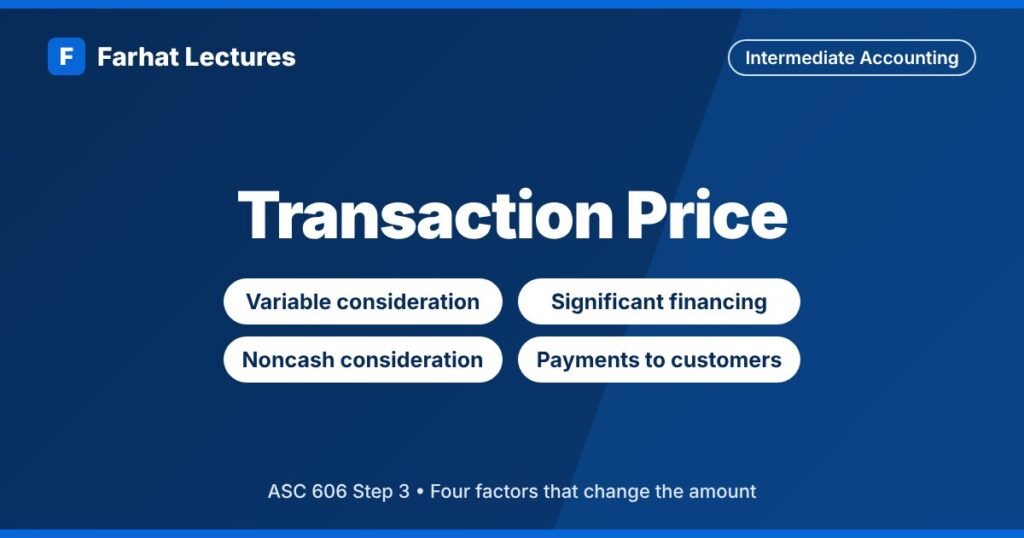
The transaction price is the consideration a company expects to be entitled to for transferring goods or services to a customer, excluding amounts collected for third parties such as sales tax. Under ASC 606 Step 3, four things can change it: variable consideration, a significant financing component, noncash consideration, and consideration paid to the customer.
Why does this matter? The transaction price is the total that Step 4 splits among the performance obligations and Step 5 turns into revenue. If the price is wrong, every revenue number after it is wrong too. It also decides how much of a deal is sales revenue and how much is interest revenue, which changes gross profit.
This guide supports lesson 17.2 (The Five-Step Process Revisited) in the Farhat Lectures Intermediate Accounting course. In Kieso, Weygandt and Warfield’s Intermediate Accounting, the matching material sits in the revenue recognition chapter. It covers Step 3 of the model; for the full five-step picture, see revenue recognition under ASC 606 and IFRS 15.
Watch: how to determine the transaction price
Watch this Farhat lesson on YouTube
In this 17-minute lesson, Professor Farhat works through Step 3 of ASC 606: determining the transaction price for a website contract, including a performance bonus.
What is the transaction price?
In many contracts, the transaction price is simple: the customer agrees to pay a fixed amount soon after delivery. A $1,200 laptop paid for at the register has a $1,200 transaction price. Step 3 becomes harder when the amount is uncertain, paid much later, paid in something other than cash, or partly paid back to the customer. Deloitte’s Step 3 overview lists the same four factors. The requirement itself sits in ASC 606-10-32-2 through 32-27 of the FASB Codification.
The 4 factors at a glance
| Factor | Question to ask | Effect on the transaction price |
|---|---|---|
| Variable consideration | Does the amount depend on a future event? | Estimate it, then apply the constraint |
| Significant financing component | Is payment much later (or earlier) than delivery? | Remove the interest; it is reported separately |
| Noncash consideration | Is the customer paying with something other than cash? | Measure it at fair value |
| Consideration payable to the customer | Is the company paying or crediting the customer? | Usually reduces the transaction price |
Variable consideration
When part of the price depends on a future event, such as a bonus, penalty, or rebate, the company estimates it using the expected value or the most likely amount. It then applies the constraint. Under ASC 606-10-32-11, the company includes an estimate only to the extent it is probable that a significant reversal in the amount of cumulative revenue recognized will not occur once the uncertainty is resolved. Two words carry the weight here. Probable means likely to happen, which is a higher bar than simply expecting it. And the test looks at cumulative revenue recognized on the contract, not just at the variable piece. Worked examples and the constraint are covered in variable consideration: expected value vs. most likely amount.
A significant financing component
When a customer pays well after delivery, part of what it pays is really interest. If the present value math here is new to you, start with present value of a single sum. The company is acting like a lender. If the financing is significant, the company measures revenue at the cash selling price, which is the payment discounted at an imputed interest rate, and reports the rest as interest revenue over time. Under ASC 606-10-32-19 the rate is the one that would apply to a separate loan between the company and that customer at contract inception. It reflects the credit standing of whoever is receiving the financing, plus any collateral. In practice a company finds that rate one of two ways:
- the prevailing rate for a similar note from a borrower with a similar credit rating, or
- the rate that discounts the note to the current cash price of the goods or services.
One more detail that shows up on exams: the company sets this rate at contract inception and does not update it later, even if market rates move.
Practical expedient: under ASC 606-10-32-18, a company does not have to adjust for financing if it expects at contract inception that the gap between delivery and payment will be one year or less. Note the word have. This is a choice the company can make, not a rule that forbids adjusting. A company that does not elect the expedient and adjusts anyway is still applying the standard correctly.
What if the customer pays in advance?
Financing can run the other way. If an advance payment provides significant financing, the customer is effectively lending to the company. The company records interest expense over that waiting period and ends up recognizing more revenue than the cash it collected. The deferred-payment example below shows the same idea in reverse.
Example (hypothetical). On January 1, 2028, Brookfield Machinery sells equipment and accepts a 3-year, zero-interest-bearing note with a face amount of $266,200. The equipment’s cash selling price is $200,000, which implies a 10% rate ($200,000 × 1.103 = $266,200). The equipment cost Brookfield $150,000. Brookfield uses a perpetual inventory system.
| January 1, 2028 | Debit | Credit |
|---|---|---|
| Notes Receivable | 266,200 | |
| Discount on Notes Receivable | 66,200 | |
| Sales Revenue | 200,000 | |
| Cost of Goods Sold | 150,000 | |
| Inventory | 150,000 |
| Year | Carrying amount at start | Interest revenue (10%) | Carrying amount at end |
|---|---|---|---|
| 2028 | $200,000 | $20,000 | $220,000 |
| 2029 | 220,000 | 22,000 | 242,000 |
| 2030 | 242,000 | 24,200 | 266,200 |
| Total | $66,200 |
| December 31, 2028 | Debit | Credit |
|---|---|---|
| Discount on Notes Receivable | 20,000 | |
| Interest Revenue | 20,000 |
Sales revenue is $200,000, not $266,200. The $66,200 difference is interest revenue earned over three years. The discount account is explained further in discount on notes receivable.
Noncash consideration
Customers sometimes pay with goods, services, or other noncash assets. The company measures that consideration at fair value, and it uses the fair value on the date the contract starts, which ASC 606-10-32-21 calls contract inception. That date matters. If the asset is worth more or less later because its own price moved, such as a share price rising, the transaction price does not change. If fair value cannot be reasonably estimated, the company uses the standalone selling price of the goods or services it promised instead (ASC 606-10-32-22).
Example (hypothetical). Pinecrest Consulting signs a contract on March 1 to run a strategy project in exchange for 2,000 shares of the client’s publicly traded common stock. On March 1, the contract inception date, the shares trade at $18, so the transaction price is $36,000. Assume Pinecrest satisfies its performance obligation at completion. On June 30, it finishes the project and earns and receives the shares, which trade at $21 that day.
| June 30 (project complete) | Debit | Credit |
|---|---|---|
| Equity Investments | 42,000 | |
| Service Revenue | 36,000 | |
| Investment Gain | 6,000 |
Pinecrest records the shares at their $42,000 fair value on June 30 (2,000 × $21). Service revenue is $36,000, based on the fair value at contract inception (2,000 × $18). The $6,000 increase in the value of the shares is an investment gain. See investments in equity securities.
Consideration paid or payable to customers
Companies often give something back to customers: discounts, rebates, coupons, free products, or cash payments. In general, these reduce the transaction price. The exception is a payment for a distinct good or service the company receives from the customer, which is treated as a normal purchase (up to its fair value).
There is a limit on that exception. If the company pays more than the fair value of the distinct good or service it receives, the extra amount still reduces the transaction price. So a $50,000 payment for advertising services worth $30,000 is a $30,000 purchase and a $20,000 reduction in the transaction price. If the company cannot reasonably estimate the fair value of the distinct good or service, the entire payment reduces the transaction price.
Example (hypothetical). Maple Snacks sells $80,000 of products to a grocery chain and pays the chain $5,000 for preferred shelf placement. The shelf placement is not a distinct service Maple could buy separately; it is part of selling to that chain. The transaction price is $80,000 − $5,000 = $75,000.
Prompt-payment discounts. Terms such as 2/10, n/30 give the customer a discount for paying early. A prompt-payment discount is variable consideration because the company does not know whether the customer will take it. Under ASC 606, the company reflects the estimated discount in the transaction price and applies the variable consideration constraint. A textbook illustration of the gross method may show the sale recorded at the full invoice price, with a sales discount recorded if the customer pays within the discount period. See sales discounts for the entries.
Once the transaction price is set, Step 4 allocates it among the contract’s promises. See standalone selling price and, for identifying those promises, performance obligations. For guided practice, see the Revenue Recognition Principle: Determine Transaction Price lesson in the Intermediate Accounting course.
Do you revisit the transaction price later?
Yes. At the end of each reporting period the company updates its estimate of variable consideration so the transaction price still reflects what it now expects. If the estimated bonus increases, the company includes the increase only to the extent it is probable that cumulative revenue will not significantly reverse when the uncertainty is resolved.
One thing does not get revisited: the discount rate for a significant financing component. That rate is locked in at contract inception.
Returns work the same way. If a company expects customers to send some goods back, it reduces the transaction price for the expected returns and records a refund liability instead of revenue. See sales returns and allowances.
Key takeaways on the transaction price
- The transaction price is what the company expects to be entitled to, excluding amounts collected for third parties.
- Variable consideration is estimated and then constrained.
- A significant financing component splits the deal into sales revenue (at the cash price) and interest revenue; payment within one year can be ignored.
- Noncash consideration is measured at fair value on the contract inception date, not on the date it is received.
- Payments to customers reduce the price unless they buy a distinct good or service.
Common mistakes
- Recording sales revenue at the face amount of a long-term, zero-interest note.
- Assuming the one-year expedient is automatic. It is a choice, and a company has to actually elect it.
- Recording noncash consideration at the seller’s cost instead of fair value.
- Recording payments to customers, such as slotting fees, as marketing expense instead of a revenue reduction.
- Including sales tax collected for the government in the transaction price.
Practice questions with answers
Determining the transaction price: check your understanding
Use these four scenarios to practice Step 3 of ASC 606. Decide how a performance bonus, deferred payment with significant financing, noncash consideration, and a credit to a customer affect the transaction price.
1. Goods with a cash price of $50,000 are sold for a 2-year, zero-interest note with a face amount of $60,500. How much sales revenue is recognized at delivery?
Answer: $50,000. The $10,500 difference is interest revenue earned over two years (the implied rate is 10%, since $50,000 × 1.102 = $60,500).
2. A software firm accepts land with a contract inception fair value of $90,000 as payment for a system it normally sells for $95,000. What is the transaction price?
Answer: $90,000, the land’s fair value at contract inception. The standalone selling price is used only when fair value cannot be reasonably estimated.
3. A company sells $120,000 of goods to a retailer and gives the retailer a $4,000 cash incentive with no distinct service in return. What is the transaction price?
Answer: $116,000. Consideration payable to a customer reduces the transaction price unless it pays for a distinct good or service.
Want more of these? The full set of Step 3 problems, with video walkthroughs, lives in the Intermediate Accounting course.
Frequently asked questions
What is the transaction price in revenue recognition?
It is the amount of consideration a company expects to be entitled to for transferring promised goods or services to a customer, excluding amounts collected on behalf of third parties such as sales taxes.
What four factors affect the transaction price?
Variable consideration, a significant financing component, noncash consideration, and consideration paid or payable to the customer.
When do you ignore the time value of money?
A company may elect to skip the financing adjustment if, at contract inception, it expects one year or less between transferring the promised good or service and the customer’s payment.
How is noncash consideration measured?
At fair value on the contract inception date, which is the date the contract meets the ASC 606 criteria. Later changes in that asset’s own value do not change the transaction price. If fair value cannot be reasonably estimated, the company uses the standalone selling price of the goods or services it promised in exchange.
Is the transaction price the same as the contract price?
Not always. The stated price is the starting point, but estimates of variable consideration, financing adjustments, noncash payments, and payments to customers can make the transaction price different.
Is sales tax included in the transaction price?
No. Sales tax is collected on behalf of a government, not earned by the company, so it stays out. ASC 606 also lets a company elect to exclude qualifying government-assessed taxes that it collects from customers on specific sales.
Do you reassess the transaction price after the contract starts?
Yes. At each reporting date the company updates its estimate of variable consideration. The discount rate for a significant financing component is the exception, because it is set at contract inception and not revisited.
What is the difference between the transaction price and the standalone selling price?
The transaction price is the total the company expects for the whole contract, which is Step 3. The standalone selling price is what each separate promise would sell for on its own, and it is the basis for splitting that total in Step 4.
Continue learning with Farhat Lectures
Strengthen your accounting understanding with clear explanations and guided practice.
Explore the free sample courseAbout the author
Mansour Farhat is a CPA, CIA and DBA who has taught accounting at the university level for over fifteen years. He has walked thousands of CPA, CMA and EA candidates through ASC 606, and the examples on this page come from the questions students ask most often when Step 3 stops making sense.

Responses