
Variable Consideration: Expected Value vs. Most Likely Amount

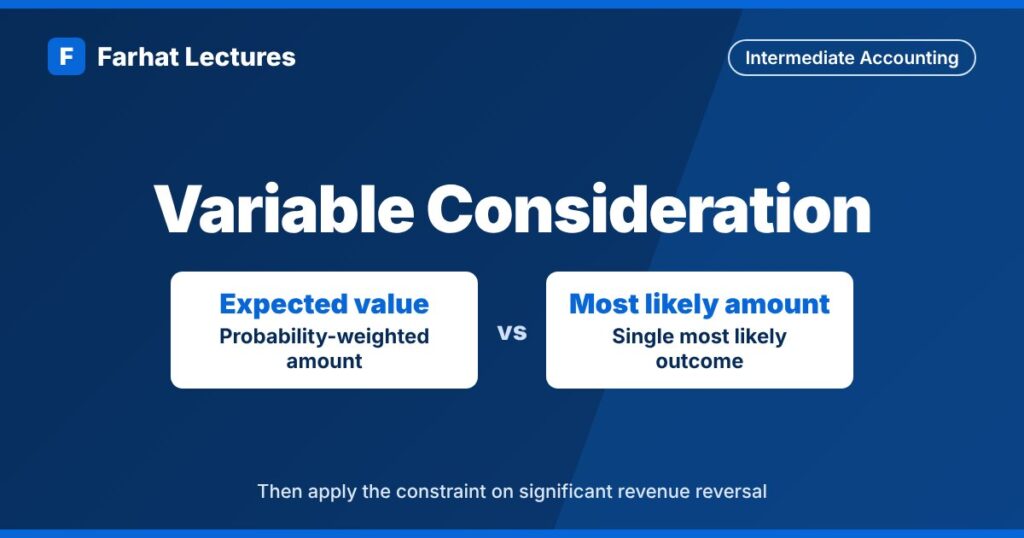
Variable consideration is any part of a contract price that can change, such as a bonus, penalty, rebate, or refund. Under ASC 606, estimate it with expected value or most likely amount, whichever better predicts what you expect to be entitled to. Include the estimate in the transaction price only to the extent it is probable that resolving the uncertainty will not cause a significant reversal of cumulative revenue.
Why does this matter? Many real contracts do not have a fixed price. If a company waits until every bonus or rebate is settled, revenue lands in the wrong period. If it books the most optimistic amount, it may have to reverse revenue later. The estimation methods and the constraint keep revenue reasonable in between.
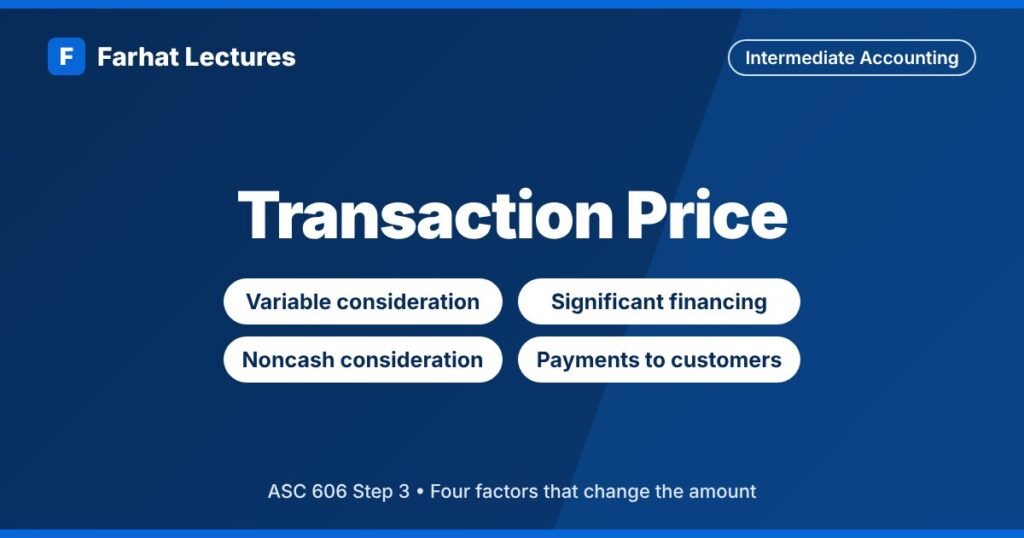
This guide covers the variable consideration part of Step 3 in the five-step revenue model, the section your intermediate accounting textbook may call the five-step process revisited. Variable consideration is one of four factors in Step 3; the other three are covered in transaction price under ASC 606.
Watch: ASC 606 Step 3: Transaction Price and Variable Consideration
Watch this Farhat lesson on YouTube
In this 17-minute lesson, Professor Farhat determines the transaction price for a website contract and shows how a performance bonus is estimated as variable consideration.
What counts as variable consideration
The price is variable whenever the amount the company will be entitled to depends on something that has not happened yet. Common sources include:
- Performance bonuses and penalties (for example, for finishing early or late)
- Volume discounts and rebates
- Price concessions, credits, and refunds
- Rights of return
- Fees based on a future result, such as a percentage of investment returns
Expected value vs. most likely amount
ASC 606-10-32-8 allows two estimation methods. The company picks the one that better predicts the consideration it will be entitled to; it is not a free choice.
One more rule that is easy to miss: ASC 606-10-32-9 says you have to apply one method consistently throughout the contract for the same uncertainty. You update your estimate every reporting period, but you do not switch from expected value to most likely amount part way through because the other number looks better.
| Expected value | Most likely amount | |
|---|---|---|
| How it works | Probability-weighted sum of all possible amounts | The single most likely amount in the range |
| Often useful when | Many possible outcomes, or many similar contracts | Only two possible outcomes (for example, bonus or no bonus) |
| Can the estimate be an amount you will never actually receive? | Yes, it is an average | No, it is one of the real outcomes |
| Typical example | A bonus that shrinks week by week | A fixed bonus for passing an inspection |
Example: the expected value method
Example (hypothetical). Ridgeline Builders signs a $400,000 contract to build a distribution center. It earns a $60,000 completion bonus if it finishes on time, and the bonus drops by $20,000 for each week the project is late. Ridgeline has built many similar projects, and its experience supports these probabilities:
| Outcome | Total consideration | Probability | Weighted amount |
|---|---|---|---|
| On time | $460,000 | 50% | $230,000 |
| One week late | 440,000 | 30% | 132,000 |
| Two weeks late | 420,000 | 20% | 84,000 |
| Expected value | 100% | $446,000 |
Because there is a range of outcomes and a base of similar contracts, the expected value of $446,000 is the better predictor. That becomes the estimated transaction price, subject to the constraint below. The most likely amount ($460,000) would ignore a 50% chance of earning less.
Example: the most likely amount method
Example (hypothetical). Cobalt Consulting installs a payroll system for $90,000. It earns a $25,000 bonus if the system passes an outside security certification by March 31; otherwise it earns nothing extra. Cobalt estimates an 85% chance of passing.
There are only two outcomes: $115,000 or $90,000. Expected value would give $90,000 + (85% × $25,000) = $111,250, an amount Cobalt can never actually receive. The most likely amount, $115,000, better predicts the result, so Cobalt uses it, again subject to the constraint.
The constraint on variable consideration
An estimate is not automatically revenue. Under ASC 606, a company includes variable consideration in the transaction price only to the extent it is probable that a significant reversal of cumulative revenue will not occur when the uncertainty is resolved. This is called the constraint.
Your textbook may say “highly probable.” That is the IFRS 15 wording. The FASB and IASB staff paper on variable consideration shows the two terms side by side: “probable” in ASC 606 and “highly probable” in IFRS 15. Both boards wanted the same level of confidence. Under IFRS, the word probable already means more likely than not, so IFRS 15 uses highly probable to match what probable means in US GAAP. The Basis for Conclusions on IFRS 15 explains this in its discussion of variable consideration, which begins at paragraph BC189.
Factors that make a reversal more likely include:
- The amount depends on things outside the company’s control, such as market prices, weather, or a third party’s judgment.
- The uncertainty will not be resolved for a long time.
- The company has little experience with similar contracts.
- There is a wide range of possible outcomes.
Example (hypothetical). Harbor Asset Advisors manages a client’s fund for one year. It earns a quarterly management fee based on assets under management, plus an incentive fee of 15% of any return above a market index, measured at year-end. Harbor recognizes each management fee as each quarter ends, because by then the amount for that quarter is known. The incentive fee depends on market returns, which Harbor cannot control and which can swing sharply. So Harbor includes none of it until year-end, when the return is known and the reversal risk is gone.
The constraint is not all-or-nothing. A company can include the portion of an estimate that passes the test and leave out the rest. It updates the estimate at each reporting date.
Say a contractor estimates a $100,000 incentive fee using expected value. Completed milestones that the customer has preliminarily confirmed in writing support $50,000 of the estimate. Payment for those milestones is independent of a government inspection, and the contractor concludes it is probable that including the $50,000 will not cause a significant reversal of cumulative revenue. The other $50,000 depends on an inspection that has been delayed twice and is outside the contractor’s control. The contractor concludes that the inspection-related amount does not meet the threshold, excludes it from the transaction price, and reassesses it at the next reporting date.
One exception worth knowing: sales-based royalties
ASC 606-10-55-65 and 55-65A provide an exception for a sales-based or usage-based royalty when an intellectual property license is the sole or predominant item to which the royalty relates. The seller recognizes royalty revenue at the later of the customer’s sale or usage and the satisfaction of the performance obligation to which the royalty is allocated. For an obligation satisfied over time, the seller recognizes the royalty only to the extent the obligation has been satisfied.
Example: a volume rebate
Example (hypothetical). Silverline Paper gives customers a 4% rebate on the whole year’s purchases if they buy at least $1,000,000 in the calendar year. In the first quarter, a large customer buys $300,000. This customer has bought well over $1,000,000 in each of the past three years, so Silverline expects the threshold to be met.
First-quarter revenue is $300,000 × 96% = $288,000.
| March 31, 2028 | Debit | Credit |
|---|---|---|
| Accounts Receivable | 300,000 | |
| Sales Revenue | 288,000 | |
| Refund Liability | 12,000 |
Silverline records the gross receivable and parks the expected 4% rebate in a refund liability, so revenue reflects only the $288,000 it expects to keep.
Some textbooks record the receivable net, at $288,000, instead of using a refund liability. Either way, revenue is $288,000. If Silverline later expects the customer to fall short, it reverses the liability and recognizes the extra revenue in that period.
After the transaction price is estimated, Step 4 splits it among the promises in the contract, covered in standalone selling price. For more worked journal entries across all five steps, see revenue recognition examples.
Key takeaways on variable consideration
- Variable consideration is any part of the price that depends on a future event.
- A range of outcomes or many similar contracts often favors expected value. Two outcomes often favor the most likely amount. Choose the method that better predicts the consideration you expect to be entitled to.
- Under ASC 606, include an estimate only to the extent it is probable that a significant reversal will not occur (IFRS 15: highly probable).
- Amounts driven by markets or other factors outside the company’s control are often constrained until resolved.
- Re-estimate variable consideration at every reporting date.
Common mistakes
- Choosing the method that gives the highest revenue instead of the one that better predicts the outcome.
- Choosing a method solely by counting the outcomes. Use the outcome pattern as a clue and choose the method that better predicts the amount the company expects to be entitled to.
- Skipping the constraint after making the estimate.
- Treating the constraint as all-or-nothing.
- Waiting until a rebate is paid to reduce revenue.
Exam tip. When a question gives you probabilities, read the outcomes first. Several possible amounts or many similar contracts often point to expected value. A yes-or-no bonus often points to the most likely amount. Use those clues to identify the better predictor. Then check whether the question asks for the estimate or the amount you can include in the transaction price after applying the constraint.
Credit risk and price concessions
At contract inception, Step 1 asks whether it is probable that the seller will collect substantially all the consideration it expects to be entitled to. If the seller expects to accept less than the stated price as a price concession, the concession reduces the amount assessed for collectibility and is subject to the variable consideration guidance. When the seller recognizes a receivable or contract asset, it accounts for credit losses on that balance separately under ASC 326.
Practice questions with answers
Variable Consideration Practice Quiz
Under ASC 606, the expected value method adds the probability-weighted outcomes, while the most likely amount method selects the single outcome with the highest probability. Practice choosing and applying these methods before evaluating the constraint on variable consideration.
1. A contract pays $200,000 plus a bonus: $30,000 (40% chance), $15,000 (40% chance), or $0 (20% chance). The company has many similar contracts. What is the estimated transaction price?
Answer: $218,000. Expected value of the bonus = (40% × $30,000) + (40% × $15,000) + (20% × $0) = $18,000, and $200,000 + $18,000 = $218,000, before applying the constraint.
2. A $50,000 contract adds a $10,000 bonus if a product passes a test, with a 70% chance of passing. Which method fits, and what is the estimate?
Answer: The most likely amount fits this yes-or-no bonus. Passing is the more likely outcome, so the estimated transaction price is $60,000 before applying the constraint.
3. A company sells $500,000 to a customer that is expected to earn a 3% volume rebate. How much revenue is recognized?
Answer: $485,000 ($500,000 × 97%). The $15,000 expected rebate reduces revenue now.
Frequently asked questions
What is variable consideration in simple terms?
It is the part of a contract price that can change based on a future event, such as a bonus, penalty, rebate, refund, or return.
How do I choose between expected value and most likely amount?
Choose the method that better predicts the consideration you expect to be entitled to. Expected value often fits a range of outcomes or many similar contracts. The most likely amount often fits a contract with two possible outcomes.
What is the constraint on variable consideration?
Under ASC 606, a company includes variable consideration in the transaction price only to the extent it is probable that resolving the uncertainty will not cause a significant reversal of cumulative revenue. IFRS 15 uses the term highly probable.
Is a volume rebate variable consideration?
Yes. The final price depends on how much the customer buys, so the company estimates the rebate it expects to give and reduces revenue as the sales occur.
Do you update the estimate of variable consideration?
Yes. The company updates its estimate, including the constraint, at each reporting date and adjusts revenue for the change.
Does the constraint apply to sales-based royalties?
ASC 606 has an exception when an intellectual property license is the sole or predominant item to which a sales-based or usage-based royalty relates. Recognize royalty revenue at the later of the customer’s sale or usage and the full or partial satisfaction of the performance obligation to which the royalty is allocated.
Can a company switch estimation methods during a contract?
No. ASC 606-10-32-9 says you apply one method consistently throughout the contract for the same uncertainty. You update the estimate every reporting period, but you do not swap expected value for most likely amount part way through to get a better number.
Does a customer’s credit risk reduce the transaction price?
Credit risk can affect whether a contract meets the Step 1 collectibility criterion. After a receivable or contract asset is recognized, account for credit losses separately under ASC 326. An expected price concession reduces the consideration the seller expects to be entitled to and is evaluated under the variable consideration guidance.
What does probable mean in ASC 606?
In US GAAP, probable means likely to occur, which is a higher bar than more likely than not. IFRS 15 uses the words highly probable to set that same level of confidence, because probable already means more likely than not under IFRS.
Continue learning with Farhat Lectures
Strengthen your accounting understanding with clear explanations and guided practice.
Explore the free sample course

Responses