
Performance Obligations: How to Identify Distinct Goods and Services

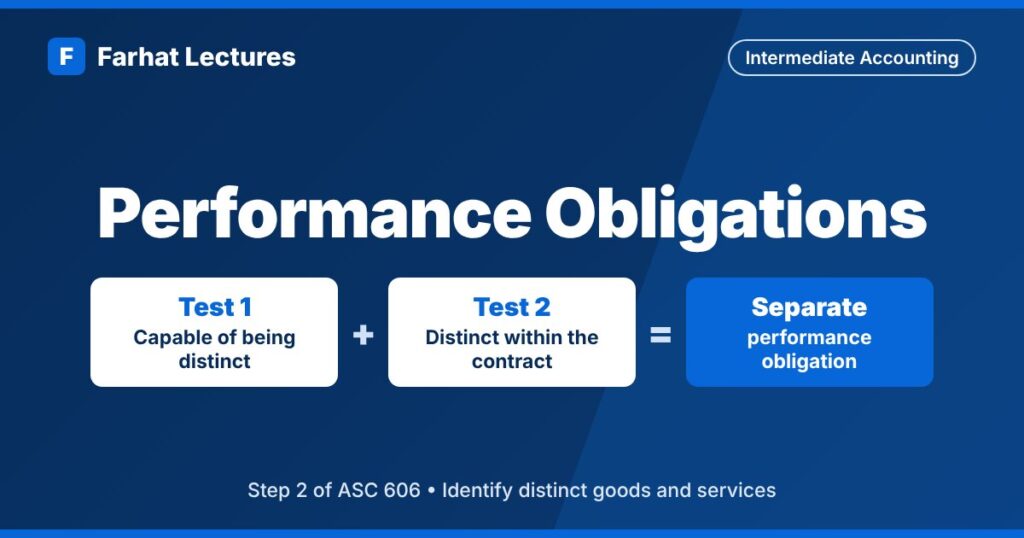
Under ASC 606, a performance obligation is a promise in a customer contract to transfer a distinct good or service, a distinct bundle, or a series of distinct goods or services that are substantially the same and transfer in the same pattern. A good or service is distinct when the customer can benefit from it on its own or with readily available resources, and the promise to transfer it is separately identifiable from the other promises. Goods or services that fail either test are combined until the bundle is distinct.
Why does this matter? Identifying performance obligations is Step 2 of the five-step revenue recognition model, and it sets the unit of account, meaning the thing you price and recognize revenue on, for everything that follows. The number of performance obligations decides how many pieces the transaction price is split into (Step 4) and when each piece becomes revenue (Step 5). Count them wrong and revenue lands in the wrong period.
This guide supports the Fundamentals of Revenue Recognition lesson, 17.1 in our intermediate accounting sequence. For a walk-through of all five steps, start with revenue recognition under ASC 606 and IFRS 15.
Watch: ASC 606 Step 2: One Performance Obligation or Several?
Watch this Farhat lesson on YouTube
In this 14-minute lesson, Professor Farhat applies the two distinct criteria to a drink-and-sandwich order, a home-construction contract, website services, and a car sold with an emergency service.
What is a performance obligation?
A performance obligation is a promise in a customer contract to transfer a distinct good or service, a distinct bundle, or a series of distinct goods or services that are substantially the same and transfer in the same pattern. The promise can be written into the contract or implied by the company’s normal business practices. A company satisfies a performance obligation, and recognizes revenue, when (or as) the customer obtains control of what was promised. The words “or as” matter, because a service delivered over months transfers control gradually rather than on one day. That timing question is covered in transfer of control in revenue recognition.
Most everyday sales have just one performance obligation: a customer buys a sandwich, and the shop’s only promise is to hand over the sandwich. Things get interesting when one contract bundles several goods or services.
What about repeated, identical deliveries?
A performance obligation can also be a series of distinct goods or services that are substantially the same and that transfer to the customer in the same pattern. ASC 606-10-25-14(b) puts this second option right next to the first one, so a contract does not have to be a single good or a bundle to count as one promise.
Monthly payroll processing for a year is the usual example. Each month of service is distinct on its own, but the company treats the twelve months as one performance obligation when every service in the series would be satisfied over time and the same method measures progress on each one. ASC 606-10-25-15 sets out those two conditions.
The practical effect is on the bookkeeping rather than the economics. One series means one promise to track and allocate to, instead of twelve.
The two tests for a distinct good or service
ASC 606-10-25-19 says a promised good or service is distinct only if both tests are met. Deloitte’s roadmap chapter on Step 2, identifying performance obligations, works through both criteria in detail, and the FASB’s own codification is the source text.
| Test | Question to ask | Signs it is met |
|---|---|---|
| 1. Capable of being distinct | Can the customer benefit from the item on its own, or together with resources that are readily available? | The company (or others) regularly sells the item separately; the customer can use it without the other promises |
| 2. Distinct within the context of the contract | Is the promise to transfer the item separately identifiable from the other promises in the contract? | The items are not inputs to one combined output, do not change each other, and do not depend heavily on each other |
A quick way to remember it: test 1 asks about the item, and test 2 asks about the contract. Bricks pass test 1 (anyone can use bricks), but in a contract to build a wall, they usually fail test 2 because they are just an input to the wall.
When promises must be combined
ASC 606-10-25-21 lists factors that show promises are not separately identifiable and should be combined into one performance obligation. The list is not exhaustive, and these three come up most often:
- Significant integration service. The company combines the goods or services into a single output that the customer contracted for, such as a finished building.
- Significant modification or customization. One item substantially modifies or customizes another, such as custom software that rewrites an existing system.
- Highly interdependent or interrelated. Each item significantly affects the other, so the company could not fulfill one promise without the other.
Examples: one performance obligation or several?
All of the following examples are hypothetical.
Example 1: A bike and a helmet
Juniper Cycles sells a customer a bicycle for $640 and a helmet for $60 in one transaction. Juniper sells both items separately every day, and the helmet does not change the bike or depend on it. Both tests are met, so there are two performance obligations. The $700 still has to be allocated across the two promises in Step 4. Because each item is priced at its normal amount, the allocation lands right back on $640 and $60.
Example 2: A custom garage
Summit Builders contracts to build a detached garage for $48,000, which covers the design, lumber, concrete, roofing, and labor. Each input could be bought on its own, so each passes test 1. But Summit’s real promise is a finished garage, and it integrates every input into that single output. Test 2 fails, so the contract has one performance obligation: the garage.
Example 3: A laptop with a support plan
Cobalt Tech sells a laptop bundled with a one-year technical support plan for $1,500. The laptop works without the support plan, and Cobalt also sells support plans on their own. The plan does not modify the laptop. There are two performance obligations, and they are satisfied at different times: the laptop when the customer receives it, and the support over the year. The $1,500 must be split between them, as shown in standalone selling price allocation.
Why the number of performance obligations matters
| One performance obligation | Several performance obligations | |
|---|---|---|
| Step 3: transaction price | Determined for the whole contract | Determined for the whole contract |
| Step 4: allocation | Not needed | Split the price by relative standalone selling prices |
| Step 5: recognition | One recognition pattern for the whole price | Each piece recognized when (or as) its promise is satisfied |
In the Cobalt example, calling the bundle one performance obligation would push some revenue into the wrong period: either the support revenue would be recognized up front with the laptop, or the laptop revenue would be spread over a year. If cash is collected before the support is provided, that part sits in a contract liability, as explained in unearned revenue.
For guided practice, see the Revenue Recognition Principle: Performance Obligation lesson in the Farhat Lectures Intermediate Accounting course.
How performance obligations are tested on the CPA exam
The AICPA tests revenue recognition in FAR, inside Area III, Select Transactions. Step 2 questions tend to arrive in one of three shapes. You count the promises in a bundled contract. You decide whether an integration service collapses several promises into one. Or you carry the count forward into an allocation question, where getting the number wrong costs you the rest of the problem.
Exam tip: the trap is stopping after test 1. Candidates spot that each input could be sold separately, answer “several”, and miss that the contract promises one combined output. Read the promise, not the invoice.
CMA candidates meet the same rules in Part 1, External Financial Reporting Decisions. The ASC 606 logic is identical; only the question format changes.
If you are working through the whole model, the five-step walkthrough in revenue recognition under ASC 606 and IFRS 15 is the place to start, and standalone selling price allocation picks up where this lesson ends.
Key takeaways on performance obligations
- A performance obligation can cover a distinct good or service, a distinct bundle, or a qualifying series of distinct goods or services with the same pattern of transfer.
- An item is distinct only if it is capable of being distinct and distinct within the contract.
- Integration, customization, and high interdependence are signs that promises should be combined.
- Identifying performance obligations drives both the allocation of the price and the timing of revenue.
Common mistakes
- Treating every line item on an invoice as a separate performance obligation without applying the two tests.
- Stopping after test 1. An item that can be sold separately can still be part of one combined output.
- Assuming one contract always means one performance obligation.
- Confusing the performance obligation with the payment terms. When the customer pays does not decide how many promises there are.
- Splitting a repeating service into one performance obligation per delivery. A series of services that are substantially the same, with the same pattern of transfer, can be a single performance obligation.
Practice: identify the performance obligations
Revenue Recognition Step 2 Practice Quiz: Identifying Performance Obligations
Practice identifying performance obligations under ASC 606. Apply both tests: whether the customer can benefit from the good or service on its own or with readily available resources, and whether the promise is separately identifiable within the contract. The four scenarios cover replacement parts, training, an integrated display, and an implied service promise.
Short answer practice
Work each one out before you read the answer underneath it.
1. A café sells a sandwich and a bottled juice together for $11, the sum of their usual menu prices. How many performance obligations are there?
Answer: Two. Each item is sold separately and benefits the customer on its own, and neither modifies or depends on the other. The $11 is still allocated across both promises, and because each is priced at its usual amount, the allocation lands on the menu prices.
2. A contractor agrees to build a custom kitchen, including cabinets, countertops, plumbing work, and installation, for one price. How many performance obligations are there?
Answer: One. The contractor integrates all the goods and services into a single output, the finished kitchen, so the promises are not separately identifiable.
3. A company sells equipment that any technician can install, plus optional installation that the company also sells on its own. How many performance obligations are there?
Answer: Two: the equipment and the installation. The customer could benefit from the equipment with installation from another provider (a readily available resource), and the standard installation does not significantly modify the equipment.
Frequently asked questions
What is a performance obligation in simple terms?
It is a promise in a customer contract to transfer a distinct good or service, a distinct bundle, or a series of distinct goods or services that are substantially the same and transfer in the same pattern. Each performance obligation is a unit for allocating the transaction price and recognizing revenue.
What makes a good or service distinct?
It must pass two tests: the customer can benefit from it on its own or with readily available resources, and the promise is separately identifiable from the other promises in the contract.
Can a contract have only one performance obligation?
Yes. Many contracts, such as a simple retail sale, have one. A contract can also have one performance obligation when several inputs are integrated into a single output, such as a building.
Is a performance obligation the same as a contract liability?
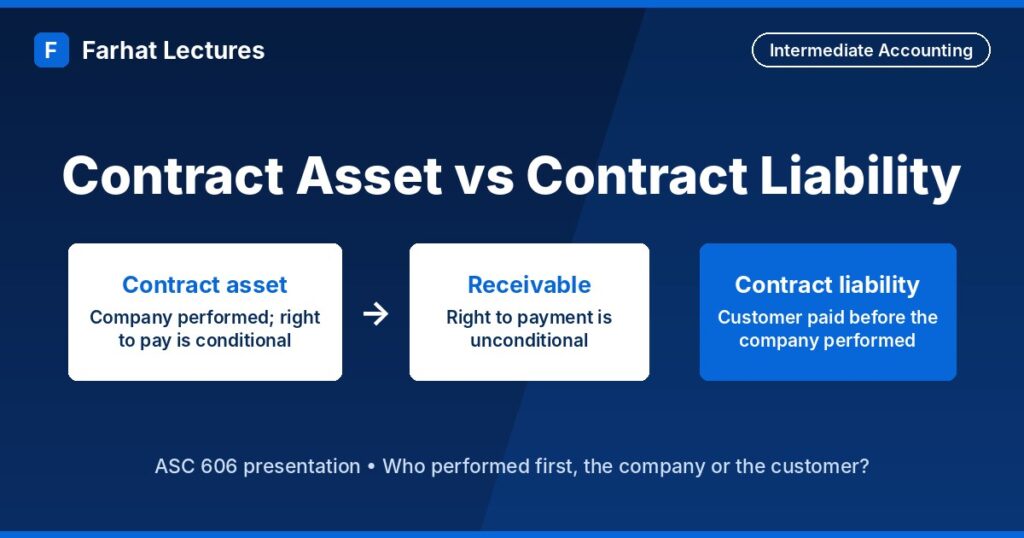
No. A performance obligation is a promise to transfer goods or services. A contract liability (often called unearned or deferred revenue) arises when the customer pays or payment becomes due, whichever comes first, before the company transfers the related goods or services.
Does IFRS 15 identify performance obligations the same way?
Yes. IFRS 15, issued by the IASB, uses the same two-part distinct test and the same five-step model as the FASB’s ASC 606. This is one of the areas where US GAAP and IFRS line up almost exactly.
Is a warranty a separate performance obligation?
It depends on the type. If the customer can buy the warranty separately, it is a separate performance obligation. If the warranty only promises that the product meets the agreed specifications, it is not a separate promise, and the company accrues the expected repair cost under ASC 460 instead.
Are customer loyalty points a performance obligation?
Often yes. An option to buy more goods or services is a separate performance obligation when it gives the customer a material right, which means a discount the customer would not have received without the first purchase. An option priced at the normal standalone selling price does not create one.
Can a company ignore small promises in a contract?
Sometimes. ASC 606 does not require a company to assess promises that are immaterial in the context of the contract. A company can also elect to treat shipping and handling that happens after the customer takes control as a fulfillment activity rather than a separate promise, an election the FASB added in ASU 2016-10.
About the author
Mansour Farhat, CPA, CIA, DBA, teaches the accounting and exam review courses on Farhat Lectures, including the Intermediate Accounting course this lesson belongs to. The examples and the common mistakes on this page come out of teaching this topic to students working through ASC 606 for the first time.
Continue learning with Farhat Lectures
Strengthen your accounting understanding with clear explanations and guided practice.
Explore the free sample course

Responses