
Available-for-Sale vs. Held-to-Maturity vs. Trading: Reporting Summary

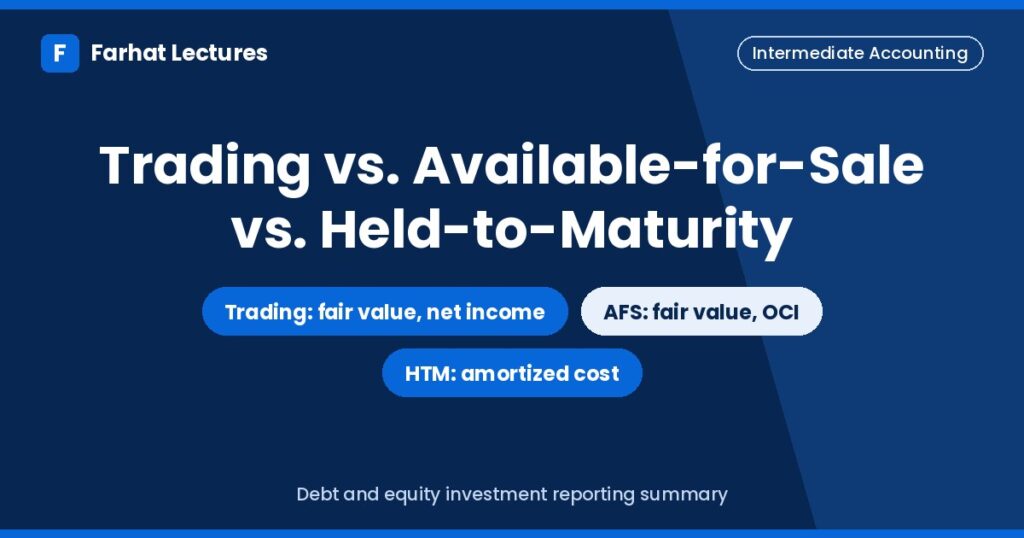
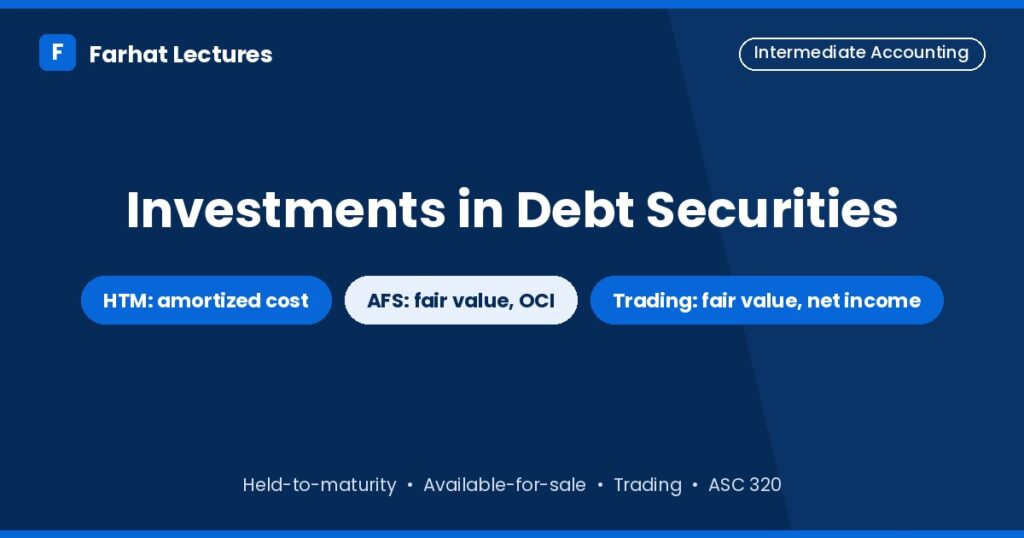
Available-for-sale (AFS) and held-to-maturity (HTM) are two of the three categories for debt securities under U.S. GAAP (ASC 320). AFS bonds are reported at fair value. Unrealized gains and noncredit losses generally go to other comprehensive income (OCI). HTM bonds are reported at amortized cost, and unrealized gains and losses are not recorded. Trading bonds are at fair value through net income.
Quick definitions: Fair value is what the bond would sell for today. Amortized cost is what you paid, adjusted over time for any premium or discount, so it moves toward face value by maturity. Accumulated other comprehensive income (AOCI) is where OCI amounts build up in equity until they’re realized.
This matters because exam questions often give one set of facts and ask how each classification would change net income, comprehensive income, and equity. This lesson pulls the debt and equity rules into one place and follows an AFS portfolio through all four financial statements. For the big picture, start with the Introduction to Accounting for Investments lesson.
Watch: Investment accounting: debt vs. equity and which method to use (starts at 6:28, HTM, trading, and available-for-sale categories)
Trading vs. available-for-sale vs. held-to-maturity: debt securities
| Classification | Balance sheet | Unrealized gains and losses | Other income effects | Impairment |
|---|---|---|---|---|
| Trading | Fair value; usually current | Net income | Interest revenue | None needed |
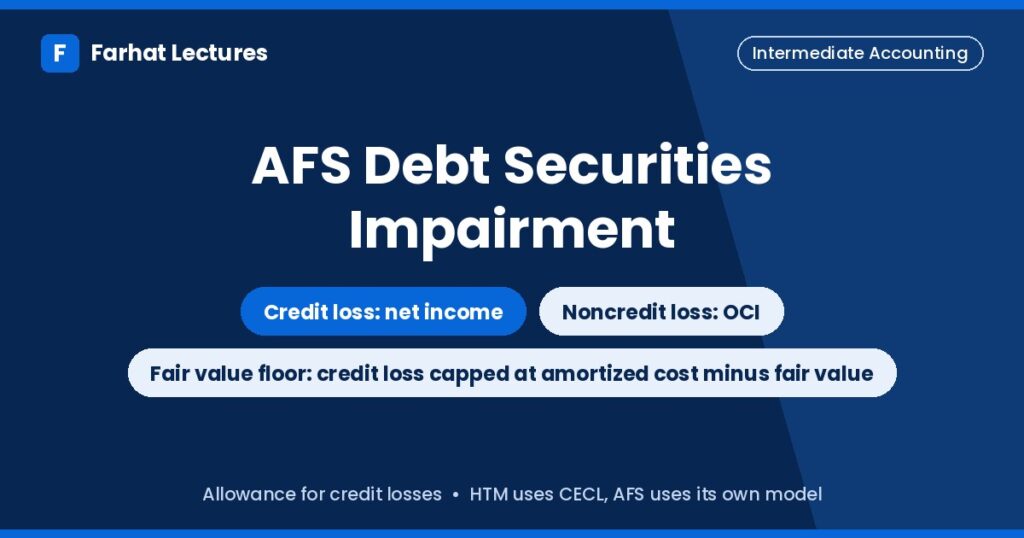
| Available-for-sale | Fair value; current or noncurrent | Unrealized gains and noncredit losses generally go to OCI, then AOCI. Credit losses go to net income. If the intent-to-sell or required-sale test is met, the full impairment goes to net income. | Interest revenue; realized gains and losses in net income | AFS model with a fair value floor |
| Held-to-maturity | Amortized cost; current or noncurrent | Not recognized | Interest revenue | CECL |
Classification depends on management’s intent when the bond is bought. For HTM, the company also needs the ability to hold the bond until it matures. The classification is reassessed at each reporting date, and moving a bond to another category follows the transfer of debt securities rules.
When can a company sell an HTM bond?
Not often. Selling or transferring HTM bonds early can call into question the company’s intent for the rest of its HTM portfolio, which is often called tainting. ASC 320 allows a few exceptions, such as a significant drop in the issuer’s credit quality, certain tax law changes, a major business combination or disposal, and changes in regulatory requirements.
ASC 320 permits a sale to be treated as a maturity if it is close enough to the maturity or call date that changes in market interest rates would have an insignificant effect on fair value. A sale within three months is an example. A sale may also qualify after the company has collected at least 85% of the principal outstanding at acquisition through prepayments or scheduled payments on debt payable in equal installments of principal and interest over its term.
Why AFS vs. HTM made headlines in 2023
When Silicon Valley Bank failed in March 2023, a lot of attention went to its held-to-maturity bonds. Rising interest rates had pushed their fair value well below amortized cost. Because HTM bonds stay at amortized cost, those unrealized losses were disclosed in the notes but never reduced equity. Unrealized losses on AFS bonds, on the other hand, had already reduced equity through AOCI. Same kind of bond, very different balance sheet.
Equity investment classifications
For equity securities, the level of ownership and influence decides the method. The KPMG Investments Executive Summary describes the fair value and measurement alternative rules.
| Holding | Method and balance sheet | Income effects |
|---|---|---|
| Less than 20% (no significant influence) | Fair value | Dividends as revenue; unrealized gains and losses in net income |
| 20% to 50% (significant influence) | Equity method: cost plus share of income, minus dividends | Share of investee income or loss |
| More than 50% (control) | Consolidated financial statements | Parent and subsidiary results combined |
| No readily determinable fair value | Fair value, or an elected measurement alternative: cost, less impairment, adjusted for observable price changes | Dividends as revenue; impairment and observable price changes in net income |
Any eligible investment can instead be reported at fair value through net income under the fair value option. On the balance sheet, the company either reports them on a separate line or shows their fair value amount in parentheses within the same line item.
Equity securities can’t be AFS anymore
Before ASU 2016-01, equity securities could be classified as trading or available-for-sale. That update took effect for public business entities for fiscal years beginning after December 15, 2017, and a year later for most other entities. Now, equity securities within the scope of ASC 321 that have a readily determinable fair value are measured at fair value through net income. The AFS and trading categories under ASC 320 apply only to debt securities.
Some older textbooks and websites still show AFS equity securities, so watch for that trap on the exam.
Worked example: AFS debt securities across the statements
Hypothetical example. Marlow Co. starts Year 1 with $80,000 of cash and $80,000 of common stock. On January 3, it buys $80,000 of debt securities and classifies them as AFS. On July 1, it sells securities that cost $30,000 for $33,500. It receives $4,200 of interest during the year. At December 31, the remaining securities cost $50,000 and have a fair value of $46,000. The bonds were bought at face value, so there’s no premium or discount to amortize. All interest was received in cash, and income taxes are ignored to keep the numbers simple. Assume the bonds sold had no prior fair-value adjustment and there were no credit losses.
Step 1: Realized vs. unrealized amounts
| Item | Calculation | Amount |
|---|---|---|
| Realized gain (net income) | $33,500 − $30,000 | $3,500 |
| Unrealized holding loss (OCI) | $46,000 − $50,000 | ($4,000) |
Step 2: Income statement and comprehensive income
| Year 1 | Amount |
|---|---|
| Interest revenue | $4,200 |
| Realized gain on investments | 3,500 |
| Net income | $7,700 |
| Other comprehensive income: unrealized holding loss | (4,000) |
| Comprehensive income | $3,700 |
Step 3: Statement of stockholders’ equity
| Item | Common stock | Retained earnings | AOCI | Total |
|---|---|---|---|---|
| Beginning balance | $80,000 | $0 | $0 | $80,000 |
| Net income | 7,700 | 7,700 | ||
| Other comprehensive loss | (4,000) | (4,000) | ||
| Ending balance | $80,000 | $7,700 | ($4,000) | $83,700 |
Step 4: Balance sheet at December 31
| Item | Amount |
|---|---|
| Cash ($80,000 − $80,000 + $33,500 + $4,200) | $37,700 |
| Debt investments (AFS), at fair value | 46,000 |
| Total assets | $83,700 |
| Common stock | $80,000 |
| Retained earnings | 7,700 |
| Accumulated other comprehensive income (loss) | (4,000) |
| Total stockholders’ equity | $83,700 |
Step 5: Statement of cash flows
Here’s the fourth statement, using the indirect method. Purchases and sales of AFS and HTM debt securities are investing activities.
| Year 1 | Amount |
|---|---|
| Operating activities | |
| Net income | $7,700 |
| Less: gain on sale of investments | (3,500) |
| Net cash provided by operating activities | 4,200 |
| Investing activities | |
| Purchase of AFS debt securities | (80,000) |
| Proceeds from sale of AFS debt securities | 33,500 |
| Net cash used in investing activities | (46,500) |
| Net decrease in cash | (42,300) |
| Cash, beginning of year | 80,000 |
| Cash, end of year | $37,700 |
The $4,000 unrealized loss isn’t cash and never went through net income, so it doesn’t show up here. Ending cash of $37,700 matches the balance sheet.
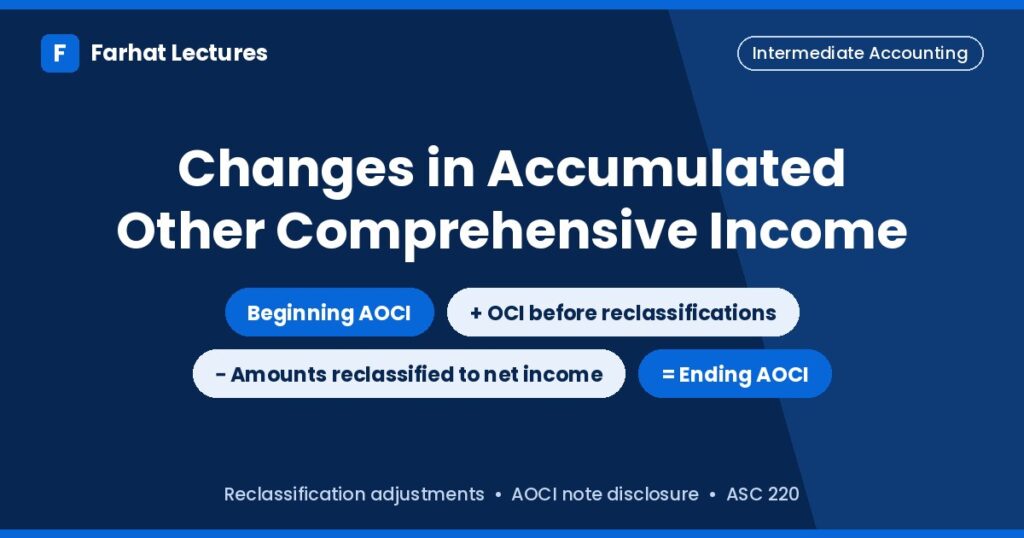
The unrealized loss lowers comprehensive income and equity but not net income. For more on OCI and reclassification adjustments, see what is comprehensive income.
Journal entries for the Marlow example
Under these assumptions, the purchase, interest receipt, and sale entries are the same under all three classifications. The December 31 comparison shows how each classification treats the fair-value decline.
| Date | Account | Debit | Credit |
|---|---|---|---|
| January 3 | Debt investments | $80,000 | (blank) |
| Cash | $80,000 | ||
| During Year 1 | Cash | 4,200 | (blank) |
| Interest revenue | 4,200 | ||
| July 1 | Cash | 33,500 | (blank) |
| Debt investments | 30,000 | ||
| Gain on sale of investments | 3,500 |
At December 31, the remaining bonds cost $50,000 but are worth $46,000. Here’s the entry under each classification:
| Classification | December 31 entry |
|---|---|
| Available-for-sale | Debit Unrealized holding gain or loss, OCI $4,000; credit Fair value adjustment, AFS $4,000 |
| Trading | Debit Unrealized holding gain or loss, income $4,000; credit Fair value adjustment, trading $4,000 |
| Held-to-maturity | No entry for the fair-value decline. The bonds stay at amortized cost of $50,000 in this example. Expected credit losses are evaluated separately. |
The fair value adjustment account is a valuation account that sits next to Debt investments. It lets the books keep the original cost while the balance sheet shows fair value.
Same facts, three classifications
| Classification | Net income | OCI | Debt investments on the balance sheet |
|---|---|---|---|
| Trading | $3,700 ($7,700 − $4,000) | $0 | $46,000 |
| Available-for-sale | $7,700 | ($4,000) | $46,000 |
| Held-to-maturity* | $7,700 | $0 | $50,000 |
*Sales from an HTM portfolio would normally call the classification into question. The row is included only to show the measurement difference.
Common mistakes
- Assuming all AFS fair-value declines go to OCI. If the company intends to sell an impaired AFS security, or is more likely than not required to sell it before recovering its amortized cost, the full impairment is recognized in net income. Otherwise, recognize credit losses in net income and noncredit losses in OCI.
- Recording fair value changes for HTM. HTM stays at amortized cost.
- Treating realized AFS gains as OCI. Once sold, the gain is realized and goes to net income.
- Classifying stock as HTM. Only debt securities have a maturity.
- Classifying stock as AFS. Since ASU 2016-01, equity securities within the scope of ASC 321 that have a readily determinable fair value are measured at fair value through net income.
- Using the equity method below 20%. Ownership under 20% without significant influence uses fair value.
Practice questions with answers
Debt Investment Classifications Under U.S. GAAP
Test how U.S. GAAP classifies held-to-maturity (HTM), trading, and available-for-sale (AFS) debt securities. The four CPA FAR practice questions cover amortized cost, fair value, and where unrealized gains and losses are reported.
Question 1: Classify each investment
(a) Bonds the company has the positive intent and ability to hold until they mature. (b) Bonds bought to profit from short-term price swings. (c) A 35% stake giving significant influence. (d) A 5% stake in a public company.
Answer:
(a) HTM, amortized cost; (b) trading, fair value through net income; (c) equity method; (d) fair value through net income
Debt classification follows management intent; equity classification follows ownership and influence.
Question 2: AFS income measures
An AFS portfolio bought at the start of the year cost $120,000 and has a year-end fair value of $127,000. The company earned $6,000 of interest and made no sales. Compute net income from the portfolio and comprehensive income.
Answer:
Net income $6,000; comprehensive income $13,000
Interest goes to net income. The $7,000 unrealized gain goes to OCI, so comprehensive income is $6,000 + $7,000 = $13,000.
Question 3: Same portfolio as trading
Using Question 2’s facts, what is net income if the portfolio is trading?
Answer:
$13,000
For trading securities, the $7,000 unrealized gain goes to net income along with the $6,000 of interest. OCI is zero.
Want more practice like this? Work through the Debt Securities Available for Sale lesson in the Farhat Lectures Intermediate Accounting course.
Key takeaways
- Trading: fair value, unrealized changes in net income.
- Available-for-sale: fair value. Unrealized gains and noncredit losses generally go to OCI. Realized gains and losses go to net income.
- Held-to-maturity: amortized cost, unrealized changes not recorded.
- Equity investments follow ownership: fair value, equity method, or consolidation.
- An AFS unrealized gain or loss reported in OCI affects comprehensive income and equity without affecting net income.
Frequently asked questions
What is the difference between available-for-sale and held-to-maturity securities?
Both are debt securities. AFS securities are reported at fair value. Unrealized gains and noncredit losses generally go to OCI. HTM securities are reported at amortized cost, and fair-value changes are not recorded. A company can use HTM only if it has the positive intent and ability to hold the bonds until they mature.
Can equity securities be classified as held-to-maturity?
No. Equity securities have no maturity date, so only debt securities can be held-to-maturity.
Can equity securities be classified as available-for-sale?
Since ASU 2016-01, equity securities within the scope of ASC 321 that have a readily determinable fair value are measured at fair value through net income. The AFS and trading categories under ASC 320 apply only to debt securities.
Where do realized gains on AFS securities go?
Realized gains and losses on AFS debt securities go to net income when the securities are sold. Unrealized gains and noncredit losses generally go to OCI. If the company intends to sell an impaired AFS security, or is more likely than not required to sell it before recovering its amortized cost, the full impairment is recognized in net income.
Are AFS debt securities current or noncurrent assets?
Either. They are current if the company expects to sell or collect them within a year (or the operating cycle) and noncurrent otherwise. Trading securities are usually current.
What if an equity investment has no readily determinable fair value?
The company may use the measurement alternative: cost, minus any impairment, adjusted for observable price changes in identical or similar investments of the same issuer.
How does the fair value option fit into this summary?
A company can elect fair value through net income for an eligible investment instead of its normal treatment. See fair value option for investments.
Where do AFS and HTM securities go on the statement of cash flows?
Purchases, sales, and maturities of AFS and HTM debt securities are investing activities. Cash flows from trading securities are classified based on why they were bought, which usually means operating activities.
Sources
- KPMG Executive Summary: Investments (debt security classification and measurement)
- FASB Accounting Standards Codification, Topics 320 and 321
About the author
Mansour Farhat, CPA, CIA, DBA, teaches accounting and CPA exam review at Farhat Lectures and on the Farhat Lectures YouTube channel.
Continue learning with Farhat Lectures
Strengthen your accounting understanding with clear explanations and guided practice.
Explore the free sample course
Responses