
Fair Value Option for Investments: How the Election Works

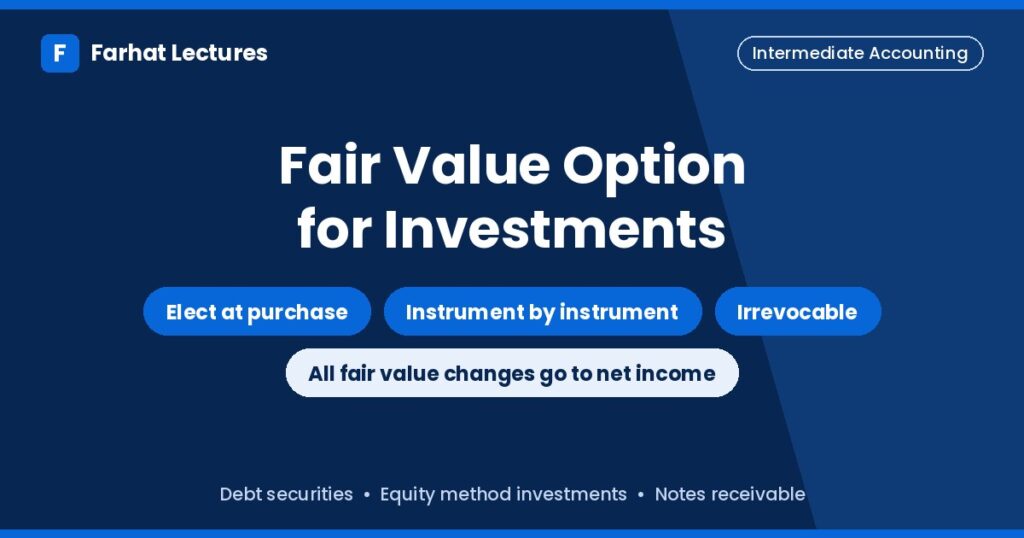
The fair value option for investments, under FASB ASC 825-10, lets a company measure an eligible financial asset, such as a bond, note receivable, or equity method investment, at fair value, with every change in fair value reported in net income. The company elects it one instrument at a time, usually at purchase, and generally cannot undo it.
This matters because the election overrides the normal rules. A held-to-maturity bond would normally sit at amortized cost, and an available-for-sale bond would generally send its noncredit unrealized gains and losses to other comprehensive income (OCI). Once the fair value option is chosen, both go straight to net income. This lesson covers the rules, the effect on each type of investment, and the debate around fair value reporting. For the liability side, see fair value option for liabilities.
Watch: The fair value option for financial instruments (starts at 3:26, fair value gains and losses in net income)
What are the rules for the fair value option for investments?
The fair value option comes from FASB Accounting Standards Codification (ASC) 825-10. FASB first introduced it in 2007 as Statement No. 159. The Deloitte fair value roadmap summarizes the key rules:
| Rule | What it means for students |
|---|---|
| Net income reporting | All unrealized holding gains and losses on the elected instrument go to net income, not OCI. |
| Instrument by instrument | The company can elect fair value for one investment and not for another, even if they are similar. |
| Election date | The choice is generally made when the company first buys the asset (or first recognizes it). A few other events also create an election date, such as an investment first becoming subject to the equity method or a remeasurement event like a business combination. |
| Irrevocable | Once elected, the instrument stays at fair value until the company no longer owns it. The only exception is a new election date, such as a remeasurement event, which gives the company a fresh choice (ASC 825-10-25-2). |
| Whole instrument | The election applies to the entire instrument, not to part of it or to selected risks. |
| Separate presentation | On the balance sheet, elected instruments are shown apart from similar items measured another way, either on their own line or with the fair value amount in parentheses. |
Which investments are eligible for the fair value option?
Most financial assets qualify. That includes held-to-maturity and available-for-sale debt securities, notes and loans receivable, and equity method investments.
ASC 825-10-15-5 lists a few items that are not eligible. The main ones are:
- Investments in subsidiaries or variable interest entities (VIEs) that the company must consolidate
- Pension and other postretirement benefit obligations
- Assets and liabilities recognized under lease accounting
- Bank deposit liabilities that customers can withdraw on demand
- Financial instruments the issuer classifies as part of equity
How does the fair value option change each type of investment?
The table compares the normal treatment with the treatment after the election. Notice that the right-hand column is the same for every row.
| Investment | Normal treatment | With the fair value option |
|---|---|---|
| Held-to-maturity debt security | Amortized cost, less any allowance for credit losses; no unrealized holding gains or losses recorded | Fair value; changes in net income |
| Available-for-sale debt security | At fair value. Noncredit unrealized changes generally go to OCI. Recognized credit losses go to earnings. | Fair value; changes in net income |
| Equity method investment (20%–50%) | Cost plus share of investee income, minus dividends | Fair value; changes in net income |
| Note receivable | Amortized cost, less any allowance | Fair value; changes in net income |
Equity securities under 20% ownership with a readily determinable fair value are already measured at fair value through net income, so the election adds little for them. For how fair values are measured and labeled Level 1, 2, or 3, see fair value disclosures.
Worked example: AFS bonds with the fair value option
Hypothetical example. On March 1, Year 1, Cobalt Co. buys bonds for $200,000 and would normally classify them as available-for-sale. It elects the fair value option. Fair values at year-end:
| Date | Fair value | Change | Where it goes with the election |
|---|---|---|---|
| Purchase, March 1, Year 1 | $200,000 | ||
| December 31, Year 1 | $214,000 | +$14,000 | Net income (gain) |
| December 31, Year 2 | $205,000 | −$9,000 | Net income (loss) |
Year 1 entry
| Account | Debit | Credit |
|---|---|---|
| Debt Investments | 14,000 | |
| Unrealized Holding Gain or Loss—Income | 14,000 |
Year 2 entry
| Account | Debit | Credit |
|---|---|---|
| Unrealized Holding Gain or Loss—Income | 9,000 | |
| Debt Investments | 9,000 |
Assuming none of the Year 2 decline is a credit loss, the bonds have the same carrying amount either way ($214,000 in Year 1 and $205,000 in Year 2). Cobalt reports the $14,000 gain and $9,000 loss in net income under the election and in OCI under normal AFS accounting. The normal AFS treatment is covered in trading vs. available-for-sale vs. held-to-maturity.
How does the fair value option work for equity method investments and notes?
Hypothetical example. Lakeshore Inc. buys 30% of Brook Corp. for $500,000 and elects the fair value option. Brook earns $60,000 during the year, and at year-end Lakeshore’s stake is worth $540,000.
| Item | Equity method | Fair value option |
|---|---|---|
| Income recognized | $18,000 share of Brook’s income (30% × $60,000) | $40,000 unrealized holding gain |
| Year-end carrying amount | $518,000 | $540,000 |
Under the election, Lakeshore does not record its share of Brook’s income. Instead, the $40,000 increase in the stake’s fair value goes to net income. The Deloitte equity method roadmap notes that the election for an equity method investment also covers the investor’s other eligible financial interests in the same investee.
Notes receivable work the same way. If a company elects the option for a note and market interest rates fall, the note’s fair value rises and the increase is reported as a gain in net income.
Why would a company elect the fair value option?
The main reason is to fix an accounting mismatch. That happens when related assets and liabilities are measured on different bases, so their gains and losses do not line up in net income.
Say a company holds a bond portfolio and issued debt to pay for it. If benchmark interest rates rise and the company’s own credit risk stays the same, the bonds and the debt both decline in fair value. If the company elects the fair value option for the bonds alone, the bond loss reduces net income while the debt stays at amortized cost. Electing the option for both allows the interest-rate-driven gain on the debt to offset some or all of the bond loss in net income. The company reports changes attributable to the debt’s own credit risk in OCI.
FASB designed the option for exactly this purpose: to reduce earnings swings caused by measuring related assets and liabilities differently, without the complexity of hedge accounting.
Why is fair value reporting for investments controversial?
Reporting investments is controversial. Some people want every security at fair value with changes in net income. Others prefer OCI, amortized cost, or the current mixed approach. Three issues come up most often:
- Classification based on intent. Identical bonds can be reported three different ways, depending on whether management calls them trading, available-for-sale, or held-to-maturity. Intent is subjective; fair value is not.
- Gains trading. A company can sell its AFS or HTM securities that have gained value, report those gains in income, and keep the ones that have lost value. This is sometimes called “cherry picking.”
- Liabilities not at fair value. Measuring assets at fair value but liabilities at amortized cost can make income and equity swing more than the economics suggest. The fair value option lets a company measure related assets and liabilities the same way.
Critics of the fair value option point out that its instrument-by-instrument design lets companies report some instruments at fair value and others not, which can make comparisons harder.
Common mistakes
- Putting the gain in OCI. With the election, even an AFS bond’s unrealized gains and losses go to net income.
- Electing later. The choice must be made at initial recognition or on another qualifying election date.
- Switching back. The election is irrevocable unless a new qualifying election date occurs.
- Assuming all-or-nothing. The option is chosen instrument by instrument.
- Recording equity method income too. Under the election, the investor records the fair value change, not its share of investee income.
Exam tip: When a question says the company “elected the fair value option,” the held-to-maturity, available-for-sale, or equity method label no longer decides the measurement. The investment goes to fair value, and every change goes to net income. Investments are part of the FAR section of the CPA Exam, so watch for this phrase in the question stem.
Interactive practice on the fair value option for investments
Fair Value Option for Held-to-Maturity Debt Securities
Apply ASC 825-10 to a hypothetical debt investment scenario. Select one answer for each of the four questions on when the fair value option can be elected, how long it applies, and where unrealized holding gains and losses are reported.
Practice questions with answers
Question 1: A bond intended to be held to maturity
On January 2, Delta Co. buys bonds for $80,000 that it plans to hold to maturity and elects the fair value option. On December 31, fair value is $76,500. What does Delta report?
Answer:
A $3,500 unrealized holding loss in net income; the bonds are reported at $76,500
Without the election, the bonds would stay at amortized cost and no loss would be recorded. The election moves the bonds to fair value and sends the change to net income.
Question 2: An equity method investment
Rowan Inc. buys 25% of Elm Corp. for $400,000 and elects the fair value option. Elm earns $100,000. At year-end, Rowan’s stake is worth $430,000. How much income does Rowan report from this investment?
Answer:
$30,000
Rowan reports the $30,000 increase in fair value ($430,000 − $400,000) in net income. It does not also record the $25,000 equity method share (25% × $100,000).
Question 3: Timing of the election
Last year, Kestrel Co. bought Bond A without electing the fair value option. This year it buys Bond B and wants fair value for both bonds. What can it do?
Answer:
Elect the fair value option for Bond B only
The election is made when an instrument is first recognized. Bond A’s election date has passed, so it stays on its existing basis unless a new election event, such as a business combination, happens later.
Want more practice like this? Work through the Fair Value Option for Investments lesson in the Farhat Lectures Intermediate Accounting course.
Key takeaways
- The fair value option for investments measures an eligible financial asset at fair value with changes in net income.
- The election is generally made instrument by instrument at initial recognition. It is irrevocable unless a new qualifying election date occurs.
- It overrides amortized cost for HTM bonds and notes, OCI treatment for AFS bonds, and the equity method.
- On the balance sheet, elected instruments are shown apart from those measured on other bases, either on their own line or with the fair value amount noted in parentheses.
- Impairment and transfers follow different rules for investments without the election; see AFS debt securities impairment and transfer of debt securities.
Frequently asked questions
Can a company change its mind after electing the fair value option?
No. The election is irrevocable. The company keeps measuring that instrument at fair value, with changes in net income, until it sells, collects, or otherwise no longer holds it. The only exception is a new election date, such as a remeasurement event like a business combination.
Does the company have to use the fair value option for all similar investments?
Generally no. The election is made instrument by instrument, so a company can choose fair value for one bond and keep amortized cost for an identical bond. One exception: if a company elects the option for an equity method investment, it must apply it to all of its eligible financial interests in that same investee.
Can a company elect the fair value option for a bond it bought last year?
Generally, the election is made when the company first recognizes the investment. A company that bought a bond last year can elect the option later only if a new qualifying election date occurs.
Why would a company use the fair value option for an equity method investment?
Fair value can tell investors more about what the stake is worth than the equity method’s one-line carrying amount, which reflects cost adjusted for the investor’s share of income and dividends rather than current value.
Is the fair value option only for assets?
No. It also applies to many financial liabilities, but liabilities have an extra rule for changes in the company’s own credit risk. See fair value option for liabilities.
Which investments cannot use the fair value option?
Investments in subsidiaries or variable interest entities the company must consolidate are the main exclusions. Pension obligations, lease assets and liabilities, bank demand deposits, and instruments the issuer classifies as equity are also excluded.
Why would a company choose the fair value option?
Usually to fix an accounting mismatch. Measuring related assets and liabilities the same way lets their fair value changes offset in net income, without the complexity of hedge accounting.
Sources
- Deloitte Roadmap: Fair Value Measurements, Section 12.3 Recognition of the Fair Value Option (ASC 825-10-25)
- Deloitte Roadmap: Equity Method Investments, Section 2.4 (fair value option for equity method investments)
- FASB Accounting Standards Codification, Topic 825: Financial Instruments (originally FASB Statement No. 159, 2007)
About the author
Mansour Farhat, CPA, CIA, DBA, teaches accounting and CPA exam review at Farhat Lectures and on the Farhat Lectures YouTube channel.
Continue learning with Farhat Lectures
Strengthen your accounting understanding with clear explanations and guided practice.
Explore the free sample course



Responses