
Fair Value Adjustment for Equity Securities: Unrealized Holding Gains and Losses

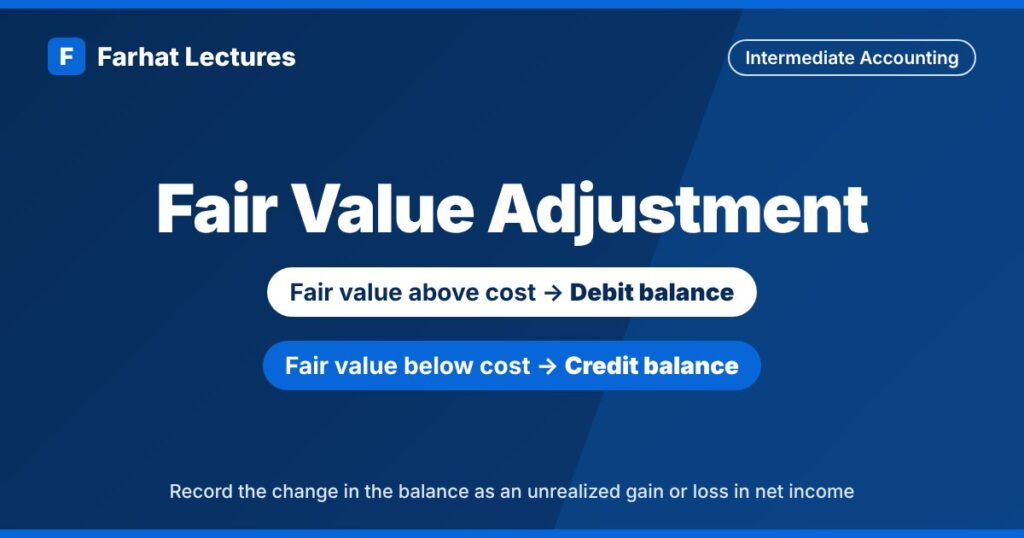
A fair value adjustment is the entry that brings an investment portfolio from cost to fair value at each reporting date. For equity securities, the Fair Value Adjustment account holds total fair value minus total cost. You record only the change needed to reach that balance, and the unrealized holding gain or loss goes to net income.
Why does this matter? Students often record the ending balance instead of the change, or forget that a sale changes what the account should hold. Both mistakes misstate net income. Once you see the account as a running balance you “true up” each period, multi-year problems become routine.
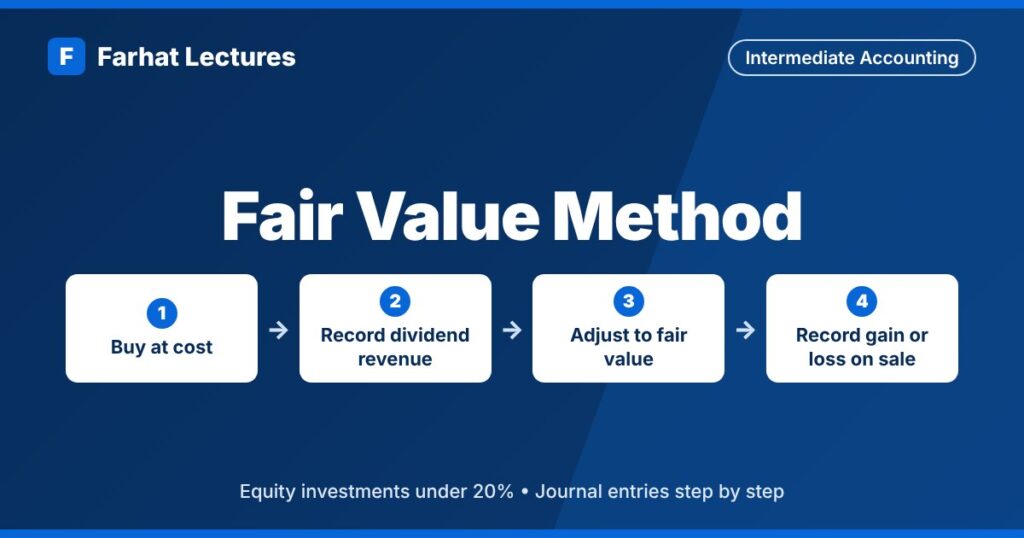
This guide supports the Investments in Equity Securities lesson in the Farhat Lectures Intermediate Accounting course. It builds on the purchase, dividend, and sale entries in fair value method for equity investments.
Watch: Fair Value Adjustments and Mark-to-Market Accounting
Watch this Farhat lesson on YouTube
This video starts at the 7:42 mark of the Farhat Lectures lesson on accounting for equity investments, where Professor Farhat covers fair value adjustments, contra and adjunct accounts, and how a sale affects the adjustment.
How the Fair Value Adjustment account works
The Fair Value Adjustment account is a valuation account. Equity Investments stays at cost, and the Fair Value Adjustment account sits beside it so that together they equal fair value.
| Portfolio position | Required balance | Acts as | Balance sheet result |
|---|---|---|---|
| Fair value above cost | Debit | An adjunct account (adds to cost) | Cost + adjustment = fair value |
| Fair value below cost | Credit | A contra account (subtracts from cost) | Cost − adjustment = fair value |
| Fair value equals cost | Zero | Not needed | Cost = fair value |
The offsetting account is Unrealized Holding Gain or Loss—Income. “Unrealized” means the shares have not been sold. “Income” means the amount goes to net income, as U.S. GAAP requires for equity securities under ASC 321 (see Deloitte’s summary of ASU 2016-01).
One scope note: this applies to equity securities with a readily determinable fair value, meaning a price you can look up, such as a stock traded on a U.S. exchange. For equity securities without one, such as shares in a private company, ASC 321 lets a company elect the measurement alternative: cost less any impairment, adjusted for observable price changes in orderly transactions for an identical or similar investment of the same issuer. Investments accounted for under the equity method, or consolidated, are outside this guide.
How do you calculate a fair value adjustment? 4 steps
| Step | What you do |
|---|---|
| 1. Total the portfolio | Add up the cost and the fair value of the securities still held at the reporting date. |
| 2. Find the required balance | Fair value − cost. Positive means a debit balance; negative means a credit balance. |
| 3. Compare with the existing balance | Look at the Fair Value Adjustment balance carried forward from the last period. |
| 4. Record the difference | Debit or credit the account by the change, with the offset to Unrealized Holding Gain or Loss—Income. |
Example: the first year-end
Example (hypothetical). Harlow Corp. bought shares of Brightway Inc. and Kestrel Co. in 2027, each less than 20% of the investee. At December 31, 2027:
| Investee | Cost | Fair value | Unrealized gain (loss) |
|---|---|---|---|
| Brightway Inc. | $100,500 | $108,000 | $7,500 |
| Kestrel Co. | 120,300 | 112,000 | (8,300) |
| Total portfolio | $220,800 | $220,000 | $(800) |
The required balance is an $800 credit. The account starts at zero, so the whole $800 is recorded:
| December 31, 2027 | Debit | Credit |
|---|---|---|
| Unrealized Holding Gain or Loss—Income | 800 | |
| Fair Value Adjustment | 800 |
Example: the next year, after a sale
In February 2028, Harlow sold all its Brightway shares for $110,400 and recorded a $9,900 realized gain against cost. On June 1, 2028, it bought 3,000 shares of Larkspur Inc. at $30 per share plus a $450 commission, for a cost of $90,450. At December 31, 2028:
Quick note on the $450 commission: this example adds it to cost, which is the common textbook treatment. ASC 321 does not give specific guidance on commissions, and some companies expense them instead. Either way, the shares are reported at fair value at the next reporting date.
| Investee | Cost | Fair value | Unrealized gain (loss) |
|---|---|---|---|
| Kestrel Co. | $120,300 | $126,000 | $5,700 |
| Larkspur Inc. | 90,450 | 87,000 | (3,450) |
| Total portfolio | $210,750 | $213,000 | $2,250 |
| Required balance | $2,250 Dr. | ||
| Existing balance | (800) Cr. | ||
| Adjustment needed | $3,050 Dr. |
| December 31, 2028 | Debit | Credit |
|---|---|---|
| Fair Value Adjustment | 3,050 | |
| Unrealized Holding Gain or Loss—Income | 3,050 |
| Fair Value Adjustment | Debit | Credit |
|---|---|---|
| Balance, December 31, 2027 | 800 | |
| Adjustment, December 31, 2028 | 3,050 | |
| Balance, December 31, 2028 | 2,250 |
The account now holds a $2,250 debit, so the portfolio is reported at $210,750 + $2,250 = $213,000, its fair value. Brightway is gone from the portfolio, so its earlier $7,500 unrealized gain no longer sits in the account.
Unrealized vs. realized gains: why nothing is counted twice
| Unrealized holding gain or loss | Realized gain or loss | |
|---|---|---|
| When it arises | At a reporting date, on shares still held | When shares are sold |
| How it is measured | Change in the Fair Value Adjustment balance | Net proceeds − cost |
| Account used | Unrealized Holding Gain or Loss—Income | Gain (or Loss) on Sale of Investments |
| Reported in net income? | Yes | Yes |
Check Harlow’s two years. Income from fair value changes and sales totals −$800 + $9,900 + $3,050 = $12,150. The true economic result is Brightway’s $9,900 gain, plus Kestrel’s $5,700 increase, minus Larkspur’s $3,450 decline: also $12,150. The 2028 adjustment quietly reversed the $7,500 of Brightway gain that was already recognized in 2027, so it is not counted again.
Where is the fair value adjustment reported?
- Balance sheet: Equity Investments at cost, plus or minus the Fair Value Adjustment, as a current or noncurrent asset depending on management’s intent.
- Income statement: unrealized holding gains under other revenues and gains, and unrealized holding losses under other expenses and losses.
Companies must also disclose how they determined fair value. See fair value disclosures: Level 1, Level 2, and Level 3. For how this method fits with the equity method and consolidation, see investments in equity securities, and for guided practice, the Accounting for Equity Securities lesson in the Intermediate Accounting course.
Where else do you see fair value adjustments?
The term shows up in a few other places, and the rules are not the same. Here is the quick map.
- Equity securities (ASC 321): unrealized gains and losses go to net income. That is what this guide covers.
- Trading debt securities (ASC 320): also adjusted to fair value, with changes in net income.
- Available-for-sale debt securities (ASC 320): measured at fair value. Noncredit unrealized gains and losses generally go to other comprehensive income (OCI) and accumulate in equity as accumulated other comprehensive income (AOCI). Under ASC 326, credit losses are generally recognized in net income through an allowance.
- Held-to-maturity debt securities: reported at amortized cost, so there is no fair value adjustment.
- Business combinations (ASC 805): the buyer records the acquired company’s identifiable assets and liabilities at fair value on the acquisition date. These step-ups, for example on inventory or equipment, are often called fair value adjustments, and they later flow through cost of goods sold or depreciation.
Not sure which bucket an investment falls into? Start with how ownership level sets the accounting.
Key takeaways on the fair value adjustment
- The Fair Value Adjustment account holds total fair value minus total cost for securities still held.
- Record only the change from the existing balance to the required balance.
- A debit balance adds to cost; a credit balance subtracts from it.
- For equity securities, unrealized holding gains and losses go to net income.
- Securities sold during the year drop out of the next adjustment, which removes their earlier unrealized gains or losses.
Common mistakes
- Recording the required ending balance as the entry instead of the change.
- Leaving sold securities in the year-end portfolio.
- Mixing two sale methods. Some textbooks first update a sold security to fair value on the sale date, so the sale itself shows little or no gain. Others, like this guide, record the sale against cost and let the next reporting-date adjustment clean up the account. Both give the same total income, so pick one method and stick with it for the whole problem.
- Reporting unrealized gains on equity securities in other comprehensive income. Under U.S. GAAP they go to net income. (IFRS 9 is different: a company can make an irrevocable election to send fair value changes on certain equity investments to other comprehensive income.)
- Mixing up the sign: a credit balance means fair value is below cost.
CPA exam tip: Read the question stem twice. Some questions ask for the adjusting entry, and others ask for the ending balance of the Fair Value Adjustment account. The wrong answers usually include both numbers, so make sure you pick the one being asked for.
Practice questions with answers
1. A new portfolio has a cost of $50,000 and a year-end fair value of $47,000. What is the entry?
Answer: Debit Unrealized Holding Gain or Loss—Income $3,000; credit Fair Value Adjustment $3,000. The required balance is a $3,000 credit, and the account started at zero.
2. The next year, the Fair Value Adjustment has a $3,000 credit balance. The portfolio’s cost is $50,000 and its fair value is $52,500. What is the entry?
Answer: The required balance is a $2,500 debit. Moving from a $3,000 credit to a $2,500 debit takes a $5,500 debit. Debit Fair Value Adjustment $5,500; credit Unrealized Holding Gain or Loss—Income $5,500.
3. The Fair Value Adjustment has a $4,000 debit balance. The portfolio’s cost is $80,000 and its fair value is $81,000. What is the entry?
Answer: The required balance is a $1,000 debit, so the account must fall by $3,000. Debit Unrealized Holding Gain or Loss—Income $3,000; credit Fair Value Adjustment $3,000. That is an unrealized loss of $3,000, even though fair value is still above cost.
Want more reps before exam day? The Farhat Lectures FAR Test Bank has exam-style questions on investments and the rest of FAR, with explanations for every answer.
Warm-up practice: stock purchases and cash dividends
Use these four questions to practice the fair value method for equity securities. Record the initial stock purchase, identify when to recognize cash dividend revenue, and determine how a passive investor treats the investee’s reported net income. These entries provide the foundation for the year-end fair value adjustments covered in this guide.
Fair Value Method for Equity Securities: Stock Purchases and Cash Dividends
Select one answer per question, then use Check my work to review your answers. All amounts are in dollars.
Frequently asked questions
What is the Fair Value Adjustment account?
It is a valuation account that sits beside Equity Investments. Its balance equals the portfolio’s total fair value minus total cost, so the two accounts together report the investments at fair value while the cost stays on record.
Is the Fair Value Adjustment a contra asset or an adjunct account?
It can be either. A credit balance reduces the investment (contra asset) when fair value is below cost, and a debit balance increases it (adjunct account) when fair value is above cost.
Where do unrealized holding gains and losses on equity securities go?
To net income, reported under other revenues and gains or other expenses and losses. Under ASC 321, equity investments measured at fair value do not use other comprehensive income.
Do you adjust the Fair Value Adjustment account when you sell shares?
Not in the approach shown here, though some textbooks update the sold shares to fair value on the sale date first. Both methods give the same total income. The sale is recorded against cost, and the next reporting-date adjustment removes the sold shares from the portfolio, which reverses any unrealized gain or loss previously recorded on them.
Can a company skip the Fair Value Adjustment account?
Some companies adjust the investment account directly. The reported fair value and net income are the same; the separate account simply keeps the original cost visible, which makes it easy to measure realized gains and losses.
What is the journal entry for a fair value adjustment?
Compare the required Fair Value Adjustment balance with the existing balance, treating debits as positive and credits as negative. Subtract the existing balance from the required balance. A positive difference means debit Fair Value Adjustment and credit Unrealized Holding Gain—Income. A negative difference means debit Unrealized Holding Loss—Income and credit Fair Value Adjustment. If the difference is zero, no entry is needed.
Is a fair value adjustment the same as an impairment?
No. Equity securities measured at fair value through net income are remeasured each reporting date without a separate impairment test. Securities under the measurement alternative are carried at cost less any impairment, adjusted for observable price changes in orderly transactions for an identical or similar investment of the same issuer.
How is the fair value adjustment different for available-for-sale debt securities?
Available-for-sale debt securities are also measured at fair value. Noncredit unrealized gains and losses generally go to other comprehensive income (OCI) and accumulate in equity as AOCI. Credit losses are generally recognized separately in net income through an allowance.
About the author
Mansour Farhat, CPA, CIA, DBA, is the instructor behind Farhat Lectures, where he teaches accounting students and CPA, CMA, and EA candidates through video lessons and practice questions. Read more about Professor Farhat.
Continue learning with Farhat Lectures
Strengthen your accounting understanding with clear explanations and guided practice.
Explore the free sample course



Responses