
Small vs. Large Stock Dividend: Journal Entries and Effects on Equity

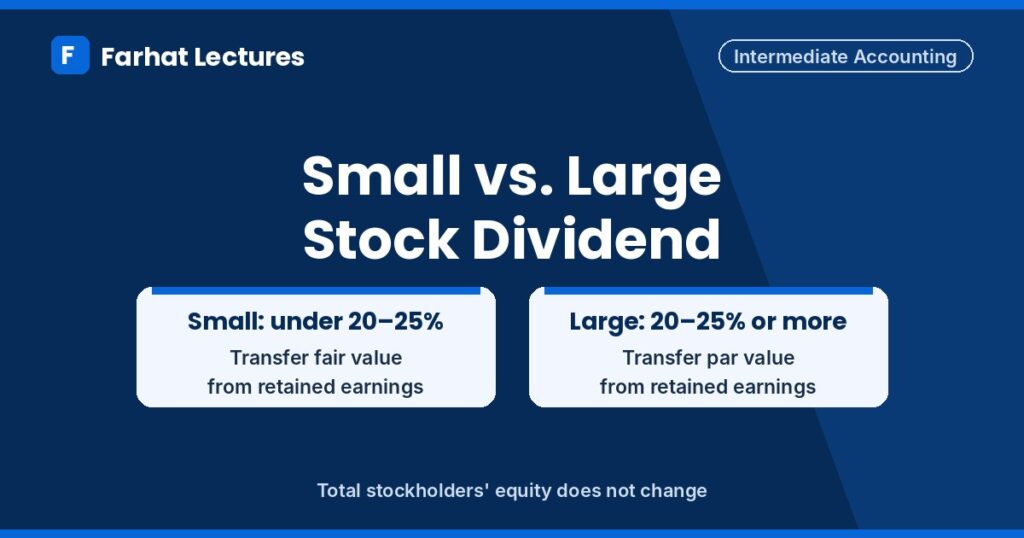
A small stock dividend (less than about 20–25% of shares outstanding) moves the fair value of the new shares out of retained earnings. A large stock dividend (about 20–25% or more) moves only their par or stated value. Either way, total stockholders’ equity, total assets, and each owner’s percentage stay the same.
A stock dividend lets a profitable company reward stockholders without paying out cash. It is also a classic topic on the CPA exam’s Financial Accounting and Reporting (FAR) section and in intermediate accounting courses, because the journal entry depends on the size test, and because students often treat the dividend distributable account as a liability.
This guide defines a stock dividend, explains the 20–25% threshold, shows the declaration and distribution entries for both sizes, and proves with numbers that total equity and ownership percentages do not change.
Watch: Small Stock Dividend | Large Stock Dividend
This Farhat Lectures video shows how small stock dividends are recorded at fair value, how large stock dividends are recorded at par value, and what each does to stockholders’ equity.
What is a stock dividend?
A stock dividend is a pro rata issuance of a corporation’s own shares to its stockholders without receiving anything in return. Pro rata means each stockholder gets new shares in proportion to the shares already owned. No assets leave the company.
Companies issue stock dividends to conserve cash, to give stockholders something visible when cash is short, or to capitalize part of retained earnings. Capitalizing means permanently moving an amount from earned capital (retained earnings) to contributed capital, so it is no longer available for cash dividends.
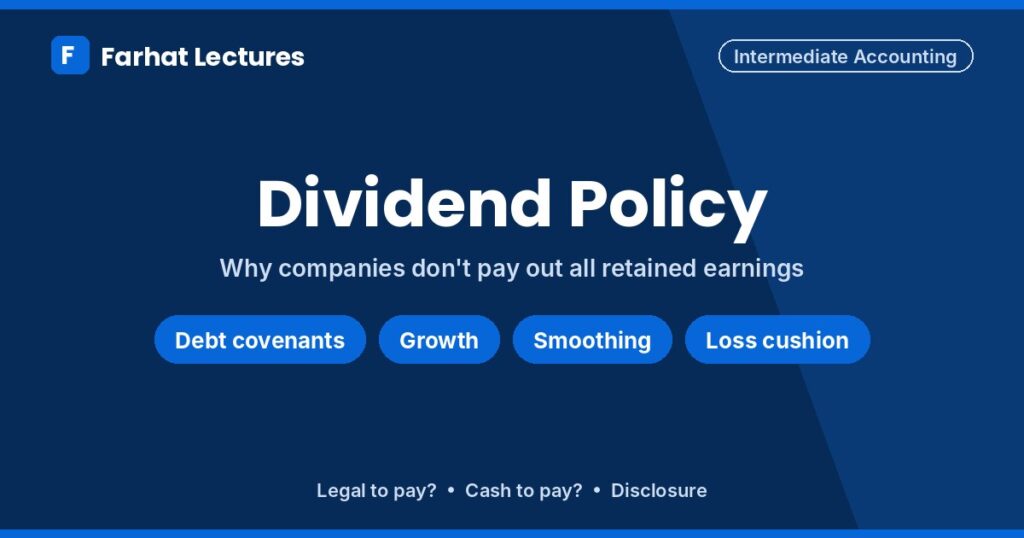
Stock dividends are part of the company’s broader dividend policy. Unlike cash dividends, they do not create a liability.
Small vs. large stock dividend: the 20–25% test
| Small (ordinary) stock dividend | Large stock dividend | |
|---|---|---|
| Size | Less than about 20–25% of the common shares outstanding | About 20–25% or more of the common shares outstanding |
| Amount moved out of retained earnings | Fair value of the new shares on the declaration date | Par or stated value of the new shares |
| Credit to Common Stock Dividend Distributable | Par value of the new shares | Par value of the new shares |
| Credit to Paid-in Capital in Excess of Par | Fair value minus par value | None |
| Reasoning | The new shares are too few to change the market price much, so their fair value is meaningful | So many new shares are issued that the market price per share is expected to fall materially, much like a stock split, so the fair value of the new shares is not a meaningful measure |
This size test comes from ASC 505-20 in the FASB Accounting Standards Codification. The range of 20–25% is a guideline, not a single bright line, so distributions in that range require judgment about whether the market price is likely to change materially. You may also see 25% used as the working cutoff, because an SEC release from 1972 described the line that way. If a problem gives a percentage inside the 20–25% range, follow any instruction in the problem about which treatment to use.
Why use fair value for a small one? The guidance reasons that many stockholders see a small stock dividend as a distribution of earnings worth the market value of the shares they receive. Critics push back, since the stockholder really receives nothing new: the same company is simply cut into more slices.
How to record a small stock dividend (example)
Brookfield Tools Inc. (a hypothetical company) has 200,000 shares of $1 par common stock outstanding. On October 1 it declares a 10% stock dividend, distributable October 25. The fair value on October 1 is $24 per share.
New shares = 200,000 × 10% = 20,000. Fair value transferred = 20,000 × $24 = $480,000. Par value = 20,000 × $1 = $20,000.
October 1: date of declaration
| Account | Debit | Credit |
|---|---|---|
| Retained Earnings (20,000 × $24) | 480,000 | |
| Common Stock Dividend Distributable (20,000 × $1) | 20,000 | |
| Paid-in Capital in Excess of Par—Common Stock | 460,000 |
October 25: date of distribution
| Account | Debit | Credit |
|---|---|---|
| Common Stock Dividend Distributable | 20,000 | |
| Common Stock | 20,000 |
Between declaration and distribution, Common Stock Dividend Distributable is reported in stockholders’ equity, right after common stock. It is not a liability, because the company owes shares, not assets.
What about the date of record? No journal entry is made on that date. It only fixes which stockholders will receive the new shares, the same as the record date for a cash dividend.
How to record a large stock dividend (example)
Now assume Brookfield declares a 40% stock dividend instead. New shares = 200,000 × 40% = 80,000. Because the dividend is large, only par value is transferred: 80,000 × $1 = $80,000. The $24 fair value is ignored.
Date of declaration
| Account | Debit | Credit |
|---|---|---|
| Retained Earnings (80,000 × $1) | 80,000 | |
| Common Stock Dividend Distributable | 80,000 |
Date of distribution
| Account | Debit | Credit |
|---|---|---|
| Common Stock Dividend Distributable | 80,000 | |
| Common Stock | 80,000 |
Under ASC 505-20, any large stock dividend is treated as a stock split in substance, because it is big enough to push the market price per share down sharply, the way a split does. That is why accountants describe it as a “stock split effected in the form of a dividend.” A 40% dividend and a 100% dividend both fall in this group. See stock dividend vs. stock split for how it compares with an ordinary split.
Exam trap: a small dividend can take more out of retained earnings
Compare the two Brookfield examples. The 10% stock dividend took $480,000 out of retained earnings, but the 40% stock dividend took only $80,000, even though it issued four times as many shares. That happens because the small dividend is measured at the $24 fair value per share and the large one at the $1 par value. Exam questions like to test whether you notice this, so always classify the dividend as small or large before you multiply.
Does a stock dividend change total equity or ownership?
Assume Brookfield’s equity before the 10% stock dividend was common stock $200,000, paid-in capital in excess of par $1,800,000, and retained earnings $3,000,000.
| Account | Before | After 10% stock dividend |
|---|---|---|
| Common stock ($1 par) | $200,000 (200,000 shares) | $220,000 (220,000 shares) |
| Paid-in capital in excess of par | $1,800,000 | $2,260,000 |
| Retained earnings | $3,000,000 | $2,520,000 |
| Total stockholders’ equity | $5,000,000 | $5,000,000 |
| Book value per share | $25.00 | $22.73 |
Total equity is unchanged; $480,000 simply moved from retained earnings to contributed capital. Book value per share falls because the same equity is spread over more shares.
You would show this movement in the statement of stockholders’ equity, where the stock dividend appears as a decrease in the retained earnings column and increases in the common stock and paid-in capital columns.
Each stockholder’s ownership percentage also stays the same. An investor who owned 15,000 shares held 7.5% (15,000 ÷ 200,000). After receiving 1,500 new shares, the investor holds 16,500 of 220,000 shares, still 7.5%.
How do stock dividends affect earnings per share?
Earnings per share (EPS) is net income available to common stockholders divided by the weighted-average number of common shares outstanding. A stock dividend adds shares without bringing in any new resources, so under ASC 260, Earnings per Share, you treat the new shares as if they had been outstanding for every period shown, not just from the distribution date.
Example: Brookfield (still hypothetical) has no preferred stock and no other share changes. It reported net income of $990,000 last year and $1,100,000 this year, and it distributed the 10% stock dividend on October 25 of this year.
| Year | Net income | Shares used | EPS |
|---|---|---|---|
| Last year, as originally reported | $990,000 | 200,000 | $4.95 |
| Last year, restated | $990,000 | 220,000 | $4.50 |
| This year | $1,100,000 | 220,000 | $5.00 |
The same rule applies when the stock dividend happens after year-end but before the financial statements are issued. EPS for that year and any earlier years shown is based on the new number of shares.
Stock dividends and treasury shares
Some state laws prohibit issuing stock dividends on treasury shares. Where it is allowed, a company may include treasury shares when it plans to use them for something specific, such as employee stock options whose share counts are adjusted for stock dividends. Otherwise, issuing shares to treasury stock serves no purpose, because treasury shares are essentially authorized but unissued shares. For exam problems, compute the stock dividend on shares outstanding unless told otherwise. For a refresher, see what treasury stock is and why companies buy back shares.
Key takeaways: small vs. large stock dividend
- Small vs. large stock dividend accounting turns on size: less than about 20–25% is small, about 20–25% or more is large.
- Small: debit Retained Earnings for fair value; credit Common Stock Dividend Distributable for par and paid-in capital for the excess.
- Large: debit Retained Earnings and credit Common Stock Dividend Distributable for par value only.
- Common Stock Dividend Distributable is equity, not a liability.
- Total equity, total assets, and ownership percentages do not change.
- EPS is restated for all periods shown, as if the new shares had always been outstanding.
Common mistakes
- Classifying Common Stock Dividend Distributable as a liability.
- Using fair value for a large stock dividend, or par value for a small one.
- Using fair value on the distribution date instead of the declaration date.
- Computing the new shares from shares authorized or issued instead of shares outstanding.
- Saying a stock dividend reduces total stockholders’ equity.
- Assuming a bigger stock dividend always takes more out of retained earnings.
- Recording a journal entry on the date of record.
- Forgetting to restate prior-period EPS for the new shares.
Practice questions with answers
1. A company with 500,000 shares of $5 par common stock outstanding declares a 6% stock dividend when the fair value is $30 per share. Record the declaration.
| Account | Debit | Credit |
|---|---|---|
| Retained Earnings (30,000 × $30) | 900,000 | |
| Common Stock Dividend Distributable (30,000 × $5) | 150,000 | |
| Paid-in Capital in Excess of Par—Common Stock | 750,000 |
Why: 500,000 × 6% = 30,000 new shares. A 6% dividend is small, so fair value is used.
2. Same company, but the stock dividend is 30%. Record the declaration.
| Account | Debit | Credit |
|---|---|---|
| Retained Earnings (150,000 × $5) | 750,000 | |
| Common Stock Dividend Distributable | 750,000 |
Why: 500,000 × 30% = 150,000 new shares. A 30% dividend is large, so only par value is transferred.
3. An investor owns 2,000 of a company’s 40,000 outstanding shares. The company issues a 10% stock dividend. How many shares does the investor own afterward, and what is the ownership percentage?
Answer: 2,200 shares (2,000 + 200), out of 44,000 shares outstanding. Ownership stays at 5% (2,000 ÷ 40,000 before; 2,200 ÷ 44,000 after).
Interactive quiz: small vs. large stock dividends
Check your understanding with four quick questions on how to classify a stock dividend as small or large, which amount leaves retained earnings in each case, and how the credits are split between Common Stock Dividend Distributable and Paid-in Capital in Excess of Par. Pick your answers, then select Check my work to see how each one is solved. To review the rule first, go back to the 20–25% test.
Frequently asked questions
What is the difference between a small and a large stock dividend?
A small stock dividend is less than about 20–25% of the common shares outstanding and is recorded at the fair value of the shares issued. A large stock dividend is about 20–25% or more and is recorded at par or stated value.
Is Common Stock Dividend Distributable a liability?
No. It is a stockholders’ equity account, reported with common stock, because the company will settle it by issuing its own shares, not by paying assets.
Does a stock dividend change total stockholders’ equity?
No. It moves an amount from retained earnings to contributed capital. Total equity, total assets, and each stockholder’s percentage ownership stay the same.
Which fair value is used for a small stock dividend?
The fair value (market price) of the shares on the date of declaration.
Do treasury shares receive stock dividends?
Generally no. Some state laws prohibit it, and treasury shares are basically authorized but unissued shares, so giving them new shares usually accomplishes nothing. Compute the dividend on shares outstanding unless a problem says otherwise.
Is a stock dividend taxable to the stockholder?
Usually not. Under Internal Revenue Code Section 305(a), a corporation’s distribution of its own stock to its stockholders is generally not taxable. Section 305(b) lists exceptions, such as when stockholders can choose cash instead of shares. The stockholder spreads the original cost basis over the old and new shares.
How does an investor record a stock dividend?
The investor records no income. They update the share count and spread the same total cost over more shares. For example, 1,000 shares that cost $20,000 ($20 per share) become 1,100 shares at about $18.18 per share after a 10% stock dividend.
Can a large stock dividend reduce retained earnings less than a small one?
Yes. A small stock dividend is measured at fair value, while a large one is measured at par. In this guide’s example, a 10% dividend reduced retained earnings by $480,000, but a 40% dividend reduced it by only $80,000.
About the author
Mansour Farhat, CPA, CIA, DBA, is the instructor behind Farhat Lectures, where he teaches accounting and exam prep for CPA, CMA, and EA candidates through online courses and the Farhat Lectures YouTube channel. Read more about Mansour.
Continue learning with Farhat Lectures
Strengthen your accounting understanding with clear explanations and guided practice.
Explore the free sample course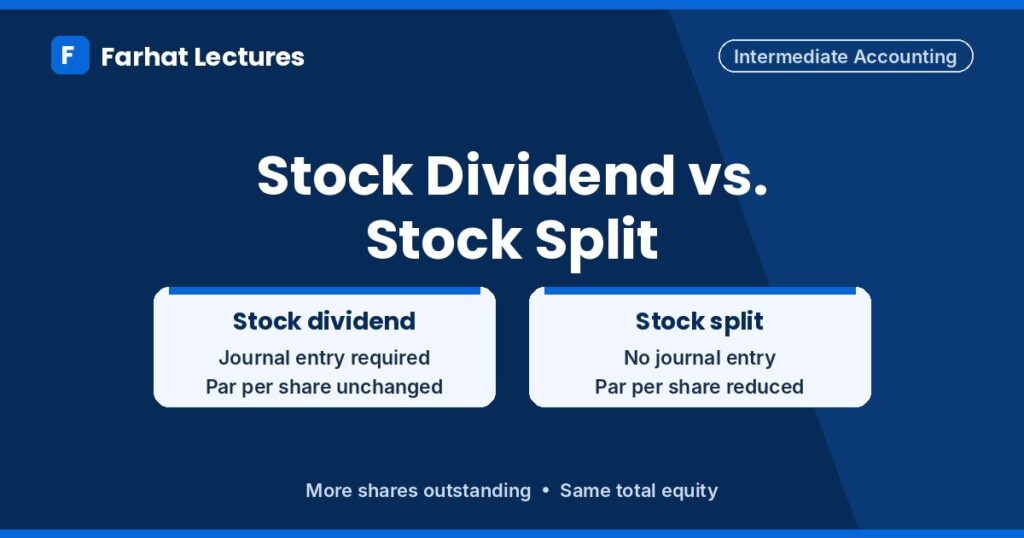
Responses