
Elements of Financial Statements: 10 Essential Definitions

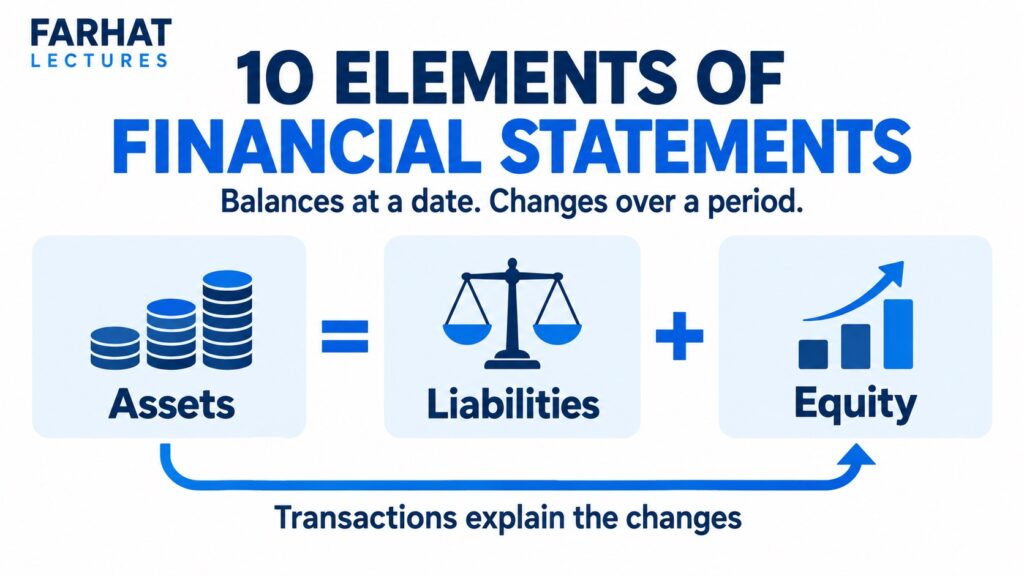
The elements of financial statements are the basic categories used to describe an entity’s financial position and the changes in it. The FASB framework identifies ten: assets, liabilities, equity, investments by owners, distributions to owners, comprehensive income, revenues, expenses, gains, and losses.
Three describe a position at a date. The other seven describe changes over a period. Understanding that distinction helps you avoid calling every cash receipt revenue or every cash payment an expense.
Practice as you learn: Try the Elements of Financial Statements Interactive Exercise — match six FASB elements with their definitions.
Watch: Elements of Financial Statements
Watch Farhat Lectures’ explanation of the ten elements of financial statements, then use the table below to review the definitions and examples. As you study, distinguish financial position at a date from changes over a period, and separate owner transactions from business performance.
The ten elements of financial statements
The table below paraphrases the concepts in FASB Concepts Statement 8, Chapter 4. The illustrations are hypothetical learning examples, not a replacement for transaction-specific accounting standards.
| Element | Plain-language meaning | Simple illustration |
|---|---|---|
| 1. Assets | Existing rights to economic benefits | A right to collect cash from a customer |
| 2. Liabilities | Existing obligations to transfer economic benefits | An amount owed to a supplier |
| 3. Equity | What remains after liabilities are deducted from assets | Owners’ residual interest |
| 4. Investments by owners | Contributions received in exchange for ownership interests | An owner contributes cash for shares |
| 5. Distributions to owners | Transfers to owners that reduce their equity | A cash dividend |
| 6. Comprehensive income | Nonowner changes in equity over the period | The total effect of income-related changes |
| 7. Revenues | Increases in assets or reductions of liabilities from providing goods, services, or other activities | Fees from completed repair services |
| 8. Expenses | Assets used or obligations incurred in providing goods, services, or other activities | Wages for services received |
| 9. Gains | Other increases in equity, excluding revenues and owner investments | A gain on selling used office equipment |
| 10. Losses | Other decreases in equity, excluding expenses and owner distributions | A loss on selling used office equipment |
Assets, liabilities, and equity: a position at a date
These three elements answer a snapshot question: “What is the entity’s position now?” The familiar equation is Assets = Liabilities + Equity. Rearranging it gives Equity = Assets − Liabilities.
Hypothetical example: Willow Services reports $75,000 of assets and $28,000 of liabilities at December 31. Its equity is $47,000. That residual is not a separate pile of cash. The assets may include several kinds of resources.
An asset is not simply any valuable thing associated with a business. Identify the present right. Employees may be highly skilled, but calling them valuable does not by itself establish an asset the company can recognize.
Likewise, a liability is an existing obligation, not merely management’s intention to spend money someday. The definition matters before you debate the amount.
Owner transactions and performance are different
If an owner contributes $8,000 in exchange for an ownership interest, the company’s cash and equity increase. That increase is an investment by an owner, not revenue earned from a customer.
If the company later distributes $2,000 to owners in their capacity as owners, equity decreases. That distribution is not an expense of earning revenue. Always identify why the company received or transferred resources.
Revenues, expenses, gains, and losses describe nonowner effects that contribute to comprehensive income. Comprehensive income is an inclusive measure of nonowner equity changes; it should not be added again on top of its components.
Revenue vs gain, expense vs loss
Students sometimes use “revenue” for every positive amount and “expense” for every negative amount. Classification requires attention to the underlying activity.
Hypothetical example: A repair business earns $3,000 by fixing customers’ equipment. That illustrates service revenue. If it sells an old office desk with a carrying amount of $200 for $260, the $60 difference illustrates a gain; the $260 proceeds are not all gain.
If the same desk sells for $170, the $30 difference illustrates a loss. By contrast, wages for the repair work illustrate an expense. These examples establish the vocabulary without extending into disposal journal entries or detailed standards.
The labels “usual” and “unusual” can be clues, but do not use frequency as the only test. Ask what the transaction represents in the entity’s activities and apply the relevant definitions.
How the statements connect: articulation
Articulation means related figures connect across financial statements. Period changes help explain the movement between beginning and ending balances.
Hypothetical example: Willow begins the year with $47,000 of equity. Owners invest $8,000, the business has $12,000 of comprehensive income, and it distributes $2,000 to owners. Assuming no other changes, ending equity is $65,000:
$47,000 + $8,000 + $12,000 − $2,000 = $65,000
Do not call the full $18,000 increase in equity comprehensive income. The net $6,000 from owner transactions explains part of that increase. Separating owner and nonowner changes is the key.
This connection illustrates why the conceptual framework defines both balances and changes. The statements describe one entity from related perspectives.
Definition is not the same as recognition
Knowing that an item fits a definition starts the analysis. It does not automatically settle when or at what amount the item appears in financial statements. Recognition and measurement add those questions.
Also avoid counting cash twice in your thinking. A loan receipt increases cash but creates an obligation. A customer payment may settle an existing receivable. Neither fact alone proves new revenue arose at the moment cash arrived.
Clear classification supports faithful representation and comparability. Readers need to distinguish performance from financing and owner transactions.
Practice questions with explanations
1. Assets are $92,000 and liabilities are $37,000. What is equity?
Answer: $55,000. Equity is the residual: $92,000 − $37,000. It does not necessarily equal the company’s cash balance.
2. An owner contributes $15,000 for shares. Is that revenue?
Answer: No. It is an investment by an owner. Cash and equity increase through an ownership transaction rather than earnings.
3. Equity increases by $11,000, including $4,000 of owner investment and no distributions. What is comprehensive income?
Answer: $7,000, assuming no other owner changes. Remove the owner contribution from the total equity increase: $11,000 − $4,000.
Frequently asked questions
Are elements the same as financial statements?
No. Elements are categories such as assets and expenses. Statements organize information about those categories.
Is comprehensive income always net income?
No. Comprehensive income includes net income and other comprehensive income. This introductory lesson focuses on its distinction from owner transactions.
Why are there ten elements if I learned five before?
Different frameworks and introductory teaching summaries group items differently. This lesson follows the FASB framework’s ten-element classification.

Responses