
Classified Financial Statements: Definition, Format, and Example

Classified financial statements are financial statements that group similar items into labeled categories, such as current and noncurrent assets and liabilities on the balance sheet, or operating and nonoperating items on the income statement. Balance sheet classification is addressed by ASC 210 under U.S. GAAP and IAS 1 under IFRS; income statement and cash flow presentation follow their respective standards.
Liquidity is the ability to meet short-term obligations; solvency is the ability to meet long-term obligations. Classification helps readers assess both, compare operating performance, and understand operating, investing, and financing cash flows.
You will see the term classified balance sheet far more often than classified financial statements, because the balance sheet is where the current and noncurrent split lives. ASC 210-10-45 in U.S. GAAP and IAS 1 paragraph 60 in IFRS both address it. A full set of financial statements also includes a statement of stockholders’ equity and a statement of comprehensive income, but those are not usually described as classified in the current and noncurrent sense. Every statement on this page is covered in depth, with video lessons and practice, in our Intermediate Accounting Course.
How Are Items Classified Across Financial Statements?
How Is a Classified Balance Sheet Organized?
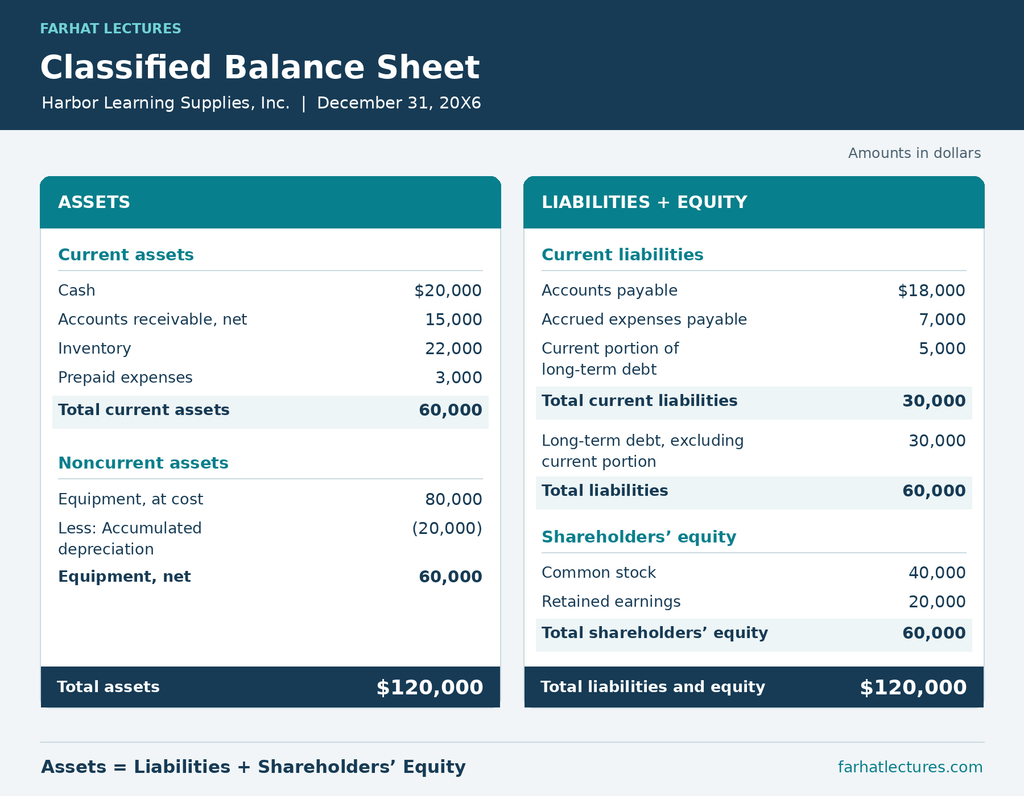
A classified balance sheet, also called a statement of financial position, splits assets and liabilities into current and noncurrent groups. U.S. companies commonly list current assets first, generally in order of liquidity. Each group gets its own subtotal. For a detailed explanation of the categories, see our classified balance sheet guide. Equity usually shows paid-in capital, retained earnings, treasury stock as a deduction, and accumulated other comprehensive income. If the terms assets, liabilities, and equity are new to you, start with our guide to the elements of financial statements.
- Assets:
- Current Assets
- Cash and Cash Equivalents
- Accounts Receivable
- Inventory
- Prepaid Expenses
- Non-Current Assets
- Property, Plant, and Equipment
- Intangible Assets
- Investments
- Long-term Receivables
- Current Assets
- Liabilities:
- Current Liabilities
- Accounts Payable
- Short-term Debt
- Accrued Liabilities
- Current Portion of Long-Term Debt
- Non-Current Liabilities
- Long-Term Debt
- Deferred Tax Liabilities
- Other Long-Term Liabilities
- Current Liabilities
- Equity:
- Common Stock
- Retained Earnings
- Additional Paid-in Capital
Video: Classified Balance Sheet Explained
Watch Professor Farhat explain the classification of assets, liabilities, and shareholders’ equity. This segment reinforces the balance-sheet categories outlined above before you continue to the income statement.
Selected segment: 1:41–10:30. Watch the complete lesson on YouTube.
How Is a Classified (Multi-Step) Income Statement Organized?
A classified income statement is usually called a multi-step income statement. It separates operating items from nonoperating items such as interest income and interest expense, and it reports subtotals along the way. A single-step income statement, by contrast, lists all revenues, then all expenses, and shows one net income figure. For public companies, FASB’s ASU 2024-03 adds a note disclosure that breaks certain expense captions into natural categories such as employee compensation and depreciation for annual periods beginning after December 15, 2027. Interim reporting requirements apply to interim periods within annual periods beginning after December 15, 2028. Early adoption is permitted. It does not change the face of the income statement.
- Revenue:
- Sales Revenue
- Service Revenue
- Other Operating Revenues
- Expenses:
- Cost of Goods Sold (COGS)
- Selling, General, and Administrative (SG&A) Expenses
- Research and Development (R&D) Expenses
- Interest Expense
- Income Tax Expense
- Key subtotals:
- Gross profit (revenue minus cost of revenue, including goods sold and services provided)
- Operating income (gross profit minus operating expenses), then income before income taxes (operating income plus or minus nonoperating items such as interest), then net income (income before income taxes minus income tax expense)
How Is the Statement of Cash Flows Classified?
The statement of cash flows is not classified as current and noncurrent. Instead, ASC 230 (U.S. GAAP) and IAS 7 (IFRS) sort every cash flow into three activities: operating, investing, and financing. The list below shows the direct method, which reports actual cash receipts and payments. Most U.S. companies use the indirect method, which starts with net income and adjusts it for noncash items and changes in working capital, but both methods end with the same total for operating cash flow. Practice sorting cash flows with the statement of cash flows classification exercise.
- Operating Activities:
- Cash collected from customers
- Cash paid to suppliers
- Cash paid to employees
- Other operating cash flows
- Investing Activities:
- Purchase of property, plant, and equipment
- Sale of investments
- Acquisition of other businesses
- Financing Activities:
- Issuance of debt
- Repayment of debt
- Issuance of equity
- Dividends paid
These examples illustrate how financial statements can be classified to provide a clearer picture of a company’s financial position, performance, and cash flow. Keep in mind that the specific line items and categories may vary depending on the industry and accounting standards followed by the company.
How Do U.S. GAAP and IFRS Classify Financial Statements Differently?
U.S. Generally Accepted Accounting Principles (GAAP), set by the Financial Accounting Standards Board (FASB), and International Financial Reporting Standards (IFRS), set by the International Accounting Standards Board (IASB), both classify financial statement items. The categories look similar, but six presentation topics merit comparison. These are the differences that matter for classification. For differences in how items are measured, such as LIFO inventory or the revaluation of property, see our FASB vs IASB comparison.
Six classification topics under U.S. GAAP and IFRS
1. Is a current and noncurrent split required?
GAAP: ASC 210-10-45 describes the current and noncurrent classification, and most commercial and industrial companies present a classified balance sheet. Banks and insurers usually present an unclassified balance sheet because the one-year split is not meaningful for them.
IFRS: IAS 1 paragraph 60 requires current and noncurrent classification unless a presentation based on liquidity gives information that is reliable and more relevant.
2. In what order are items shown?
GAAP: U.S. practice commonly lists current assets first, generally in order of liquidity, and liabilities before equity. SEC registrants must also follow applicable Regulation S-X presentation requirements.
IFRS: IAS 1 does not prescribe the order either, and many IFRS companies show noncurrent assets first and equity before liabilities. Do not treat a reversed order as an error on the exam.
3. Where do deferred taxes go?
GAAP: All deferred tax assets and liabilities are noncurrent (ASU 2015-17).
IFRS: Deferred tax assets and liabilities are never classified as current (IAS 1 paragraph 56).
Both frameworks require noncurrent presentation of deferred taxes on a classified balance sheet.
4. Can short-term debt be shown as noncurrent if it will be refinanced?
GAAP: Yes, if the company intends to refinance on a long-term basis and shows the ability to do so, either by completing a long-term refinancing after year end but before the financial statements are issued, or by having a qualifying financing agreement in place (ASC 470-10-45-14).
IFRS: Classification depends only on the rights that exist at the balance sheet date. A refinancing completed after year end does not change the classification, so the debt stays current (IAS 1 paragraphs 72 to 76).
5. What format does the income statement use?
GAAP: Both a single-step format and a multi-step format are allowed. Neither is required.
IFRS: Today, IAS 1 requires certain minimum line items and lets companies present expenses by nature or by function. Starting with annual periods beginning on or after January 1, 2027, IFRS 18 replaces IAS 1 and requires income and expenses to be classified into five categories (operating, investing, financing, income taxes, and discontinued operations) and introduces defined subtotals, including operating profit and profit before financing and income taxes. Specific rules apply to entities that invest in assets or provide financing to customers as a main business activity; some such entities do not present the latter subtotal. Early adoption is permitted.
6. How are interest and dividends classified on the statement of cash flows?
GAAP: Interest paid, interest received, and dividends received are operating. Dividends paid are financing (ASC 230).
IFRS: Under IAS 7, interest paid may be operating or financing, interest and dividends received may be operating or investing, and dividends paid may be operating or financing. IFRS 18 narrows these choices for most companies from 2027.
Both frameworks aim to give investors and creditors relevant and comparable information, and both change over time, so check the current standard before relying on any summary.
Primary sources: the full list of IFRS Accounting Standards on IFRS.org and the FASB Accounting Standards Codification on FASB.org.
Worked Examples of Classified Financial Statements
Example: Classified (Multi-Step) Income Statement
XYZ Corporation Classified Income Statement for the Year Ended December 31, 20XX
| Line item | Amount ($) |
|---|---|
| Revenue | |
| Product A sales | 2,000,000 |
| Product B sales | 1,500,000 |
| Service revenue | 800,000 |
| Total revenue | 4,300,000 |
| Cost of revenue | |
| Cost of goods sold, Product A | 1,200,000 |
| Cost of goods sold, Product B | 900,000 |
| Cost of services | 400,000 |
| Total cost of revenue | 2,500,000 |
| Gross profit | 1,800,000 |
| Operating expenses | |
| Selling expenses | 500,000 |
| General and administrative expenses | 300,000 |
| Research and development expenses | 150,000 |
| Total operating expenses | 950,000 |
| Operating income | 850,000 |
| Other income and expenses | |
| Interest income | 50,000 |
| Interest expense | (30,000) |
| Other gains (losses) | 20,000 |
| Total other income and expenses | 40,000 |
| Income before income taxes | 890,000 |
| Income tax expense | (200,000) |
| Net income | 690,000 |
This is a simplified example, but you can see that revenue is classified by product and service lines, and expenses are categorized into cost of revenue and various operating expenses. This classification provides a more detailed view of the company’s financial performance for internal and external reporting purposes. Remember that the level of detail and specific classifications may vary based on the company’s industry, accounting policies, and reporting requirements.
Example: Classified Balance Sheet (Statement of Financial Position)
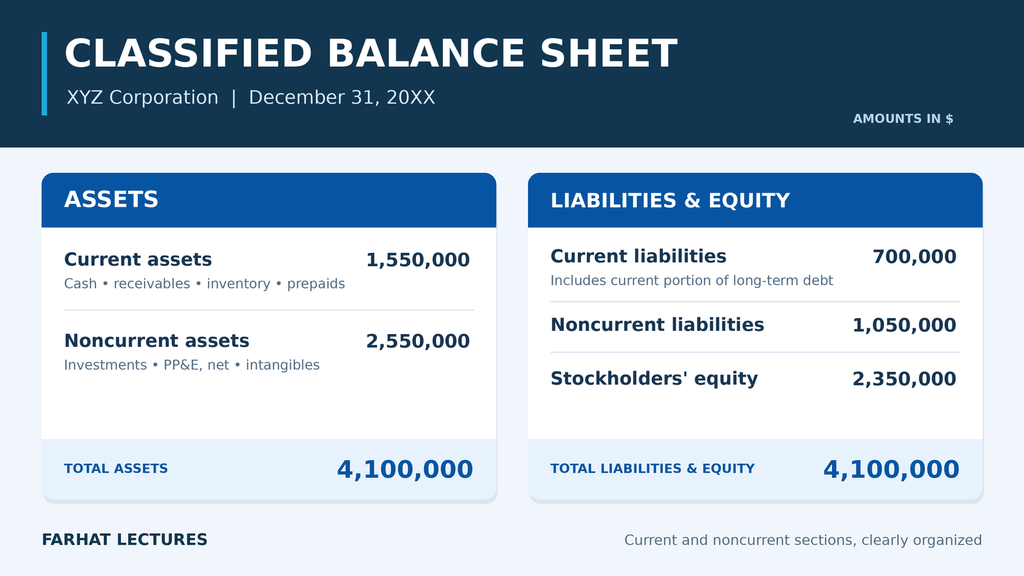
Here is the same company’s balance sheet at year end, using the same classification logic. Notice the subtotals for current assets and current liabilities. Those two numbers drive the liquidity ratios in the next section.
XYZ Corporation Classified Balance Sheet at December 31, 20XX
| Line item | Amount ($) |
|---|---|
| Current assets | |
| Cash and cash equivalents | 350,000 |
| Accounts receivable, net of allowance for credit losses | 620,000 |
| Inventory | 540,000 |
| Prepaid expenses | 40,000 |
| Total current assets | 1,550,000 |
| Noncurrent assets | |
| Long-term investments | 300,000 |
| Property, plant, and equipment | 2,900,000 |
| Less: accumulated depreciation | (900,000) |
| Property, plant, and equipment, net | 2,000,000 |
| Intangible assets, net | 250,000 |
| Total noncurrent assets | 2,550,000 |
| Total assets | 4,100,000 |
| Current liabilities | |
| Accounts payable | 410,000 |
| Accrued liabilities | 120,000 |
| Income taxes payable | 70,000 |
| Current portion of long-term debt | 100,000 |
| Total current liabilities | 700,000 |
| Noncurrent liabilities | |
| Long-term debt, net of current portion | 900,000 |
| Deferred tax liabilities | 150,000 |
| Total noncurrent liabilities | 1,050,000 |
| Total liabilities | 1,750,000 |
| Stockholders’ equity | |
| Common stock | 500,000 |
| Additional paid-in capital | 700,000 |
| Retained earnings | 1,150,000 |
| Total stockholders’ equity | 2,350,000 |
| Total liabilities and stockholders’ equity | 4,100,000 |
Three things to notice. First, the 100,000 of long-term debt due within the next year is pulled out of the 1,000,000 total and shown as a current liability. Second, accumulated depreciation is a contra asset, so it is subtracted from the cost of property, plant, and equipment to arrive at the net amount. Third, deferred tax liabilities are always noncurrent, even if part of the balance is expected to reverse next year.
Why Does Classification Matter? Working Capital and the Current Ratio
Classification exists so that readers can answer one question fast: can this company pay what it owes in the next year? Two measures come straight off a classified balance sheet. Professor Farhat walks through these and other liquidity ratios in the Intermediate Accounting course.
Working capital = current assets minus current liabilities. For XYZ: 1,550,000 minus 700,000 = 850,000.
Current ratio = current assets divided by current liabilities. For XYZ: 1,550,000 divided by 700,000 = about 2.2. XYZ holds about 2.20 dollars of current assets for every dollar of current liabilities.
Now imagine XYZ had not separated the current portion of its long-term debt. Current liabilities would show 600,000 instead of 700,000, and the current ratio would look like 2.6 instead of 2.2. That is why the exam cares so much about getting the split right: a classification error changes the ratios that lenders use.
Common Mistakes and CPA Exam (FAR) Tips
These are the errors we see most often from students and in FAR simulations.
- Forgetting the operating cycle. The rule is one year or the operating cycle, whichever is longer. A shipbuilder with a three-year operating cycle can classify a trade receivable collectible in two years as current when it arises within that normal operating cycle.
- Leaving the current portion of long-term debt inside noncurrent liabilities. Debt principal due within the next year is generally current, subject to applicable exceptions. Operating-cycle liabilities and financing obligations require separate analysis; an extended operating cycle does not automatically make every debt maturity within that cycle current. See the current portion of long-term debt lesson for a worked example.
- Reclassifying short-term debt as noncurrent without meeting ASC 470-10-45-14. Under U.S. GAAP you need both the intent to refinance on a long-term basis and proof of the ability to do so before the statements are issued. Under IFRS, only rights that exist at the balance sheet date count. The short-term obligations expected to be refinanced lesson covers both frameworks.
- Showing deferred taxes as current. They are always noncurrent under both frameworks.
- Treating prepaid expenses as noncurrent. A prepaid that will be used within the year is a current asset even though it will never turn into cash.
- Netting restricted cash with cash. Cash restricted for a long-term purpose, such as a plant construction fund, is noncurrent.
- Putting treasury stock in assets. Treasury stock is a deduction from stockholders’ equity, never an asset.
- Calling a reversed IFRS layout wrong. IFRS companies often list noncurrent items first and equity before liabilities. The order is a choice, not an error.
Practice Question
On December 31, Year 1, Rowan Co. has a $400,000 note payable due March 31, Year 2 and intends to refinance the entire obligation on a long-term basis. Rowan has no contractual right at December 31 to defer settlement for at least twelve months. On February 15, Year 2, before its Year 1 financial statements are issued, Rowan refinances the full amount with a five-year bond issue. How should Rowan classify the 400,000 note on its December 31, Year 1 balance sheet under U.S. GAAP?
- A. As a current liability, because it is due within one year of the balance sheet date.
- B. As a noncurrent liability, because Rowan demonstrated the intent and ability to refinance on a long-term basis before the statements were issued.
- C. Half current and half noncurrent.
- D. It should be removed from the balance sheet because it has been refinanced.
Answer choice B is correct. Under ASC 470-10-45-14, Rowan intends to refinance the obligation on a long-term basis and demonstrates the ability to do so by issuing five-year bonds before the Year 1 financial statements are issued. The full $400,000 is therefore excluded from current liabilities.
Answer choice A is incorrect. Although the original maturity is within one year, the qualifying U.S. GAAP refinancing exception applies.
Answer choice C is incorrect. The entire obligation qualifies for noncurrent classification; no fact supports a 50% allocation.
Answer choice D is incorrect. The note remains an obligation at December 31. Subsequent refinancing affects its classification, not its recognition at that date.
IFRS comparison: Answer A would apply because Rowan had no right at December 31 to defer settlement for at least twelve months. Refinancing after year-end does not create that right retrospectively.
Key Takeaways
- Classified financial statements group similar items into categories with subtotals so readers can judge liquidity, solvency, and performance quickly.
- The balance sheet separates current and noncurrent assets and liabilities. Apply the operating-cycle criteria and the specific debt-classification requirements rather than treating every obligation identically.
- A classified income statement is a multi-step income statement that separates operating from nonoperating items and reports gross profit, operating income, income before income taxes, and net income.
- The statement of cash flows is classified by activity (operating, investing, financing) under ASC 230 and IAS 7, not by current and noncurrent.
- Deferred taxes are always noncurrent under both frameworks. Refinanced short-term debt can be noncurrent under U.S. GAAP but stays current under IFRS unless the right to refinance existed at year end.
- IFRS 18 applies to annual periods beginning on or after January 1, 2027, with early adoption permitted. It introduces five income and expense categories and defined subtotals, subject to specific rules for certain main business activities.
Frequently Asked Questions
What is the difference between a classified and an unclassified balance sheet?
A classified balance sheet splits assets and liabilities into current and noncurrent groups and shows a subtotal for each. An unclassified balance sheet lists assets and liabilities without that split. Banks and insurance companies often present an unclassified balance sheet in order of liquidity because the one-year cutoff is not meaningful for their business.
What makes an asset or liability current?
Current assets generally include cash available for current operations and assets expected to be realized, sold, or consumed within one year or the normal operating cycle, whichever is longer. Current liabilities include normal operating-cycle obligations and debt due within the applicable short-term period, subject to specific exceptions. Under IFRS, trading status and rights to defer settlement also affect classification. Apply ASC 210 and relevant debt guidance under U.S. GAAP, and IAS 1 paragraphs 66 and 69 under IFRS.
Are deferred tax assets and liabilities current or noncurrent?
Always noncurrent. U.S. GAAP requires this under ASU 2015-17, and IAS 1 paragraph 56 prohibits classifying deferred taxes as current.
Is the statement of cash flows a classified statement?
Not in the current and noncurrent sense. It classifies cash flows into operating, investing, and financing activities under ASC 230 and IAS 7. The main GAAP versus IFRS difference is where interest and dividends go: U.S. GAAP puts interest paid in operating and dividends paid in financing, while IAS 7 currently allows choices.
How does the CPA exam test classified financial statements?
FAR tests preparing and correcting a classified balance sheet, including the current portion of long-term debt, short-term debt expected to be refinanced, and items that belong in equity rather than assets. Expect simulations that give you a trial balance or a messy balance sheet and ask you to classify each item.
Keep Going
Ready to practice? Work through the classified balance sheet exercise in the Intermediate Accounting course, where Professor Farhat classifies a full trial balance step by step. Studying for the CPA exam? The FAR test bank has simulation-style questions on balance sheet classification, and you can try the free sample course first to see how the lessons work.

Responses