
IFRS 16 Lease Accounting: Examples and Journal Entries

IFRS 16 is the International Accounting Standards Board (IASB) lease standard, effective for annual periods beginning on or after January 1, 2019. It requires a lessee to recognize a right-of-use asset and a lease liability for almost every lease, with optional exemptions for short-term and low-value leases. Lessors still classify leases as finance or operating. This guide connects the rules to an original worked example, journal entries, and an amortization schedule.
The IASB issued IFRS 16 Leases in January 2016. It replaced IAS 17 Leases and three related interpretations (IFRIC 4, SIC-15, and SIC-27). This lesson focuses on the lessee’s cost model. Section 5 compares the standard with US GAAP under ASC 842, which is issued by the Financial Accounting Standards Board (FASB). You can read the official summary on the IFRS Foundation website.
IFRS 16 at a glance
- Issued by: the International Accounting Standards Board (IASB), January 2016.
- Effective: annual reporting periods beginning on or after January 1, 2019.
- Replaced: IAS 17 Leases, IFRIC 4, SIC-15, and SIC-27.
- Lessee model: one model. Recognize a right-of-use asset and a lease liability for almost every lease.
- Exemptions: optional for short-term leases (12 months or less, no purchase option) and leases of low-value assets.
- Lessor model: unchanged in substance. Lessors still classify leases as finance or operating.
- US GAAP counterpart: ASC 842, issued by FASB.
- Watch: a short video excerpt from Professor Farhat appears in Section 2, right before the worked example.
The two balances tell different stories.
Right-of-use asset: the remaining benefit from using the asset.
Lease liability: the remaining obligation for included lease payments.
After commencement, depreciation changes the asset while interest and payments change the liability.
1. What is a lease under IFRS 16, and which leases are exempt?
Start with the contract. A lease gives a customer control over the use of an identified asset for a period in exchange for consideration. Ask whether the customer obtains substantially all of the economic benefits from using the asset and directs how and for what purpose it is used. A supplier’s substantive substitution rights can prevent an asset from being identified.
For example, an agreement to use a specified delivery van can contain a lease when the customer controls its use. An agreement to purchase delivery services does not automatically become a lease merely because the supplier uses a van.
Short-term and low-value lease exemptions
A lessee may elect recognition exemptions for qualifying short-term leases and leases of low-value assets. These are choices, not automatic exclusions from the standard.
- Short-term lease: the lease term at commencement is 12 months or less, and the contract contains no purchase option. Make this election by class of underlying asset.
- Low-value asset: assess the asset’s value when new, rather than the size of the monthly payment or its current used value. The election can be made lease by lease. IFRS 16 does not prescribe a universal monetary cutoff.
When an exemption is elected, recognize the related payments as expense, generally on a straight-line basis over the lease term unless another systematic basis better represents the benefit received. These ongoing exemptions should not be confused with historical transition relief.
2. How do you measure the lease liability and right-of-use asset?
Recognition begins on the commencement date, when the lessor makes the asset available for use. Signing the contract and beginning to use the asset can occur on different dates.
Lease liability: discount the included unpaid payments
The initial liability is the present value of included lease payments that remain unpaid at commencement. Use the interest rate implicit in the lease if it is readily determinable. That is the rate that makes the present value of the lease payments and the unguaranteed residual value equal to the fair value of the asset plus the lessor’s initial direct costs. If that rate is not readily determinable, use the lessee’s incremental borrowing rate: the rate the lessee would pay to borrow, over a similar term and with similar security, the funds needed to obtain an asset of similar value to the right-of-use asset in a similar economic environment.
Include fixed payments and in-substance fixed payments (payments that look variable on paper but are unavoidable in practice), less any lease incentives the lessor still owes you. Add payments that depend on an index or a rate, measured using the index or rate at commencement. Add amounts you expect to pay under a residual value guarantee, which is your promise that the asset will be worth at least a set amount when you hand it back. Finally, add the exercise price of a purchase option you are reasonably certain to use and any termination penalty the lease term assumes you will pay. Do not automatically capitalize every future payment: genuinely variable amounts based solely on sales or usage are generally excluded from the initial liability.
The lease term includes the noncancelable period and relevant optional periods when the required reasonable-certainty assessment is met. Assess options before calculating present value.
Right-of-use asset: begin with the liability and adjust
Initial right-of-use asset
= Initial lease liability
+ Payments made at or before commencement
− Lease incentives received
+ Qualifying initial direct costs
+ Recognized qualifying dismantling or restoration obligations
The asset and liability can therefore differ at commencement. A prepayment affects the asset but is not an unpaid amount in the initial liability.
Short IFRS 16 Video: Depreciation and Lease Payments
Watch Professor Farhat explain depreciation of the right-of-use asset and how a lease payment is divided between interest and principal. This 1-minute-20-second excerpt (7:05–8:25) prepares you for the worked example below.
Open the IFRS 16 lesson on YouTube at 7:05.
3. IFRS 16 example: calculation, schedule, and journal entries
Illustrative case: Cedar Equipment Services leases a machine on January 1, 20X1. The machine is available for use immediately. The contract requires three payments of $12,000, each due on December 31, beginning in 20X1. The appropriate annual discount rate is 6%.
Assume a three-year lease term, a useful life exceeding three years, no ownership transfer, no purchase or renewal option, no residual value guarantee, and no prepayments, incentives, initial direct costs, restoration obligations, or impairment. Neither recognition exemption applies. The machine’s benefits are consumed evenly. Amounts are shown in dollars.
Step 1: Calculate the initial balances
Because the payments occur at each year-end, use the present value of an ordinary annuity:
Lease liability = $12,000 × [1 − (1.06)−3] ÷ 0.06 = $32,076.14
The undiscounted payments total $36,000. The difference of $3,923.86 becomes interest over the lease term. With no initial adjustments in this case, the right-of-use asset also starts at $32,076.14.
Step 2: Separate interest from the principal reduction
Year 1 interest is $32,076.14 × 6% = $1,924.57. Of the $12,000 payment, $10,075.43 reduces principal. The liability after that payment is $22,000.71.
| Year | Opening liability | Interest (6%) | Cash payment | Principal reduction | Closing liability |
|---|---|---|---|---|---|
| 1 | 32,076.14 | 1,924.57 | 12,000.00 | 10,075.43 | 22,000.71 |
| 2 | 22,000.71 | 1,320.04 | 12,000.00 | 10,679.96 | 11,320.75 |
| 3 | 11,320.75 | 679.25 | 12,000.00 | 11,320.75 | 0.00 |
Amounts are rounded to cents. Use a consistent rounding policy and adjust the final depreciation charge for any residual rounding difference.
Step 3: Calculate depreciation
Under the stated assumptions, depreciate the asset over three years:
Annual depreciation = $32,076.14 ÷ 3 = $10,692.05.
The Year 1 ending right-of-use asset, net of accumulated depreciation, is $21,384.09 after posting the rounded depreciation entry. It differs from the $22,000.71 lease liability because depreciation and principal reduction follow different patterns.
Step 4: Record the IFRS 16 journal entries
| Date and purpose | Account | Debit ($) | Credit ($) |
|---|---|---|---|
| January 1, 20X1: recognize the lease | Right-of-use asset | 32,076.14 | |
| Lease liability | 32,076.14 | ||
| December 31, 20X1: record interest and payment | Interest expense | 1,924.57 | |
| Lease liability | 10,075.43 | ||
| Cash | 12,000.00 | ||
| December 31, 20X1: record depreciation | Depreciation expense | 10,692.05 | |
| Accumulated depreciation: right-of-use asset | 10,692.05 |
The payment entry combines the interest accrual and cash payment on the same date. If interest was accrued separately earlier, the payment entry would settle that accrued amount instead. Over all three years, depreciation plus interest totals $36,000, matching the total contractual payments in this simplified case.
What if payments are made in advance?
Exam questions often move the payment to the start of each year. Keep everything else about Cedar the same, but assume each $12,000 payment is due on January 1, beginning on the commencement date.
The first payment is paid on commencement day, so it is not an unpaid payment. The lease liability is the present value of the two payments still to come, due January 1, 20X2 and January 1, 20X3:
Lease liability = $12,000 × [1 − (1.06)−2] ÷ 0.06 = $22,000.71
The right-of-use asset is that liability plus the $12,000 paid at commencement, so $34,000.71. Depreciation is $34,000.71 ÷ 3 = $11,333.57 per year. Year 1 interest is $22,000.71 × 6% = $1,320.04. Year 1 total expense is $11,333.57 + $1,320.04 = $12,653.61.
The journal entries change shape because interest is accrued at year end and the cash goes out at the start of the next year:
- January 1, 20X1: debit Right-of-use asset $34,000.71; credit Lease liability $22,000.71; credit Cash $12,000.00.
- December 31, 20X1: debit Interest expense $1,320.04; credit Lease liability $1,320.04. The liability is now $23,320.75.
- December 31, 20X1: debit Depreciation expense $11,333.57; credit Accumulated depreciation: right-of-use asset $11,333.57.
- January 1, 20X2: debit Lease liability $12,000.00; credit Cash $12,000.00. The liability falls to $11,320.75.
Payment timing affects present value. Paying at the start of each year increases the initial right-of-use asset from $32,076.14 to $34,000.71, while the $12,000 commencement payment is excluded from the initial liability. The repeated balances of $22,000.71 and $11,320.75 represent equivalent remaining payment streams at different points in the two examples; they do not mean that moving payment dates leaves present value unchanged.
Common mistakes in IFRS 16 questions
- Recording the liability at $36,000. The liability is the present value of the unpaid payments, not their sum. The $3,923.86 difference is future interest.
- Reducing the liability by the full $12,000. Only the principal portion, $10,075.43 in Year 1, reduces the liability. The rest is interest expense.
- Depreciating over the asset’s useful life when ownership does not transfer. With no transfer of ownership and no purchase option, depreciate over the shorter of the lease term and the asset’s useful life. In the Cedar example that is three years.
- Using the wrong annuity formula. Payments at the end of each year use an ordinary annuity. Payments at the start of each year mean the first payment is excluded from the liability and added to the right-of-use asset instead.
- Remeasuring because interest rates moved. A change in market rates alone does not remeasure an existing lease. Remeasure when the lease term, a purchase-option assessment, a residual value guarantee amount, or an index-linked payment changes, using the rules in Section 4.
- Treating a lease with a purchase option as short-term. A lease that contains a purchase option can never use the short-term exemption, even if it runs for only ten months.
4. Subsequent measurement and financial statement effects
Under the cost model, reduce the right-of-use asset for depreciation and impairment, and adjust it for applicable liability remeasurements. Increase the liability for interest and reduce it for payments. Do not reduce both balances by the full cash payment.
Choose the appropriate depreciation period
If ownership transfers by the end of the lease, or the asset’s cost reflects exercise of a purchase option, depreciate over the underlying asset’s useful life. Otherwise, depreciate to the earlier of the end of the right-of-use asset’s useful life and the end of the lease term.
Remeasure only when the rules require it
A change in market borrowing rates alone does not automatically remeasure an existing lease. Specified changes in the lease term or purchase-option assessment generally require a revised discount rate. Changes in payments caused by an index generally use the existing rate; changes caused by a floating interest rate use a revised rate. Lease modifications require a separate assessment of whether they create a separate lease.
A remeasurement usually adjusts the right-of-use asset, although special rules apply when that asset has been reduced to zero or the lease scope decreases.
| Statement or measure | Effect |
|---|---|
| Balance sheet at commencement | Recognize an asset and liability of $32,076.14 each. No cash changes hands at commencement in this example. |
| Year 1 income statement | Depreciation of $10,692.05 plus interest of $1,924.57 produces total expense of $12,616.62. |
| Year 1 cash flows | Total lease cash paid is $12,000. Principal of $10,075.43 is a financing cash outflow. Assuming Cedar has not adopted IFRS 18, IAS 7 permits the $1,924.57 interest payment to be classified consistently as operating or financing. Assuming Cedar has no specified main business activity of investing in assets or providing financing to customers, interest paid is classified as financing after IFRS 18 adoption. IFRS 18 is effective for annual periods beginning on or after January 1, 2027, with early application permitted. |
| EBITDA | Compared with IAS 17 operating-lease treatment, recognizing depreciation and interest generally increases conventional EBITDA. This accounting presentation does not generate cash. |
| Financial ratios | Recognized liabilities increase, but the effect on individual ratios depends on their definitions and the entity’s other balances. |
5. How does IFRS 16 differ from ASC 842, and what about lessors?
Keep the two parties separate. IFRS 16 largely retains the lessor’s finance-versus-operating classification. A finance lease transfers substantially all ownership risks and rewards; an operating lease does not. A lessor’s classification is not the lessee’s single-model accounting decision.
For a sublease, an intermediate lessor generally assesses classification by reference to the right-of-use asset from the head lease. If the head lease is a short-term lease accounted for using the recognition exemption, the sublease is classified as operating.
| Issue | IFRS 16 | US GAAP: ASC 842 |
|---|---|---|
| Accounting model | A single lessee model, subject to recognition exemptions. | Finance and operating lease classifications. |
| Balance sheet | Generally recognizes a right-of-use asset and lease liability. | Generally recognizes both for finance and operating leases. |
| Expense pattern | Separate depreciation and interest; total expense is usually higher in earlier years for a simple fixed-payment lease. | Finance leases generally have separate amortization and interest. Operating leases generally have a single straight-line lease cost. |
| Short-term leases | Optional exemption for qualifying leases. | An optional short-term lease exemption also exists, with its own eligibility rules. |
| Low-value assets | A specific recognition exemption is available. | No equivalent specific low-value asset exemption. |
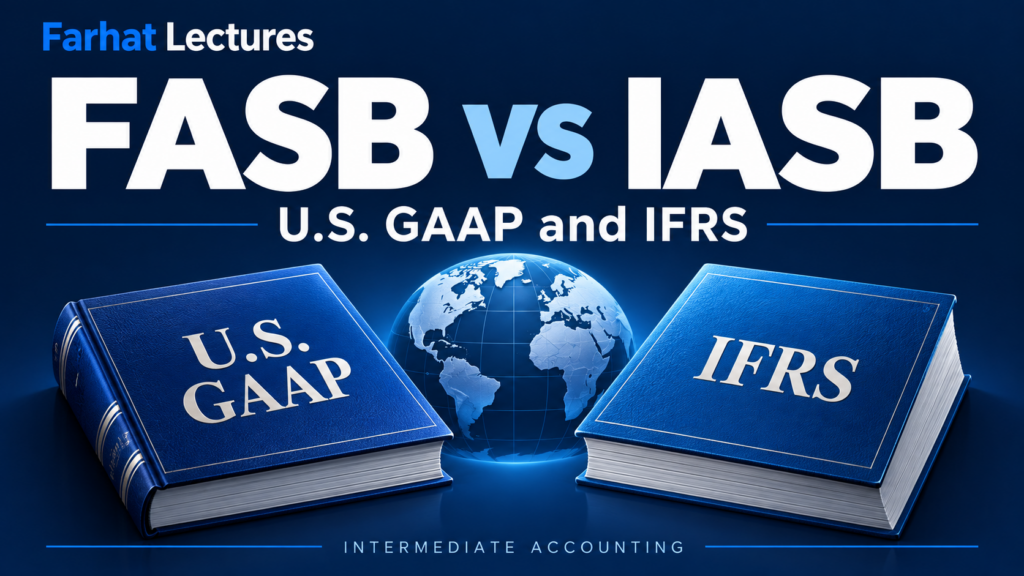
Students working with both frameworks should label each example before choosing the expense model. For background on the standard setters, read Farhat Lectures’ comparison of FASB and IASB.
If you are studying US GAAP as well, work through the Farhat Lectures lesson on ASC 842 lessee accounting for finance and operating leases, then come back and compare the expense pattern with the Cedar example above.
6. Optional Video Review: Lessee Accounting Under US GAAP
Watch Professor Farhat’s Introduction to Accounting for Leases: Lessee to review lease identification and the lessee’s perspective. This video is a US GAAP/CPA FAR background lesson. Apply the IFRS 16 rules and example on this page when studying IFRS; do not import the ASC 842 operating-lease expense model into the IFRS example.
Exam preparation: This article teaches IFRS 16. For US GAAP lease questions, use ASC 842. Before planning your examination study, consult the current official blueprint or syllabus for your qualification and examination session; coverage can differ by examination and change over time.
Watch Professor Farhat’s lessee-accounting lesson on YouTube.
Continue with the International Accounting course for broader IFRS study. For present-value practice and US GAAP lease lessons, explore the Intermediate Accounting course.
7. Check your understanding
Try these questions before opening each explanation.
Question 1: In the Cedar example, why is the initial liability less than $36,000?
The $36,000 total includes future interest. Discounting the three year-end payments at 6% produces the $32,076.14 commencement liability. The $3,923.86 difference is recognized as interest over time.
Question 2: Does Cedar’s first $12,000 payment reduce the liability by $12,000?
No. The payment covers $1,924.57 of interest and $10,075.43 of principal. The principal portion reduces the liability to $22,000.71.
Question 3: Can a ten-month lease containing a purchase option qualify as a short-term lease?
No. Under IFRS 16, a lease containing a purchase option does not meet the short-term lease definition, even when its stated duration is less than 12 months. Consider other applicable requirements separately.
Key takeaways
- IFRS 16 puts nearly every lease on the lessee’s balance sheet as a right-of-use asset and a lease liability.
- The lease liability is the present value of the unpaid lease payments. Cedar’s three $12,000 year-end payments at 6% are worth $32,076.14 at commencement.
- Each payment splits into interest (opening liability × rate) and principal. The liability does not fall by the full cash paid.
- Cedar uses straight-line depreciation because the machine’s benefits are consumed evenly. In general, select a depreciation method that reflects consumption of benefits and apply the depreciation-period rules in Section 4. The asset and liability need not have equal carrying amounts after commencement.
- Short-term and low-value exemptions are elections, not automatic, and a purchase option removes short-term status.
- The single model applies to lessees only. Lessors still classify leases as finance or operating under IFRS 16.
IFRS 16 frequently asked questions
Are all leases recognized on the balance sheet?
Most leases within the lessee model are recognized, but the standard has scope exclusions and optional recognition exemptions. Identify the arrangement and assess the relevant requirements before recording an asset and liability.
Is the right-of-use asset always equal to the lease liability?
No. Initial adjustments can make the balances different at commencement. Later, depreciation and liability amortization usually cause different carrying amounts, even when the opening balances were equal.
Does a higher EBITDA mean the lease creates more cash?
No. EBITDA can increase because depreciation and interest are excluded from that measure. Changing the accounting presentation does not change the contractual cash payments.
What is IFRS 16 in simple terms?
IFRS 16 is the IASB’s lease standard. It puts almost every lease on the lessee’s balance sheet as a right-of-use asset and a lease liability, replacing the old IAS 17 split between operating and finance leases for lessees.
When did IFRS 16 take effect?
For annual reporting periods beginning on or after January 1, 2019. The IASB issued the standard in January 2016, and it replaced IAS 17, IFRIC 4, SIC-15, and SIC-27.
Which discount rate does a lessee use under IFRS 16?
The interest rate implicit in the lease if it is readily determinable. If it is not, the lessee uses its incremental borrowing rate.
Is there a dollar limit for the low-value asset exemption?
No. The standard sets no amount. The Basis for Conclusions (paragraph BC100) says the IASB had in mind assets worth about US$5,000 or less when new. Treat that as a guide, not a rule, and judge the asset’s value when new rather than its current value.
Which lease framework should I study for my examination?
Use the current official blueprint or syllabus for your qualification and examination session. This article explains IFRS 16; use ASC 842 materials for US GAAP lease questions.
Continue learning
Recalculate the Cedar example independently and explain the purpose of each debit and credit. For additional instruction, explore the Farhat Lectures free sample course or continue your IFRS studies with the International Accounting course.
About the author: Professor Mansour Farhat, DBA, CPA, CIA, MAcc, is an accounting educator and the founder of Farhat Lectures. His lessons connect accounting concepts with calculations, journal entries, and practice.
The Cedar example is an original illustration prepared for this lesson. Every figure was recalculated before publication.

Responses