
Self-Paced CPA Exam Study Plan: 5 Simple Steps


By Professor Mansour Farhat, DBA, CPA, CIA, founder of Farhat Lectures
A self-paced CPA exam study plan is a schedule you build around your own starting point, weekly availability, and exam deadlines. You diagnose gaps with practice questions, set one specific weekly goal, pair lessons with fresh practice, log every recurring error, and adjust next week based on what you can now solve on your own.
A suggested course schedule can provide structure. Use it as a starting point, then set realistic weekly goals and revisit them. For the broader timing question, see Professor Farhat’s guide to how many hours to study for the CPA exam.
Watch: How Long to Study for Each Section of the CPA Exam
Before you map out your weeks, watch Professor Farhat talk through how study time differs from section to section. Then use the five steps below to turn that time into a weekly plan that fits your life.
How Do You Build a Self-Paced CPA Exam Study Plan?
1. Identify your starting point
Attempt unfamiliar questions across the topics in your section, from your review course or a resource like the Farhat Lectures FAR test bank. Record whether each mistake comes from a missing concept, a calculation, or misreading the requirement. Use that evidence to choose priorities while keeping coverage of the whole section in view.
2. Set a specific weekly goal
Choose an observable result, such as explaining bond pricing and solving a new problem without notes. Schedule manageable sessions around work and family commitments. Reserve a buffer session for difficult material or interruptions.
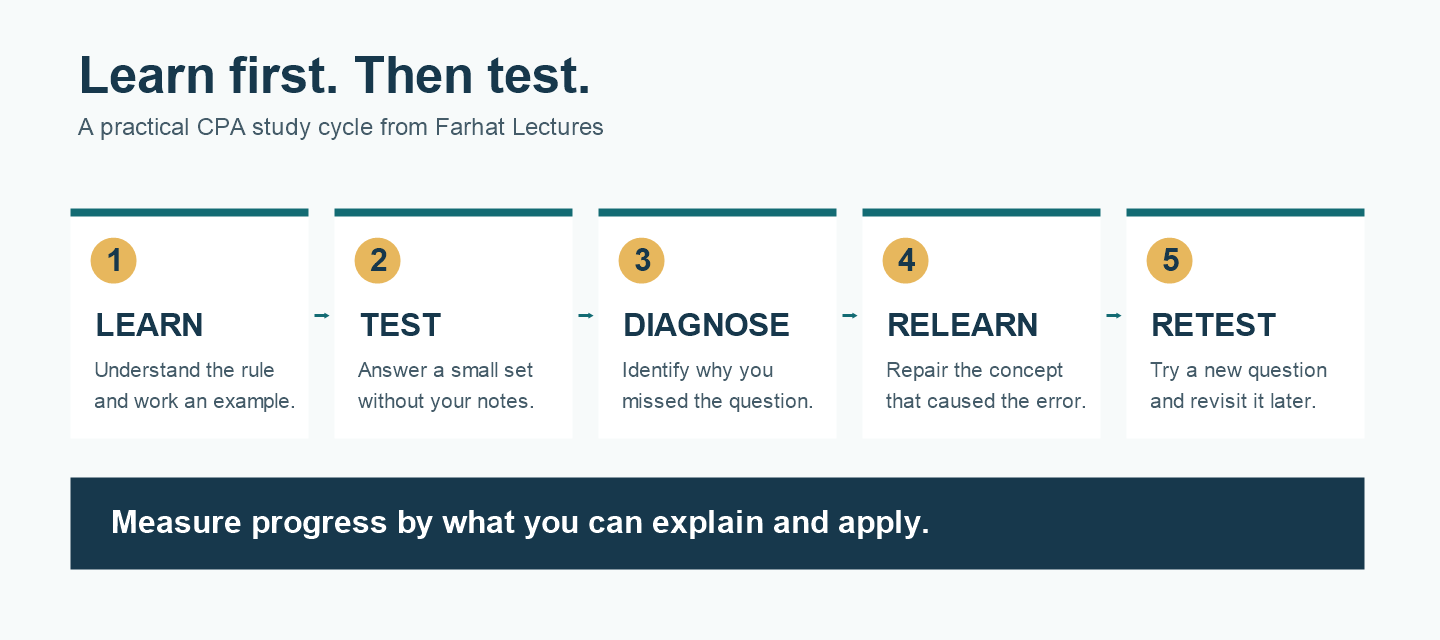
3. Connect explanations with practice
Choose a relevant lesson from the Farhat Lectures course catalog. Pause to work through examples, then close your notes and answer a fresh question. Explain why the correct choice works and why the alternatives do not.
4. Keep an error log and cumulative review
For each recurring error, record the topic, mistaken reasoning, corrected explanation, and a follow-up question. You’ll find a full example entry below. Revisit earlier topics alongside new material. Include task-based simulations (the case-style questions on the exam where you work with documents, journal entries, or calculations) so your plan develops application skills as well as multiple-choice performance.
5. Adjust the next week using evidence
Compare your goal with what you can now do independently. If a concept remains unclear, revisit its foundation or seek help through Farhat Lectures support. If understanding is stronger, move forward while retaining review sessions.
What Does a Weekly Self-Paced CPA Study Plan Look Like?
This is an illustrative sequence, not a required workload or a prediction of readiness. Adjust session length and topic coverage to your circumstances.
| Session | Purpose | Evidence of progress |
|---|---|---|
| Monday | Study one priority concept | Explain the rule in your own words |
| Tuesday | Practice unfamiliar questions | Identify and correct errors |
| Wednesday | Revisit a difficult step | Solve a different example independently |
| Thursday | Work through a simulation | Apply the concept to several requirements |
| Friday | Review earlier topics | Recognize gaps in mixed practice |
| Weekend | Use a buffer session, review goals, and rest | Choose realistic priorities for next week |
Example: One Error Log Entry
Here’s what a useful error log entry looks like for a FAR topic many candidates miss: pricing a bond.
Question: A company issues $100,000 of 5-year bonds with a 5% stated interest rate, paid annually, when the market rate is 6%. What is the issue price?
Topic: Bonds payable, issue price
Mistaken reasoning: I discounted the cash flows at the 5% stated rate and got $100,000.
Corrected explanation: The stated rate only sets the cash interest payment: $100,000 × 5% = $5,000 a year. The market rate is the rate you discount with.
- Present value of the principal: $100,000 × 0.74726 = $74,726 (0.74726 is the present value of $1 at 6% for 5 years)
- Present value of the interest: $5,000 × 4.21236 = $21,062 (4.21236 is the present value of an ordinary annuity of $1 at 6% for 5 years)
- Issue price: $74,726 + $21,062 = $95,788
The bonds sell at a $4,212 discount because the stated rate is below the market rate.
Follow-up question: Using the effective interest method (interest expense equals the bond’s carrying value times the market rate), what is interest expense for Year 1?
Answer: $95,788 × 6% = $5,747. Cash paid is $5,000, so $747 of the discount is amortized and the carrying value rises to $96,535.
When you can solve the follow-up without notes, mark the entry closed.
Sample Self-Paced Timeline for One CPA Section
Every section moves through the same three phases. How long each phase lasts depends on your starting point and your schedule.
- Diagnose (your first few sessions). Attempt unfamiliar questions across the whole section and log where you miss. The AICPA publishes a blueprint for each section that lists what’s tested, so use it as your coverage checklist.
- Learn and practice (most of your plan). Work through one priority topic at a time using the weekly cycle above. Mix in simulations every week, not just at the end.
- Final review (your last stretch before exam day). Switch to mixed practice across the whole section, rework every open item in your error log, and take at least one timed practice exam under four-hour conditions.
Before you book your date, check that it falls inside your Notice to Schedule period and, for BAR, ISC, or TCP, inside a testing window.
Using a CPA Review Course Too?
Many candidates follow a review course such as Becker, Gleim, Surgent, Miles, or UWorld. A self-paced plan works alongside it. Let your review course set the topic order, then use the steps above to decide where to slow down.
When a lesson moves too fast, Farhat Lectures offers supplemental courses matched to each of those review providers. You get a second explanation of the same topic and get back on track.
How Does the CPA Exam Schedule Shape Your Plan?
Your study plan has to fit the exam’s calendar, not just your own. Here’s what to put on yours.
The Uniform CPA Exam, developed by the AICPA (American Institute of Certified Public Accountants), has three Core sections every candidate takes: Auditing and Attestation (AUD), Financial Accounting and Reporting (FAR), and Taxation and Regulation (REG). You also choose one Discipline section: Business Analysis and Reporting (BAR), Information Systems and Controls (ISC), or Tax Compliance and Planning (TCP). Each section is a four-hour exam.
- Core sections offer continuous testing, so you can sit for them throughout the year.
- Discipline sections have set testing windows. In 2026, they’re offered only in January, April, July, and October. Pick your Discipline month early and plan backward from it.
- July 2027 platform change: The exam moves to a new testing platform. Testing pauses from July 1 through July 11, 2027, and score releases take longer for a period afterward. If you’re aiming for mid-2027, read our breakdown of CPA exam changes in 2027 and the AICPA’s announcement.
- Notice to Schedule (NTS): This is the authorization your jurisdiction issues once your exam application is approved. You need it to book a section, and it expires after a period your jurisdiction sets.
- Credit window: Once you pass your first section, you have a limited time to pass the rest. NASBA (the National Association of State Boards of Accountancy) recommends 30 months, and most jurisdictions now use 30 months. Some use a different length or start the clock on a different date, so confirm your board’s rule before you build your timeline.
Put your NTS expiration, your Discipline window, and your credit-window end date on one calendar. Then decide your section order. Professor Farhat explains why he recommends starting with FAR in his guide to the hardest CPA exam section.
How Do You Know You’re Ready to Sit for a Section?
Track performance on unfamiliar questions, repeated mistakes, and simulations completed without assistance. A high score on memorized questions can hide a gap. No single practice percentage guarantees exam success. Professor Farhat’s guide to how hard the CPA exam is explains why applying concepts, not memorizing answers, is what gets you through.
To pass, you need a score of 75 on each section, reported on a 0 to 99 scale. That score is scaled, not a percentage of questions answered correctly, so don’t try to convert a practice percentage into an exam score. Use the signals above instead, and watch whether your error log is shrinking.
Self-Paced CPA Study Plan FAQs
How do I stay accountable while studying at my own pace?
Keep regular appointments and record one learning outcome after each session. Review your progress weekly with a study partner or use your written goals to check your own follow-through.
What if my CPA study schedule becomes unrealistic?
Reassess available time, prioritize the largest gaps, and use your buffer session. Replan deliberately instead of repeatedly carrying unfinished work forward.
When should I revisit a topic?
Return when you cannot explain the reasoning or apply it to changed facts. Study the difficult step, then check understanding with a new question.
How Long Does a Self-Paced CPA Exam Study Plan Take?
There is no fixed timeline. It depends on your accounting background, the section you’re studying, and how many hours you can give each week. Build your plan from what practice shows you still need, and see Professor Farhat’s guide to how many hours to study for the CPA exam for a deeper look.
Can I Follow a Self-Paced CPA Study Plan While Working Full Time?
Yes. Schedule shorter, consistent sessions on weekdays, keep one buffer session each week, and book your Discipline section early, because it’s only offered in set testing windows.
Which CPA Exam Section Should I Study First?
Professor Farhat recommends starting with FAR because it builds the accounting foundation other sections rely on. If you choose BAR as your Discipline, taking it soon after FAR lets you reuse that foundation.
When Can I Take My Discipline Section?
In 2026, BAR, ISC, and TCP are offered only during the first month of each calendar quarter: January, April, July, and October. Core sections (AUD, FAR, REG) are offered year-round, so plan your Discipline date first and schedule your Core sections around it. Check the AICPA’s current calendar before booking, since the 2027 schedule includes changes.
Start with one learning goal
Pick one concept that keeps tripping you up and try a lesson in the Farhat Lectures free sample course. Then add it to this week’s plan, close your notes, and test yourself on a fresh question. That’s your self-paced CPA exam study plan in action: one goal, real practice, and an adjustment for next week.
About Professor Farhat
Professor Mansour Farhat, DBA, CPA, CIA, MAcc, is the founder of Farhat Lectures and an accounting educator. His teaching emphasizes clear explanations, practical examples, and building the understanding needed to apply accounting concepts independently.




Responses