
Initial Franchise Fee Revenue Recognition: Allocation and Journal Entries

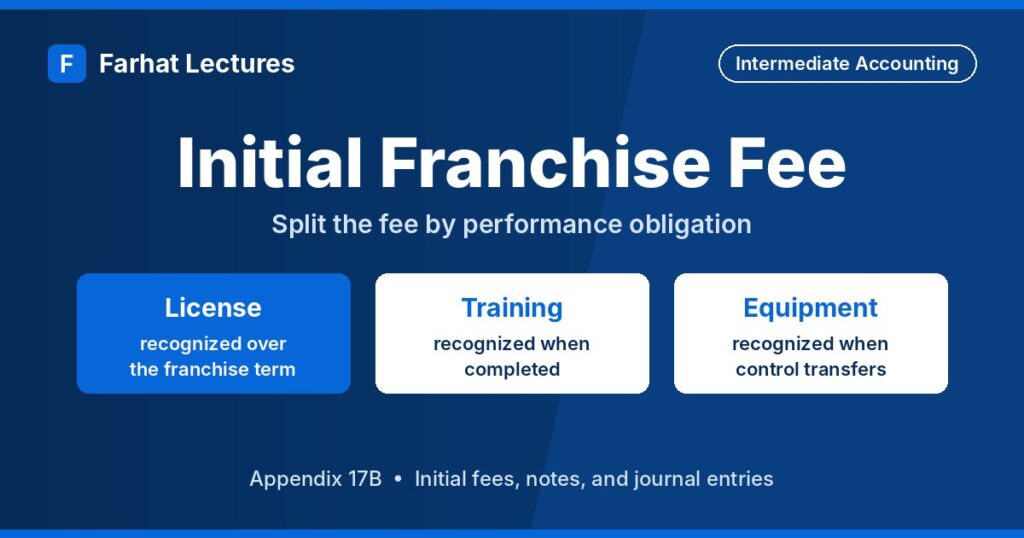
Under ASC 606, a franchisor recognizes initial franchise fee revenue when or as it satisfies each performance obligation. Amounts paid or due before the related goods or services transfer are recorded as a contract liability. When a note requires a significant financing adjustment, the franchisor measures the transaction price as cash received plus the present value of the note and allocates that price to the performance obligations.
Key takeaways
- Maple Grill records the initial fee as a contract liability at signing because it has yet to satisfy any performance obligation.
- When a note requires a significant financing adjustment, measure the fee as cash received plus the present value of the note. Recognize the note discount as interest revenue over the life of the note.
- Split the measured fee among the separate promises using their relative standalone selling prices.
- In this example, Maple Grill recognizes training revenue at completion, equipment revenue when control transfers, and franchise license revenue over the license term.
- For the sales-based royalties in this example, recognize revenue separately from the fixed initial fee when the franchisee’s sale has occurred and the related performance obligation has been satisfied or partially satisfied.
Why does this matter? Franchise agreements bundle several promises into one upfront price, and some franchisees pay part of that price over several years. Recording the full fee on day one would overstate revenue before the franchisor has done the work, and it would ignore the interest built into a multi-year payment plan.
This lesson supports the franchise revenue recognition appendix in your intermediate accounting textbook. For the question of when each piece becomes revenue, including royalties, read franchise revenue recognition: point in time vs. over time.
Watch: ASC 606 Step 3: Transaction Price & Variable Consideration
Watch this Farhat lesson on YouTube
This lesson covers ASC 606 step 3 in general rather than franchises specifically, and the part you want starts at 9:42. There, Professor Farhat works through the time value of money in the transaction price using a three-year zero-interest note, then amortizes the discount to interest revenue. The Maple Grill example below applies the same method to calculate the note’s present value and recognize interest.
What is an initial franchise fee?
A franchisor is the company that grants business rights, such as the right to use its trade name and operating system. The franchisee is the business owner who operates the franchised location. Franchisors earn two kinds of fees:
| Fee | What it pays for | Typical timing |
|---|---|---|
| Initial franchise fee | Establishing the franchise relationship: the franchise license plus initial services such as site selection help, training, and equipment | Paid at signing, sometimes partly by note |
| Continuing franchise fees | Ongoing rights and support such as advertising, management training, and updated operating manuals | Usually a percentage of the franchisee’s sales (a royalty) |
This article focuses on the initial fee. Continuing fees follow a separate royalty rule, explained in the continuing fees section of the companion lesson.
Initial franchise fee revenue recognition in five steps
The initial fee follows the five-step model of ASC 606 (Accounting Standards Codification Topic 606, Revenue from Contracts with Customers):
- Identify the contract: the signed franchise agreement.
- Identify the performance obligations: each distinct promise, such as the franchise license, training, and equipment.
- Determine the transaction price: cash received plus the present value of any note, whenever the financing in that note is significant. The difference between a note’s face amount and its present value is future interest, not franchise revenue.
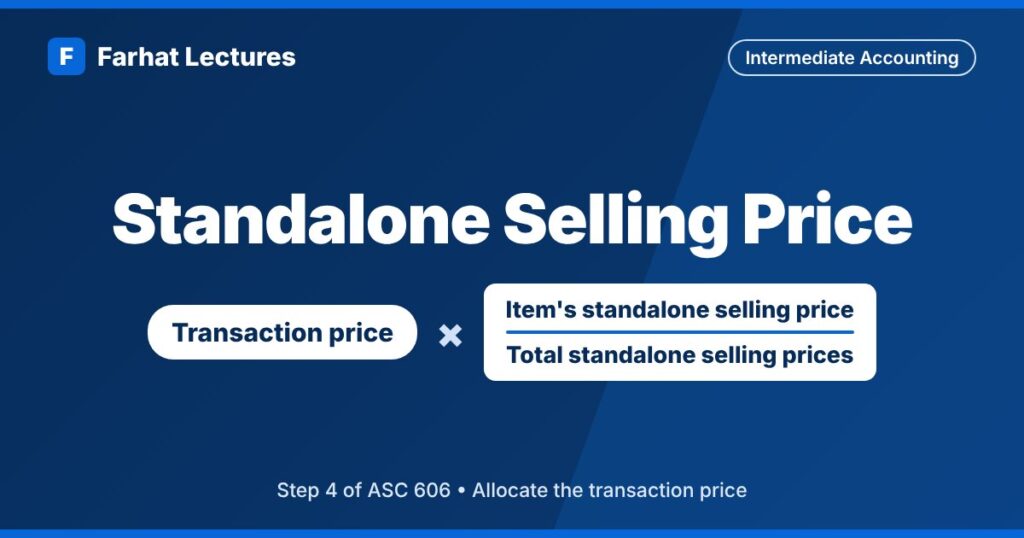
- Allocate the price to each performance obligation based on relative standalone selling prices (the price at which each item would be sold on its own).
- Recognize revenue when (or as) each obligation is satisfied.
Example: a franchise fee paid partly by note
This is a hypothetical example. On December 31, Year 1, Maple Grill Inc. signs a franchise agreement with Riverbend Foods. The license runs for 10 years starting on the day the store opens. The initial fee is $60,000: $24,000 in cash at signing and a $36,000 zero-interest note, payable in four annual payments of $9,000 every December 31 starting in Year 2. Riverbend could borrow at 10%.
Maple Grill promises three things: the franchise license (the right to operate under the Maple Grill name for 10 years from opening day), pre-opening training, and kitchen equipment that costs Maple Grill $9,000. Maple Grill sells training and equipment separately, and Riverbend can benefit from each together with readily available resources. The promises to provide training and equipment are also separately identifiable from each other and from the license in this contract. On its own, Maple Grill prices the license at $32,000, the training at $11,000, and the equipment at $13,000. Those are the standalone selling prices, and they add up to $56,000.
Applying step 3: find the transaction price
Present value of the note = $9,000 × 3.16987 (four-year ordinary annuity factor at 10%) = $28,529. The discount is $36,000 − $28,529 = $7,471, which Maple Grill will earn as interest revenue over four years. Transaction price = $24,000 + $28,529 = $52,529.
Applying step 4: allocate the price
| Performance obligation | Allocated amount | When it is satisfied |
|---|---|---|
| Franchise license (10 years from opening) | $30,017 | Over time, evenly over the 10-year term |
| Pre-opening training | $10,318 | Point in time, when training is completed |
| Kitchen equipment (cost $9,000) | $12,194 | Point in time, when control transfers at installation |
| Total transaction price | $52,529 |
Here is where each amount comes from. Divide each standalone selling price by the $56,000 total, then apply that share to the $52,529 transaction price:
- License: $52,529 x ($32,000 / $56,000) = $30,017
- Training: $52,529 x ($11,000 / $56,000) = $10,318
- Equipment: $52,529 x ($13,000 / $56,000) = $12,194
Notice that the allocated amounts are lower than the standalone selling prices. That is because the three promises together sell for $56,000 but the transaction price is only $52,529, so every promise absorbs a share of that difference. Round numbers are rare here, and that is normal.
Journal entries from signing to year-end
December 31, Year 1: sign the agreement
| Account | Debit | Credit |
|---|---|---|
| Cash | 24,000 | |
| Notes Receivable | 36,000 | |
| Discount on Notes Receivable | 7,471 | |
| Unearned Franchise Revenue (license) | 30,017 | |
| Unearned Service Revenue (training) | 10,318 | |
| Unearned Sales Revenue (equipment) | 12,194 |
No revenue yet. The unearned accounts are contract liabilities: Maple Grill has been paid, or holds a note, for work it has not done.
March 1, Year 2: training done, equipment installed, store opens
| Account | Debit | Credit |
|---|---|---|
| Unearned Service Revenue (training) | 10,318 | |
| Service Revenue | 10,318 | |
| Unearned Sales Revenue (equipment) | 12,194 | |
| Sales Revenue | 12,194 | |
| Cost of Goods Sold | 9,000 | |
| Inventory | 9,000 |
December 31, Year 2: license revenue and note collection
The license term started on March 1, so Year 2 includes 10 months: $30,017 ÷ 10 years × 10/12 = $2,501. Interest on the note for the full year is $28,529 × 10% = $2,853.
| Account | Debit | Credit |
|---|---|---|
| Unearned Franchise Revenue (license) | 2,501 | |
| Franchise Revenue | 2,501 | |
| Cash | 9,000 | |
| Notes Receivable | 9,000 | |
| Discount on Notes Receivable | 2,853 | |
| Interest Revenue | 2,853 |
The discount keeps shrinking until the note is fully collected:
| Year | Beginning carrying value | Interest revenue (10%) | Cash received | Ending carrying value |
|---|---|---|---|---|
| Year 2 | $28,529 | $2,853 | $9,000 | $22,382 |
| Year 3 | $22,382 | $2,238 | $9,000 | $15,620 |
| Year 4 | $15,620 | $1,562 | $9,000 | $8,182 |
| Year 5 | $8,182 | $818 | $9,000 | $0 |
| Total | $7,471 | $36,000 |
Maple Grill accounts for sales-based royalties on the franchise license separately from the fixed initial fee. Under ASC 606-10-55-65, it recognizes royalty revenue at the later of the franchisee’s sale or usage and the satisfaction or partial satisfaction of the performance obligation to which the royalty is allocated. For more on the discount mechanics, see the transaction price lesson.
Textbook example vs. current US GAAP
Private-company franchisors have one extra option. ASU 2021-02 lets them treat a listed set of pre-opening services, such as site selection help and training, as distinct from the franchise license, and lets them bundle those services into a single performance obligation. It does not remove the need to work out a standalone selling price for that bundle, and a franchisor that elects it has to say so in its disclosures.
Common mistakes
- Crediting Franchise Revenue for the whole fee on signing day.
- Recording the note at its face amount, which counts future interest as franchise revenue.
- Starting license revenue before the franchisee can use the franchise (before opening).
- Forgetting the cost of goods sold entry when equipment is delivered.
- Mixing continuing sales-based royalties into the fixed initial fee or recognizing those royalties before both conditions in ASC 606-10-55-65 are met.
Interactive initial franchise fee practice
Initial Franchise Fee Revenue Recognition Practice
An initial franchise fee may cover the franchise license, pre-opening training, and equipment. Practice applying ASC 606 to initial franchise fees. These five multiple-choice questions cover continuing royalties, the present value of a franchise note, allocation to performance obligations, and when a franchisor recognizes revenue.
Practice questions with answers
1. A franchisor collects a $40,000 initial fee in cash at signing. It allocates $15,000 to training (completed when the store opens on January 1) and $25,000 to a five-year franchise license. How much revenue does it recognize in the first year of operations?
Answer: $20,000. Training revenue of $15,000 is recognized when training is complete. The license is recognized over time: $25,000 ÷ 5 = $5,000 for the first full year. Total: $15,000 + $5,000 = $20,000.
2. A franchisee signs a zero-interest note for the balance of an initial fee: three annual payments of $5,000, the first due one year after signing. The market rate for this franchisee is 8%. What is the present value of the note, the discount, and the first year of interest revenue?
Answer: The present value is about $12,885 ($5,000 × 2.57710, the present value factor for a three-year ordinary annuity at 8%). The discount is $15,000 − $12,885 = $2,115. First-year interest revenue is $12,885 × 8% = $1,031.
3. On signing day, a franchisor receives a $10,000 nonrefundable payment. No training, equipment, or license access has been provided yet. What is the journal entry?
Answer: Debit Cash $10,000 and credit Unearned Franchise Revenue $10,000. A nonrefundable payment is still not revenue until the franchisor performs.
4. A private-company franchisor charges a $50,000 initial fee and provides site selection help and training before opening. Can it skip the analysis of whether those services are distinct from the license?
Answer: It can simplify that analysis, not skip it. ASU 2021-02 lets a franchisor that is not a public business entity treat the listed pre-opening services as distinct from the franchise license, and bundle them into a single performance obligation. The franchisor still has to work out a standalone selling price for that bundle and for the license, and it has to disclose that it elected the expedient.
Frequently asked questions
Is an initial franchise fee recognized as revenue when it is received?
Not automatically. Cash received before the franchisor performs is a liability (unearned revenue, also called a contract liability). Revenue is recognized as each performance obligation in the franchise agreement is satisfied.
Does a franchisor have to discount a franchise fee paid by note?
Adjust the note payments for the time value of money when they provide significant financing. ASC 606 permits a practical expedient when, at contract inception, the franchisor expects the time between transferring the related good or service and receiving payment to be one year or less.
Are pre-opening services always a separate performance obligation?
Only if they are distinct from the franchise license. Private-company franchisors may elect the ASU 2021-02 practical expedient, which lets them treat a listed set of pre-opening services as distinct from the license.
How does the franchisee record the same initial fee?
The franchisee records the fee paid for the franchise rights as an intangible asset and amortizes it. See accounting for franchises from both sides.
What is the journal entry for an initial franchise fee?
In the Maple Grill example, debit Cash for the amount received and Notes Receivable for the face amount of the note. Credit Discount on Notes Receivable for the financing component and credit the amounts allocated to the unsatisfied performance obligations to the applicable contract liability accounts.
How do you calculate the present value of a franchise fee note?
When a note calls for equal annual payments starting one year after signing, multiply the annual payment by the present value factor for an ordinary annuity at the appropriate discount rate. For four annual payments of $9,000 at 10 percent, the factor is 3.16987, so the present value is $28,529 and the discount is $7,471.
Is an initial franchise fee recognized at a point in time or over time?
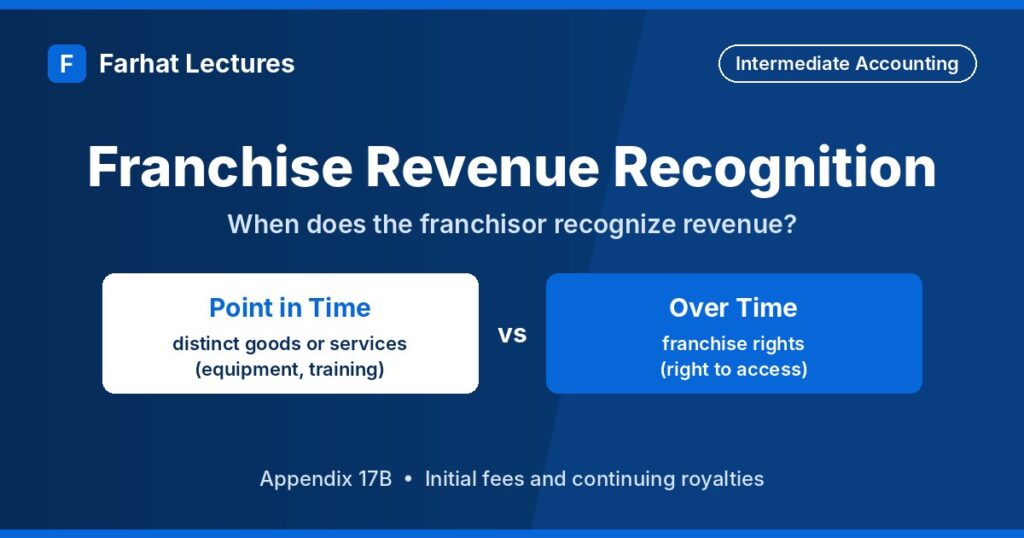
It depends on the performance obligation. In the Maple Grill example, training revenue is recognized at completion, equipment revenue when control transfers, and franchise license revenue over the license term.
When does a franchisor start recognizing franchise license revenue?
When the franchisee can actually use the franchise rights, which is normally the opening date rather than the signing date. The revenue is then spread over the license term.
Sources
- Deloitte DART: identifying the nature of a license (ASC 606-10-55-58 to 55-60)
- Deloitte DART: significant financing component (ASC 606-10-32-15 to 32-20)
- FASB ASU 2021-02, Franchisors: Revenue from Contracts with Customers (Subtopic 952-606)
Continue learning with Farhat Lectures
Revenue recognition is one of the most heavily tested areas on the CPA exam. Work through it with clear explanations, worked journal entries, and guided practice.
Explore the free sample courseAbout the author
Mansour Farhat is a CPA, CIA, and DBA who teaches accounting and auditing and has helped thousands of CPA, CMA, and EA candidates work through revenue recognition. The mistakes listed above are the ones his students make most often on franchise fee problems.

Responses