
Franchise Revenue Recognition: Point in Time vs. Over Time

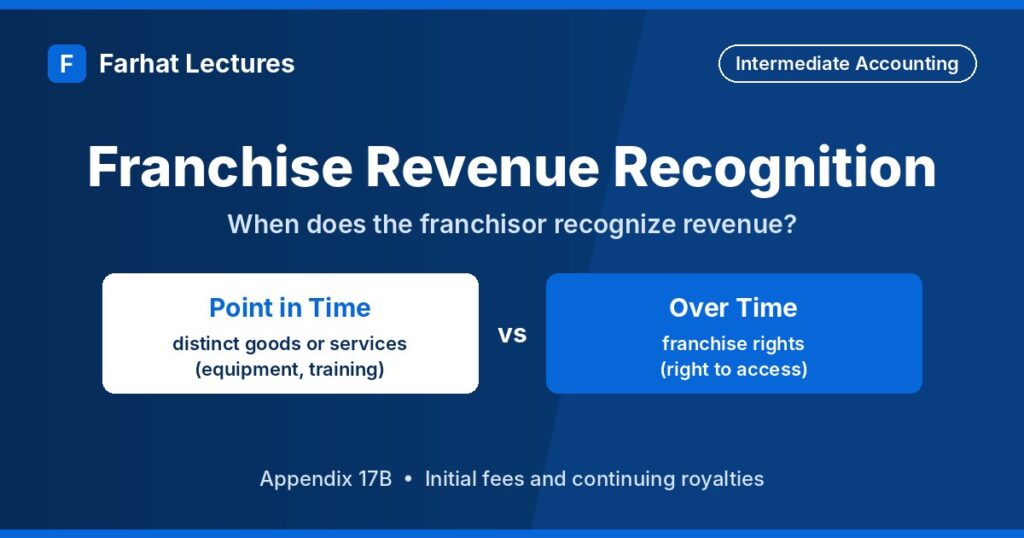
Under ASC 606, franchise revenue recognition depends on what the franchisor promised. Franchise rights are symbolic intellectual property, so the license fee is recognized over the franchise term. Equipment and supplies are recognized at a point in time when control transfers. When a sales-based royalty relates solely or mainly to the franchise license, the franchisor recognizes it at the later of the franchisee’s sale or satisfaction of the related performance obligation, in whole or in part.
Why does this matter? The same franchise agreement can produce revenue on signing-related dates, every month of a multi-year term, and every time the franchisee rings up a sale. Picking the wrong pattern moves revenue into the wrong year, which is exactly what this part of Appendix 17B tests.
This lesson covers when franchise revenue is recognized. For a broader look at fees, royalties, and journal entries, see accounting for franchises. Revenue recognition is a core FAR topic on the CPA exam, and the timing questions below are the ones that cost students points.
Watch: IFRS 15 Step 5: Revenue Over Time vs. at a Point in Time
This segment starts at 1:52, where Professor Farhat explains the difference between revenue over time and at a point in time, then walks through the point-in-time indicators and the three over-time criteria. The control concepts are the same under ASC 606.
Franchise revenue recognition timing: point in time vs. over time
Under ASC 606 (Accounting Standards Codification Topic 606, Revenue from Contracts with Customers), revenue is recognized when the customer obtains control of a promised good or service. Control can transfer all at once or gradually.
| Franchise promise | Timing | Why |
|---|---|---|
| Equipment or supplies sold to the franchisee | Point in time | Control transfers on delivery or installation |
| Pre-opening training | Usually over time | Training on brand standards is usually not distinct, so it rides along with the license. If it is genuinely distinct, recognize it as the training is delivered. |
| Franchise rights (trade name, territory, know-how) | Over time | Right to access a brand the franchisor keeps supporting |
| Ongoing support, such as marketing and updated manuals | Over time | Benefit is received as the service is provided |
| Sales-based royalties for the franchise license | As sales occur if the license obligation is being satisfied | Sales-based royalty exception |
A shortcut for private franchisors: ASC 952-606
Splitting an initial fee into separate promises takes real judgment, and most franchisors found that pre-opening services were not distinct from the license at all. So the FASB added a practical expedient in ASC 952-606, through ASU 2021-02.
A franchisor that is not a public business entity can elect to treat a defined list of pre-opening services as distinct from the franchise license. That means no case-by-case analysis of whether site selection, operating manuals, or staff training stand on their own. A franchisor that elects the expedient can also make a second election to account for all of those qualifying pre-opening services as one single performance obligation.
Two limits are worth remembering. The expedient is only available to franchisors that are not public business entities, and a franchisor that uses it has to disclose that it did. Public franchisors still work through the full ASC 606 analysis.
Right to use vs. right to access
A franchise is a license of intellectual property: the franchisee may use the franchisor’s name, methods, and know-how without owning them. ASC 606 sorts licenses into two kinds:
- Right to use (functional intellectual property, such as finished software or a film): the customer gets the property as it exists on the license date. Revenue is recognized at a point in time, unless the franchisor is required to keep updating the property and the customer has to use the updated version.
- Right to access (symbolic intellectual property, such as brands, logos, and franchise rights): the property’s value depends on the licensor’s continuing activities. Revenue is recognized over time.
ASC 606-10-55-59 and 55-60 name franchise rights as an example of symbolic intellectual property. That is why franchise license revenue is generally spread over the franchise term, usually on a straight-line basis. Under ASC 606-10-55-58C, the franchisor must make the intellectual property available and the period in which the franchisee can use and benefit from the rights must have begun. In the BrightPath example below, both conditions are met on the opening date.
Example: franchise rights recognized over time
This is a hypothetical example. BrightPath Tutoring Inc. sells franchises for tutoring centers. On November 1, Year 1, it signs a franchise agreement and collects a $12,000 initial fee. The six-year franchise term runs from the January 1, Year 2 opening date. BrightPath provides almost no upfront services. Instead, it updates its curriculum and training videos every month and runs national advertising. The franchisee also pays a 6% royalty on its annual sales, due each January 20 for the prior year. The center opens on January 1, Year 2, and reports $150,000 of sales in Year 2.
The only distinct promise is ongoing access to the BrightPath brand and system, so the $12,000 is recognized evenly over the six-year term: $12,000 ÷ 6 = $2,000 per year. The Year 2 royalty is $150,000 × 6% = $9,000.
Notice what does not happen in Year 1. Two months pass between signing and year-end, but the center has not opened, so the franchisee cannot use the rights yet. BrightPath recognizes no franchise revenue in Year 1. The whole $12,000 sits in Unearned Franchise Revenue until the term begins on January 1, Year 2.
November 1, Year 1: collect the initial fee
| Account | Debit | Credit |
|---|---|---|
| Cash | 12,000 | |
| Unearned Franchise Revenue | 12,000 |
Two separate entries happen on the same date. The first releases a year of license revenue, and the second accrues the royalty.
December 31, Year 2: recognize license revenue and the royalty
| Account | Debit | Credit |
|---|---|---|
| Unearned Franchise Revenue | 2,000 | |
| Franchise Revenue | 2,000 | |
| Accounts Receivable | 9,000 | |
| Franchise Revenue | 9,000 |
January 20, Year 3: collect the royalty
| Account | Debit | Credit |
|---|---|---|
| Cash | 9,000 | |
| Accounts Receivable | 9,000 |
BrightPath repeats the $2,000 entry each year until the remaining $10,000 of unearned revenue is gone at the end of the term.
Continuing franchise fees and royalties
Continuing franchise fees are usually a percentage of the franchisee’s sales, so the total is unknown when the contract is signed. That makes them variable consideration. When the royalty relates solely or predominantly to a license of intellectual property, ASC 606 applies the sales-based royalty exception (ASC 606-10-55-65 and 55-65A). The franchisor recognizes royalty revenue at the later of
- when the franchisee’s sale occurs, or
- when the related performance obligation is satisfied (or partly satisfied).
In the BrightPath example, the related license obligation is being satisfied when the franchisee makes the sales, so the royalties are recognized in that period. The payment date does not matter, which is why BrightPath accrues the Year 2 royalty at December 31 even though the cash arrives in January.
For the bigger picture of both the franchisor and franchisee, see accounting for franchises: fees, royalties, and journal entries.
Common mistakes
- Recognizing the full initial fee when the store opens without asking whether the franchisor still owes ongoing access and support.
- Starting license revenue on the signing date instead of when the franchisee can begin using the rights.
- Estimating and recognizing all future royalties upfront.
- Assuming pre-opening training is always a separate promise. For most franchises it is not distinct from the license, so it is recognized over the term along with the license.
- Waiting for the royalty payment even though the sales have occurred and the related performance obligation has been satisfied to the applicable extent.
- Treating every promise in the agreement the same way. Equipment, training, and the license can each have different timing.
Interactive franchise revenue recognition exercise
Apply ASC 606 to five franchise arrangements covering equipment sales, pre-opening training, franchise rights, ongoing support, and sales-based royalties. For these scenarios, assume the franchisee receives the benefit of the distinct training at completion and the related license obligation is being satisfied when the franchisee makes the sales that trigger the royalties.
Practice questions with answers
1. A franchisor receives an $18,000 initial fee for a nine-year franchise license (no other distinct promises). The franchisee opens on July 1, and the franchisor has a December 31 year-end. How much license revenue is recognized in the first year?
Answer: $1,000. The fee is recognized evenly over the nine-year term starting on the opening date: $18,000 ÷ 9 = $2,000 per year, × 6/12 = $1,000.
2. A franchisee’s sales for the year are $240,000, and the agreement requires a 5% royalty payable on January 20 of the next year. What does the franchisor record at year-end?
Answer: Debit Accounts Receivable $12,000 and credit Franchise Revenue $12,000 ($240,000 × 5%). The royalty is recognized in the year the sales occur, even though cash arrives the next January.
3. Classify each promise as point in time or over time: (a) a fryer sold and installed for the franchisee, (b) the right to use the franchisor’s brand for 10 years, (c) monthly marketing support.
Answer: (a) Point in time, when control of the equipment transfers. (b) Over time, because franchise rights give a right to access. (c) Over time, as the support is provided each month.
Want more reps on this? The FAR CPA test bank has multiple-choice questions on revenue recognition timing, and the full Intermediate Accounting course walks through Appendix 17B start to finish.
Key takeaways
- Franchise rights are symbolic intellectual property under ASC 606, so the license fee is recognized over the franchise term and not on the signing date.
- License revenue starts once the intellectual property has been made available and the franchisee can use and benefit from the rights. In the BrightPath example, that is the opening date.
- Equipment and supplies are recognized at a point in time, when control transfers.
- Pre-opening training is usually not distinct from the license, so it is recognized over the term along with it.
- A sales-based royalty that relates solely or predominantly to the license is recognized at the later of the sale or when the related performance obligation is satisfied in whole or in part.
- A franchisor that is not a public business entity can elect the ASC 952-606 practical expedient for qualifying pre-opening services.
Frequently asked questions
Is franchise revenue recognized over time or at a point in time?
Both can apply in one agreement. Revenue from the franchise rights is generally recognized over time, because the franchisee has a right to access the franchisor’s brand. Equipment and supplies are recognized at a point in time, when control transfers. Training is usually bundled into the license and recognized over time, because it is rarely distinct from the brand itself.
Why are franchise rights recognized over time under ASC 606?
ASC 606 classifies franchise rights as symbolic intellectual property. Their value depends on the franchisor continuing to support and maintain the brand, so the franchisee receives the benefit throughout the franchise term.
When does the franchisor start recognizing the initial fee?
For the license portion of the fee, recognition starts once the franchisor makes the intellectual property available and the franchisee can use and benefit from the rights. Under ASC 606-10-55-58C, collecting the fee does not start revenue recognition. The opening date is the start date in the BrightPath example.
When are royalties from a franchisee recognized?
When a sales-based royalty relates solely or predominantly to the license, the franchisor recognizes it at the later of the franchisee’s sale or when the related performance obligation is satisfied in whole or in part. In the BrightPath example, the license obligation is being satisfied when the sales occur.
Can a franchisor skip splitting the initial fee into separate promises?
A franchisor that is not a public business entity can elect the practical expedient in ASC 952-606. It lets the franchisor treat qualifying pre-opening services as distinct from the license, and elect to account for them as a single performance obligation.
Does IFRS 15 treat franchise revenue the same way?
The concepts are very similar. IFRS 15 asks whether the franchisor’s ongoing activities significantly affect the intellectual property, and franchise arrangements usually meet that test, so license revenue is also typically recognized over time.
Sources
- Deloitte DART: identifying the nature of a license (ASC 606-10-55-58 to 55-60)
- Deloitte DART: sales- or usage-based royalties (ASC 606-10-55-65)
- Deloitte DART: revenue recognized over time (ASC 606-10-25-27)
- FASB ASU 2016-10, Identifying Performance Obligations and Licensing (free PDF)
- ASC 606-10-55-376 through 55-382, Example 57, Franchise Rights
- ASC 952-606, Franchisors, and FASB ASU 2021-02, Franchisors: Practical Expedient
Continue learning with Farhat Lectures
Strengthen your accounting understanding with clear explanations and guided practice.
Explore the free sample course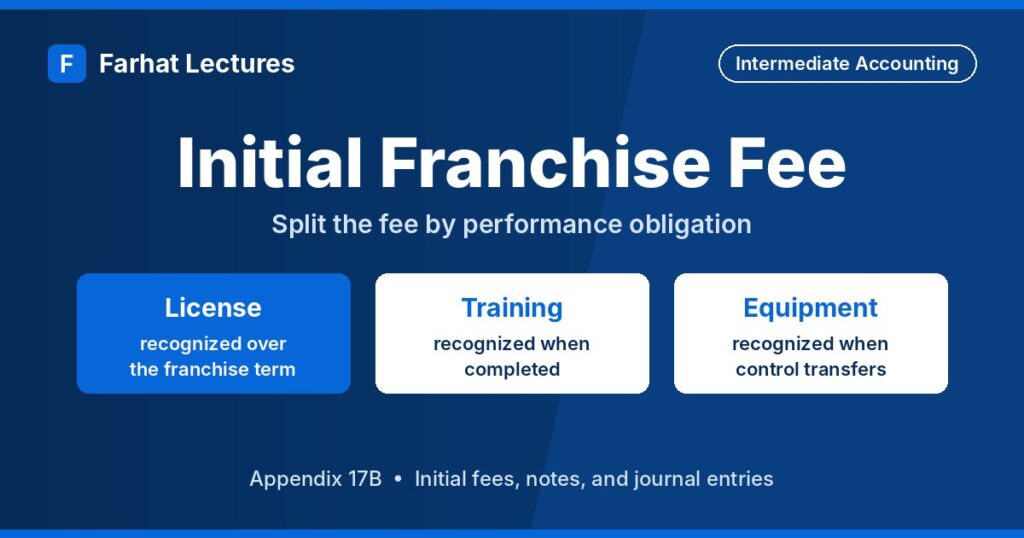


Responses