
Accounting for Franchises: Fees, Royalties & Journal Entries

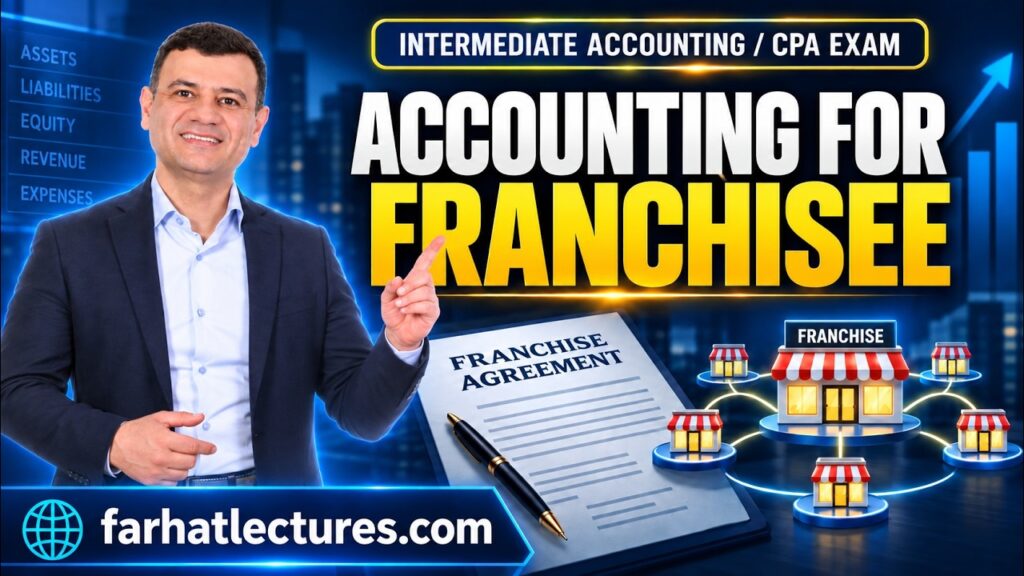
Accounting for franchises has two sides. The franchisor recognizes the initial franchise fee as revenue under ASC 606 as it delivers the license and related services, and records sales-based royalties as franchisee sales occur. The franchisee records the initial fee for the franchise right as an intangible asset and amortizes it, while royalties are expensed as the underlying sales occur. Advertising contributions are expensed as the related services are provided; qualifying advance payments are initially recorded as prepaid assets.
This guide covers U.S. GAAP financial accounting, including initial franchise fees, royalties, advertising contributions, inventory, leases, and startup costs. Follow the comparison and journal entries, then use the questions to check your understanding. Income tax treatment is outside the scope of this lesson.
Key idea: The payment date does not determine every accounting result. Identify what the payment purchases, which party is reporting, and when the related right, good, or service is provided.
Study focus: Practice distinguishing the franchisor from the franchisee, identifying performance obligations, allocating initial fees, and recording franchise rights, amortization, royalties, and contract liabilities.
Watch Professor Farhat Explain Franchise Accounting
This lesson walks through the franchisee side: recording the franchise right, amortizing it, and handling royalties and other operating costs. Watch it first, then follow the journal entries below, which use the same approach. The franchisor side is covered in the written sections that follow.
You can also watch the franchise accounting lesson on Farhat Lectures’ YouTube channel.
Accounting for Franchises: Franchisor vs. Franchisee
A franchise is a contract that lets one business (the franchisee) operate under another company’s brand and operating system (the franchisor) in exchange for fees. In accounting, that single contract is a contract with a customer for the franchisor under ASC 606 and an intangible asset for the franchisee under ASC 350.
The franchisor grants the right to operate under its brand. The franchisee obtains that right and operates the outlet. Their accounting follows different recognition requirements.
| Transaction | Franchisor | Franchisee |
|---|---|---|
| Initial franchise fee | Allocate consideration to performance obligations; recognize revenue as they are satisfied. | Capitalize the cost attributable to franchise rights; evaluate separately purchased services and other items. |
| Sales-based royalty | Apply the applicable sales-based royalty recognition guidance. | Recognize royalty expense as the obligation is incurred. |
| Advertising contribution | Assess contractual obligations and principal-versus-agent presentation. | Assess whether the amount is a current expense or a qualifying prepayment. |
| Inventory purchase | Recognize the sale when control transfers; record the related cost of sales. | Record inventory, then expense its cost when sold or consumed as appropriate. |
| Property lease | Apply lessor accounting under ASC 842. | Apply lessee accounting, including applicable recognition exemptions. |
How Does a Franchisor Recognize Revenue Under ASC 606?
Initial fees and performance obligations
An upfront fee is not automatically revenue when collected, and the entire amount is not automatically spread over the contract term. Identify the promised goods and services, identify distinct performance obligations, and allocate the transaction price based on relative standalone selling prices (the prices of the promised goods or services if sold separately). A good or service is distinct when the franchisee can benefit from it on its own or together with readily available resources, and the promise to transfer it is separately identifiable from the other promises in the contract. Both conditions must be met; a separately priced service is not automatically a separate performance obligation.
A franchise brand license commonly provides access to intellectual property over time. Distinct training or other initial services may have a different recognition pattern. Recognize the allocated revenue when or as each performance obligation is satisfied. Cash received before performance generally creates a contract liability, which is the franchisor’s obligation to deliver goods or services it has already been paid for. Many people call this deferred revenue.
If the five steps are new to you, start with Farhat’s five-step revenue recognition lesson, then come back here.
Practical expedient for qualifying nonpublic franchisors
ASC 952-606, added by the FASB in Accounting Standards Update (ASU) 2021-02, permits franchisors that are not public business entities (in plain terms, private companies) to treat specified pre-opening services, such as training and site selection, as distinct from the franchise license. An additional policy election can group qualifying services into one performance obligation. These elections simplify identifying obligations; they do not eliminate allocation or revenue-recognition requirements.
Ongoing royalties and advertising funds
For a sales-based royalty within the intellectual-property royalty exception, revenue is recognized at the later of the underlying sale and satisfaction, or partial satisfaction, of the related performance obligation. In a typical operating franchise, this often results in recognition as the franchisee’s sales occur.
Advertising collections require a separate assessment. A franchisor that controls the advertising activity is a principal. It reports the contributions as revenue and the advertising spending as expense. A franchisor that only passes the money to another party that controls the advertising is an agent, and it reports only its fee or commission, not the gross collections. Amounts held on behalf of others may create a liability. Do not assume that all advertising collections are excluded from revenue or recognized only when the cash is spent.
Goods, services, and leases
Recognize inventory sales when control passes to the franchisee. Recognize service revenue over time or at a point in time, as the relevant criteria require. Apply ASC 842 to a property or equipment lease instead of treating every payment as franchise-fee revenue.
Franchisee Accounting: What Is an Asset or an Expense?
- Franchise rights: Capitalize qualifying costs of the acquired right. Amortize finite-lived rights over their estimated useful life, considering contractual limits and supportable renewal assumptions. Use the consumption pattern when determinable; otherwise use straight-line amortization. Begin amortization when the asset is available for its intended use.
- Royalties and advertising: Expense royalties as the sales that trigger them occur, and expense advertising contributions as the advertising services are provided. A payment made in advance is a prepaid asset only if it buys a future benefit.
- Inventory and equipment: Classify purchases according to their nature. Goods held for sale are inventory; qualifying equipment and improvements are capital assets. Not every purchase from a franchisor is an immediate expense.
- Startup activities: Expense training and other startup costs as incurred unless a different applicable requirement supports asset recognition. Evaluate renovations separately from training. Review finite-lived assets for impairment when required.
- Leases: Both operating and finance leases generally produce a right-of-use asset (the franchisee’s right to use the property during the lease) and a lease liability (the obligation to make the lease payments). A qualifying short-term lease may be exempt from this recognition if the lessee elects the accounting policy by class of underlying asset.
Want to go deeper on any of these? Farhat’s Intermediate Accounting course has full lessons on intangible assets, startup costs, franchise revenue recognition, and lessee accounting under ASC 842.
Accounting for Franchises: Coffee Bliss Journal Entries
John operates a Coffee Bliss Cafe franchise. The following examples use accrual accounting and a perpetual inventory system. Each entry states its own timing assumptions; the monthly entries should not be confused with annual amortization.
1. Acquire the franchise rights
John pays $100,000 for a ten-year franchise right. Assume the entire payment relates to that right, its useful life is ten years, residual value is zero, and straight-line amortization reflects consumption. No separately purchased training or other services are included in this fee.
| Account | Debit | Credit |
|---|---|---|
| Franchise Rights | $100,000 | — |
| Cash | — | $100,000 |
For a full year after the right becomes available for use, amortization is $100,000 ÷ 10 = $10,000. Prorate the amount if the first period is shorter than a full year.
| Account | Debit | Credit |
|---|---|---|
| Amortization Expense | $10,000 | — |
| Accumulated Amortization—Franchise Rights | — | $10,000 |
2. Accrue monthly royalties
Monthly sales are $50,000, and the royalty rate is 5%. The incurred but unpaid royalty is $50,000 × 5% = $2,500.
| Account | Debit | Credit |
|---|---|---|
| Royalty Expense | $2,500 | — |
| Accounts Payable | — | $2,500 |
3. Accrue the advertising contribution
The contribution is 2% of the $50,000 monthly sales, so $50,000 × 2% = $1,000. Assume this obligation relates to current-period advertising services and is unpaid. It does not represent an advance purchase of future advertising.
| Account | Debit | Credit |
|---|---|---|
| Advertising Expense | $1,000 | — |
| Accounts Payable | — | $1,000 |
If a different payment qualifies as a prepayment for future services, initially debit Prepaid Advertising and recognize expense as the applicable benefit is received.
4. Purchase inventory on account
John receives $10,000 of coffee beans, cups, and other items that qualify as inventory. None has yet been sold or consumed, and payment remains outstanding.
| Account | Debit | Credit |
|---|---|---|
| Inventory | $10,000 | — |
| Accounts Payable | — | $10,000 |
This transaction increases inventory and a payable. It does not create rent expense. Record the appropriate cost of sales or supplies expense when the inventory is sold or consumed.
5. Record rent under an explicit short-term lease assumption
For this simplified entry only, assume the separate premises lease has a twelve-month term, no renewal or purchase options, fixed rent of $3,000 per month, and no incentives or prepayments. John has elected the short-term lease recognition exemption for this asset class. The ten-year franchise agreement does not determine the separate premises lease term.
| Account | Debit | Credit |
|---|---|---|
| Rent Expense | $3,000 | — |
| Accounts Payable | — | $3,000 |
For a lease outside that exemption, a rent-expense entry alone is incomplete: measure and recognize the right-of-use asset and lease liability and apply the appropriate subsequent accounting.
6. Separate improvements from training
John also pays $20,000 in cash for two different things: $15,000 for improvements to the leased premises that qualify for capitalization, and $5,000 for staff training that has already been delivered. This is an independent illustration, separate from the short-term lease in entry 5. Assume these premises have a five-year remaining lease term, ownership will not transfer to John, and no purchase option is reasonably certain to be exercised. Account for the lease itself under ASC 842, including the right-of-use asset and lease liability; the entry below records only the improvements and training.
| Account | Debit | Credit |
|---|---|---|
| Leasehold Improvements | $15,000 | — |
| Training Expense | $5,000 | — |
| Cash | — | $20,000 |
Depreciate the improvements once they are ready for use, over the shorter of their useful life and the remaining lease term. With a five-year remaining lease term and a useful life of at least five years, that is $15,000 ÷ 5 = $3,000 per year. Do not use the ten-year franchise term automatically for improvements to the separately leased premises.
Franchisor Example: Allocate an Initial Fee
This independent illustration uses different contract assumptions from John’s franchise-right acquisition. A franchisor collects $100,000 before performance. Assume the allocation based on relative standalone selling prices is $20,000 to distinct training and $80,000 to a ten-year franchise license. The license is satisfied evenly over time. Financing effects and other promises are assumed immaterial for this example.
| Account | Debit | Credit |
|---|---|---|
| Cash | $100,000 | — |
| Contract Liability | — | $100,000 |
Training is completed when the license period begins. Assume the training performance obligation is satisfied at that point.
| Account | Debit | Credit |
|---|---|---|
| Contract Liability | $20,000 | — |
| Training Revenue | — | $20,000 |
The first full year of license revenue is $80,000 ÷ 10 = $8,000.
| Account | Debit | Credit |
|---|---|---|
| Contract Liability | $8,000 | — |
| Franchise License Revenue | — | $8,000 |
Check: Revenue from the upfront fee is $28,000, and the remaining contract liability is $72,000. This demonstrates why the upfront fee cannot always be treated as one amount recognized on one timetable.
Common Mistakes in Accounting for Franchises
- Recognizing an initial fee solely because cash was collected.
- Deferring every initial service over the license term without evaluating performance obligations.
- Expensing the acquisition cost of a finite-lived franchise right immediately.
- Recording an inventory purchase as rent or another unrelated expense.
- Combining capital improvements and training in one expense account.
- Using a simple rent entry for every lease without considering ASC 842.
Practice Questions
Try each question before opening the explanation.
1. A franchisee has $60,000 of monthly sales and owes a 5% royalty. What expense should it accrue?
$3,000. Multiply $60,000 by 5%. Debit Royalty Expense and credit Accounts Payable if the amount has not been paid.
2. Does an upfront franchise payment determine the franchisor’s revenue immediately?
No. Identify the performance obligations and allocate the consideration. Recognize revenue as those obligations are satisfied; record a contract liability for amounts received before performance.
3. Why is the entire $20,000 renovation-and-training payment in entry 6 not expensed?
The $15,000 of qualifying leasehold improvements is a long-lived asset, so it is capitalized and depreciated over the shorter of its useful life and the remaining lease term. Only the $5,000 of training, a startup cost under ASC 720-15, is expensed when incurred.
Key Takeaways
- The franchisor treats the franchise agreement as a contract with a customer under ASC 606: identify the performance obligations, allocate the fee, and recognize revenue as each obligation is satisfied.
- Cash collected before performance is a contract liability, not revenue.
- The franchisor recognizes sales-based royalties when the franchisee’s sales occur, as long as the license obligation has been satisfied or partially satisfied. The franchisee expenses them in the same period.
- The franchisee capitalizes the cost of the franchise right as a finite-lived intangible asset and amortizes it over its useful life, usually straight-line.
- Expense royalties as the underlying sales occur and training costs as incurred. Recognize advertising expense as the related services are provided; qualifying advance payments are prepaid assets. Capitalize inventory, equipment, and leasehold improvements when the applicable asset-recognition requirements are met.
- Leases follow ASC 842, not franchise-fee accounting. Only a qualifying short-term lease can be expensed as rent without recording a right-of-use asset.
Frequently Asked Questions About Accounting for Franchises
Is a franchise fee an asset or an expense?
For the franchisee, a fee attributable to acquiring a finite-lived franchise right is generally an intangible asset that is amortized. Separately purchased services, ongoing royalties, and other payments require their own analysis.
Are all initial franchise fees recognized over the agreement term?
No. The franchisor considers the separate performance obligations and their satisfaction patterns. An amount allocated to a franchise license may be recognized over time, while an amount allocated to distinct initial services may be recognized differently.
Are advertising fund contributions always prepaid expenses?
No. Evaluate the contract and the period to which the obligation relates. Current-period services may produce an expense, while a qualifying advance payment may produce a prepaid asset.
Does the ten-year franchise agreement make every related asset a ten-year asset?
No. Franchise rights, equipment, leasehold improvements, and right-of-use assets have separate recognition and measurement requirements. Apply the appropriate useful life, contractual limits, and lease provisions to each item.
What is a sales-based royalty in franchise accounting?
A sales-based royalty is a recurring fee calculated as a percentage of the franchisee’s sales, such as 5% of monthly revenue. The franchisor recognizes it as revenue when the franchisee’s sales occur, provided the license performance obligation has been satisfied or partially satisfied (ASC 606-10-55-65). The franchisee records royalty expense in the same period.
Which franchise accounting skills should students practice?
Practice capitalizing and amortizing franchise rights, considering impairment when required, identifying performance obligations, allocating an initial fee, recording contract liabilities, and applying the sales-based royalty guidance. The examples and questions on this page reinforce these skills.
Continue Learning With Farhat Lectures
Want more practice with entries like these? The Intermediate Accounting course has full lessons on intangible assets, revenue recognition, and lessee accounting, each followed by practice questions. Not ready to commit? Try the free sample course first and see how the lessons work.
About the author: Professor Mansour Farhat, DBA, CPA, CIA, MAcc, is the founder of Farhat Lectures and an accounting educator who helps students and professional exam candidates understand and apply accounting concepts.
Last reviewed: October 2026.



Responses