
Failed Sale-Leaseback: When a Sale Is Really a Financing

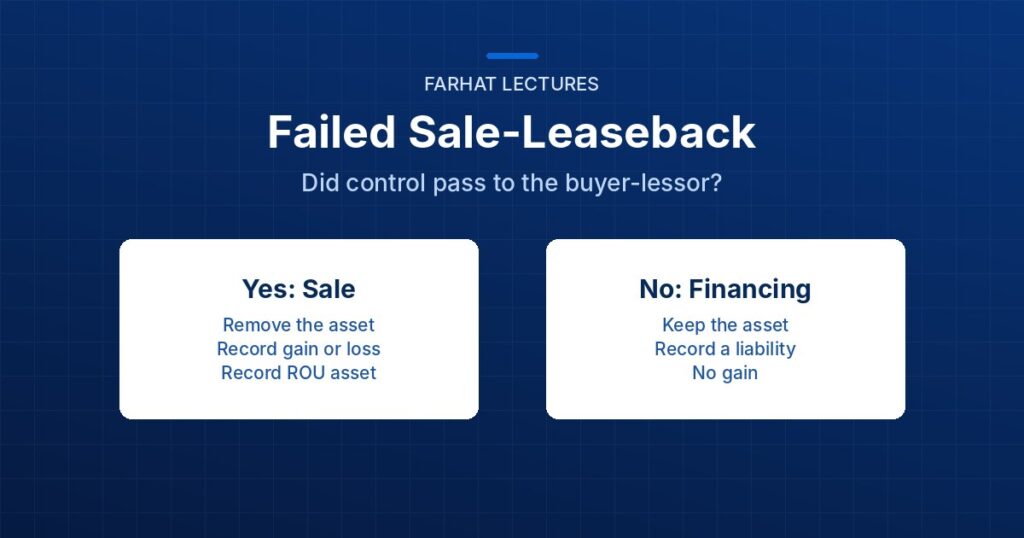
A failed sale-leaseback happens when an asset is sold and leased back, but the transfer is not a sale under FASB ASC 842-40, usually because the leaseback is a finance lease or the seller can buy the asset back. The seller-lessee keeps and depreciates the asset, records the cash as a loan, and recognizes no gain.
Why it matters: the same signed contract can produce a large gain or no gain at all, depending on the lease terms. Students often mix up the two outcomes or record a gain that should never appear.
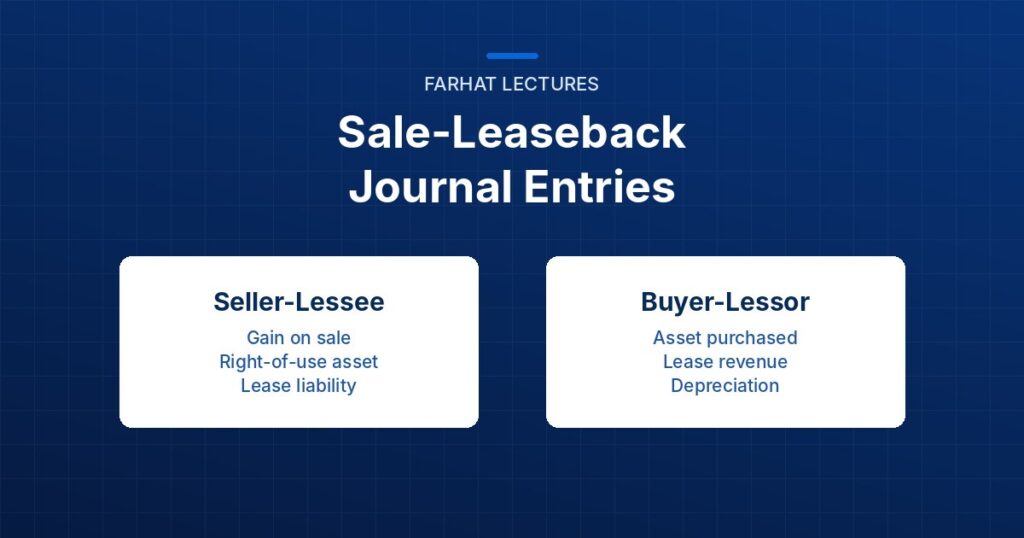
This lesson focuses on the failed side. For the control test in full, see sale-leaseback accounting under ASC 842, and for successful-sale entries, see sale-leaseback journal entries. All examples are hypothetical.
Watch: Sale and Leaseback: Sale vs. Financing & Journal Entries (a short comparison of both outcomes)
What is a failed sale-leaseback?
In a sale-leaseback, the seller-lessee sells an asset and leases it back. Under ASC 842, that transfer counts as a sale only if the buyer-lessor obtains control. When it does not, the deal is a failed sale, also called a financing transaction. In substance, the seller-lessee borrowed money and pledged its own asset.
What makes a sale-leaseback fail?
| Cause | Why control stays with the seller-lessee |
|---|---|
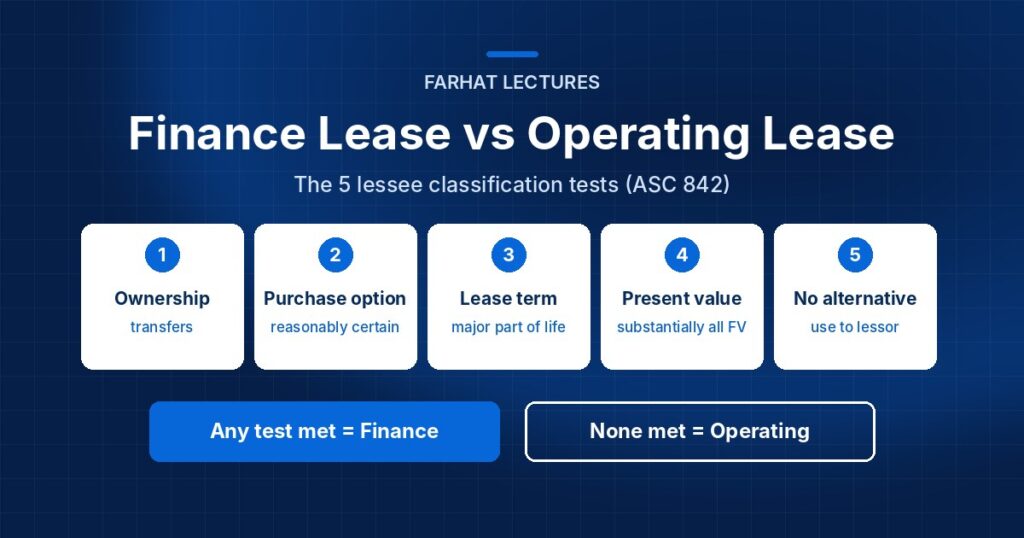
| The leaseback is a finance lease | Meeting any lease classification test (for example, a lease term covering a major part of the asset’s life) means the seller-lessee effectively controls the asset. |
| The buyer-lessor would classify the leaseback as a sales-type lease | If the buyer-lessor would account for the lease as a sales-type lease, it has not really obtained control of the asset, so there is no sale. |
| The seller-lessee has a repurchase option | It can take the asset back (see repurchase agreements under ASC 606). This blocks a sale unless the price is fair value at exercise and similar assets are readily available. |
| Control does not pass under ASC 606 | For example, there is no valid contract for accounting purposes. See transfer of control. |
Sale vs failed sale compared
| Item | Successful sale | Failed sale (financing) |
|---|---|---|
| The asset | Removed from the books | Stays on the books |
| Gain or loss | Recognized immediately | None |
| Cash received | Sale proceeds | Financial liability (like notes payable) |
| Lease accounting | ROU asset and lease liability | Not applied |
| Depreciation | Stops | Continues |
| Each payment | Lease expense (operating lease) | Interest expense plus repayment of the liability |
Example: Riverside Clinics
Hypothetical example. On January 1, Riverside Clinics sells its medical office building to Granite Realty for $2,900,000, its fair value. The building cost $3,000,000, has accumulated depreciation of $600,000, and has 20 years of economic life left. Riverside leases it back for 16 years, paying $280,000 at the end of each year. Riverside does not know the rate built into the lease, so it uses its incremental borrowing rate (the rate it would pay to borrow on similar terms), which is 7%.
The lease term is 16 ÷ 20 = 80% of the remaining life, which is a major part of it (a common benchmark is 75% or more). The present value of the payments at 7% is $280,000 × 9.44665 = $2,645,062, or 91.2% of fair value, which is substantially all of it (a common benchmark is 90% or more). Either test alone makes the leaseback a finance lease, so the transfer is a failed sale.
| Entry | Account | Debit | Credit |
|---|---|---|---|
| Financing | Cash | $2,900,000 | |
| Notes Payable (financial liability) | $2,900,000 |
The building and its $600,000 of accumulated depreciation stay exactly where they are. Riverside uses its 7% borrowing rate as the interest rate on the liability, and it keeps depreciating the building straight-line over the remaining 20 years with no salvage value ($2,400,000 ÷ 20 = $120,000).
| Entry | Account | Debit | Credit |
|---|---|---|---|
| Payment | Interest Expense ($2,900,000 × 7%) | $203,000 | |
| Notes Payable | $77,000 | ||
| Cash | $280,000 | ||
| Depreciation | Depreciation Expense | $120,000 | |
| Accumulated Depreciation—Buildings | $120,000 |
After the first payment, the liability is $2,900,000 − $77,000 = $2,823,000.
Compare a successful sale. Assume instead that Riverside leases the building back for five years at market rent, Granite obtains control under ASC 606, and no other term prevents sale recognition. Riverside removes the building from its books, recognizes a $500,000 gain ($2,900,000 − $2,400,000), and records a right-of-use asset and lease liability for the operating leaseback.
Check the interest rate. ASC 842-40-30-6 requires the seller-lessee to adjust the interest rate on a failed-sale liability, if needed, so that two things are true. First, compare total interest with total payments over the shorter of the lease term and the financing term. Interest cannot exceed payments over that period. Second, at the earlier of lease-end or the date control transfers to the buyer-lessor, the asset’s carrying amount cannot exceed the financing liability. In Riverside’s case, the financing and lease terms both run for 16 years, and control transfers at the end of year 16.
Riverside passes both checks at 7%. Total interest over 16 years is about $2,332,620, well below total payments of $4,480,000. At the end of year 16, the liability is about $752,620, while the building’s carrying amount is $480,000 ($2,400,000 − 16 × $120,000).
When the lease ends, Riverside removes both the building and the remaining liability and recognizes the difference, about $272,620, as a gain. If the liability had been smaller than the building’s carrying amount, Riverside would have had to raise the interest rate up front so that no loss would appear at the end.
Why is no gain recognized?
A gain on selling a building is recognized only when control of the building passes to the buyer, using the same control test as ASC 606. In a failed sale-leaseback, the seller-lessee still controls the economic benefits of the asset. The idea is similar to an inventory “sale” that the seller has agreed to buy back. Our lesson on repurchase agreements under ASC 606 explains that logic.
What does the buyer-lessor record?
The buyer-lessor’s side mirrors the seller-lessee’s. Because it did not obtain control, it does not record the building. Instead, it records a receivable (a financial asset) for the cash it paid. Each payment it collects is split between interest income and a reduction of the receivable.
Using the Riverside facts, and assuming Granite Realty also uses a 7% rate, Granite records these entries:
| Entry | Account | Debit | Credit |
|---|---|---|---|
| January 1 | Note Receivable | $2,900,000 | |
| January 1 | Cash | $2,900,000 | |
| December 31 | Cash | $280,000 | |
| December 31 | Interest Income ($2,900,000 × 7%) | $203,000 | |
| December 31 | Note Receivable | $77,000 |
How is this different under IFRS 16?
The core idea is the same. IFRS 16 uses the control test in IFRS 15, the international revenue standard. If the transfer does not qualify as a sale, the seller-lessee keeps the asset and accounts for the financial liability under IFRS 9.
The bigger difference shows up when the sale succeeds. Under ASC 842, the seller-lessee recognizes the full gain. Under IFRS 16, it recognizes only the part of the gain that relates to the rights it transferred to the buyer-lessor.
Common mistakes
- Recording a gain on a failed sale. No gain or loss appears, however much the price exceeds the carrying amount.
- Removing the asset. The asset stays on the balance sheet and keeps being depreciated.
- Recording an ROU asset and lease liability. A failed sale is a financing, so lease accounting is not applied to the seller-lessee’s payments.
- Treating every payment as expense. Part of each payment reduces the liability, and only the interest part is expense.
- Skipping the interest rate check. Before using a rate on a failed-sale liability, confirm the liability will not end up smaller than the asset’s carrying amount when control passes to the buyer-lessor.
Exam tip: On U.S. GAAP questions under ASC 842, classify the leaseback before you calculate anything. If the leaseback is a finance lease, stop there: no sale, no gain, and no ROU asset. Students often lose time computing a gain the question never asked for.
Practice questions
Question 1
A seller-lessee sells a building at fair value and leases it back for 10 of its 40 remaining years. The lease gives the seller-lessee an option to buy the building back for a fixed $1,200,000. Similar buildings are not readily available. Is this a sale?
Show answer
No. The fixed-price repurchase option is not at fair value at exercise, so it blocks sale accounting even though the lease term is only 25% of the life. The deal is a failed sale and is recorded as a financing.
Question 2
Delta Tools sells equipment (carrying amount $600,000) for $750,000 and leases it back under a finance lease. Record the sale-date entry.
Show answer
Debit Cash $750,000; credit Notes Payable (financial liability) $750,000. Delta keeps the equipment on its books and recognizes no gain.
Question 3
A failed-sale liability is $1,000,000 at 6% interest, with a $110,000 payment at year end. How much is interest expense, and what is the new liability balance?
Show answer
Interest expense is $1,000,000 × 6% = $60,000. The remaining $50,000 of the payment reduces the liability to $950,000.
Key takeaways
- A failed sale-leaseback is a financing, not a sale.
- A finance leaseback, a leaseback the buyer-lessor would classify as a sales-type lease, or a repurchase option (with narrow exceptions) causes the sale to fail.
- The seller-lessee keeps and depreciates the asset, records the cash as a liability, and recognizes no gain or loss.
- Each payment is split between interest expense and repayment of the liability.
Frequently asked questions
Is a failed sale-leaseback the same as a finance lease?
Not quite. A finance leaseback is one reason a sale fails. Once it fails, the seller-lessee does not apply lease accounting at all. It keeps the asset and records a financial liability, as it would for a loan.
Does the seller-lessee keep depreciating the asset in a failed sale?
Yes. The asset stays on the seller-lessee’s balance sheet and is depreciated and tested for impairment like any other asset it owns.
Why is there no gain in a failed sale-leaseback?
Because nothing was sold for accounting purposes. The seller-lessee still controls the asset, so the cash it received is borrowed money, not sale proceeds.
Can a repurchase option ever allow a sale?
Yes, but only if the exercise price is the asset’s fair value at the time of exercise and substantially similar assets are readily available in the market.
What does the buyer-lessor record in a failed sale?
It does not record the asset. It records a receivable, a financial asset, for the cash it paid, and treats the payments it receives as collections of that loan plus interest.
How do you record a failed sale-leaseback journal entry?
At the transfer date, debit Cash and credit a financial liability, often called notes payable or a financing obligation, for the cash received. The asset stays on the books. Each later payment is split: debit Interest Expense, debit the liability for the rest, and credit Cash.
What happens when a failed sale-leaseback ends?
When control passes to the buyer-lessor, usually at the end of the lease, the seller-lessee removes both the asset and the remaining liability. Any excess of the liability over the asset’s carrying amount is a gain. The interest rate check in ASC 842-40-30-6 makes sure this step never produces a loss.
Is a failed sale-leaseback treated the same way under IFRS?
Mostly, yes. Under IFRS 16, a transfer that is not a sale under IFRS 15 is also a financing. The seller-lessee keeps the asset and records a financial liability under IFRS 9.
Sources
- FASB Accounting Standards Codification, Subtopic 842-40: Sale and Leaseback Transactions
- Deloitte Roadmap, 10.3 Determining Whether the Transfer of an Asset Is a Sale
- Deloitte Roadmap, 10.4 Recognition and Measurement
- Journal of Accountancy, Accounting for sale and leaseback transactions
- KPMG, Sale-leaseback accounting: IFRS Accounting Standards vs US GAAP
About the author
Mansour Farhat, CPA, CIA, DBA, teaches accounting and CPA exam topics through Farhat Lectures and its YouTube lessons. Read more about Professor Farhat.
Continue learning with Farhat Lectures
Sale-leasebacks build on lease classification, right-of-use assets, and revenue recognition. Try a full lesson with worked problems before you move on.
Explore the free sample course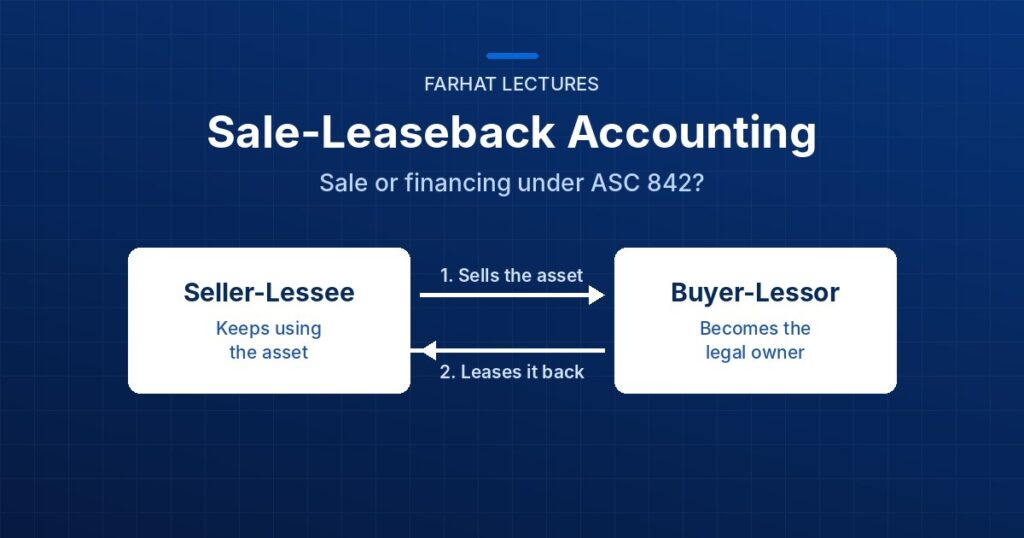

Responses