
Finance Lease vs Operating Lease: The 5 Lease Classification Tests

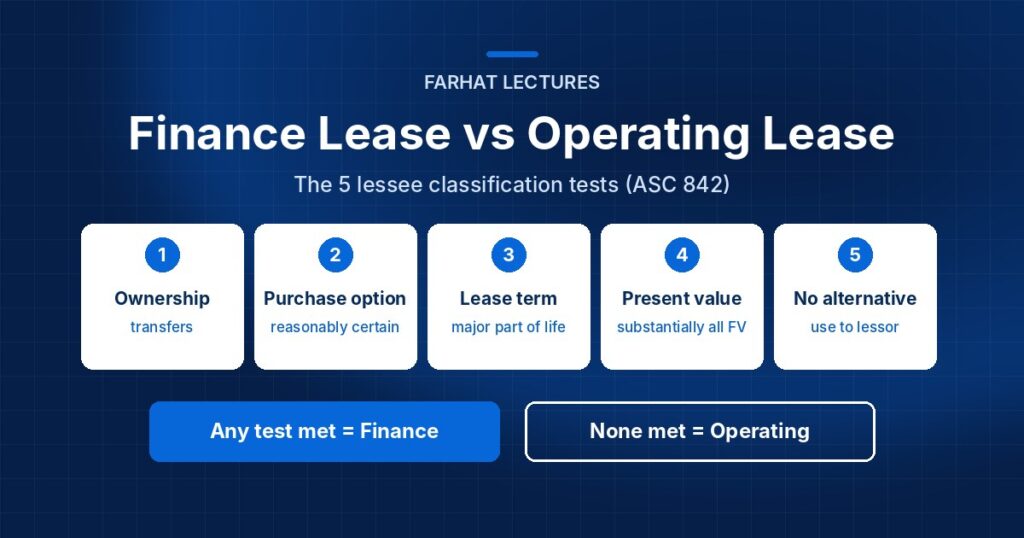
At commencement, a lessee classifies a lease as a finance lease if it meets any one of five tests under ASC 842. Ownership transfers to the lessee by the end of the lease, the lessee is reasonably certain to exercise a purchase option, the lease term covers a major part of the asset’s remaining economic life, the combined present value of lease payments and any lessee-guaranteed residual value not already included in those payments equals or exceeds substantially all of the asset’s fair value, or the specialized asset is expected to have no alternative use to the lessor at the end of the lease. If none of the five tests is met, the lessee classifies the lease as an operating lease.
The finance lease vs operating lease decision matters because it controls how the lessee reports the lease after day one. A finance lease is treated much like buying the asset with borrowed money, so the lessee reports interest plus amortization. An operating lease reports one straight-line lease cost. Both types put a right-of-use (ROU) asset and a lease liability on the balance sheet. The only exception is a short-term lease, meaning 12 months or less with no purchase option the lessee is reasonably certain to exercise, which a lessee can elect to keep off the balance sheet.
Watch: Finance vs. Operating Lease: 5 Classification Tests | ASC 842. Jump to 5:32 for the ownership test, 6:24 for the purchase option, 7:31 for lease term, 8:19 for present value, 9:42 for alternative use, and 10:34 for renewal options.
Finance lease vs operating lease: the 5 classification tests
A simple way to study the tests is to work through them in order. The first “yes” ends the analysis with a finance lease. Five “no” answers mean an operating lease. The tests are applied to the lease term, which starts with the non-cancelable period of the lease.
| # | Test | Question the lessee asks | Homework guideline |
|---|---|---|---|
| 1 | Transfer of ownership | Does ownership pass to the lessee by the end of the term? | Yes or no; no threshold |
| 2 | Purchase option | Is the lessee reasonably certain to exercise an option to buy? | Usually a bargain purchase option |
| 3 | Lease term | Is the term a major part of the asset’s remaining economic life? | 75% or more |
| 4 | Present value | Is the PV of lease payments plus any lessee-guaranteed residual substantially all of fair value? | 90% or more |
| 5 | Alternative use | Is the asset so specialized that the lessor has no other use for it at the end? | Yes or no; no threshold |
1. Transfer of ownership test
If the contract transfers legal title to the lessee by the end of the term, the lease is a finance lease. This is the easiest test to apply. A lease of office space that the lessee simply vacates at the end fails this test.
2. Purchase option test
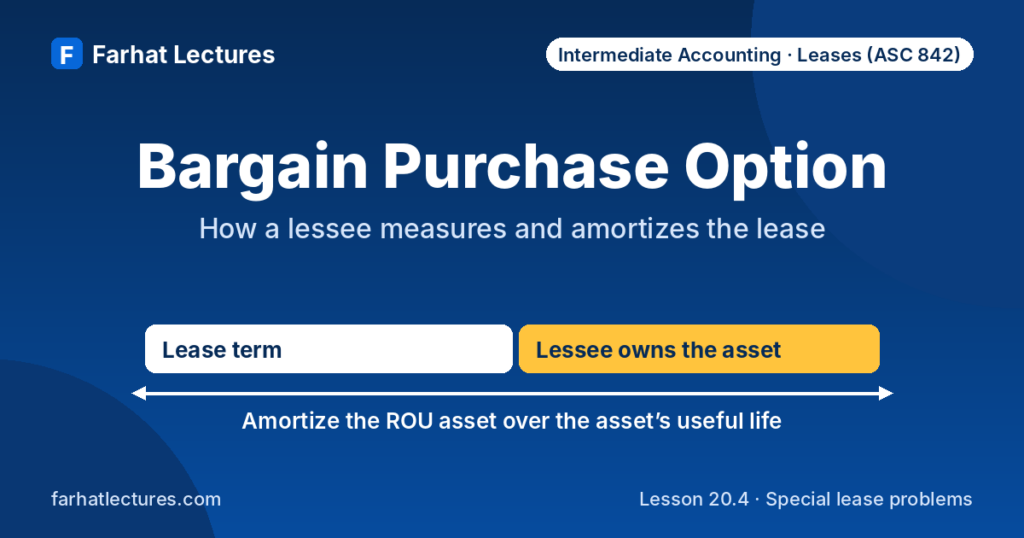
This test is met when the lessee is reasonably certain to exercise an option to buy the asset. The common case is a bargain purchase option: the option price is so far below the asset’s expected fair value when the option can be exercised that a rational lessee would almost certainly buy.
Hypothetical example: a 3-year truck lease lets the lessee buy the truck for $1,500 at the end, when it is expected to be worth $14,000. Buying at that price is an obvious choice, so the test is met and the lease is a finance lease.
3. Lease term test
A lease is a finance lease when the term covers a major part of the asset’s remaining economic life. The guideline is 75% or more. ASC 842 says not to use this test when the lease starts at or near the end of the asset’s economic life. The implementation guidance treats that as the last 25% of the asset’s total economic life.
The lease term is the non-cancelable period plus three kinds of option periods: renewal periods the lessee is reasonably certain to exercise, periods after a termination option the lessee is reasonably certain not to exercise, and periods the lessor can require by extending the lease or choosing to continue it when it has a termination option. A bargain renewal option, where the renewal rent is far below the expected fair rent, is the typical example. Add those renewal periods to the term before you compare it with economic life.
4. Present value test
The lessee discounts the lease payments, including any residual value it guarantees, and compares the result with the asset’s fair value at commencement. If the present value (PV) is substantially all of fair value, which the guideline sets at 90% or more, the lessee is effectively buying the asset. Deciding which payments to include and which rate to use takes care, so we cover it in detail in the present value test for leases.
5. Alternative use test
If the asset is so specialized that the lessor cannot lease or sell it to anyone else at the end of the term, the lessee is expected to use up all of its benefits. That makes it a finance lease. Build-to-suit equipment designed for one customer’s facility is the classic case.
Finance lease vs operating lease example: classifying three leases
Hypothetical example. Ridgeway Freight signs three non-cancelable leases. None transfers ownership, and none has a purchase option. The present values below use Ridgeway’s 8% incremental borrowing rate (the rate Ridgeway would pay to borrow on similar terms) because the rate implicit in each lease was not readily determinable.
| Lease | Key facts | Test met? | Classification |
|---|---|---|---|
| Forklift | 6-year term; 8-year economic life; PV of payments $41,000; fair value $50,000 | Lease term: 6 ÷ 8 = 75%, which meets the guideline | Finance lease |
| Office floor | 5-year term in a 40-year building; PV 30% of fair value; lessor can re-lease the space | None: 12.5% of life, 30% of fair value, alternative use exists | Operating lease |
| Custom conveyor | 4-year term; 10-year life; PV 70% of fair value; built for Ridgeway’s dock layout only | Alternative use: the lessor has no other use for it | Finance lease |
Notice that the conveyor fails both numeric tests but is still a finance lease. One “yes” is enough. Exam tip: on the CPA exam’s FAR section and in intermediate accounting exams, check all five tests before you answer, even when the numbers point to an operating lease.
How does a finance lease differ from an operating lease after classification?
Classification does not change what goes on the balance sheet. It changes how the cost flows through the income statement and the cash flow statement.
| Item | Finance lease | Operating lease |
|---|---|---|
| Balance sheet | ROU asset and lease liability | ROU asset and lease liability |
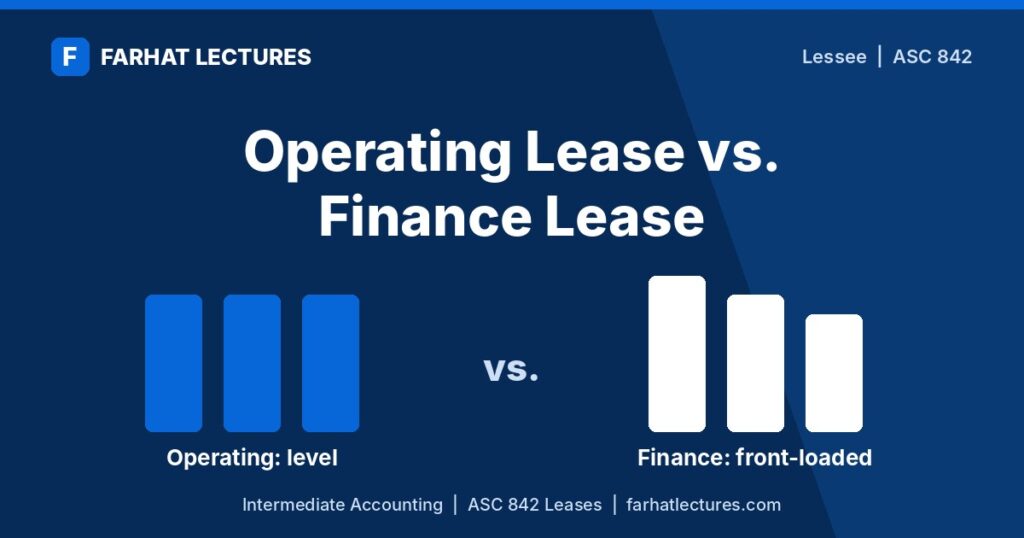
| Income statement | Amortization expense on the ROU asset plus interest expense on the liability, shown separately | One single lease cost, generally straight-line over the term |
| Expense pattern | Higher in early years, lower later | About the same each year |
| Cash flow statement | Principal payments in financing activities; interest payments in operating activities | Lease payments in operating activities |
Over the full lease term, total expense is generally the same. Only the timing differs. To see one lease worked both ways with journal entries, read operating lease vs finance lease: how the lessee’s numbers differ.
Interactive exercise: Classify six leases under ASC 842
Classify each noncancelable lease independently at commencement. For these six questions, use 75% or more of the asset’s remaining economic life as the lease-term guideline and 90% or more of fair value as the present-value guideline.
Common mistakes
- Requiring every test to be met. Only one test needs to be met for a finance lease.
- Treating operating leases as off-balance-sheet. Both types are recorded on the balance sheet unless the lessee elects the short-term exception for leases of 12 months or less with no purchase option it is reasonably certain to exercise. Compare the old rules in our lesson on off-balance-sheet financing.
- Forgetting bargain renewal periods. They belong in the lease term before you apply the 75% guideline.
- Treating 75% and 90% as rules. They are implementation guidelines. The standard itself says “major part” and “substantially all.”
- Applying U.S. GAAP tests under IFRS. IFRS 16 lessees do not use this two-way split. See our IFRS 16 lease accounting guide.
Still unsure who classifies what? Review lessor vs lessee first, then come back to these tests.
Practice questions
Question 1
A non-cancelable lease has a 4-year term. The equipment has a 5-year economic life and is new. There is no ownership transfer, no purchase option, the PV of payments is 84% of fair value, and the equipment is standard. How should the lessee classify the lease?
Show answer
Finance lease. The lease term test is met because 4 ÷ 5 = 80%, which is at least 75%. The PV test fails at 84%, but one test is enough.
Question 2
A lessee leases computers for 3 years at $400 per month. It can renew for 2 more years at $50 per month, while fair rent then is expected to be $350. The computers have a 6-year life. What is the lease term, and is the lease term test met?
Show answer
The renewal rent is far below fair rent, so renewal is reasonably certain and the lease term is 5 years. Because 5 ÷ 6 = 83%, the lease term test is met and this is a finance lease.
Question 3
Standard office copiers are leased for 3 years of a 7-year life. The PV of payments is $82,000, and fair value is $100,000. There is no ownership transfer or purchase option. Classify the lease.
Show answer
Operating lease. The term is 43% of the life, below 75%. The PV is 82% of fair value, below 90%. The copiers have alternative uses, and there is no ownership transfer or purchase option.
Key takeaways
- One test is enough. Meeting any of the five tests makes the lease a finance lease.
- The 75% and 90% figures are guidelines for “major part” and “substantially all,” not bright-line rules.
- The lease term includes option periods the lessee is reasonably certain to use, such as a bargain renewal.
- Both finance and operating leases go on the balance sheet, except short-term leases the lessee elects to leave off.
- Classification changes the expense pattern and cash flow presentation, not the total cost.
Frequently asked questions
Are operating leases on the balance sheet under ASC 842?
Yes. A lessee records a right-of-use asset and a lease liability for both finance and operating leases. The only exception is a short-term lease (12 months or less, with no purchase option the lessee is reasonably certain to exercise), which the lessee can elect to keep off the balance sheet.
How many criteria must a lease meet to be a finance lease?
Just one. If the lease meets any one of the five criteria at commencement, the lessee classifies it as a finance lease. If it meets none, it is an operating lease.
Are the 75% and 90% thresholds required?
No. ASC 842 uses the phrases “major part” and “substantially all.” The 75% and 90% figures come from the implementation guidance as one reasonable approach, and most textbooks use them for homework.
Is a finance lease the same as a capital lease?
Largely, yes. “Capital lease” was the term under the old standard, ASC 840. ASC 842 renamed it “finance lease” and revised the criteria, including adding the alternative use test.
Does a lessor use the same five tests?
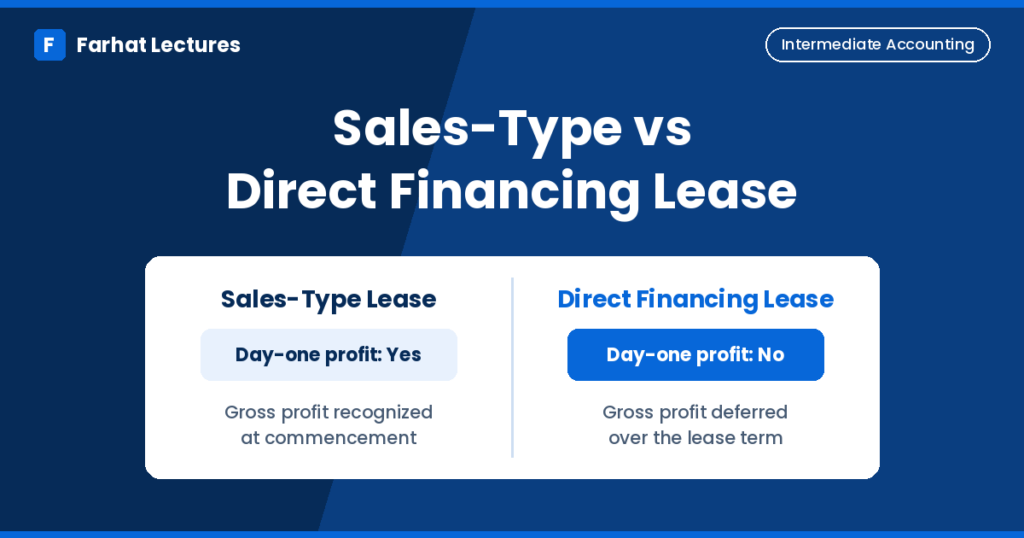
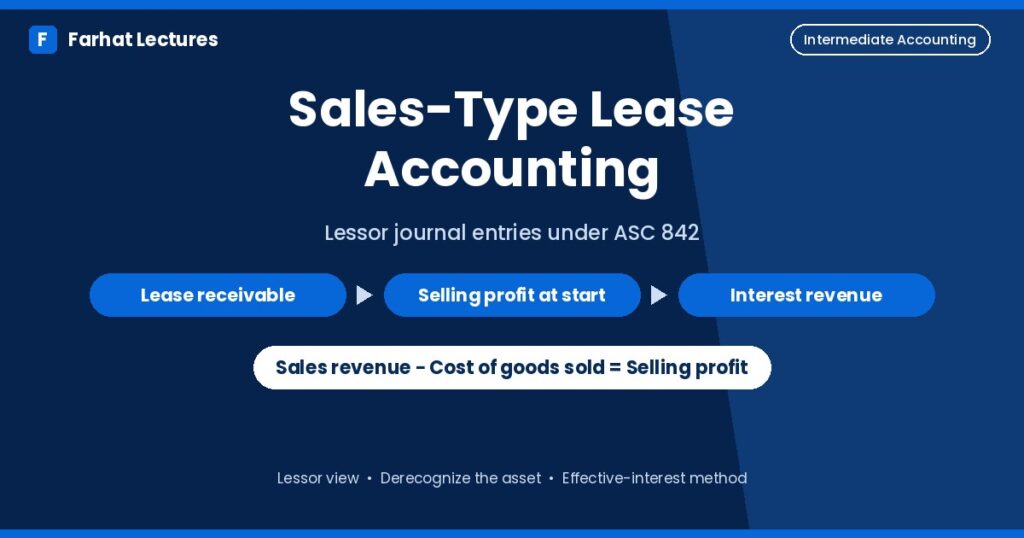
Yes. A lessor applies the same five tests. If any one is met, the lessor generally classifies the lease as a sales-type lease. If none is met, the lease can still be a direct financing lease when a residual value guarantee from a third party unrelated to the lessor brings the present value up to substantially all of fair value and collection is probable. Otherwise, it is an operating lease. See sales-type vs direct financing lease.
Can a lease’s classification change after commencement?
Only in limited cases. A lessee reassesses classification when the lease is modified and the change is not accounted for as a separate contract, or when the lease term or its assessment of a purchase option changes. Otherwise, the classification made at commencement stays.
What discount rate does the lessee use for the present value test?
The rate implicit in the lease, if the lessee can readily determine it. If not, the lessee uses its incremental borrowing rate. A lessee that is not a public business entity can elect a risk-free rate by class of asset.
Sources
- FASB Accounting Standards Codification, Topic 842: Leases (ASC 842-10-25-2)
- Deloitte DART, Leasing Roadmap 8.3: Lease classification
- Deloitte DART, Leasing Roadmap 5.2: Lease term
About the author
Mansour Farhat, CPA, CIA, DBA, teaches accounting and CPA exam topics through Farhat Lectures and its YouTube lessons. Read more about Professor Farhat.
Continue learning with Farhat Lectures
Classification is the first big decision in lease accounting. Practice it in a full lesson with worked problems before you move on to measurement.
Explore the free sample course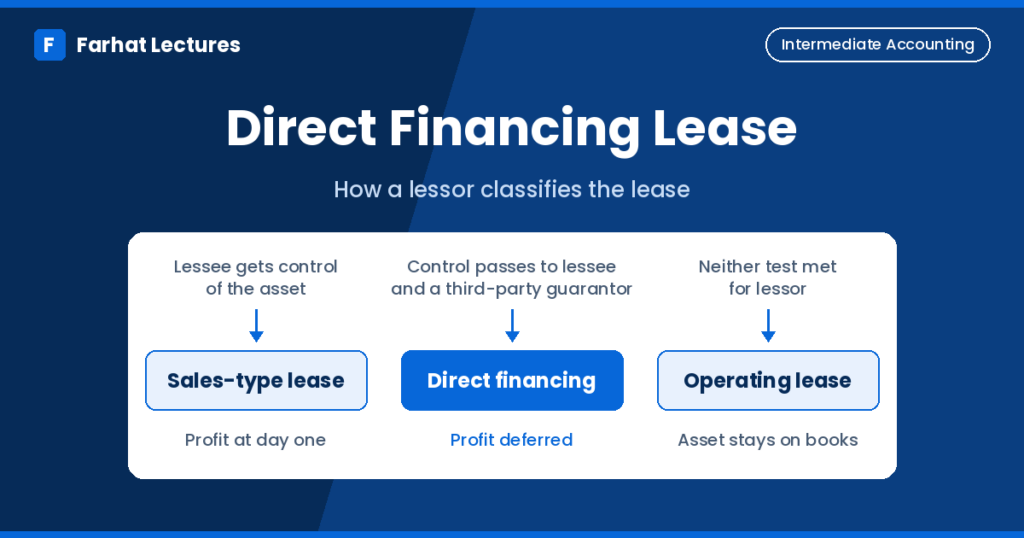
Responses