
Sale-Leaseback Accounting: How ASC 842 Decides Sale or Financing

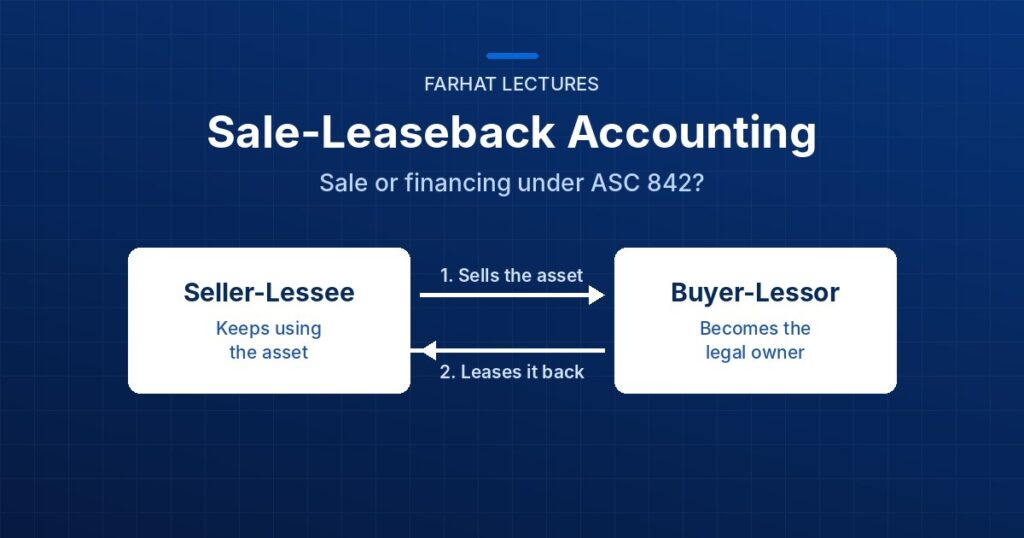
Sale-leaseback accounting covers a deal where a company sells an asset and leases it back. Under the FASB’s ASC 842-40, the seller-lessee asks one question: did control pass to the buyer? If yes, it records a sale, recognizes the gain or loss, and books an operating leaseback. If no, it keeps the asset and records the cash as a loan.
Why it matters: sale-leasebacks involve buildings, aircraft, and equipment worth billions of dollars each year. The sale-or-financing decision changes the balance sheet, the gain on the income statement, and the debt a company reports. It is a core intermediate accounting topic, and CPA candidates see it in the BAR (Business Analysis and Reporting) section of the exam.
This guide covers the big picture. For full two-year entries, see sale-leaseback journal entries, and for deals that do not qualify as a sale, see failed sale-leaseback accounting. All examples use original, hypothetical numbers.
Watch: Accounting for Sale-Leaseback Agreements (the section from 8:05 covers sale versus failed sale)
What is a sale-leaseback?
In a sale-leaseback (also called a sale and leaseback), one company, the seller-lessee, transfers an asset to another company, the buyer-lessor. The seller-lessee then leases the same asset back. It keeps using the asset, but now pays rent instead of owning it.
Restaurant chains use sale-leasebacks for their buildings, banks for office space, utilities for power plants, and airlines for aircraft.
Why do companies use sale-leasebacks?
| Seller-lessee | Buyer-lessor |
|---|---|
| Turns cash tied up in property into money for operations or growth, while still using the asset | Often earns a higher return than on a traditional loan |
| Can design the lease terms to avoid some costs and restrictions of conventional borrowing | Holds legal title to the asset, which protects it if the seller-lessee stops paying |
| May save tax, because rent payments are deductible, while an owner deducts only depreciation and interest (land is never depreciated) | May gain an inflation hedge if the property rises in value |
Sale-leaseback accounting: how ASC 842 decides sale or financing
ASC 842 borrows the control idea from revenue recognition. The seller-lessee works through three checks.
| Check | Question | What the answer means |
|---|---|---|
| 1. Control under ASC 606 | Is there a valid contract, and has control of the asset passed to the buyer-lessor? (See our lesson on transfer of control.) | Continue to check 2. If control has not passed, it is a financing. |
| 2. Leaseback classification | Would the leaseback be a finance lease for the seller-lessee (or a sales-type lease for the buyer-lessor)? | If yes, there is no sale. The seller-lessee effectively keeps control. |
| 3. Repurchase option | Can the seller-lessee buy the asset back? (A repurchase right means control may never have passed. See our lesson on transfer of control.) | If yes, there is no sale, unless both of these are true: the exercise price is fair value at the exercise date, and assets that are substantially the same are readily available in the marketplace. An obligation to buy the asset back always means there is no sale. |
Check 2 uses the five lease classification tests. Meeting any one of them makes the leaseback a finance lease, which means control has effectively come back to the seller-lessee.
Exam tip: On a sale-leaseback question, classify the leaseback first. If it is a finance lease, stop there. There is no sale and no gain, no matter how much cash changed hands.
| Lease classification test | Finance lease if… |
|---|---|
| 1. Transfer of ownership | Ownership passes to the lessee by the end of the lease |
| 2. Purchase option reasonably certain to be exercised | The lessee is reasonably certain to buy the asset |
| 3. Lease term | The lease covers a major part of the asset’s remaining economic life (75% or more is a common benchmark). Skip this test if the lease begins at or near the end of the asset’s economic life. |
| 4. Present value of payments | The present value of the lease payments plus the present value of any residual value guaranteed by the lessee and not already included in those payments equals or exceeds substantially all of the asset’s fair value (90% or more is a common benchmark). |
| 5. Specialized asset | The asset is so specialized that the lessor has no other use for it at the end |
What does the seller-lessee record in a sale?
When the transfer is a sale, the seller-lessee does three things:
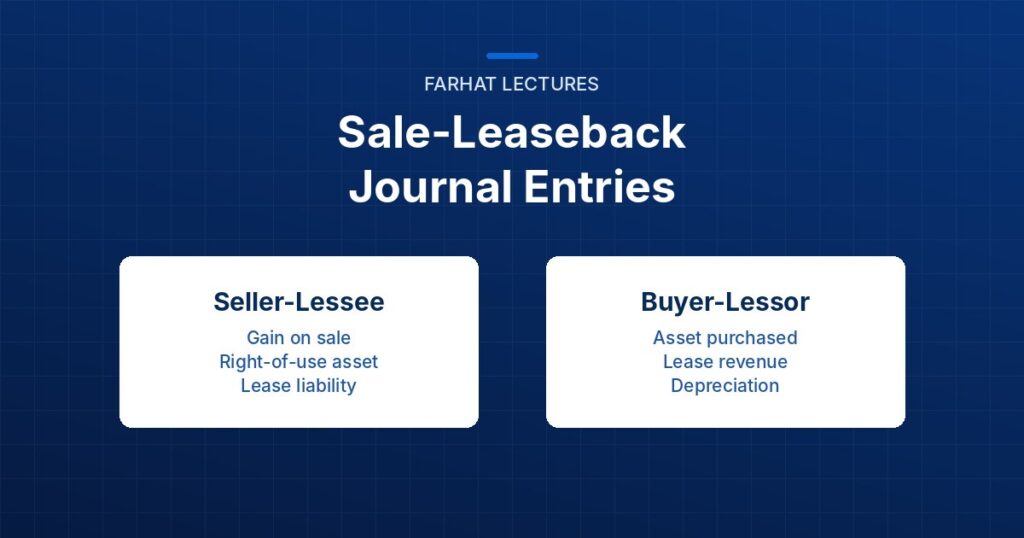
- Records the cash and removes the asset. It takes the asset and its accumulated depreciation off the books. This is called derecognizing the asset.
- Recognizes a gain or loss equal to the sale price after any required off-market adjustment, less the asset’s carrying amount.
- Records the leaseback as an operating lease, with a right-of-use (ROU) asset and a lease liability at the present value of the lease payments.
Example: a warehouse sale-leaseback
Hypothetical example. On January 1, Lakeview Bakeries transfers its warehouse for $1,350,000, its fair value. The buyer takes title and can sell the warehouse to another investor, subject to Lakeview’s six-year right to occupy it. The warehouse cost $1,500,000 and has accumulated depreciation of $400,000, so its carrying amount is $1,100,000. Lakeview leases it back for 6 years. Payments are $120,000 at the end of each year, and the warehouse has 20 years of economic life left. There is no purchase or repurchase option, and Lakeview’s incremental borrowing rate is 7%.
The present value of the payments is $120,000 × 4.76654 = $571,985.
| Test | Result |
|---|---|
| Transfer of ownership | No. The warehouse stays with the buyer. |
| Purchase option | None. |
| Lease term | 6 ÷ 20 = 30% of remaining life. Not a major part. |
| Present value | $571,985 ÷ $1,350,000 = 42.4% of fair value. Not substantially all. |
| Specialized asset | No. A warehouse has other uses. |
The buyer obtains control of the warehouse under ASC 606. Lakeview retains only the right to occupy it for six years. The leaseback is an operating lease, and Lakeview has no repurchase right, so it recognizes the sale.
| Entry | Account | Debit | Credit |
|---|---|---|---|
| Record the sale | Cash | $1,350,000 | |
| Accumulated Depreciation—Buildings | $400,000 | ||
| Buildings | $1,500,000 | ||
| Gain on Disposal of Plant Assets | $250,000 | ||
| Record the leaseback | Right-of-Use Asset | $571,985 | |
| Lease Liability | $571,985 |
The full $250,000 gain is recognized now. Each year Lakeview then records a single straight-line lease expense of $120,000, as shown in our sale-leaseback journal entries lesson.
Off-market terms: when the price and fair value differ
The entries above assume the sale price equals fair value. When an off-market adjustment is required, use the adjusted sale price to calculate the gain or loss.
- Price below fair value: the shortfall is treated as prepaid rent and added to the right-of-use asset.
- Price above fair value: the excess is treated as extra financing from the buyer-lessor and recorded as a financial liability.
Use whichever difference is more readily determinable: the difference between the sale price and the asset’s fair value, or the difference between the present value of the contractual lease payments and the present value of market rental payments.
Hypothetical example. Suppose Lakeview had sold the warehouse for $1,250,000 instead, with fair value still $1,350,000 and rent set below market to make up the difference. The $100,000 shortfall is prepaid rent. The gain is still $250,000 ($1,350,000 fair value minus the $1,100,000 carrying amount).
| Account | Debit | Credit |
|---|---|---|
| Cash | $1,250,000 | |
| Right-of-Use Asset (prepaid rent) | $100,000 | |
| Accumulated Depreciation, Buildings | $400,000 | |
| Buildings | $1,500,000 | |
| Gain on Disposal of Plant Assets | $250,000 |
Lakeview still records the leaseback separately, debiting the right-of-use asset and crediting the lease liability for the present value of its lower lease payments. If Lakeview had instead sold for $1,450,000, the extra $100,000 would be a financial liability owed to the buyer-lessor, and the gain would still be $250,000.
Watch this part of the lesson: fair value adjustments when the sale price differs from fair value (16:03).
What if the transfer is not a sale?
Suppose Lakeview had leased the warehouse back for 18 of its 20 remaining years. That is 90% of its life, so the leaseback would be a finance lease. Control has effectively stayed with Lakeview, so the deal is a failed sale. Lakeview keeps the warehouse on its books, keeps depreciating it, records the $1,350,000 as a liability, and recognizes no gain. Our lesson on failed sale-leasebacks walks through those entries.
Watch this part of the lesson: failed sale treated as a financing arrangement (14:07).
How does the buyer-lessor account for a sale-leaseback?
The buyer-lessor follows the same sale-or-financing answer as the seller-lessee.
- If the transfer is a sale: the buyer-lessor records the asset it bought. Lakeview’s buyer would record the warehouse at its $1,350,000 cost. It then accounts for the leaseback as a lessor, usually as an operating lease, so it depreciates the warehouse and records lease income.
- If the transfer is not a sale: the buyer-lessor does not record the asset. It records the cash it paid as a receivable, in effect a loan to the seller-lessee, and earns interest income on it. See our failed sale-leaseback lesson for both sides’ entries.
Common mistakes
- Recording the ROU asset at the sale price. The ROU asset starts at the present value of the lease payments, not the price the buyer paid.
- Deferring the gain. Under ASC 842, a sale at fair value produces a gain or loss recognized immediately.
- Forgetting accumulated depreciation. Derecognizing the asset means removing both its cost and its accumulated depreciation.
- Treating a finance leaseback as a sale. If any classification test is met, there is no sale.
- Measuring the gain with an off-market price. Calculate the gain or loss using the adjusted sale price less the asset’s carrying amount. In Lakeview’s below-market sale, the $100,000 adjustment is prepaid rent.
Practice questions
Apply the ASC 842 control test to a restaurant property in three multiple-choice questions. Then use the numerical examples below to practice recording the amounts.
Practice problem 1: Hart Co. leases equipment back for 3 years
Hart Co. transfers equipment with a cost of $500,000 and accumulated depreciation of $100,000 for its fair value of $460,000. The buyer takes title and can sell the equipment subject to Hart’s lease. It leases the equipment back for 3 of its 10 remaining years, with no options. The present value of the payments is $150,000. Is this a sale, and what does Hart record?
Show answer
Yes. The buyer obtains control of the equipment under ASC 606. The three-year lease uses 30% of the remaining life, and the present value of the payments is 32.6% of fair value. The leaseback is an operating lease, and Hart has no repurchase option, so Hart recognizes the sale. Hart debits Cash $460,000 and Accumulated Depreciation $100,000, credits Equipment $500,000, and credits Gain $60,000. It also debits Right-of-Use Asset and credits Lease Liability for $150,000.
Practice problem 2: The same deal with an 8-year leaseback
Same facts, but the leaseback runs for 8 of the 10 remaining years. Is this a sale?
Show answer
No. 8 ÷ 10 = 80% is a major part of the asset’s life, so the leaseback is a finance lease. The transfer is a failed sale. Hart keeps the equipment, records the $460,000 as a financial liability, and recognizes no gain.
Practice problem 3: A sale at a loss
A company sells a building at its fair value of $900,000. The carrying amount is $950,000, and the leaseback is an operating lease. What is recognized on the sale?
Show answer
A $50,000 loss ($900,000 − $950,000), recognized immediately. A sale-leaseback at fair value can produce a loss just as easily as a gain.
Key takeaways
- A sale-leaseback is a sale of an asset followed by a lease of the same asset back to the seller.
- The deciding question is whether control passed to the buyer-lessor.
- A finance leaseback or a repurchase option (with narrow exceptions) means there was no sale.
- In a sale, the seller-lessee removes the asset, recognizes the full gain or loss, and records an ROU asset and lease liability.
- If the price is not fair value, the gap becomes prepaid rent (price too low) or extra financing (price too high), never part of the gain.
Frequently asked questions
Is the gain on a sale-leaseback deferred under ASC 842?
No. When the transfer is a sale at fair value, the seller-lessee recognizes the full gain or loss when the buyer-lessor obtains control. The older standard, ASC 840, generally deferred sale-leaseback gains over the lease term.
What if the sale price is not fair value?
The seller-lessee measures the gain or loss using the sale price after any required off-market adjustment, less the asset’s carrying amount. If the price is below fair value, the shortfall is treated as prepaid rent. If the price is above fair value, the excess is treated as additional financing from the buyer-lessor, not as part of the gain.
Does a repurchase option always cause a failed sale?
Almost always. A seller-lessee option to buy the asset back blocks sale accounting unless two conditions are both met: the exercise price is the asset’s fair value at the exercise date, and alternative assets that are substantially the same are readily available in the marketplace. An obligation to buy the asset back always blocks sale accounting.
How is IFRS 16 different?
Under IFRS 16, the seller-lessee recognizes only the part of the gain that relates to the rights transferred to the buyer-lessor. Under ASC 842, the seller-lessee recognizes the full difference between the sale price after any required off-market adjustment and the asset’s carrying amount.
Who are the seller-lessee and the buyer-lessor?
The seller-lessee is the company that sells the asset and then rents it back. The buyer-lessor is the company that buys the asset and becomes the landlord.
Does a sale-leaseback take debt off the balance sheet?
Not fully. Under ASC 842, even a successful sale-leaseback puts a right-of-use asset and a lease liability on the seller-lessee’s balance sheet. Under the older ASC 840, operating leasebacks stayed off the balance sheet.
How does the buyer-lessor record a failed sale-leaseback?
It does not record the asset. It records the cash it paid as a receivable, in effect a loan to the seller-lessee, and earns interest income over time.
Sources
- FASB Accounting Standards Codification, Subtopic 842-40: Sale and Leaseback Transactions
- Deloitte Roadmap, 10.3 Determining Whether the Transfer of an Asset Is a Sale
- Deloitte Roadmap, 10.4 Recognition and Measurement
- PwC Viewpoint, 6.4 When the transaction qualifies as a sale
- KPMG, Sale and leaseback: IFRS Accounting Standards vs US GAAP
About the author
Mansour Farhat, CPA, CIA, DBA, teaches accounting and CPA exam topics through Farhat Lectures and its YouTube lessons. Read more about Professor Farhat.
Continue learning with Farhat Lectures
Sale-leasebacks build on lease classification, right-of-use assets, and revenue recognition. Try a full lesson with worked problems before you move on.
Explore the free sample course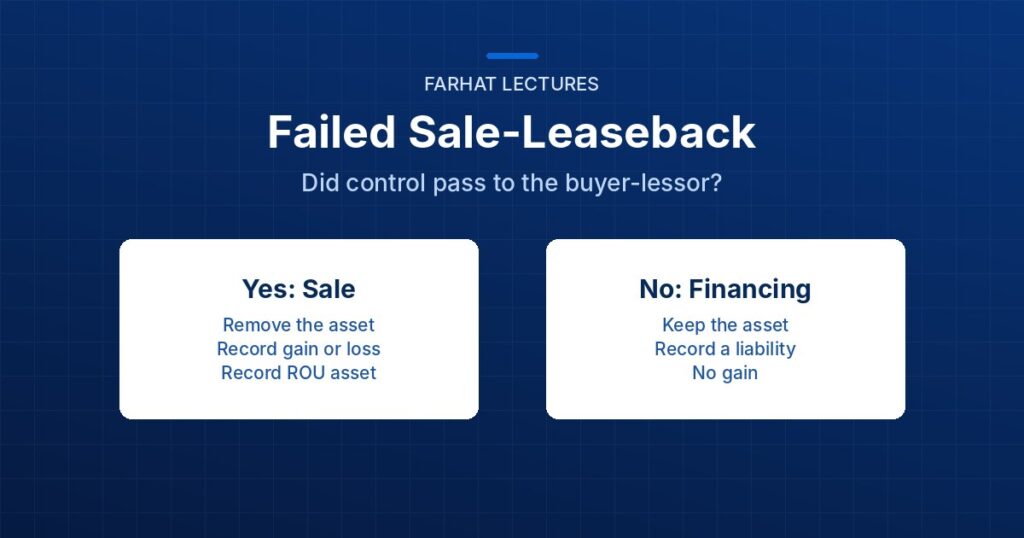

Responses