
Contract With a Customer: The 5 ASC 606 Contract Criteria

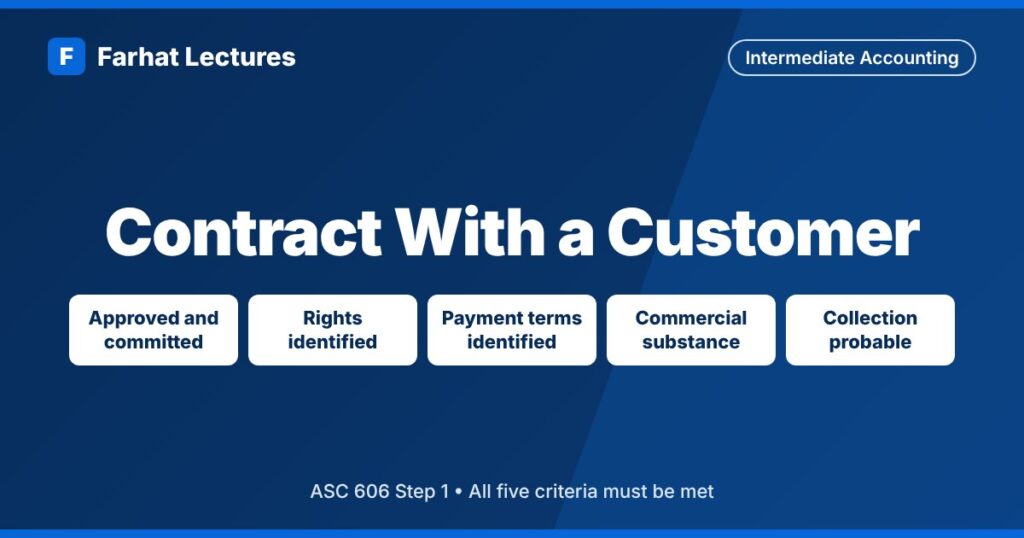
A contract with a customer is an agreement that creates enforceable rights and obligations. Under ASC 606-10-25-1, the revenue model applies only when all five criteria are met: the parties approved and are committed, each party’s rights are identified, payment terms are identified, the contract has commercial substance, and collecting substantially all of the consideration is probable.
Why does this matter? Identifying the contract is Step 1 of the five-step revenue recognition model. If a criterion is missing, the company keeps assessing the agreement. Any consideration received is recorded as a liability until the contract criteria are met or one of the conditions in ASC 606-10-25-7 permits revenue recognition. Exam questions often hide the problem in Step 1, for example a deal either side can cancel for free or a customer who is unlikely to pay.
If you are studying for the CPA exam, revenue recognition sits in FAR Area III, Select Transactions, which carries 25 to 35 percent of that section. The FASB wrote these criteria in ASC 606, and the IASB wrote the matching rules in IFRS 15. Step 1 shows up in both multiple choice questions and task-based simulations, usually by hiding a cancellation right or a collection problem somewhere in the fact pattern.
This guide covers the Five-Step Process Revisited material from the revenue recognition chapter of intermediate accounting. For a quick tour of all five steps first, see revenue recognition under ASC 606 and IFRS 15.
Watch: how to identify a contract with a customer
Watch this Farhat lesson on YouTube
In this 11-minute lesson, Professor Farhat explains how to identify a contract with a customer and test it against the five ASC 606 criteria before moving to Step 2.
Want the full chapter rather than one lesson? The complete walkthrough lives in the Farhat Lectures Intermediate Accounting course, where each step of the revenue model has its own worked examples and practice set.
What is a contract with a customer?
A contract is an agreement that creates enforceable rights and obligations. It does not have to be a signed document. A contract can be:
- Written, such as a signed purchase agreement.
- Oral, such as a phone order the seller accepts.
- Implied by customary business practice, such as a coffee shop handing you a latte after you order and tap your card.
When the contract begins, the company gains a right to receive payment and takes on obligations to deliver goods or services (its performance obligations). Together, these rights and obligations create a net asset or a net liability for the company as the contract is carried out.
Who counts as a customer?
A customer is a party that contracts with the company to obtain goods or services that come from the company’s ordinary activities. That definition matters because not every agreement has a customer in it. When two companies share the risks and benefits of developing something together, that is a collaboration, not a customer contract, and ASC 606 does not apply to it. Check that a customer exists before you start testing the five criteria.
The 5 ASC 606 contract criteria
ASC 606-10-25-1 lists five criteria. All five must be met at contract inception. Deloitte’s Roadmap walks through each criterion in its discussion of the criteria for identifying a contract with a customer.
| Criterion | What it means | Question to ask |
|---|---|---|
| 1. Approval and commitment | The parties have approved the contract (in writing, orally, or by practice) and are committed to perform. | Has everyone actually agreed to go ahead? |
| 2. Rights identified | The company can identify each party’s rights to the goods or services being transferred. | Do we know what each side gets? |
| 3. Payment terms identified | The company can identify how and when it will be paid. | Do we know the price and payment terms? |
| 4. Commercial substance | The contract is expected to change the company’s future cash flows (risk, timing, or amount). | Is this a real economic exchange? |
| 5. Collection is probable | It is probable the company will collect substantially all of the consideration it expects to be entitled to. | Is the customer able and willing to pay? |
When no contract exists yet
A contract is treated as not existing for accounting purposes when it is wholly unperformed and each party has the enforceable right to terminate it independently without compensating the other. An agreement is wholly unperformed when the seller has transferred no promised goods or services and has neither received nor become entitled to any consideration for them.
Example (hypothetical). On February 10, 2028, Northpoint Furniture agrees to deliver conference tables to a customer on May 15, 2028. The customer must pay the $12,000 price on June 15, 2028. The tables cost Northpoint $7,000. Either party can cancel without penalty until delivery. Before delivery, Northpoint receives no payment and has no right to receive any. Northpoint delivers on May 15.
| Date | What happens | Entry? |
|---|---|---|
| February 10 | Contract signed; wholly unperformed and cancelable without compensation | No entry |
| May 15 | Northpoint delivers the tables (it has performed) | Record revenue and cost of goods sold |
| June 15 | Customer pays | Record collection of the receivable |
| May 15, 2028 | Debit | Credit |
|---|---|---|
| Accounts Receivable | 12,000 | |
| Sales Revenue | 12,000 | |
| Cost of Goods Sold | 7,000 | |
| Inventory | 7,000 |
| June 15, 2028 | Debit | Credit |
|---|---|---|
| Cash | 12,000 | |
| Accounts Receivable | 12,000 |
What if a customer pays before the criteria are met? The company records the cash as a liability, not revenue, until the criteria are met or another condition in the standard applies, such as the contract being terminated with the payment nonrefundable (see Deloitte’s Step 1 overview). Payments received in advance under a valid contract are covered in unearned revenue. For the distinction between a deposit liability and a contract liability, see contract assets and contract liabilities.
Collectibility: probable vs. bad debts
Collectibility just means the likelihood of actually getting paid.
The fifth criterion trips up many students. At contract inception, assess whether the customer has the ability and intention to pay substantially all of the consideration the company expects to be entitled to when payment is due. If collection is not probable, this criterion is unmet and the company continues to assess the agreement.
Probable collection is a Step 1 criterion. For a qualifying contract, the company recognizes the amount of the transaction price allocated to each performance obligation when or as it satisfies that obligation. The company records expected credit losses separately as bad debt expense.
Bad debt or price concession?
There is one important exception, and it is a favorite on exams. If the company never really expected to collect the full price and plans to accept less, that is a price concession, not a bad debt. A price concession is variable consideration under ASC 606-10-32-5 through 32-7, so it reduces the transaction price and therefore reduces revenue.
The test is to ask why the company expects to receive less money:
- The customer cannot pay. That is a credit loss. The company records the shortfall separately as bad debt expense.
- The company chose to charge less. That is a price concession. Revenue itself comes down.
One note on wording. Many textbooks call this bad debt expense and the allowance for doubtful accounts. Under the current credit loss standard, ASC 326, you will also see credit loss expense and allowance for credit losses. Both sets of terms describe the same idea.
For how companies estimate those losses in the first place, see the lesson on the allowance for credit losses.
Example (hypothetical). In November 2028, Glenwood Supply sells $250,000 of tools to many retail customers on account. Control has passed to the customers, and Glenwood concludes collection is probable. From experience, about 3% of these receivables will not be collected.
| November 2028 | Debit | Credit |
|---|---|---|
| Accounts Receivable | 250,000 | |
| Sales Revenue | 250,000 | |
| Bad Debt Expense | 7,500 | |
| Allowance for Doubtful Accounts | 7,500 |
Revenue is $250,000. The $7,500 (3% of $250,000) is an operating expense, not a reduction of revenue.
U.S. GAAP vs. IFRS. Both standards say “probable,” but the word means different things. Under U.S. GAAP it means likely to occur, a high bar. Under IFRS 15 it means more likely than not. Deloitte lists this among the differences between U.S. GAAP and IFRS.
Applying Step 1 in order
| Ask this | If no | If yes |
|---|---|---|
| Is there a customer, rather than a collaboration partner? | ASC 606 does not apply | Keep going |
| Is the agreement enforceable, in writing, orally, or by practice? | No contract yet | Keep going |
| Are all five criteria met at inception? | No contract yet. Hold any cash received as a liability and keep assessing | Keep going |
| Is the agreement wholly unperformed (no promised goods or services transferred, no consideration received, and no entitlement to consideration), and does each party have the enforceable right to cancel independently without compensation? | Keep going | No contract yet. Record nothing |
| Should two or more agreements be combined? | Treat separately | Account for them as one contract |
| Step 1 complete | Move to Step 2 and identify the performance obligations | |
One more timing point. A company tests these criteria at contract inception. Under ASC 606-10-25-5 it does not reassess them later unless there is an indication of a significant change in facts and circumstances, such as a serious drop in the customer’s ability to pay. If a contract fails the criteria at inception, ASC 606-10-25-6 says the company keeps assessing it to see whether the criteria are met later.
Once Step 1 is settled, the next question is what the company actually promised. That is Step 2, covered in performance obligations.
When contracts are combined
Sometimes one deal is split across several documents, for example one contract for equipment and another for related services. ASC 606-10-25-9 requires the company to account for two or more contracts as a single contract when the contracts are entered into at or near the same time with the same customer, or with related parties of that customer, and at least one of the following is true:
- The contracts were negotiated as a package with a single commercial objective.
- The amount of consideration in one contract depends on the price or performance of the other contract.
- The goods or services promised across the contracts are a single performance obligation.
The goal is to account for the economics of the deal, not the paperwork. Contract modifications follow a separate set of rules, so a later change to a signed deal is not the same question as combining two deals at the start.
Once a valid contract exists, the next question is what the company promised to deliver. That is Step 2, covered in performance obligations. Then Step 3 sets the price, covered in transaction price under ASC 606.
For guided practice, see the Revenue Recognition Principle: Contract lesson in the Farhat Lectures Intermediate Accounting course.
Key takeaways on a contract with a customer
- A contract can be written, oral, or implied by business practice.
- All five ASC 606 criteria must be met before the revenue model applies.
- A wholly unperformed contract that either party can cancel without penalty is not yet a contract for accounting purposes.
- Probable collection is a contract criterion. Recognize the amount allocated to each performance obligation when or as it is satisfied. Record expected credit losses separately as bad debt expense. A price concession reduces the transaction price.
- Cash received before the contract criteria are met is recorded as a liability until the criteria are met or an ASC 606-10-25-7 condition applies.
Common mistakes
- Recording revenue when the contract is signed instead of when the company performs.
- Assuming a contract must be in writing.
- Reducing revenue for expected bad debts instead of recording bad debt expense.
- Treating “collection is probable” as “collection is guaranteed.”
- Recording a customer deposit as revenue when no valid contract exists.
Practice questions with answers
1. On March 1, a company signs a contract to deliver goods on June 1 for $8,000, payable July 1. Either party can cancel without penalty before delivery. As of March 1, no goods have been delivered, no payment has been received, and the seller has no right to payment. What entry is made on March 1?
Answer: No entry. The contract is wholly unperformed and either party can cancel without compensation, so no contract exists yet for accounting purposes.
2. A company sells $400,000 of goods on account. Collection is probable, but it expects 2% to be uncollectible. How much revenue does it recognize?
Answer: $400,000. The expected loss of $8,000 (2% × $400,000) is recorded as bad debt expense, not as a reduction of revenue.
3. A customer wires a $5,000 deposit, but the company concludes collection of the remaining $45,000 is not probable. How is the $5,000 recorded?
Answer: As a liability. The collectibility criterion is not met, so no contract exists, and cash received is held as a liability until the criteria are met or the standard’s other conditions for recognizing revenue apply.
Revenue Recognition Step 1: Customer Contract Criteria Practice Quiz
Apply ASC 606 Step 1 to four scenarios covering oral agreements, the five contract criteria, missing payment terms, and cancellation rights.
Frequently asked questions
What is a contract with a customer under ASC 606?
It is an agreement between two or more parties that creates enforceable rights and obligations and meets all five ASC 606-10-25-1 criteria: approval and commitment, identified rights, identified payment terms, commercial substance, and probable collection of substantially all the consideration.
Does a contract have to be in writing?
No. A contract can be written, oral, or implied by the company’s customary business practices, as long as it creates enforceable rights and obligations.
What does commercial substance mean?
It means the contract is expected to change the risk, timing, or amount of the company’s future cash flows. A swap that changes nothing economically does not qualify.
What happens if collection is not probable?
The collectibility criterion is unmet, so the company continues to assess the agreement. Any cash received is recorded as a liability until the criteria are met or an ASC 606-10-25-7 condition permits revenue recognition.
Is the contract criteria test the same under IFRS 15?
The five criteria are the same, but “probable” means more likely than not under IFRS 15, which is a lower threshold than “likely to occur” under U.S. GAAP.
Does probable collection mean the company expects to collect 100 percent?
No. The test is whether collecting substantially all of the consideration the company expects to be entitled to is probable. The standard uses “substantially all” on purpose, so a contract can still exist even when the company does not expect to collect every dollar.
What is the difference between a bad debt and a price concession?
A bad debt is a customer who cannot pay, and it is recorded as expense without touching revenue. A price concession is the company choosing to accept less than the stated price, and it reduces the transaction price and therefore revenue. Ask why the company expects less money.
Do companies test the five criteria again after signing?
No. The criteria are tested at contract inception. Under ASC 606-10-25-5 a company does not reassess them unless there is an indication of a significant change in facts and circumstances, such as a serious drop in the customer’s ability to pay.
Where is this tested on the CPA exam?
Revenue recognition sits in FAR Area III, Select Transactions, which carries 25 to 35 percent of that section. Step 1 appears in both multiple choice questions and simulations, often by hiding a cancellation right or a collection problem in the fact pattern.
Is a customer deposit revenue?
No. A deposit received under a valid contract is a contract liability, often called unearned or deferred revenue, until the company performs. If no valid contract exists yet, the cash is still held as a liability.
Continue learning with Farhat Lectures
Strengthen your accounting understanding with clear explanations and guided practice.
Explore the free sample courseRelated lessons
About the author
Mansour Farhat, CPA, CIA, DBA, is the instructor behind Farhat Lectures. He teaches accounting and exam review for the CPA, CMA, and EA credentials, and he publishes free accounting lessons on the Farhat Lectures YouTube channel. CPA stands for Certified Public Accountant, CIA for Certified Internal Auditor, and DBA for Doctor of Business Administration.

Responses