
Diluted EPS Example with Multiple Securities: Options, Convertible Bonds, and Preferred Stock

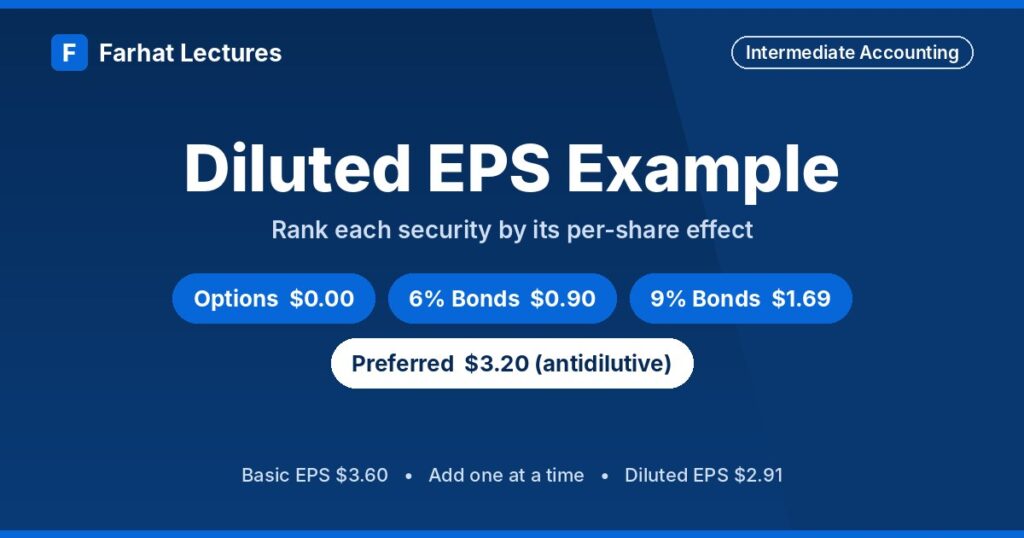
A diluted EPS example with several securities works in four steps: compute basic earnings per share (EPS), find each security’s per-share effect, rank those effects from smallest to largest, then add the securities one at a time and stop when the next one would not lower EPS. Here, basic EPS is $3.60 and diluted EPS is $2.91. Diluted EPS shows what earnings per share would be if every dilutive option, warrant, and convertible security became common stock. The worked example below applies those steps to Harborview Corp., a hypothetical company with stock options, two convertible bonds, and convertible preferred stock.
This matters because the textbook rule is easy to state but easy to get wrong in practice. Students often add every security at once, test them in the wrong order, or forget cumulative preferred dividends. Each mistake changes the diluted EPS number that appears on the income statement.
This guide supports Appendix 15B (Comprehensive Earnings per Share Example) in intermediate accounting. If you need the basics first, start with how to calculate diluted EPS or the basic and diluted EPS overview.
Watch: Basic and Diluted EPS Comprehensive Example
In this 24-minute lesson, I work a full basic and diluted EPS problem using the treasury stock method and the if-converted method, the same tools used in the Harborview example below.
The facts for this diluted EPS example
Harborview Corp. (hypothetical) reports the following for 2028:
- Net income: $2,400,000. Income tax rate: 25%.
- Common stock: 600,000 shares outstanding all year.
- Options to buy 60,000 common shares at $25. The options are fully vested, so there is no unrecognized compensation cost to add to the assumed proceeds. Average market price during 2028: $40.
- 6% convertible bonds, $2,000,000 face value, issued at face in a prior year. Each $1,000 bond converts into 50 common shares.
- 9% convertible bonds, $3,000,000 face value, issued at face in a prior year. Each $1,000 bond converts into 40 common shares.
- 8% cumulative convertible preferred stock, $100 par, 30,000 shares outstanding all year. Together they convert into 75,000 common shares (2.5 per preferred share). No dividends were declared in 2028.
- Nothing was converted or exercised during the year.
Step 1: Compute basic EPS
Basic EPS uses income available to common stockholders. Because the preferred stock is cumulative, the year’s dividend (8% × $3,000,000 = $240,000) is subtracted even though it was not declared. The unpaid amount becomes dividends in arrears, and the rules for each preferred stock type are covered in preferred dividends in EPS.
| Item | Amount |
|---|---|
| Net income | $2,400,000 |
| Less: cumulative preferred dividend requirement | (240,000) |
| Income available to common stockholders | $2,160,000 |
| Weighted-average common shares | 600,000 |
| Basic EPS ($2,160,000 ÷ 600,000) | $3.60 |
The $3.60 is the starting point. Every later step asks whether a security would push this figure down.
Step 2: Find the per-share effect of each security
The per-share effect (also called the incremental effect) is the amount added to the numerator divided by the shares added to the denominator if the security were converted or exercised. A smaller result means a more dilutive security.
| Security | Numerator add-back | Shares added | Per-share effect |
|---|---|---|---|
| Options (treasury stock method) | None | 22,500 | $0.00 |
| 6% convertible bonds (if-converted) | $90,000 | 100,000 | $0.90 |
| 9% convertible bonds (if-converted) | $202,500 | 120,000 | $1.69 |
| 8% convertible preferred (if-converted) | $240,000 | 75,000 | $3.20 |
How each figure was built
- Options: assumed proceeds are 60,000 × $25 = $1,500,000. At the $40 average price, those proceeds buy back 37,500 shares. Net new shares: 60,000 − 37,500 = 22,500. There is no income effect.
- 6% bonds: interest of $120,000 (6% × $2,000,000) would be saved, but it is tax-deductible, so the after-tax add-back is $120,000 × (1 − 0.25) = $90,000. Shares: 2,000 bonds × 50 = 100,000.
- 9% bonds: $270,000 × 0.75 = $202,500 added back; 3,000 bonds × 40 = 120,000 shares.
- Preferred stock: conversion would remove the $240,000 dividend deduction. Dividends are not tax-deductible, so there is no tax adjustment.
Every security here was outstanding all year. If a convertible bond had been issued on July 1, you would add back only half a year of after-tax interest and count its shares for half the year. The if-converted method assumes conversion at the start of the year, or on the issue date if that is later.
For the mechanics behind each method, see the treasury stock method for options and the if-converted method for convertible bonds and preferred stock.
Step 3: Rank the securities from most to least dilutive
Order the per-share effects from smallest to largest: options ($0.00), 6% bonds ($0.90), 9% bonds ($1.69), and preferred stock ($3.20). Notice the preferred stock’s $3.20 is below basic EPS of $3.60, so it looks dilutive on its own. The sequence will show whether it still is.
Why rank at all? U.S. GAAP requires potential common shares to be considered in sequence from the most dilutive to the least dilutive, so the reported figure shows the maximum dilution (see paragraph 14 of FASB Statement No. 128, now codified in ASC 260). The single-security tests are explained in the guide to antidilutive securities.
Step 4: Add the securities one at a time
| Step | Numerator | Shares | EPS | Result |
|---|---|---|---|---|
| Basic EPS | $2,160,000 | 600,000 | $3.60 | Starting point |
| + Options | $2,160,000 | 622,500 | $3.47 | Dilutive, keep |
| + 6% bonds | $2,250,000 | 722,500 | $3.11 | Dilutive, keep |
| + 9% bonds | $2,452,500 | 842,500 | $2.91 | Dilutive, keep |
| + Preferred stock | $2,692,500 | 917,500 | $2.93 | Antidilutive, exclude |
Adding the preferred stock raises EPS from $2.91 to $2.93, so it is antidilutive at this point in the sequence and is left out. Its $3.20 effect was below basic EPS, but it was above the running figure of $2.91. That comparison, not the comparison with basic EPS, is the one that counts.
Diluted EPS = $2.91. In this diluted EPS example, three of the four securities are dilutive and one is excluded.
What goes wrong if you skip the ranking
Suppose a student tests the preferred stock first. Against basic EPS it looks dilutive: $2,400,000 ÷ 675,000 = $3.56, which is below $3.60. If it stays in and the other three securities are added, the final figure is $2,692,500 ÷ 917,500 = $2.93. That answer overstates diluted EPS, because an antidilutive security slipped in. Ranking first is what guarantees the lowest, correct figure of $2.91.
How Harborview reports basic and diluted EPS
| Income statement line | Amount |
|---|---|
| Net income | $2,400,000 |
| Basic earnings per common share | $3.60 |
| Diluted earnings per common share | $2.91 |
Harborview has no discontinued operations, so income from continuing operations equals net income. After the preferred dividend, that gives the $2,160,000 numerator used to test dilution, called the control number. When a company does report discontinued operations, the test uses income from continuing operations instead, as explained in the control number guide.
What if the company reports a loss?
If Harborview had a loss from continuing operations, adding shares from its options would reduce the loss per share. Assumed conversion of its bonds and preferred stock would add shares and increase the earnings numerator, also reducing the loss per share. All of Harborview’s potential common shares would be antidilutive, so its diluted loss per share would equal its basic loss per share.
For example, suppose Harborview had a net loss of $600,000 instead of net income. The cumulative preferred dividend still counts, so the loss to common stockholders is $840,000 ($600,000 + $240,000). Basic loss per share is $840,000 ÷ 600,000 = $(1.40). Adding just the options would give $840,000 ÷ 622,500 = $(1.35), a smaller loss, so the options are left out. Diluted loss per share is also $(1.40).
Under U.S. GAAP, a loss from continuing operations generally makes potential common shares antidilutive. Certain contracts that may be settled in stock or cash can also require a numerator adjustment. Include the effect of such a contract if the combined numerator and denominator adjustments increase the loss per share from continuing operations. FASB ASU 2025-12 clarifies this treatment for annual reporting periods beginning after December 15, 2026.
Common mistakes in a diluted EPS example
- Skipping the cumulative preferred dividend because it was not declared.
- Adding back the full bond interest instead of the after-tax amount.
- Applying a tax adjustment to preferred dividends, which are not deductible.
- Testing each security only against basic EPS rather than against the running EPS figure.
- Including all securities at once, which can let an antidilutive item into the answer.
Exam tip for CPA candidates
EPS is tested in the Financial Accounting and Reporting (FAR) section of the CPA exam. When a question gives you several convertible securities, build the per-share effect table and rank it before you touch the running EPS. Watch for two traps: a cumulative preferred dividend that was not declared, and a security that looks dilutive against basic EPS but turns antidilutive against the running figure.
Key takeaways
- Harborview’s basic EPS is $3.60 and its diluted EPS is $2.91.
- Rank securities by per-share effect, smallest first, then add them one at a time.
- Test each new security against the running EPS, not against basic EPS.
- Add back bond interest after tax, but add back preferred dividends with no tax adjustment.
- Deduct cumulative preferred dividends in basic EPS even when they were not declared.
Practice questions with answers
How to Compute Diluted Earnings per Share (EPS)
In this separate four-question scenario, practice ranking potential common shares by their incremental per-share effect and testing them against the running EPS.
Basic earnings per share is $3.15, based on the weighted-average common shares outstanding. Choose the next step at each stage of the diluted EPS calculation. Assume at least one potential common stock security remains to be tested whenever a question asks whether to continue.
1. Using Harborview’s facts, suppose the average market price were $20 instead of $40. How would the options be treated?
Answer: They would be excluded. The $25 exercise price is above the $20 market price, so assumed proceeds of $1,500,000 would buy back 75,000 shares, more than the 60,000 shares the options would issue. The options are out of the money and antidilutive.
2. A company has $5,000,000 of 7% convertible bonds; each $1,000 bond converts into 25 shares, and the tax rate is 20%. What is the per-share effect?
Answer: Interest is $350,000, or $280,000 after tax ($350,000 × 0.80). Shares are 5,000 × 25 = 125,000. Per-share effect = $280,000 ÷ 125,000 = $2.24.
3. If Harborview’s preferred stock converted into 100,000 common shares instead of 75,000, would it be dilutive?
Answer: Yes. The per-share effect would be $240,000 ÷ 100,000 = $2.40, below the running EPS of $2.91. EPS would become $2,692,500 ÷ 942,500 = $2.86, so the preferred stock would be included.
Frequently asked questions
How do you calculate diluted EPS with multiple securities?
Start with basic EPS. Compute each security’s per-share effect (numerator add-back divided by added shares), rank the effects from smallest to largest, then add the securities one at a time. Keep each one only if it lowers the running EPS figure.
Why do you subtract preferred dividends that were not declared?
Cumulative preferred dividends belong to preferred stockholders for the year whether or not the board declares them, so the current year’s amount is deducted to find income available to common stockholders.
Why are stock options usually tested first?
Options and warrants have no numerator effect, so their per-share effect is $0. That makes them the most dilutive item whenever the average market price is above the exercise price.
Can diluted EPS be higher than basic EPS?
Not on the line that controls dilution. Antidilutive securities are excluded based on income from continuing operations, so diluted EPS on that line is lower than or equal to basic EPS. The same share count is then used for every other EPS line, though. If a company has income from continuing operations and a loss from discontinued operations, diluted EPS on the net income line can come out higher (a smaller loss per share) than basic EPS.
What happens to diluted EPS when a company has a loss?
Diluted EPS generally equals basic EPS when there is a loss from continuing operations. Certain contracts that may be settled in stock or cash can still be dilutive if their combined numerator and denominator adjustments increase the loss per share from continuing operations.
Does IFRS rank dilutive securities the same way?
Yes. IAS 33 also tests potential ordinary shares one at a time, from the most dilutive to the least dilutive, and uses profit from continuing operations attributable to the parent as the control number.
Is diluted EPS tested on the CPA exam?
Yes. Basic and diluted EPS are tested in the FAR (Financial Accounting and Reporting) section, and questions can combine several convertible securities with a cumulative preferred dividend, like the Harborview example.
Sources: FASB Statement No. 128, Earnings per Share (paragraphs 13–14 on sequencing and antidilution); IFRS Foundation, IAS 33 Earnings per Share.
The current U.S. GAAP home for these rules is FASB Accounting Standards Codification (ASC) Topic 260, Earnings per Share. The control number rule is in ASC 260-10-45-18.
About the author: Mansour Farhat, CPA, CIA, DBA, teaches accounting and CPA exam review at Farhat Lectures, where he records video lessons like the EPS walkthrough above and writes worked examples for intermediate accounting students and CPA candidates.
Continue learning with Farhat Lectures
Practice diluted EPS problems like these with clear explanations and guided practice.
Explore the free sample course



Responses