
Stock Appreciation Rights Journal Entries: Percentage Approach Example

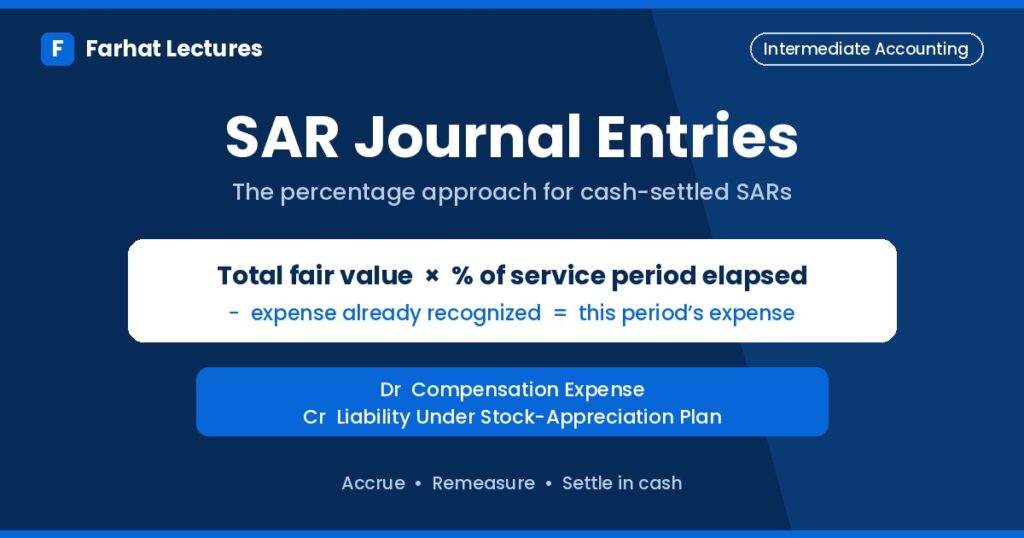
Stock appreciation rights (SARs) pay employees the rise in stock price above a set price. For cash-settled SARs, debit Compensation Expense and credit Liability Under Stock-Appreciation Plan when the required accrual increases. Debit the liability and credit Compensation Expense when the required accrual decreases. During the service period, the required accrual equals current total fair value times the percentage of service completed. At exercise, debit the remeasured liability and credit Cash.
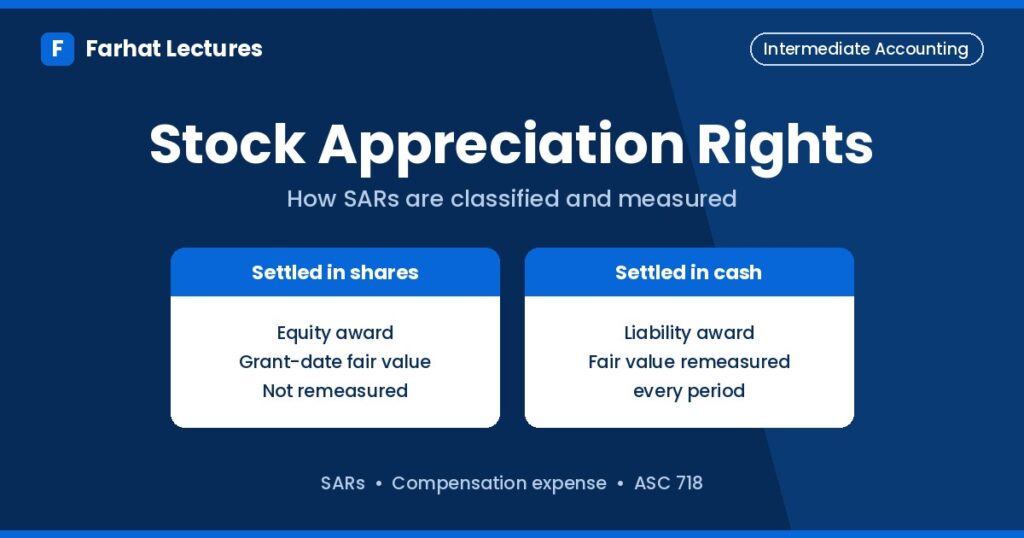
Cash-settled stock appreciation rights (SARs) are liability awards, so their cost is not fixed on the grant date. The company remeasures the liability at every reporting date until it pays the employee. That makes these entries a favorite topic in intermediate accounting exams and in CPA exam prep for stock compensation, because compensation expense can jump, turn negative, and keep changing after the service period ends.
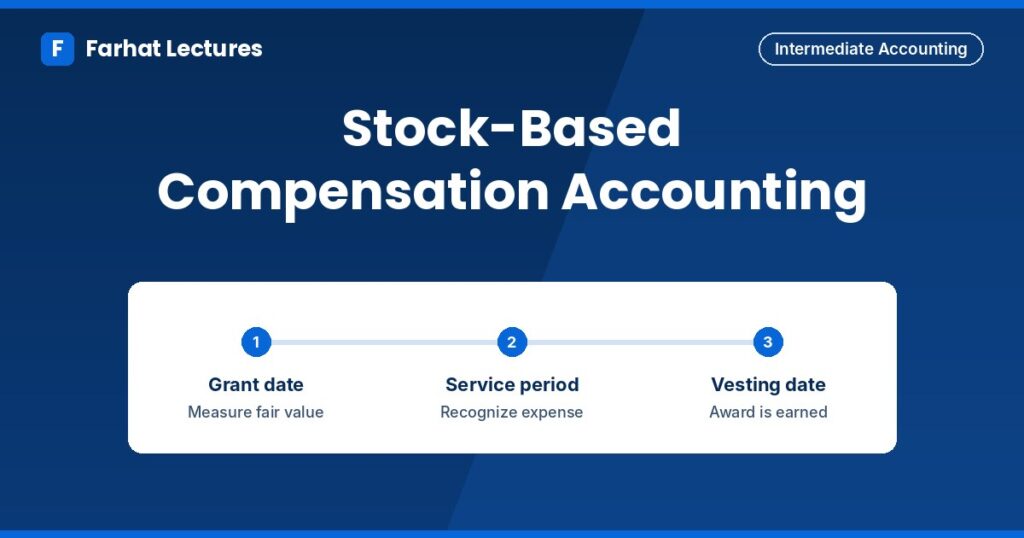
This guide supports the stock-appreciation rights section of the share-based compensation coverage in intermediate accounting textbooks. It uses one original, hypothetical example from grant to cash settlement. If you need the basics first, read stock appreciation rights accounting: equity vs. liability awards. For the bigger picture, see our guide to stock-based compensation accounting.
Watch: Stock Appreciation Rights Explained
This video starts at the accounting segment, where Professor Farhat measures compensation expense and works through an example across the service period.
Already enrolled? Work through the matching lesson, Stock Appreciation Rights, Compensation Expense, in the Intermediate Accounting course.
What is the percentage approach for cash-settled SARs?
The company estimates the fair value of the SARs at each period end, usually with an option-pricing model. It then allocates that total over the service period. In a four-year plan, cumulative expense is one-fourth of the current estimate after year 1, two-fourths after year 2, three-fourths after year 3, and all of it after year 4.
A quick note on measurement: public companies use fair value. A nonpublic (private) company can instead elect to measure all of its liability awards at intrinsic value. Intrinsic value is the greater of zero or the stock price minus the exercise price. Many textbook problems use intrinsic value to keep the math simple. The steps below work the same way with either number.
| Step | What to compute |
|---|---|
| 1 | Total fair value = fair value per SAR × number of SARs |
| 2 | Cumulative expense to date = total fair value × % of service period completed |
| 3 | Expense this period = cumulative expense to date − expense already recognized |
| 4 | Record a debit to expense if positive, or a credit to expense if negative |
ASC 718-30 requires this remeasurement for liability awards. Deloitte’s recognition guidance for liability-classified awards reproduces the Codification example for cash-settled SARs.
Example: the facts
On January 1, 2027, Harbor Peak Software (a hypothetical company) grants executives 9,000 SARs. Each SAR pays cash equal to the stock price above a pre-established price of $25. The service period is three years (2027 to 2029). The executives hold the SARs past the service period and exercise them all on December 31, 2030, when the stock trades at $32.
Fair value per SAR at each year end is $6 (2027), $2 (2028), $9 (2029), and $7 (2030). On the exercise date, fair value equals the cash payout: $32 − $25 = $7. To keep the focus on the entries, assume no SARs are forfeited.
Compensation expense schedule
| Date | Fair value per SAR | Total fair value (9,000 SARs) | % of service accrued | Cumulative expense to date | Expense this year |
|---|---|---|---|---|---|
| 12/31/2027 | $6 | $54,000 | 33⅓% | $18,000 | $18,000 |
| 12/31/2028 | $2 | $18,000 | 66⅔% | $12,000 | $(6,000) |
| 12/31/2029 | $9 | $81,000 | 100% | $81,000 | $69,000 |
| 12/31/2030 | $7 | $63,000 | 100% | $63,000 | $(18,000) |
In 2028 the fair value fell, so cumulative expense dropped from $18,000 to $12,000 and Harbor Peak records a $6,000 credit. In 2030 the service period is over, so the full $18,000 decline goes straight to expense as a credit. Total expense over four years is $63,000, the exact cash paid.
Stock appreciation rights journal entries year by year
December 31, 2027: accrue one-third of the estimated cost
| Account | Debit | Credit |
|---|---|---|
| Compensation Expense | 18,000 | |
| Liability Under Stock-Appreciation Plan | 18,000 |
December 31, 2028: fair value fell, so reduce the liability
| Account | Debit | Credit |
|---|---|---|
| Liability Under Stock-Appreciation Plan | 6,000 | |
| Compensation Expense | 6,000 |
December 31, 2029: service period complete, accrue 100%
| Account | Debit | Credit |
|---|---|---|
| Compensation Expense | 69,000 | |
| Liability Under Stock-Appreciation Plan | 69,000 |
December 31, 2030: remeasure after the service period
| Account | Debit | Credit |
|---|---|---|
| Liability Under Stock-Appreciation Plan | 18,000 | |
| Compensation Expense | 18,000 |
December 31, 2030: executives exercise and receive cash
| Account | Debit | Credit |
|---|---|---|
| Liability Under Stock-Appreciation Plan | 63,000 | |
| Cash (9,000 × $7) | 63,000 |
How do you track the SAR liability?
| Date | Change | Balance |
|---|---|---|
| 12/31/2027 | +18,000 | 18,000 |
| 12/31/2028 | −6,000 | 12,000 |
| 12/31/2029 | +69,000 | 81,000 |
| 12/31/2030 remeasurement | −18,000 | 63,000 |
| 12/31/2030 cash payment | −63,000 | 0 |
In this example, cumulative compensation expense equals the remaining SAR liability plus cash already paid. Before settlement, the liability alone equals cumulative expense. After the $63,000 cash payment, the liability is zero and cumulative expense is still $63,000.
What happens after the service period?
Many students stop at the end of the service period. But if cash-settled SARs are still outstanding, the company keeps adjusting the liability, and the expense, for every change in fair value until the rights are exercised or expire. Because the service is already earned, each change is recognized in full, not prorated.
What if SARs expire or are only partly exercised?
If the SARs are never exercised and expire worthless, the company reduces the liability to zero through compensation expense as fair value falls. Total expense for the plan ends at zero.
If employees exercise only some of their SARs, record the cash payment for those rights only. Suppose Harbor Peak’s executives had exercised 6,000 of the 9,000 SARs on December 31, 2030, at $7 each:
| Account | Debit | Credit |
|---|---|---|
| Liability Under Stock-Appreciation Plan | 42,000 | |
| Cash (6,000 × $7) | 42,000 |
Assume the 3,000 unexercised SARs also have a fair value of $7 each on that date. The remaining $21,000 liability (3,000 × $7) stays on the books and is remeasured until those SARs are exercised or expire.
Can SAR compensation expense go below zero?
A credit to compensation expense cannot exceed the expense previously recognized for the plan. Cumulative expense can fall to zero but never below it, because a SAR’s fair value can’t drop below zero, so the liability can’t either. For example, if the SARs had become worthless at the end of 2028, Harbor Peak would credit expense for $18,000. That reverses everything recognized so far and brings cumulative expense to zero, but no lower.
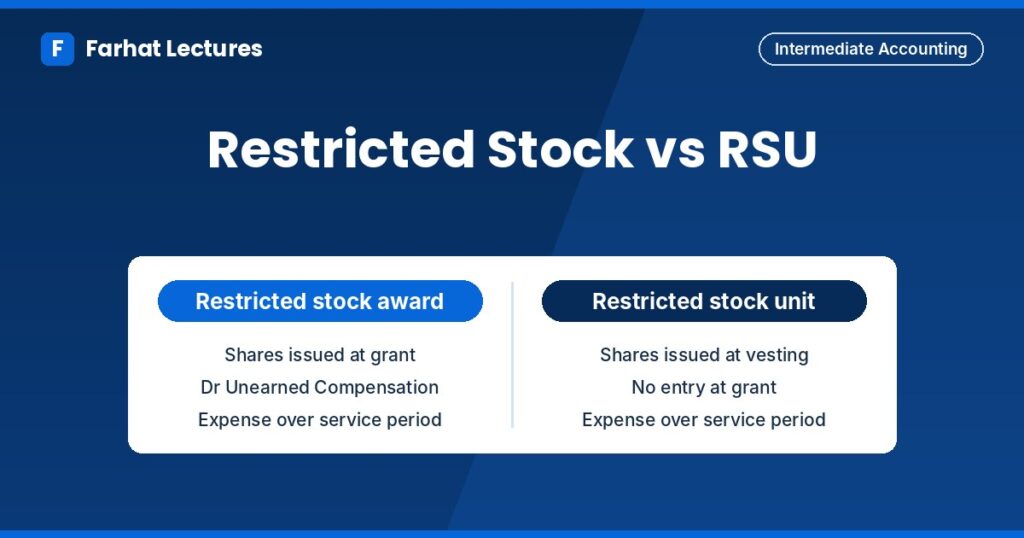
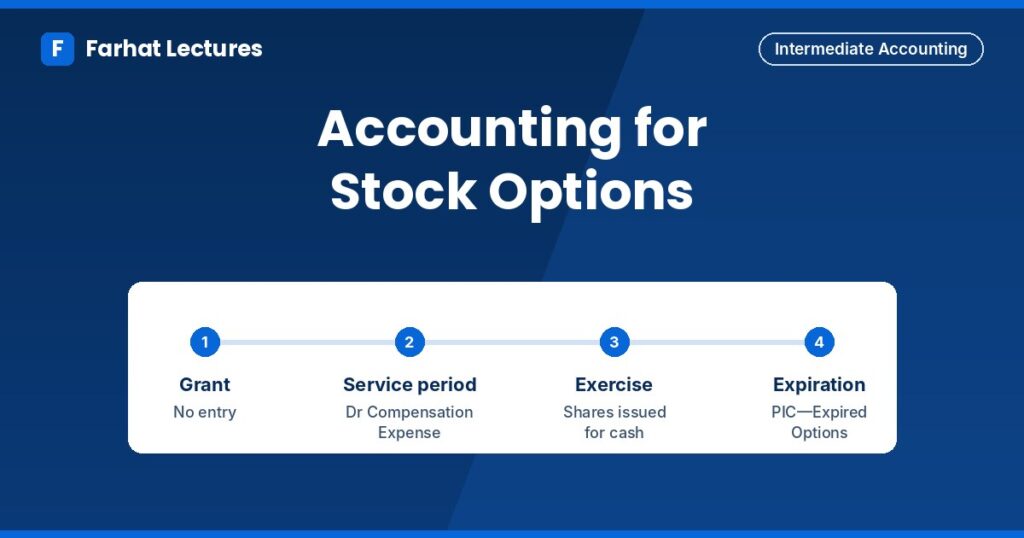
Equity-classified share-settled SARs are measured at grant-date fair value without subsequent remeasurement, just like equity-classified stock options. See stock appreciation rights vs stock options for how the two compare.
Common mistakes
- Booking the whole year’s fair value as expense. During the service period, take only the completed percentage, then subtract prior expense.
- Forgetting the prior expense. Each year’s entry is the change in cumulative expense, not the cumulative amount itself.
- Prorating after the service period. Once service is complete, record the full change in fair value.
- Crediting Paid-in Capital. Cash-settled SARs are liabilities, so the credit goes to Liability Under Stock-Appreciation Plan.
- Using grant-date fair value. Cash-settled SARs use the fair value at each reporting date, not the value on the grant date.
Practice questions
1. A company grants 4,000 cash-settled SARs with a four-year service period. Fair value is $5 per SAR at the end of year 1. What is year 1 compensation expense?
Answer: $5,000. Total fair value is 4,000 × $5 = $20,000, and 25% of the service period is complete.
2. Continuing question 1, fair value is $8 per SAR at the end of year 2. What is year 2 expense?
Answer: $11,000. Cumulative expense is $32,000 × 50% = $16,000, minus the $5,000 already recognized.
3. After the service period ends, 4,000 outstanding cash-settled SARs fall in fair value from $10 to $7. Record the entry.
| Account | Debit | Credit |
|---|---|---|
| Liability Under Stock-Appreciation Plan | 12,000 | |
| Compensation Expense | 12,000 |
Why: Service is complete, so the full $3 decline × 4,000 SARs = $12,000 reduces both the liability and expense.
Interactive practice for cash-settled SAR journal entries
Cash-settled stock appreciation rights are liability awards. Remeasure the liability at each reporting date through settlement. Use these four questions to practice the percentage approach and record accruals, decreases in fair value, and cash payments.
Frequently asked questions
What are stock appreciation rights (SARs)?
SARs are awards that give employees the increase in the company’s stock price above a pre-established price, without paying an exercise price. Cash-settled SARs are liability awards. Share-settled SARs are equity awards when the award terms qualify for equity classification.
What is the journal entry to record SAR compensation expense?
For cash-settled SARs, debit Compensation Expense and credit Liability Under Stock-Appreciation Plan for the increase in cumulative expense. If cumulative expense falls, reverse the entry: debit the liability and credit Compensation Expense.
What is the percentage approach for SARs?
It is the method of allocating a liability SAR’s cost. Cumulative expense to date equals total fair value times the percentage of the service period completed. This period’s expense is that amount minus expense already recognized.
Why can SAR compensation expense be negative in a year?
A company credits Compensation Expense when the required accrual for cash-settled SARs falls below the amount already recognized. During the service period, completing more service can increase the required accrual even when fair value falls. Cumulative expense cannot go below zero.
Is SAR expense still recorded after the service period ends?
Yes, for cash-settled SARs that are still outstanding. The company records the full change in fair value each period until the rights are exercised or expire.
What is the journal entry when cash-settled SARs are exercised?
Debit Liability Under Stock-Appreciation Plan and credit Cash for the amount paid, which equals the market price minus the pre-established price, times the number of SARs exercised.
What happens if cash-settled SARs expire unexercised?
The company reduces the liability to zero through compensation expense as fair value falls, so total expense for the plan ends at zero.
Do share-settled SARs use these entries?
Equity-classified share-settled SARs use a paid-in capital account. The company recognizes grant-date fair value over the service period without subsequent remeasurement. Classification depends on the award terms.
About the author: Mansour Farhat, CPA, CIA, DBA, is the instructor behind Farhat Lectures, where he teaches accounting courses and CPA, CMA, and EA exam review. Learn more about Professor Farhat.
Continue learning with Farhat Lectures
Strengthen your accounting understanding with clear explanations and guided practice.
Want the whole chapter? The Intermediate Accounting course covers stock compensation plans, dilutive securities, and earnings per share, with video lessons and practice.
Explore the free sample course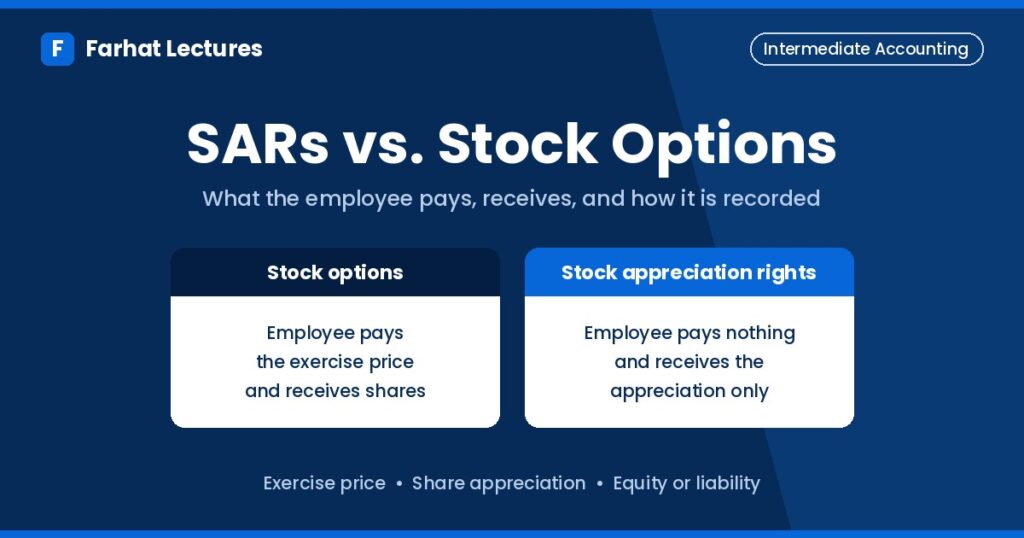
Responses