
Accounting for Stock Options: Journal Entries From Grant to Expiration

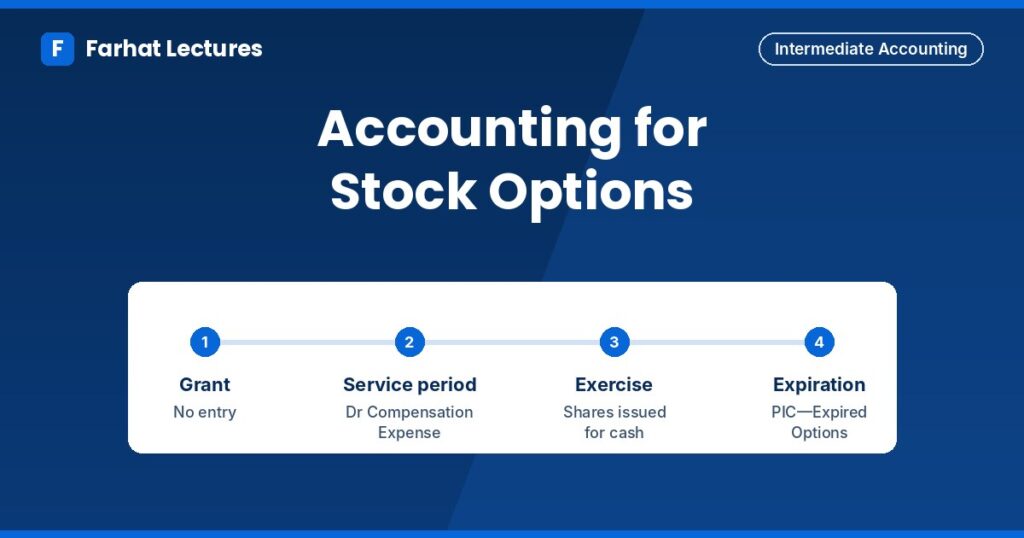
Accounting for stock options under ASC 718 begins by measuring equity-classified employee options at their grant-date fair value. When the options are granted for future service, the company records no entry on the grant date and recognizes compensation expense as employees provide that service. Each period, debit Compensation Expense and credit Paid-in Capital – Stock Options. At exercise, record the cash and issue shares. If vested options expire, the expense stays.
Why it matters: stock options are a core topic in intermediate accounting courses and on the CPA exam, where stock compensation is tested in BAR (Business Analysis and Reporting) under the current exam blueprint. Most errors come from mixing up the dates: when the cost is measured, when it is expensed, and what happens at exercise, expiration, and forfeiture.
This lesson works through every entry with one original, hypothetical example. For the big picture of the fair value method and other plan types, see the stock-based compensation accounting overview.
Watch: Stock Compensation Journal Entries: Grant, Exercise & Expiration
Professor Farhat works a complete stock option problem from the grant date through exercise and expiration, matching the steps in this lesson.
Watch this Farhat lesson on YouTube · Watch another worked stock option example
What is a stock option? The employee’s side
A stock option gives an employee the right, but not the obligation, to buy company stock at a fixed exercise price for a set period. The employee usually must work through a vesting period before using the options.
Hypothetical example: you receive options to buy 6,000 shares at $30. They vest after 3 years and expire 8 years after the grant date. After vesting, the market price drives your decision:
| Market price | Exercise? | Why |
|---|---|---|
| $45 | Yes, it makes sense | You pay $30 for a share worth $45, a $15 gain per share (6,000 × $15 = $90,000 before taxes). |
| $26 | No | You could buy the stock more cheaply in the market. |
| Never above $30 | No; options expire | The options lapse unused at the expiration date. |
Employee stock options usually cannot be sold or transferred. The plan terms restrict them because they are pay for the employee’s own services, and incentive stock options (ISOs), a tax-favored type of option, can pass to someone else only through a will or inheritance.
What are the journal entries for stock options? Key dates and entries
| Date or event | What happens | Journal entry |
|---|---|---|
| Grant date | Total compensation cost is measured at fair value | None |
| Each period of service | Expense the cost evenly over the service period | Dr Compensation Expense; Cr Paid-in Capital – Stock Options |
| Exercise | Employees pay the exercise price and receive shares | Dr Cash and Paid-in Capital – Stock Options; Cr Common Stock and Paid-in Capital in Excess of Par |
| Expiration | Vested options lapse unused | Dr Paid-in Capital – Stock Options; Cr Paid-in Capital – Expired Stock Options |
| Forfeiture | Employee leaves before vesting | Dr Paid-in Capital – Stock Options; Cr Compensation Expense (cumulative amount) |
How is the fair value of a stock option measured?
Companies use an option-pricing model, such as the Black-Scholes-Merton formula or a binomial (lattice) model. Under ASC 718, the model must consider at least these six inputs:
- The exercise price
- The expected term of the option
- The current market price of the stock
- Expected volatility of the stock price
- Expected dividends
- The risk-free interest rate for the expected term
Exam trap: fair value is not the same as intrinsic value (market price minus exercise price). In the Brightwater example below, the $40 exercise price equals the $40 market price, so intrinsic value on the grant date is $0. Each option is still worth $15, because employees have years for the stock price to rise.
Accounting for stock options: full example from grant to expiration
Hypothetical facts: On January 1, 2027, Brightwater Inc. grants its managers options to buy 12,000 shares of $1 par common stock. The exercise price is $40, equal to the market price that day. The options vest after a 3-year service period and expire 8 years after the grant date. An option-pricing model values the options at $180,000 in total ($15 per option).
Step 1: Grant date (January 1, 2027)
No journal entry. Brightwater notes the total cost of $180,000, but no service has been performed yet.
Step 2: Compensation expense (December 31, 2027, 2028, and 2029)
$180,000 ÷ 3 years = $60,000 each year:
| Account | Debit | Credit |
|---|---|---|
| Compensation Expense | 60,000 | |
| Paid-in Capital – Stock Options | 60,000 |
After three entries, Paid-in Capital – Stock Options has a $180,000 credit balance, reported in stockholders’ equity.
Good to know: Brightwater’s options all vest at once at the end of three years (called cliff vesting). If options vest in pieces, such as one-third each year, and vesting depends only on service, the company may expense the award straight-line over the full service period or tranche by tranche. Either way, cumulative expense at any date must be at least the grant-date value of the options vested by then.
Step 3: Exercise (March 15, 2031)
Managers exercise 3,000 options, or 25% of the 12,000. Brightwater receives 3,000 × $40 = $120,000 and removes 25% of the paid-in capital (0.25 × $180,000 = $45,000). The total credited to equity is $165,000: $3,000 to Common Stock at par and the rest to Paid-in Capital in Excess of Par.
| Account | Debit | Credit |
|---|---|---|
| Cash (3,000 × $40) | 120,000 | |
| Paid-in Capital – Stock Options (25% × $180,000) | 45,000 | |
| Common Stock (3,000 × $1) | 3,000 | |
| Paid-in Capital in Excess of Par – Common Stock | 162,000 |
The market price on the exercise date does not appear in the entry. If you need a refresher on par value and excess-of-par accounts, see issuance of common stock journal entries.
Step 4: Expiration (January 1, 2035)
The other 9,000 options are never exercised. Their $135,000 balance (75% × $180,000) moves to a more descriptive equity account:
| Account | Debit | Credit |
|---|---|---|
| Paid-in Capital – Stock Options | 135,000 | |
| Paid-in Capital – Expired Stock Options | 135,000 |
Compensation expense is not reversed. The managers did provide three years of service, so the expense was real.
| Date | Event | Debit | Credit | Balance |
|---|---|---|---|---|
| 12/31/2027 | Expense | 60,000 | 60,000 | |
| 12/31/2028 | Expense | 60,000 | 120,000 | |
| 12/31/2029 | Expense | 60,000 | 180,000 | |
| 3/15/2031 | Exercise of 25% | 45,000 | 135,000 | |
| 1/1/2035 | Expiration of 75% | 135,000 | 0 |
Forfeiture before vesting
If an employee leaves before completing the service period, the employee forfeits the options. In the period of forfeiture, the company reverses the expense already recorded on the forfeited options: it debits Paid-in Capital – Stock Options and credits Compensation Expense.
Variation on the example: suppose one manager holding 2,000 of Brightwater’s 12,000 options leaves on March 1, 2029, before that year’s expense is recorded. Expense already recorded on those options is 2,000 × $15 × 2/3 = $20,000.
| Account | Debit | Credit |
|---|---|---|
| Paid-in Capital – Stock Options | 20,000 | |
| Compensation Expense | 20,000 |
On December 31, 2029, Brightwater records the third year only for the remaining 10,000 options: 10,000 × $15 ÷ 3 = $50,000.
In this variation, Paid-in Capital – Stock Options ends the vesting period at $150,000 ($120,000 − $20,000 + $50,000), which equals 10,000 options × $15.
Good to know: this approach recognizes forfeitures when they happen. Companies have been allowed to choose it as an accounting policy since FASB ASU 2016-09, which took effect for public companies in 2017. Before that update, companies had to estimate expected forfeitures up front and true up later, and they may still choose that method. Follow your textbook’s approach on exams.
Forfeiture vs. expiration: the distinction students miss
| Forfeiture | Expiration | |
|---|---|---|
| When it happens | Before vesting: the employee leaves early | After vesting: options are never exercised |
| Was the service received? | No | Yes |
| Effect on expense | Reverse expense recorded to date (credit Compensation Expense) | No change to expense |
| Equity entry | Debit Paid-in Capital – Stock Options | Debit Paid-in Capital – Stock Options; credit Paid-in Capital – Expired Stock Options |
How do income taxes affect stock option accounting?
The book expense and the tax deduction usually happen at different times, so stock options create deferred taxes.
For nonqualified stock options (NQSOs), the company generally takes a tax deduction for the spread (market price minus exercise price) when employees exercise. Because the book expense comes first, the company records a deferred tax asset as it records compensation expense.
When employees exercise nonqualified stock options, the company reverses the related deferred tax asset and compares it with the tax benefit from the actual deduction. Under ASU 2016-09, it recognizes any excess tax benefit or tax shortfall in income tax expense in the period the deduction arises.
For incentive stock options (ISOs), the company generally gets no deduction unless the employee sells the shares too early (a disqualifying disposition), so no deferred tax asset is recorded.
On the employee side, the NQSO spread at exercise is generally taxed as ordinary wage income. Exercising an ISO generally creates no regular federal income tax at exercise. The spread can trigger an alternative minimum tax (AMT) adjustment. That adjustment generally does not apply if the employee disposes of the shares in the same tax year as the exercise.
Common mistakes
- Recording an entry at grant. The cost is measured on the grant date, but nothing is journalized.
- Using the market price at exercise. The exercise entry uses the cash actually paid plus the related paid-in capital, not the current market value.
- Reversing expense when options expire. Only forfeitures before vesting reverse expense.
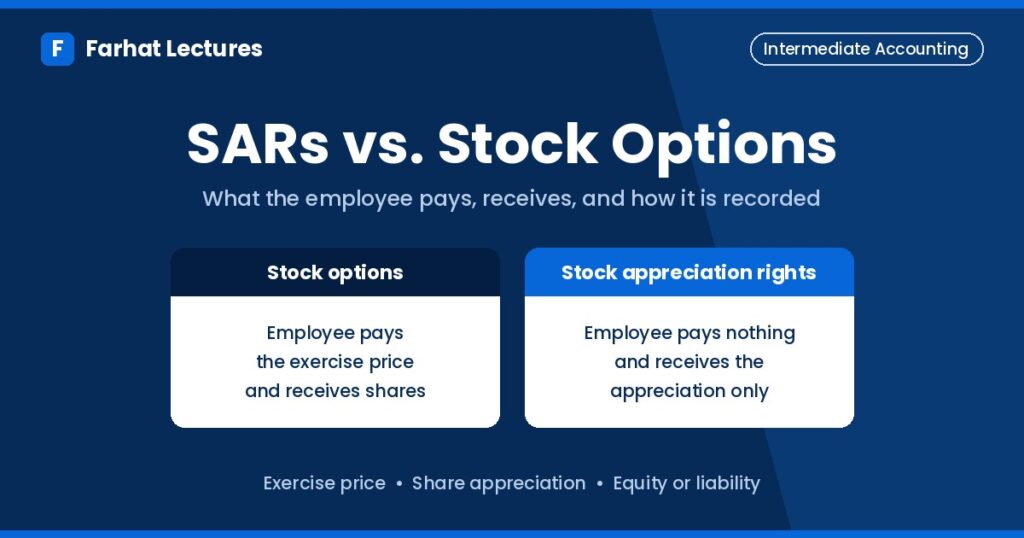
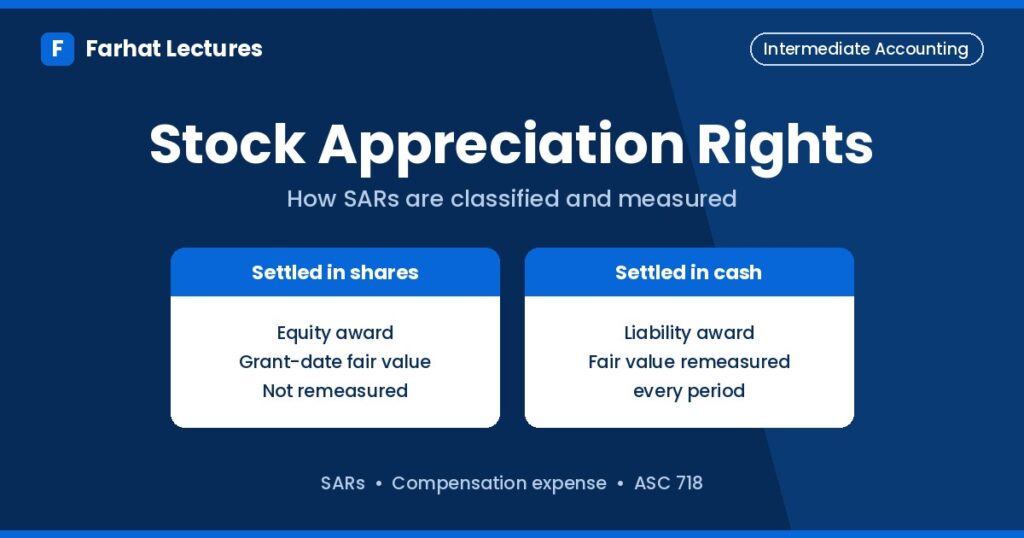
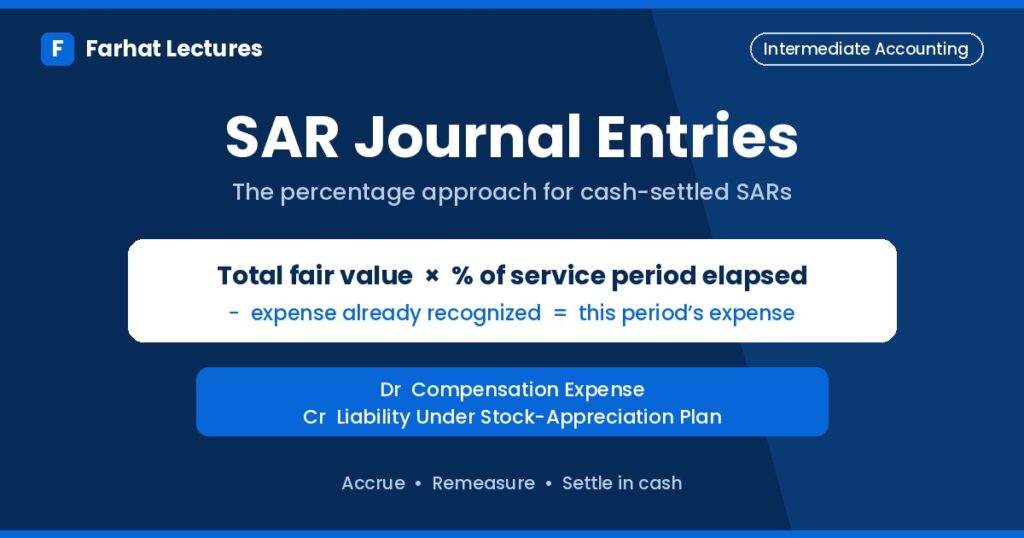
- Re-measuring for price changes. For equity-classified options, the grant-date fair value is fixed unless the award is later modified. Awards settled in cash, such as cash-settled stock appreciation rights, are different: they are remeasured each period.
- Forgetting the par value split. Credit Common Stock at par and the remainder to Paid-in Capital in Excess of Par.
Unexercised options also affect diluted earnings per share, and if you are comparing options with instruments sold to investors, see stock warrants explained.
Practice questions with answers
Under ASC 718, companies measure equity-classified employee stock options at grant-date fair value using an option-pricing model. For options granted for future service, companies recognize compensation expense over the requisite service period, which is the period employees must work to earn the options. Start with four quick multiple-choice questions, then try the three journal entry problems below. Cover each answer and work it out first.
1. A company grants 5,000 options with a total fair value of $60,000 and a 4-year service period. What entry does it record at the end of each year?
| Account | Debit | Credit |
|---|---|---|
| Compensation Expense | 15,000 | |
| Paid-in Capital – Stock Options | 15,000 |
$60,000 ÷ 4 = $15,000 per year. Nothing is recorded on the grant date.
2. After vesting, employees exercise 2,000 of the 5,000 options at a $25 exercise price. Par value is $1, and the paid-in capital balance is $60,000. Record the exercise.
| Account | Debit | Credit |
|---|---|---|
| Cash (2,000 × $25) | 50,000 | |
| Paid-in Capital – Stock Options (40% × $60,000) | 24,000 | |
| Common Stock (2,000 × $1) | 2,000 | |
| Paid-in Capital in Excess of Par – Common Stock | 72,000 |
2,000 ÷ 5,000 = 40% of the options, so 40% of the paid-in capital is removed. Debits and credits both total $74,000.
3. The remaining 3,000 options expire unused. Record the entry and state the effect on compensation expense.
| Account | Debit | Credit |
|---|---|---|
| Paid-in Capital – Stock Options | 36,000 | |
| Paid-in Capital – Expired Stock Options | 36,000 |
The remaining balance is $60,000 − $24,000 = $36,000. Compensation expense is unchanged because the employees completed the service period.
Frequently asked questions
Why is there no journal entry on the grant date?
On the grant date, employees have not yet performed the service they are being paid for. The company measures the total cost that day but records the expense as the services are performed over the service period.
Does a drop in the stock price reduce stock option expense?
No. The total cost is fixed at the grant-date fair value. If the price later falls below the exercise price, employees may never exercise, but the company still records the full expense for the service period.
Is Paid-in Capital – Stock Options a liability?
No. For options that will be settled in shares, it is a stockholders’ equity account. It is reclassified to common stock accounts when options are exercised or to Paid-in Capital – Expired Stock Options when they lapse.
What is the difference between forfeiture and expiration?
Forfeiture means the employee left before vesting, so the company reverses expense recorded on those options. Expiration means vested options were never used; the company keeps the expense and only reclassifies the paid-in capital.
Are employee stock options the same as stock warrants?
Both give the right to buy shares at a set price, but employee stock options are compensation for services and are expensed over the service period. Warrants are usually issued to investors or lenders.
Is stock option expense based on fair value or intrinsic value?
Fair value. Under ASC 718, public companies measure employee stock options at grant-date fair value using an option-pricing model. Intrinsic value (market price minus exercise price) is often zero at grant, but the options still have value because employees can wait for the price to rise.
Do stock options affect diluted earnings per share?
Yes. Dilutive employee stock options are included in diluted earnings per share using the treasury stock method. The method assumes the company uses the exercise proceeds plus the average unrecognized compensation cost for the period, when applicable, to repurchase shares at the average market price. Antidilutive options are excluded.
Where is stock compensation tested on the CPA exam?
Under the current CPA exam blueprint, stock compensation (share-based payments) is tested in BAR, the Business Analysis and Reporting discipline section. It is also a standard chapter in intermediate accounting courses.
Sources
- FASB Accounting Standards Codification, Topic 718: Compensation—Stock Compensation
- FASB ASU 2016-09: Improvements to Employee Share-Based Payment Accounting
- RSM: A guide for accounting for stock compensation
- IRS Publication 525: Taxable and Nontaxable Income (employee stock options)
About the author: Mansour Farhat, CPA, CIA, DBA, is the instructor behind Farhat Lectures, where he teaches accounting courses and CPA, CMA, and EA exam review. Learn more about Professor Farhat.
Continue learning with Farhat Lectures
Strengthen your accounting understanding with clear explanations and guided practice.
Want the whole chapter? The Intermediate Accounting course covers dilutive securities and stock compensation from start to finish, with video lessons and practice.
Responses