
Conversion of Convertible Bonds: Book Value Method and Induced Conversions

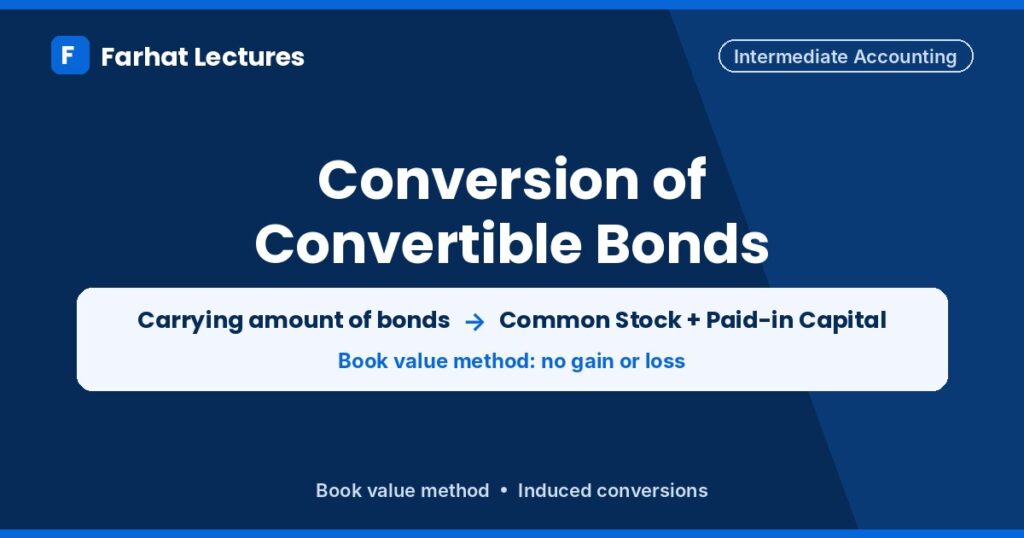
Use the book value method when convertible bonds accounted for entirely as a liability are converted into common shares under the original terms. Debit Bonds Payable and remove any unamortized premium, discount, or debt issuance costs. Credit Common Stock for the shares’ total par value and Paid-in Capital in Excess of Par for the rest. No gain or loss is recognized, and the stock’s market price is ignored.
In other words, the bonds’ carrying amount (face value plus any unamortized premium, less any unamortized discount and debt issuance costs) simply moves from liabilities to equity. Paid-in Capital in Excess of Par is also called additional paid-in capital, or APIC. For a qualifying induced conversion, the issuer records the incremental fair value of the sweetener as debt conversion expense.
This matters because the conversion entry is a classic exam journal entry in the dilutive securities chapter, for CPA FAR candidates and intermediate accounting students alike. It also explains how debt turns into equity on the balance sheet, which affects the debt-to-equity ratio and, later, earnings per share.
This guide covers the conversion entry with a premium and with a discount, why fair value is ignored, and induced conversions. For how the bonds were recorded in the first place, see accounting for convertible bonds at issuance.
Watch: Convertible Securities (Bonds) CPA Simulation
This 5-minute video works through a CPA Exam FAR simulation that journalizes the conversion of convertible bonds into common stock with the book value method, the same entry covered in the examples below.
How do you record the conversion of convertible bonds?
| Step | What to do |
|---|---|
| 1. Update the bonds | Record interest and amortize any premium, discount, or debt issuance costs up to the conversion date. |
| 2. Find the carrying amount | Face value + unamortized premium − unamortized discount − unamortized debt issuance costs, as applicable. |
| 3. Count the shares | Number of bonds converted × shares per bond. |
| 4. Credit Common Stock | Shares issued × par (or stated) value. |
| 5. Plug paid-in capital | Carrying amount − par value of shares = Paid-in Capital in Excess of Par. |
What about accrued interest at conversion?
Interest is accrued right up to the conversion date. Sometimes the bond terms say holders give up (forfeit) the interest that has built up since the last payment date when they convert. Under ASC 470-20-40-11, the issuer still records that interest as interest expense up to the conversion date, then credits the accrued amount to equity as part of the cost of the shares issued, net of any related tax effect.
For example, if $5,000 of accrued interest is forfeited, first debit Interest Expense $5,000 and credit Interest Payable $5,000. At conversion, debit Interest Payable $5,000 along with Bonds Payable, and the $5,000 increases Paid-in Capital in Excess of Par (ignoring taxes).
Example: conversion of convertible bonds with a premium
Facts (hypothetical). Northfield Co. has $500,000 face value of convertible bonds outstanding (500 bonds of $1,000 each). On the conversion date, after updating amortization, the unamortized premium is $8,000. Each bond converts into 20 shares of $5 par common stock. Northfield’s stock is trading at $60 per share.
Carrying amount = $500,000 + $8,000 = $508,000. Shares issued = 500 × 20 = 10,000. Par value = 10,000 × $5 = $50,000.
| Account | Debit | Credit |
|---|---|---|
| Bonds Payable | 500,000 | |
| Premium on Bonds Payable | 8,000 | |
| Common Stock (10,000 × $5) | 50,000 | |
| Paid-in Capital in Excess of Par—Common Stock | 458,000 |
The $60 market price would value the shares at $600,000, but that number appears nowhere. Only the $508,000 book value moves from liabilities to equity.
Example: conversion with a discount
Now assume Northfield’s bonds had an unamortized discount of $8,000 instead. The carrying amount is $492,000.
| Account | Debit | Credit |
|---|---|---|
| Bonds Payable | 500,000 | |
| Discount on Bonds Payable | 8,000 | |
| Common Stock (10,000 × $5) | 50,000 | |
| Paid-in Capital in Excess of Par—Common Stock | 442,000 |
The discount account has a debit balance, so it is credited to remove it. Paid-in capital is $16,000 lower than in the premium case, because the carrying amount is $16,000 lower.
Why does the conversion of convertible bonds create no gain or loss?
When the bonds were issued, the company agreed either to repay a stated amount of cash or to issue a stated number of shares. Converting under those original terms is simply an exchange of one security for another. No new bargain is struck, so the company records no gain or loss, and the stock’s current fair value is irrelevant.
Watch for this exam trap: some textbooks describe a market value method that records the new shares at fair value and books a gain or loss. U.S. GAAP does not allow that method for conversions under the original terms. If an answer choice shows a gain or loss on a regular conversion, it is wrong.
What is an induced conversion?
Sometimes an issuer wants bondholders to convert sooner, for example to stop paying interest or to improve its debt-to-equity ratio. It may offer a sweetener, such as cash or additional shares, if holders convert within a limited period. Induced conversion accounting under ASC 470-20 applies when the offer meets the qualification criteria.
Under ASU 2024-04, the changed terms must be available for a limited time. The settlement must preserve the form and amount of the consideration due under the existing conversion terms, and the conversion feature must be substantive both at issuance and when the holder accepts the offer.
For a qualifying induced conversion, the issuer measures the expense at acceptance as the fair value of all consideration transferred less the fair value of the consideration due under the existing conversion terms. The FASB clarified when this guidance applies in ASU 2024-04, Induced Conversions of Convertible Debt Instruments, effective for annual periods beginning after December 15, 2025. GAAP treats the sweetener as a cost of getting holders to convert early, so it goes to expense in net income. It is not a reduction of equity.
Example: cash sweetener
Facts (hypothetical). Westbrook Inc. has $2,000,000 of convertible bonds with no remaining premium or discount. They convert into 80,000 shares of $1 par common stock. To cut interest costs, Westbrook pays bondholders an extra $60,000 if they convert within 30 days, and they all accept.
| Account | Debit | Credit |
|---|---|---|
| Debt Conversion Expense | 60,000 | |
| Bonds Payable | 2,000,000 | |
| Common Stock (80,000 × $1) | 80,000 | |
| Paid-in Capital in Excess of Par—Common Stock | 1,920,000 | |
| Cash | 60,000 |
Example: extra shares as the sweetener
Suppose Westbrook instead offers 2,000 extra shares, and its stock is worth $40 per share when holders accept. Holders receive 82,000 shares worth $3,280,000 instead of 80,000 shares worth $3,200,000. The $80,000 excess is debt conversion expense.
| Account | Debit | Credit |
|---|---|---|
| Debt Conversion Expense (2,000 × $40) | 80,000 | |
| Bonds Payable | 2,000,000 | |
| Common Stock (82,000 × $1) | 82,000 | |
| Paid-in Capital in Excess of Par—Common Stock | 1,998,000 |
Conversion vs. induced conversion vs. retirement
| Event | What the holder receives | Income statement effect |
|---|---|---|
| Conversion under original terms | The shares promised in the bond agreement | None (book value method) |
| Induced conversion | The original shares plus a sweetener | Debt conversion expense for the sweetener |
| Retirement for cash | Cash | Gain or loss on extinguishment |
Retirement for cash is shown in accounting for convertible bonds. Converting preferred stock follows the same book value idea; see convertible preferred stock. To see how dilutive securities affect a company’s share count and EPS, read what dilutive securities are.
How does conversion affect the balance sheet and EPS?
Go back to the Northfield premium example. Liabilities drop by $508,000 and equity rises by $508,000. Total assets do not change, because no cash moves. With less debt and more equity, the debt-to-equity ratio improves.
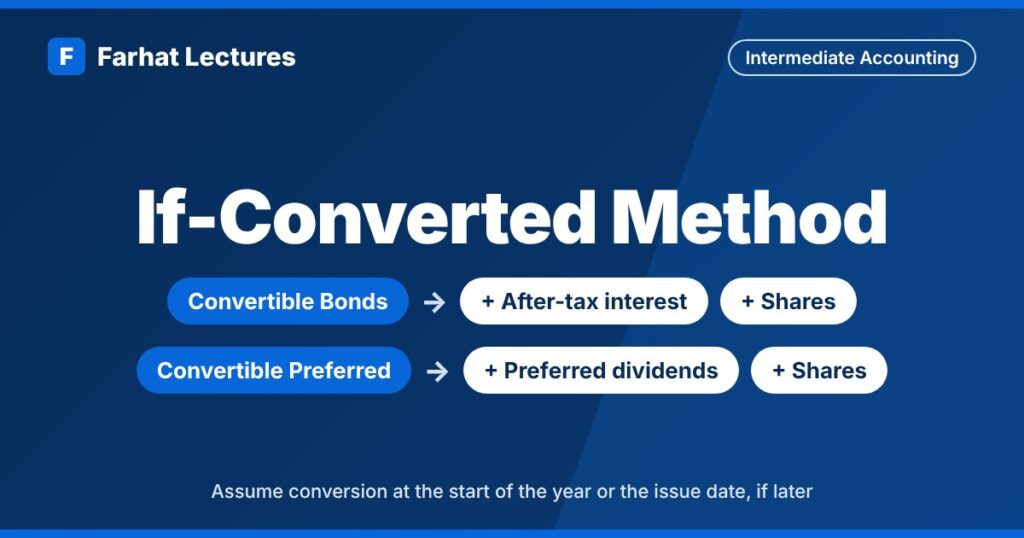
For earnings per share, the 10,000 new shares count in weighted-average shares outstanding from the conversion date, and interest expense on those bonds stops. Before conversion, diluted EPS may already have included these shares under the if-converted method, which adds the shares to the denominator and adds back the after-tax interest to the numerator when the effect is dilutive. For more on how this works, see dilutive securities and dilution.
Key takeaways on the conversion of convertible bonds
- The conversion of convertible bonds uses the book value method: move the carrying amount into Common Stock and Paid-in Capital in Excess of Par.
- No gain or loss is recorded, and the stock’s fair value is ignored.
- Remove any premium (debit) or discount (credit) along with Bonds Payable.
- A sweetener paid to induce conversion is recognized as debt conversion expense.
- Accrued interest that holders forfeit at conversion is still expensed up to the conversion date, then credited to equity.
Common mistakes
- Recording the new shares at market value and booking a gain or loss.
- Forgetting to update amortization to the conversion date before computing the carrying amount.
- Leaving the premium or discount on the books after the bonds are gone.
- Debiting paid-in capital for a sweetener instead of recording an expense.
- Ignoring accrued interest that holders give up when they convert.
Interactive practice: Convertible bond conversion
Under the book value method, an issuer records a conversion under the original bond terms by transferring the bonds’ carrying amount to equity. The issuer credits Common Stock for the shares’ total par value and Additional Paid-in Capital for the excess of carrying amount over par. The conversion produces no gain or loss.
Practice questions with answers
Practice 1: Conversion at a discount
Bonds with a $300,000 face value and an unamortized discount of $4,500 are converted into 6,000 shares of $10 par common stock. Record the conversion.
| Account | Debit | Credit |
|---|---|---|
| Bonds Payable | 300,000 | |
| Discount on Bonds Payable | 4,500 | |
| Common Stock (6,000 × $10) | 60,000 | |
| Paid-in Capital in Excess of Par—Common Stock | 235,500 |
Why: The carrying amount is $295,500. After $60,000 to Common Stock, $235,500 remains for paid-in capital.
Practice 2: Does the market price matter?
In Practice 1, the stock was trading at $75 per share on the conversion date. Does that change the entry?
Answer: No. Under the book value method, the market price is irrelevant and no gain or loss is recorded.
Practice 3: Induced conversion with a cash sweetener
A company pays $25,000 cash to induce conversion of $1,000,000 of bonds with a $10,000 unamortized premium into 40,000 shares of $1 par stock. Record the entry.
| Account | Debit | Credit |
|---|---|---|
| Debt Conversion Expense | 25,000 | |
| Bonds Payable | 1,000,000 | |
| Premium on Bonds Payable | 10,000 | |
| Common Stock (40,000 × $1) | 40,000 | |
| Paid-in Capital in Excess of Par—Common Stock | 970,000 | |
| Cash | 25,000 |
Why: The $1,010,000 carrying amount moves to equity, and the $25,000 sweetener is an expense.
Frequently asked questions
What is the book value method for converting bonds?
It records the common stock issued at the carrying amount (book value) of the bonds converted. Bonds Payable and any premium or discount are removed, Common Stock is credited for par, and the rest goes to Paid-in Capital in Excess of Par. No gain or loss is recorded.
Why is the stock’s market price ignored on conversion?
Because the conversion follows terms agreed when the bonds were issued. The company is simply exchanging one security for another under an existing contract, so there is nothing to gain or lose.
What is a sweetener in an induced conversion?
It is extra cash, extra shares, or other consideration the issuer offers for a limited time to encourage bondholders to convert early. Its fair value is recognized as debt conversion expense.
Is debt conversion expense an operating expense?
ASC 470-20 requires the sweetener to be recognized as an expense in net income, not as a reduction of equity, but it does not name a specific income statement line. Because the cost comes from a financing transaction, companies generally present it outside operating income, alongside items such as interest expense.
Does the same rule apply to convertible preferred stock?
An ordinary conversion of equity-classified preferred stock under its original terms generally uses the book value method. Under SEC staff guidance in ASC 260-10-S99-2, the excess of the fair value transferred to induce conversion over the fair value issuable under the original terms is a deemed dividend. It reduces income available to common stockholders for basic EPS.
What happens to accrued interest when bonds are converted?
The issuer accrues interest up to the conversion date. If holders forfeit that interest under the bond terms, the accrued amount is not paid in cash. Instead, it is credited to equity as part of the cost of the shares issued, net of any related tax effect.
About the author: Mansour Farhat, CPA, CIA, DBA, creates the lessons and video lectures at Farhat Lectures for CPA, CMA, and EA candidates and accounting students.
Continue learning with Farhat Lectures
Strengthen your accounting understanding with clear explanations and guided practice.
Explore the free sample course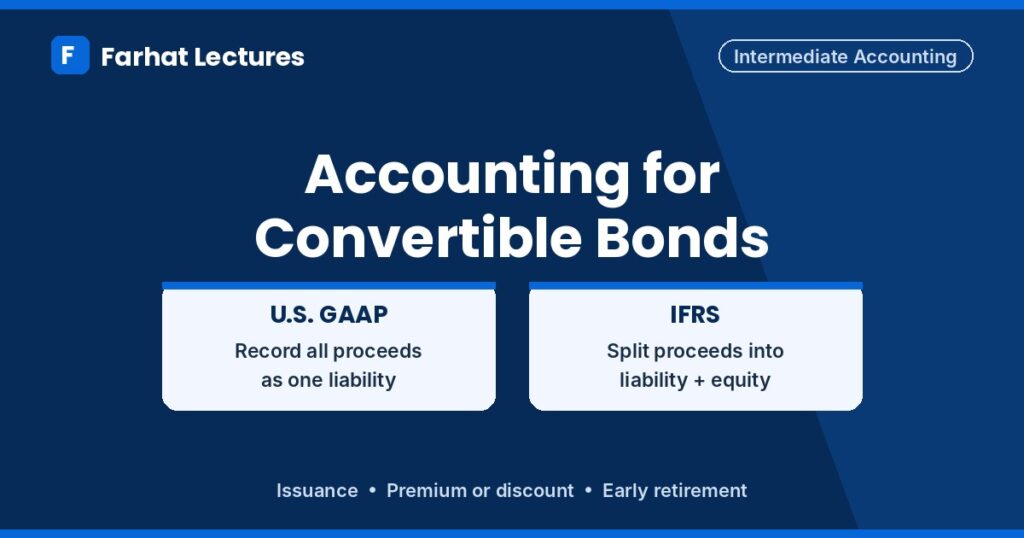
Responses