
Stock Dividend vs. Stock Split: Differences, Journal Entries, and Examples

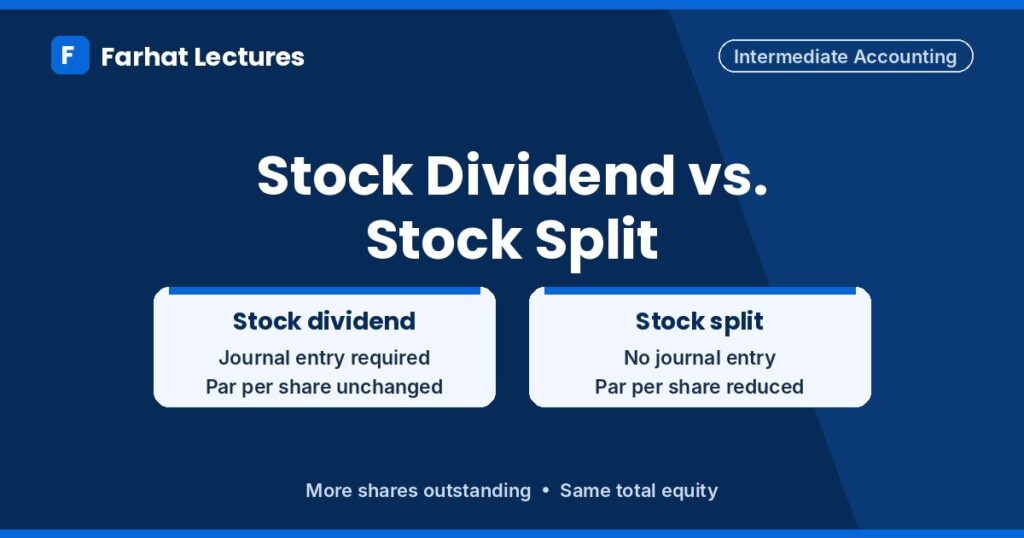
A stock dividend and a stock split both give stockholders more shares, but only a stock dividend needs a journal entry. A stock dividend keeps par value per share the same and moves an amount from retained earnings to paid-in capital. A stock split lowers par value per share, so no account balance changes. Neither changes total stockholders’ equity.
Both transactions give stockholders more shares without any cash changing hands, and both lower the market price per share. That is why students mix them up. Knowing which accounts change, and why, lets you answer the most common exam questions on this topic quickly.
This guide compares the two side by side, works through a stock split and a “split-up effected in the form of a dividend,” explains reverse splits, and covers the EPS and tax effects, with a summary table of how every type of distribution affects the financial statements.
Watch: Stock Split Explained
In this 6-minute lesson, Mansour Farhat explains what a stock split is, why companies split their stock, and why total stockholders’ equity stays the same.
Stock dividend vs. stock split at a glance
| Feature | Stock dividend | Stock split |
|---|---|---|
| Number of shares outstanding | Increases | Increases (decreases in a reverse split) |
| Par or stated value per share | Unchanged | Decreases in proportion to the split |
| Total par value of shares | Increases | Unchanged |
| Retained earnings | Decreases | Unchanged |
| Journal entry | Yes, at declaration and distribution | No; memorandum note only |
| Total stockholders’ equity | Unchanged | Unchanged |
| Main purpose | Conserve cash, capitalize retained earnings, or give stockholders a visible distribution | Lower the market price per share to widen ownership |
For the full journal entries for 10% and 40% distributions, see small vs. large stock dividend.
Why do companies split their stock?
When a company keeps earning and reinvesting profits for years, its share price can rise far above the range many individual investors are comfortable paying. Management may believe that wider ownership is good for the company, so it targets a lower price per share. A stock split does exactly that: every old share becomes several new shares, and the price per share falls in proportion.
A real example: Nvidia completed a 10-for-1 stock split in June 2024, after its share price had passed $1,000. Stockholders received nine additional shares for each share they owned, and the stock began trading on a split-adjusted basis on June 10, 2024 (Nvidia press release, May 22, 2024). The split itself did not change what the company was worth; only the number of shares and the price per share changed.
One real-world detail: Nvidia’s par value stayed at $0.001 per share after the split (Nvidia Form 8-K, June 7, 2024). Many companies keep par value unchanged when they split their stock. When that happens, the par value of the new shares is moved into the common stock account from additional paid-in capital, and total stockholders’ equity still does not change.
Example: 2-for-1 stock split
Lakeview Software (a hypothetical company) has 500,000 shares of $2 par common stock and retained earnings of $3,000,000. It declares a 2-for-1 stock split.
| Item | Before split | After 2-for-1 split |
|---|---|---|
| Shares outstanding | 500,000 | 1,000,000 |
| Par value per share | $2.00 | $1.00 |
| Common stock (total par) | $1,000,000 | $1,000,000 |
| Retained earnings | $3,000,000 | $3,000,000 |
| Total stockholders’ equity | $4,000,000 | $4,000,000 |
Because the number of shares doubles while par per share halves, total par value stays at $1,000,000. No account balance changes, so there is no journal entry. Lakeview simply updates its records to show 1,000,000 shares at $1 par.
What is a split-up effected in the form of a dividend?
Sometimes a company wants the market effect of a split but issues the shares as a dividend, often because state law or the charter makes changing par value difficult. When a stock dividend is large enough, usually more than 20–25% of the shares outstanding, it lowers the market price the way a split does. ASC 505-20 says companies should avoid the word “dividend” for this kind of distribution. When state law requires it, the distribution should be described as a stock split effected in the form of a dividend, which textbooks often call a split-up effected in the form of a dividend.
Because par value per share does not change, textbooks and the CPA exam transfer the par value of the new shares from retained earnings to common stock (not the market value). That is the treatment to use on the exam. ASC 505-20-30-6 is a bit more flexible: it requires retained earnings to be capitalized only to the extent state law requires, so some companies take the par value of the new shares from additional paid-in capital instead. Either way, total stockholders’ equity does not change.
Example. Lakeview instead issues a 100% stock dividend: 500,000 new shares at $2 par.
| Account | Debit | Credit |
|---|---|---|
| Retained Earnings (500,000 × $2) | 1,000,000 | |
| Common Stock Dividend Distributable | 1,000,000 |
| Account | Debit | Credit |
|---|---|---|
| Common Stock Dividend Distributable | 1,000,000 | |
| Common Stock | 1,000,000 |
| Result | 2-for-1 stock split | 100% stock dividend (split-up) |
|---|---|---|
| Shares outstanding | 1,000,000 | 1,000,000 |
| Par value per share | $1.00 | $2.00 |
| Common stock | $1,000,000 | $2,000,000 |
| Retained earnings | $3,000,000 | $2,000,000 |
| Total stockholders’ equity | $4,000,000 | $4,000,000 |
Stockholders end up with the same number of shares either way. The difference is entirely in how equity is labeled.
Exam tip: If a CPA exam question describes a large stock dividend issued to lower the market price, treat it as a split-up effected in the form of a dividend and use par value, not market value. If the question asks for the entry for a true stock split, the answer is no entry, only a memorandum note.
How does a reverse stock split work?
A reverse stock split combines shares. In a 1-for-5 reverse split, every five old shares become one new share. If Lakeview later combined its 1,000,000 shares of $1 par stock in a 1-for-5 reverse split, it would have 200,000 shares at $5 par, and total par value would stay at $1,000,000. Like a regular split, it needs no journal entry.
Companies use reverse splits to raise a very low share price, for example to keep meeting a stock exchange’s minimum price requirement. The risk is that investors and analysts may read a reverse split as a sign of trouble.
How do stock dividends and stock splits affect EPS?
Earnings per share (EPS) is net income available to common stockholders divided by the weighted-average number of common shares outstanding. When a company issues a stock dividend or splits its stock, EPS is restated as if the new shares had been outstanding for every period shown. Under ASC 260-10-55-12, this also applies when the split or stock dividend happens after year-end but before the financial statements are issued.
Example. Suppose Lakeview has no preferred stock and earns $500,000 of net income this year with 500,000 weighted-average shares, so EPS is $1.00. Shortly after year-end, before its financial statements are issued, Lakeview completes the 2-for-1 split. It reports EPS of $0.50 for the year ($500,000 ÷ 1,000,000 shares) and restates prior years the same way.
Unlike shares issued for cash, a split or stock dividend is not weighted by the date it happens. It applies to the whole year, and to every earlier year presented. For the full calculation, see earnings per share (EPS).
Are stock dividends and stock splits taxable?
For stockholders, a proportional stock dividend or stock split is generally not taxable income under Internal Revenue Code (IRC) Section 305(a). Instead, the stockholder spreads the original cost basis (the amount paid for the shares) over the old and new shares, as IRS Publication 550 explains.
Example. Dana paid $3,000 for 100 shares, a basis of $30 per share. After a 2-for-1 split, she owns 200 shares with a basis of $15 each. If she had received a 10% stock dividend instead, she would own 110 shares with a basis of about $27.27 each ($3,000 ÷ 110). Her total basis stays $3,000 either way.
There are exceptions. For example, a stock dividend is taxable if stockholders can choose cash instead of shares. Cash received for a fractional share is treated as a sale of that fractional share.
Effects of dividends and splits on the financial statements
| Effect on | Cash dividend: declaration | Cash dividend: payment | Small stock dividend | Large stock dividend | Stock split |
|---|---|---|---|---|---|
| Retained earnings | Decrease | None | Decrease (fair value) | Decrease (par value) | None |
| Capital stock | None | None | Increase (par value) | Increase (par value) | None |
| Additional paid-in capital | None | None | Increase (fair value over par) | None | None |
| Total stockholders’ equity | Decrease | None | None | None | None |
| Working capital | Decrease | None | None | None | None |
| Total assets | None | Decrease | None | None | None |
| Shares outstanding | None | None | Increase | Increase | Increase |
Cash entries are explained in the cash dividend journal entry lesson, and noncash distributions in the property dividend journal entry lesson. For why a company might choose shares over cash in the first place, see dividend policy.
Key takeaways: stock dividend vs. stock split
- In a stock dividend vs. stock split comparison, only the stock dividend needs a journal entry.
- A stock dividend keeps par per share and moves retained earnings into contributed capital.
- A stock split lowers par per share in proportion, so total par value and every account balance stay the same.
- A large distribution meant to lower the share price is a split-up effected in the form of a dividend and transfers par value from retained earnings.
- Neither a stock dividend nor a stock split, including a split-up effected in the form of a dividend, changes total stockholders’ equity or total assets.
- Earnings per share is restated for every period shown after a stock split or stock dividend.
Common mistakes
- Making a journal entry for a stock split.
- Forgetting to reduce par value per share after a split.
- Treating a 2-for-1 split and a 100% stock dividend as identical in the accounts.
- Using market value for a split-up effected in the form of a dividend.
- Assuming a split or stock dividend makes stockholders wealthier. They own the same share of the same company.
- Weighting a stock split by the date it happened when computing EPS, instead of applying it to the whole year and all prior years shown.
Practice questions with answers
1. A company has 300,000 shares of $3 par common stock outstanding and declares a 3-for-1 stock split. How many shares and what par value per share result? What journal entry is needed?
Answer: 900,000 shares at $1 par. Total par stays $900,000. No journal entry is needed; the company makes only a memorandum note.
2. The same company instead issues a 200% stock dividend, effected as a split-up. Record the declaration.
| Account | Debit | Credit |
|---|---|---|
| Retained Earnings (600,000 × $3) | 1,800,000 | |
| Common Stock Dividend Distributable | 1,800,000 |
Why: 300,000 × 200% = 600,000 new shares at the unchanged $3 par. A split-up transfers par value, not market value.
3. A company with 2,000,000 shares at $0.01 par completes a 1-for-10 reverse split. What are the new share count, par value, and total par?
Answer: 200,000 shares at $0.10 par. Total par stays at $20,000 (2,000,000 × $0.01 = 200,000 × $0.10), and no journal entry is needed.
Interactive stock dividend quiz
Check your understanding with four quick questions on what counts as a stock dividend, how a small stock dividend is measured, and how it affects total stockholders’ equity, each stockholder’s ownership percentage, and book value per share. Pick your answers, then select Check my work to see how each one is solved. For the full journal entries, see small vs. large stock dividend.
Frequently asked questions
What is the main difference between a stock dividend and a stock split?
A stock dividend issues new shares and transfers an amount from retained earnings to contributed capital, while par value per share stays the same. A stock split increases shares and reduces par value per share proportionately, with no journal entry.
Is there a journal entry for a stock split?
No. A stock split changes the number of shares and the par value per share, but no account balance changes. Companies make only a memorandum note in the records.
Is a 2-for-1 stock split the same as a 100% stock dividend?
Both double the number of shares, but the accounting differs. A 100% stock dividend keeps par value per share and transfers the par value of the new shares from retained earnings to common stock. A 2-for-1 split halves par value per share and needs no entry.
What is a reverse stock split?
A reverse split combines shares, for example five old shares into one new share. It reduces the number of shares, increases par value per share and the market price per share, and, like a regular split, needs no journal entry.
Why do companies split their stock?
Mainly to lower the market price per share so that more investors can afford to buy it, which can widen ownership of the company.
Do stock dividends and stock splits affect earnings per share?
Yes. EPS uses the new share count for every period presented, as if the shares had always been outstanding. This applies even when the split or stock dividend happens after year-end but before the financial statements are issued (ASC 260-10-55-12).
Are stock dividends and stock splits taxable to stockholders?
Usually not. A proportional stock dividend or stock split is generally not taxable under IRC Section 305(a). The stockholder spreads the original cost basis over the old and new shares. Cash received for a fractional share is treated as a sale of that fractional share.
What is the difference between a small and a large stock dividend?
A small stock dividend is less than about 20% to 25% of the shares outstanding and is recorded at fair value. A large stock dividend is above that range and is recorded at par value, as a split-up effected in the form of a dividend.
About the author: Mansour Farhat, CPA, CIA, DBA, is the instructor behind Farhat Lectures, where he teaches financial and intermediate accounting along with CPA, CMA, and EA exam review lessons. This lesson draws on the stockholders’ equity unit of his Intermediate Accounting course.
Last updated: November 2026
Continue learning with Farhat Lectures
Strengthen your accounting understanding with clear explanations and guided practice.
Explore the free sample course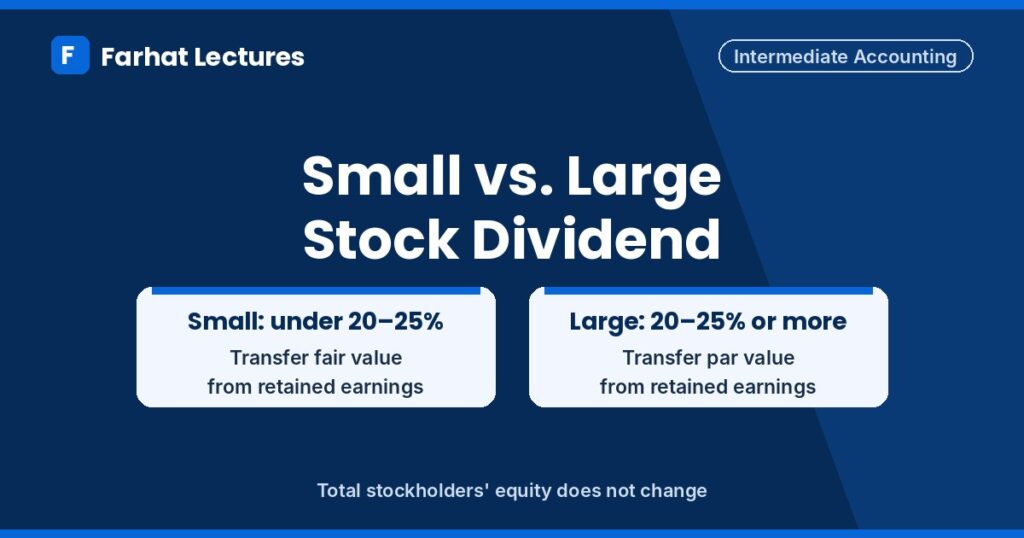

Responses