
Proportional vs. Incremental Method: Lump-Sum and Noncash Stock Issuances

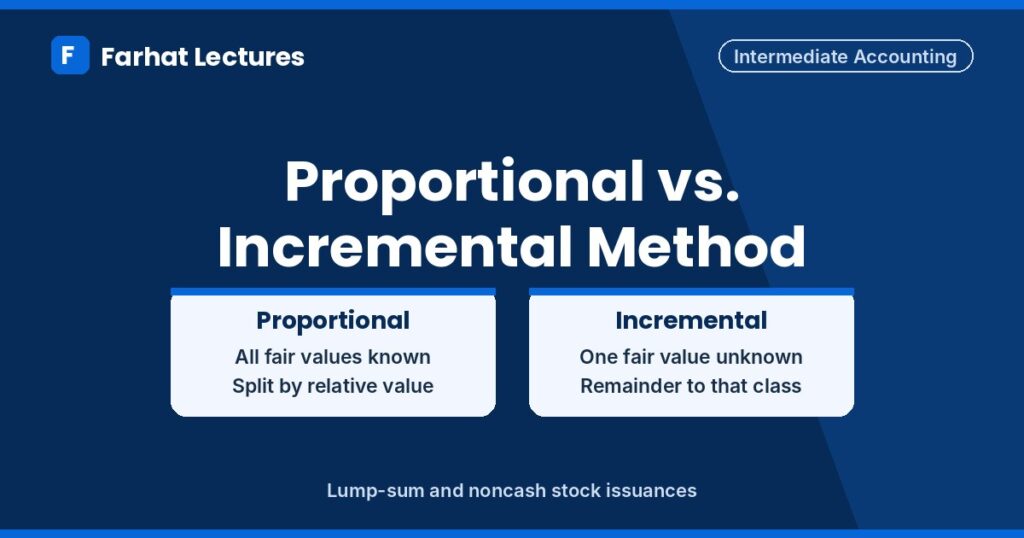
The proportional and incremental methods split one lump-sum price among classes of stock sold together. If every class has a known fair value, use the proportional method and allocate by relative fair value. If one class has no known fair value, use the incremental method: give the known class its fair value and the remainder to the other.
Most companies sell each class of stock separately, so the proceeds are easy to track. Sometimes, though, a corporation sells common and preferred shares together for one payment, for example when one investor buys a bundle of both. Each class has its own Stock and Paid-in Capital accounts, so the company must decide how much of the single price belongs to each one.
This guide also covers a closely related valuation problem: issuing stock for land, equipment, or other property instead of cash. Both topics come from the same idea. When the amount received for each class is not obvious, you measure it using the most reliable fair value available.
Watch: proportional vs. incremental method explained
This short Farhat Lectures video walks through both methods with journal entries. Watch it first, then use the examples below to practice.
Proportional vs incremental method at a glance
| Proportional method | Incremental method | |
|---|---|---|
| When to use it | Fair value is known for every class | Fair value is known for some classes but not all |
| How the lump sum is split | Each class gets (its fair value ÷ total fair value) × lump sum | Known classes get their fair values; the unknown class gets what is left |
| Who absorbs a premium or discount | Shared by all classes in proportion | Falls entirely on the class without a known fair value |
| Typical exam clue | “Fair value of the common is $X and of the preferred is $Y” | “The preferred stock has no established fair value” |
Example: proportional method
Brightline Co. (hypothetical) issues, for a lump sum of $81,000:
- 2,000 shares of $2 par common stock with a fair value of $25 per share ($50,000 total)
- 1,000 shares of $10 par preferred stock with a fair value of $40 per share ($40,000 total)
Total fair value is $90,000, but Brightline received only $81,000. The proportional method shares the difference.
| Class | Fair value | Fraction of total | Allocated proceeds |
|---|---|---|---|
| Common | $50,000 | 50/90 | $81,000 × 50/90 = $45,000 |
| Preferred | $40,000 | 40/90 | $81,000 × 40/90 = $36,000 |
| Total | $90,000 | $81,000 |
| Account | Debit | Credit |
|---|---|---|
| Cash | 81,000 | |
| Common Stock (2,000 × $2) | 4,000 | |
| Paid-in Capital in Excess of Par—Common Stock ($45,000 − $4,000) | 41,000 | |
| Preferred Stock (1,000 × $10) | 10,000 | |
| Paid-in Capital in Excess of Par—Preferred Stock ($36,000 − $10,000) | 26,000 |
Example: incremental method
Now assume the same facts, except Brightline’s preferred stock has no established fair value. The common stock’s fair value is still $50,000.
| Step | Amount |
|---|---|
| Lump sum received | $81,000 |
| Less: fair value of common stock (known) | (50,000) |
| Remainder allocated to preferred stock | $31,000 |
| Account | Debit | Credit |
|---|---|---|
| Cash | 81,000 | |
| Common Stock (2,000 × $2) | 4,000 | |
| Paid-in Capital in Excess of Par—Common Stock ($50,000 − $4,000) | 46,000 | |
| Preferred Stock (1,000 × $10) | 10,000 | |
| Paid-in Capital in Excess of Par—Preferred Stock ($31,000 − $10,000) | 21,000 |
Compare the two results. Under the proportional method, the $9,000 shortfall was shared. Under the incremental method, the preferred stock absorbed all of it, because only the common stock had a reliable fair value.
Exam tip: relative fair value allocation is not limited to stock. You will see the same idea when a company buys several assets for one price (a basket purchase) and when it issues bonds with detachable stock warrants. For bonds with warrants, if only one piece has a known fair value, the incremental method works the same way it does here.
Interactive quiz: allocate a lump-sum stock sale
Check your understanding before moving on. Each question describes one payment for two classes of stock. Decide which method the facts support, use the hints if you get stuck, then open the solution to see how the numbers are derived.
When no fair value is known
If the company cannot determine a fair value for any of the classes, neither method works on its own. The company may use an expert’s appraisal. Or, if it expects one class to have a determinable fair value soon, it may allocate on a best-estimate basis now and adjust later when that fair value is established.
Stock issued for noncash assets
A company may issue shares in exchange for land, a building, equipment, or a patent. The general rule is to record the transaction at the fair value of the stock issued or the fair value of the property received, whichever is more clearly determinable. U.S. GAAP’s asset acquisition guidance (ASC 805-50-30-2) uses the same test: when a company pays with its own shares, it measures cost at the fair value of what it gave or what it received, whichever is more clearly evident.
In an arm’s-length exchange (one between independent parties with no special relationship), the two fair values should be close, so the choice rarely matters. If neither is readily determinable, use a valuation technique, such as prices for comparable assets or a discounted cash flow estimate. Never use the stock’s par value, stated value, or book value as the measurement. The same fair value thinking shows up when a company pays a property dividend, where the asset being distributed is first adjusted to its fair value.
Example. Cedar Labs (hypothetical) issues 8,000 shares of $5 par common stock to buy a small warehouse building from its owner. Common Stock is always credited for $40,000 (8,000 × $5). The amount recorded for the building depends on which fair value is reliable.
| Situation | Building recorded at | Common Stock | Paid-in Capital in Excess of Par |
|---|---|---|---|
| The stock trades at $20 per share; the building’s fair value is unclear | $160,000 (8,000 × $20) | $40,000 | $120,000 |
| The stock is not traded; an appraisal values the building at $150,000 | $150,000 | $40,000 | $110,000 |
| Neither is readily available; a discounted cash flow valuation gives $130,000 | $130,000 | $40,000 | $90,000 |
In every case the entry is the same shape: debit Building, credit Common Stock for par, and credit Paid-in Capital in Excess of Par for the rest. A seller’s asking price is not fair value, so do not use it unless it is supported by a reliable valuation.
One exception to know: when a company issues shares to pay employees or outside suppliers for goods or services used in its operations, the deal is a share-based payment under Accounting Standards Codification (ASC) Topic 718, which the FASB extended to nonemployees in Accounting Standards Update 2018-07.
Under ASC 718, these payments are generally measured at the grant-date fair value of the shares issued, not at whichever value is more clearly determinable. Share-based payment rules are a separate topic. For the basic cash issuance entries, see how to record the issuance of common stock.
Watered stock vs. secret reserves
The board of directors sets the value of property received for stock, and that power can be misused. Overvaluing or undervaluing the property distorts both assets and equity. You will see that distortion in the stockholders’ equity section of the balance sheet.
| Watered stock | Secret reserve | |
|---|---|---|
| What happened | Assets received for stock were overvalued | Assets were undervalued or liabilities overstated |
| Effect on equity | Stockholders’ equity is overstated | Stockholders’ equity is understated |
| Other causes | Inflated appraisals of property received | Excessive depreciation, expensing capital expenditures, too-large write-downs, or an excessive warranty liability |
| Fix | Write the overvalued assets down | Correct the understated assets or overstated liabilities |
Key takeaways: proportional vs incremental method
- The proportional vs incremental method choice depends on one question: is the fair value of every class known?
- Proportional: allocate the lump sum by relative fair value. Incremental: give known classes their fair value and the remainder to the unknown class.
- Stock issued for property is recorded at the more clearly determinable fair value, never at par or book value.
- Overvalued property creates watered stock; undervalued assets or overstated liabilities create secret reserves.
Common mistakes
- Using the proportional method when one class has no fair value.
- Allocating the lump sum by par value instead of fair value.
- Forgetting to split each class’s allocation between its Stock account (par) and its paid-in capital in excess account.
- Recording property received for stock at the stock’s par value or at the seller’s asking price.
- Mixing up watered stock (equity too high) and secret reserves (equity too low).
Practice questions with answers
1. A company issues 1,000 shares of $1 par common (fair value $36 per share) and 500 shares of $20 par preferred (fair value $48 per share) for a lump sum of $54,000. Use the proportional method.
Total fair value is $36,000 + $24,000 = $60,000. Common gets $54,000 × 36/60 = $32,400. Preferred gets $54,000 × 24/60 = $21,600.
| Account | Debit | Credit |
|---|---|---|
| Cash | 54,000 | |
| Common Stock (1,000 × $1) | 1,000 | |
| Paid-in Capital in Excess of Par—Common Stock | 31,400 | |
| Preferred Stock (500 × $20) | 10,000 | |
| Paid-in Capital in Excess of Par—Preferred Stock | 11,600 |
2. Use the same facts, but the preferred stock has no known fair value. How much is allocated to each class?
Answer: Use the incremental method. Common gets its full fair value of $36,000. Preferred gets the remainder, $54,000 − $36,000 = $18,000, so its paid-in capital in excess of par is $18,000 − $10,000 = $8,000.
3. A company issues 10,000 shares of $1 par common stock for land. The seller was asking $95,000, a qualified appraiser values the land at $80,000, and the stock is not traded. Record the entry.
| Account | Debit | Credit |
|---|---|---|
| Land | 80,000 | |
| Common Stock (10,000 × $1) | 10,000 | |
| Paid-in Capital in Excess of Par—Common Stock | 70,000 |
Why: The appraisal is the more clearly determinable fair value. The asking price is not a fair value measurement.
Frequently asked questions
When do you use the proportional method?
Use it when the fair value (or another sound basis for relative value) is known for every class of security sold together. Each class gets a share of the lump sum based on its fair value relative to the total.
When do you use the incremental method?
Use it when the fair value of one class is not known. Assign the known class its fair value and give the remainder of the lump sum to the class without a known fair value.
What if no class has a known fair value?
The company may rely on an expert appraisal, or use a best estimate and adjust it later when a fair value becomes available.
How do you value stock issued for land or equipment?
Use the fair value of the stock or the fair value of the asset, whichever is more clearly determinable. If neither is readily available, use a valuation technique. Do not use the stock’s par, stated, or book value. If the shares pay employees or suppliers for goods or services used in operations, ASC Topic 718 applies instead.
What is the difference between watered stock and a secret reserve?
Watered stock means assets and equity are overstated because property received for stock was overvalued. A secret reserve means equity is understated because assets were undervalued or liabilities overstated.
Is the proportional method the same as the relative fair value method?
Yes, in substance. The proportional method allocates the lump sum by each class’s fair value relative to the total fair value, which is a relative fair value allocation.
What happens if the lump sum is more than the total fair value?
The extra amount is shared under the proportional method and goes entirely to the class without a known fair value under the incremental method. Using Brightline’s fair values ($50,000 common, $40,000 preferred) and a $99,000 lump sum, the proportional method gives common $55,000 and preferred $44,000. The incremental method gives common $50,000 and preferred $49,000.
About the author
Mansour Farhat, CPA, CIA, DBA, is the instructor behind Farhat Lectures, where he teaches accounting courses and CPA exam review. Learn more about Mansour.
Continue learning with Farhat Lectures
Strengthen your accounting understanding with clear explanations and guided practice.
Explore the free sample course


Responses