
Cash Basis vs Accrual Basis: Simple Examples and Differences

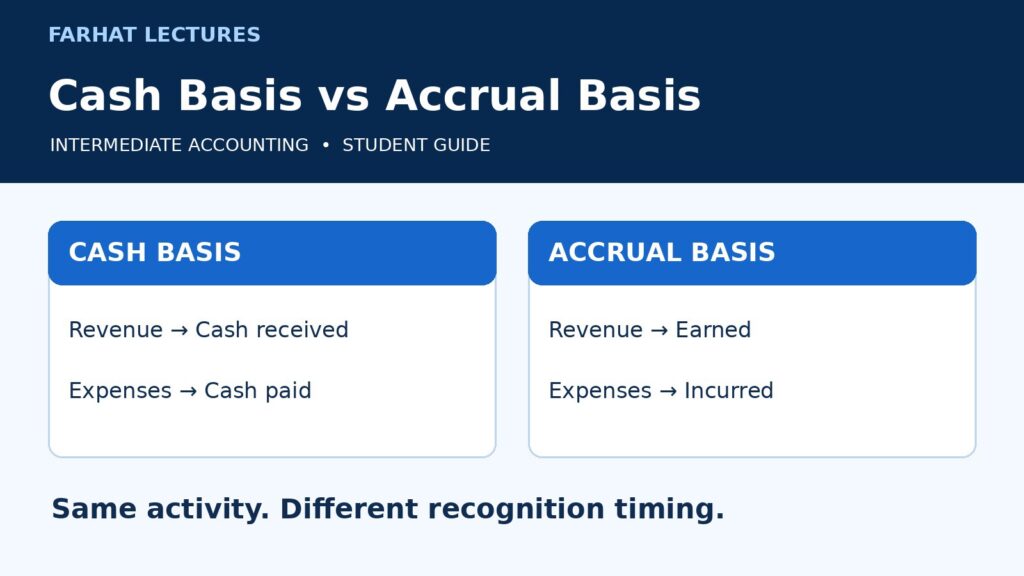
The difference between cash basis vs accrual basis is timing. Cash basis records revenue when cash is received and expenses when cash is paid. Accrual basis records revenue when it is earned and expenses when they are incurred, no matter when cash moves. U.S. GAAP (generally accepted accounting principles) requires accrual; cash basis is simpler and popular with small businesses.
This distinction matters because a profitable month can produce little cash, while a large collection can arrive after the work was completed. Understanding both measures helps you interpret an income statement and the related balance-sheet accounts.
Watch Professor Farhat: Review cash and accrual timing, then follow the worked calculations.
Watch the matching Farhat Lectures video on YouTube. This lesson focuses on converting cash records to accrual amounts, the natural next step after this comparison. The opening covers recognition timing; revenue conversion begins at 3:50 and expense conversion at 8:03.
What is the difference between cash basis and accrual basis?
To recognize an item means to include it in the financial statements. A performance obligation is a promise in a contract to transfer a distinct good or service to a customer, as defined in ASC 606, the revenue recognition standard. In this guide, “strict cash basis” means the pure cash basis, with no accrual adjustments at all. Under accrual accounting, people often say revenue is recognized when it is “earned.” That’s shorthand for the point when the promised good or service has been transferred to the customer. Sending an invoice or receiving money does not, by itself, establish that the revenue belongs in that period.
| Question | Strict cash basis | Accrual basis |
|---|---|---|
| When is service revenue recognized? | When customer cash is received | When the service obligation is satisfied |
| When is an operating expense recognized? | When the related cash is paid | When the cost is incurred or the benefit is consumed |
| Uncollected earned service fees | Excluded from revenue until collection | Revenue and accounts receivable |
| Unpaid expense already incurred | Excluded from expense until payment | Expense and an accrued liability |
| Customer advance for future work | Recognized as revenue when the cash is collected | Unearned revenue, a liability, until earned |
U.S. generally accepted accounting principles (GAAP) require accrual accounting for financial reporting. Using accrual timing is necessary but does not establish full GAAP compliance: the relevant recognition, measurement, presentation, and disclosure requirements also apply.
The Financial Accounting Standards Board (FASB) explains the underlying timing distinction in its Conceptual Framework, paragraph OB17. This framework provides conceptual context; it is not authoritative GAAP.
A hypothetical three-month example
Cedar Design completes a $15,000 design project in January. A subcontractor performs $9,000 of related work that month. Cedar collects the customer’s payment in February and pays the subcontractor in March. Assume no other activity, taxes, opening balances, or owner transactions.
| Month | Cash-basis revenue | Cash-basis expense | Cash-basis income | Accrual income |
|---|---|---|---|---|
| January | $0 | $0 | $0 | $6,000 |
| February | $15,000 | $0 | $15,000 | $0 |
| March | $0 | $9,000 | ($9,000) | $0 |
| Total | $15,000 | $9,000 | $6,000 | $6,000 |
Accrual accounting reports $15,000 revenue and $9,000 expense in January, producing $6,000 income when the work occurs. February’s collection settles the receivable. March’s payment settles the payable. Neither settlement creates another accrual revenue or expense.
Across these three months the totals agree because all of this example’s revenue and expenses are eventually collected and paid. That result depends on the simplified facts. It does not mean cash and accrual income must agree over any arbitrarily selected period.
How does each basis change the balance sheet?
At January 31, Cedar has no cash from the project, but it has a right to receive $15,000 and an obligation to pay $9,000. Accrual accounting reports Accounts Receivable $15,000, Accounts Payable $9,000, and equity of $6,000. The accounting equation balances: $15,000 assets = $9,000 liabilities + $6,000 equity.
Strict cash reporting leaves out the receivable and the payable because no cash has moved yet, so cash-basis equity from the project is $0 at January 31. At February 28, cash is $15,000, the receivable is settled, and the $9,000 payable remains. Accrual equity is still $6,000, while cash-basis equity is $15,000. At March 31, cash is $6,000 and the payable is settled, so both bases now show equity of $6,000. All three dates describe the same project but different stages of collection and payment.
Receivables and payables help users assess potential future collections and payments. They do not guarantee collection or replace a cash forecast. To calculate the adjustments from cash records, continue to the cash-to-accrual conversion guide.
Cash basis vs accrual basis: pros and cons
Neither basis is right for every situation. Here’s how they compare in practice.
| Factor | Cash basis | Accrual basis |
|---|---|---|
| Ease of use | Simple. You record money in and money out. | More work. You track receivables, payables, prepaid expenses, and accruals. |
| Picture of performance | Can make a month look better or worse than it really was. | Matches revenue and expenses to the period they belong to. |
| Picture of financial position | Shows cash, but not what customers owe you or what you owe others. | Shows receivables and payables alongside cash. |
| GAAP | Not GAAP. | Required for GAAP financial statements. |
| Typical users | Many small businesses and individuals, especially for taxes. | Companies issuing GAAP statements and businesses whose lenders or investors want them. |
Cash basis follows the timing of revenue receipts and expense payments. Accrual basis reports revenue and expenses in the periods to which they relate. Income under either method is different from the bank balance: loans and owner contributions increase cash without creating revenue.
What is modified cash basis?
Modified cash basis starts with cash reporting and adds a limited set of accrual-style adjustments, such as capitalizing equipment and recording depreciation. It is a mixture of cash and accrual approaches. The stated policies determine which modifications are used.
For example, assume a practice pays $12,000 for equipment and its stated modified-cash policy capitalizes equipment. If depreciation for the period is $2,000, that policy recognizes $2,000 expense rather than treating the entire purchase as a current operating expense. This is a hypothetical policy illustration, not a universal modified-cash rule.
Depreciation alone does not make the statements GAAP compliant. For broader framework choices and presentation, see special purpose frameworks and modified cash basis.
Which businesses can use the cash method for taxes?
Everything above is about financial reporting. Tax has its own rules, and a business’s tax method is a separate choice from how it keeps GAAP books.
For federal income tax, IRC Section 448 generally bars three groups from the cash method: C corporations, partnerships that have a C corporation as a partner, and tax shelters.
The main exception is the Section 448(c) gross receipts test. For tax years beginning in 2026, a C corporation or a partnership with a C corporation partner can generally qualify for this exception if it is not a tax shelter and its average annual gross receipts for the three prior tax years are $32 million or less (Rev. Proc. 2025-32). The limit was $31 million for 2025, and it is adjusted for inflation every year, so always check the figure for the year you’re studying.
A few more points to remember:
- Tax shelters are barred from the cash method under Section 448, regardless of whether they meet the gross receipts test.
- Sole proprietors, S corporations, and partnerships without a C corporation partner are generally outside the entity-based Section 448 restrictions. The tax-shelter restriction and other applicable tax rules still need to be considered.
- Farming businesses and qualified personal service corporations have their own exceptions.
For the full IRS rules, see IRS Publication 538, Accounting Periods and Methods.
Common mistakes students should avoid
- Equating income with cash. A collection can relate to prior-period revenue, and a payment can settle a prior-period expense.
- Recognizing revenue twice. Once earned revenue is recorded, its later collection reduces the receivable.
- Calling every receipt revenue. A bank loan or owner contribution is not customer revenue.
- Thinking accrual reporting ignores cash. A full set of GAAP financial statements includes a statement of cash flows. Under the indirect method, that statement starts with accrual net income and adjusts it to cash from operating activities.
- Mixing up book and tax rules. GAAP financial reporting and federal tax have different rules, so always check which one a question is asking about. The tax rules are summarized in the section above.
Key takeaways
- Cash basis records revenue when cash is received and expenses when cash is paid.
- Accrual basis records revenue when the performance obligation is satisfied and expenses when they are incurred.
- U.S. GAAP requires accrual accounting. Cash basis and modified cash basis are special purpose frameworks.
- Over the life of a simple project, total income under both bases can match, but month by month it often won’t.
- Collecting a receivable or paying a payable settles an earlier item. It does not create new revenue or expense.
- Your tax method is a separate decision. For tax years beginning in 2026, the Section 448(c) threshold is $32 million of average annual gross receipts over the three prior tax years. This is not a universal cash-method ceiling for every business; tax-shelter restrictions still apply.
How cash vs accrual shows up on the CPA exam
On the FAR section, this topic usually appears in two ways.
First, conversion questions give you cash collections and payments plus changes in receivables, payables, prepaid expenses, and unearned revenue, and ask for accrual revenue, expense, or net income. Two formulas address the timing adjustments:
- Accrual revenue = cash collected from customers, plus the increase in accounts receivable (or minus a decrease), plus the decrease in unearned revenue (or minus an increase).
- Accrual expense = cash paid for the related operating expenses, plus the increase in related payables or accrued liabilities (or minus a decrease), plus the decrease in prepaid expenses (or minus an increase).
These formulas cover the stated timing differences, not every adjustment needed to determine net income. Recognize applicable noncash expenses, such as depreciation, separately and only once. Exclude borrowing, owner contributions, loan principal repayments, and purchases of long-term assets from the operating revenue and expense cash amounts used above.
Try it on Cedar Design’s January: $0 collected plus a $15,000 increase in accounts receivable gives $15,000 of accrual revenue.
Second, special purpose framework questions test cash-basis and modified cash-basis statements. When a question mentions either one, it is telling you the statements are not GAAP statements, and the titles change too, for example a statement of cash receipts and disbursements instead of an income statement.
Want more practice like this? Explore the free sample course.
Cash Basis vs Accrual Basis: Interactive Exercise
Test yourself on when revenue and expenses are recognized under accrual-basis accounting and the strict cash basis, and how cash-basis accounting relates to GAAP.
Quick review
What is accrual-basis accounting? Companies that prepare financial statements under U.S. GAAP use accrual-basis accounting. Revenue is recognized when the performance obligation is satisfied, and expenses are recognized in the period incurred, regardless of when cash is received or paid.
What is the strict cash basis? Companies record revenue only when they receive cash and expenses only when they pay cash.
Are cash-basis financial statements in conformity with GAAP? No. The cash basis ignores the revenue recognition principle and the expense recognition principle.
Choose the correct answers
Answer six questions about revenue recognition, expense recognition, and U.S. GAAP. Select one answer for each question, then select Check answers for feedback. Use Start again to retry. The strict cash-basis questions concern operating revenue and expenses; modified cash-basis and tax rules may differ.
View answers and explanations
- When the performance obligation is satisfied. Accrual-basis revenue recognition does not depend on when cash is received.
- In the period incurred. Accrual-basis expenses are recognized regardless of when cash is paid.
- Only when cash is received. Under the strict cash basis, receiving cash determines when revenue is recorded.
- Only when cash is paid. Under the strict cash basis, paying cash determines when expenses are recorded.
- Both the revenue recognition principle and the expense recognition principle. The cash basis ignores both principles.
- No. Cash-basis financial statements are not in conformity with GAAP because the cash basis ignores those two recognition principles.
Practice questions with answers
1. Services worth $4,500 are completed in December and collected in January. Which period reports accrual revenue?
Answer: December. The service is completed then. January’s collection reduces Accounts Receivable; it does not create a second revenue.
2. A $700 December utility expense is paid in January. What does December accrual accounting show?
Answer: A $700 expense and $700 liability. The expense belongs to December even though payment occurs later. Strict cash-basis expense appears in January.
3. A company receives $2,400 in December for services to be performed entirely in January. What is December accrual revenue?
Answer: Zero. The receipt creates Cash and Unearned Revenue of $2,400. Revenue follows performance in January.
Frequently asked questions
Can accrual income be positive when cash decreases?
Yes. Uncollected sales, prepaid costs, and payments of earlier obligations can cause cash and income to move differently.
Why is accrual information useful to creditors?
It reports earned amounts awaiting collection and incurred amounts awaiting payment, alongside cash. Creditors can consider these balances when assessing future cash needs.
How do I move from cash records to accrual income?
Adjust customer collections for receivables and unearned revenue; adjust expense payments for prepaids and accrued liabilities. Include applicable noncash expenses once. Work through the linked conversion lesson next.
Is cash basis accounting allowed under GAAP?
No. U.S. GAAP requires accrual accounting. Cash-basis and modified cash-basis statements are special purpose frameworks, which some entities use when their readers don’t need GAAP statements.
Which is better, cash basis or accrual basis?
It depends on who is reading the numbers. Accrual gives a truer picture of performance and is required for GAAP statements. Cash basis is simpler and follows the timing of revenue receipts and expense payments, which is why many small businesses use it, especially for taxes. Cash-basis income is not the bank balance: loans and owner contributions can increase cash without creating revenue.
Can a business switch from cash basis to accrual basis?
Yes. For its books, the business starts recording receivables, payables, prepaid expenses, and accrued expenses. For federal income tax, a change in accounting method generally needs IRS consent, which is usually requested on Form 3115.
Under the accrual method, can you owe tax on money you haven’t collected?
Yes, it can happen. Under the tax accrual method, income is generally reported once you have a fixed right to receive it and the amount can be determined with reasonable accuracy, even if the customer hasn’t paid yet.

Responses