
Recognition vs Measurement in Accounting (With Example)

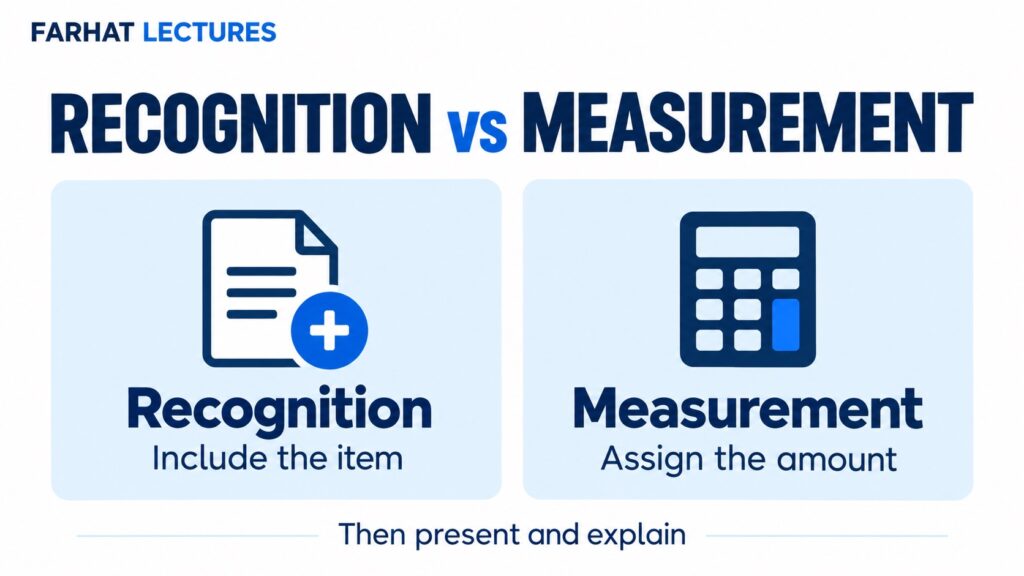
Recognition vs measurement is the difference between two decisions in financial reporting. Recognition decides whether an item belongs in the financial statements. Measurement decides what amount to report for it. Under FASB’s Conceptual Framework, an item is recognized when it meets an element definition, is measurable using an attribute such as cost or fair value, and can be faithfully represented.
This guide also covers the three questions that follow those two: presentation (how the item is displayed), notes (what gets explained), and derecognition (when the item is removed). These concepts show how recognition and measurement connect with the rest of financial reporting.
Watch: recognition and measurement explained
In FASB’s Conceptual Framework, Professor Farhat places recognition and measurement within the broader financial reporting framework. The video below starts at 8:47, where the recognition and measurement discussion begins.
Use the lecture as a conceptual overview. For the current FASB recognition criteria, see What does recognition mean in accounting? below.
One thing to watch for: before August 2023, the FASB framework listed four recognition criteria (definitions, measurability, relevance, and reliability) in Concepts Statement 5, which dates from 1984. Chapter 5 of Concepts Statement 8 replaced that list with the three criteria explained below. If a lecture, textbook, or review course lists four criteria, it is using the earlier version. For questions about the current FASB framework, use the three criteria below; follow any explicitly stated historical context in the question.
As you watch: separate the decision to include an item from the decision about its reported amount. Then use the comparison below and the Maple Consulting example to connect those decisions with presentation, notes, and derecognition.
Recognition vs measurement: what is the difference?
| Concept | Main question | Simple illustration |
|---|---|---|
| Recognition | Should the item be included? | Include an existing supplier obligation |
| Measurement | What amount represents it? | Assign the obligation a monetary amount |
| Presentation | How should it be displayed? | Group it with an appropriate liability line item |
| Notes | What explanation is needed? | Explain relevant terms or policies |
| Derecognition | When should it be removed? | Remove an obligation after it is settled |
Think of these as five connected questions, not five separate tasks. Once you decide an item belongs in the statements, you still have to decide how much to show, where to show it, and what to explain about it.
What does recognition mean in accounting?
Recognition is the process of including an item in the financial statements as an asset, liability, equity, revenue, or expense, described in words and numbers, with its amount included in the statement totals. Mentioning a number in a note or elsewhere in the report is not recognition. FASB is explicit on this point: disclosing an amount is not the same as recognizing it.
FASB Concepts Statement 8, Chapter 5 (Recognition and Derecognition, issued August 2023) sets three recognition criteria. An item is recognized when it meets all three at the same time:
- Definition. The item meets the definition of an element of financial statements, such as an asset, a liability, equity, revenue, or an expense.
- Measurability. The item can be measured and has a relevant measurement attribute. A measurement attribute is the basis used to put a number on the item, such as historical cost or fair value, and it must give useful information.
- Faithful representation. The item can be depicted and measured in a way that is complete, neutral, and free from error. Free from error does not mean that every estimate is perfectly accurate; the estimation process and the description of its uncertainty must faithfully represent the item.
Materiality and the cost constraint also inform the framework. Materiality depends on an item’s nature, magnitude, or both, in the circumstances of the entity; even a small amount can be material because of its nature. The cost constraint considers whether the benefits of financial information justify the costs of providing it. It informs standard setting and does not independently permit an entity to disregard applicable GAAP because compliance is costly.
Start with the definition. An expected future purchase does not automatically create a present liability today. Conversely, an existing obligation does not disappear simply because paying it would be inconvenient.
Review the elements of financial statements before tackling recognition. The definitions establish what kind of item you are considering; recognition determines its inclusion.
What does measurement mean in accounting?
Measurement is the process of determining the amount at which a recognized item is reported in the financial statements. The amount can come from an observable transaction price, such as an invoice, or from an estimate, depending on what the applicable standard requires. It is not the amount management would prefer to show.
FASB Concepts Statement 8, Chapter 6 (Measurement), issued in July 2024, sets out an important premise. An asset should not be reported above the amount that can be recovered through its use or sale. A liability should not be reported below the amount needed to settle it over the expected life of the obligation.
This is a conceptual guide, not a universal instruction to use the same valuation for every item. Specific GAAP determines the method and timing in actual accounting. Later lessons address those detailed measurement rules.
Uncertainty about the amount does not, by itself, block recognition. A reasonable estimate can be useful information when the basis for the estimate and its limits are explained. The relevant question is whether the estimate provides relevant information and can be faithfully represented, including an appropriate explanation of uncertainty; certainty about the future is not required. A warranty liability is a common example: the exact cost of future repairs is unknown, but a company with years of claims history can estimate it well enough to recognize it.
One transaction, several reporting questions
Hypothetical example: Maple Consulting receives and uses $2,400 of routine office services during September. The supplier’s invoice is unpaid at month-end. Assume the services and obligation meet the applicable recognition requirements, with no disputed amount or unusual terms.
Recognition: Maple includes the expense and the obligation in its statements. Waiting for cash payment would fail to describe the existing obligation under the assumptions of this example.
Measurement: The agreed $2,400 invoice supplies the amount in this simple case. If there were uncertainty or special terms, the measurement analysis could require additional work under the relevant standards.
Presentation: Maple groups the expense and payable appropriately in the statements. Showing a total is not enough if its label leads readers to misunderstand the underlying items.
Notes: Maple considers what additional explanation is required and useful. This does not mean every routine invoice needs its own note. Notes supplement the statements with relevant context at an appropriate level of detail.
Derecognition: Maple pays the full invoice in October and the obligation is discharged. It removes that payable. Payment settles the recognized liability; it does not create the same September expense a second time.
The same example as journal entries
| Account | Debit | Credit |
|---|---|---|
| Office services expense | $2,400 | — |
| Accounts payable | — | $2,400 |
| Account | Debit | Credit |
|---|---|---|
| Accounts payable | $2,400 | — |
| Cash | — | $2,400 |
After both entries, Maple has recorded the expense once, the payable is gone, and cash is down by $2,400. The October journal entry affects only balance sheet accounts and creates no additional expense. The cash payment is also reported as an operating cash outflow in Maple’s statement of cash flows.
Want to practice entries like these with guided feedback? The free sample course walks through accrual entries step by step.
Presentation and notes are complementary
Presentation concerns the arrangement of line items, subtotals, totals, and labels. Notes can explain matters such as an item’s nature, accounting policies, or uncertainty that a single line cannot communicate adequately.
In FASB Concepts Statement 8, Chapter 7 (Presentation) and Chapter 8 (Notes to Financial Statements) cover these two communication roles. Financial statements and their notes should be read together.
A common mistake is to say, “We disclosed it, so recognition does not matter.” Disclosure is not a substitute when an item must be recognized. Equally, recognizing an amount does not eliminate every need for explanation.
The qualitative characteristics explain why both matter. A number is only useful if a reader can tell what it represents. Clear presentation supports understandability. Notes that explain policies and uncertainties support completeness.
What is derecognition, and what mistakes should you avoid?
At the conceptual level, derecognition occurs when an item no longer satisfies any one of the recognition criteria. A settled payable provides a straightforward example because the present obligation has ended.
Do not confuse derecognition with reducing an amount. An asset can remain recognized at a revised measurement. Nor can management remove an obligation simply because it would prefer a stronger-looking balance sheet.
Finally, keep the framework’s status clear. It guides thinking and standard setting but does not override GAAP. The framework overview explains that boundary. A complicated litigation or financial-instrument question needs specific standards, beyond this introductory comparison.
How recognition vs measurement shows up on the CPA and CMA exams
The CPA Exam’s FAR section tests financial reporting under US GAAP, and CMA Part 1, Section A (External Financial Reporting Decisions) covers recognition, measurement, valuation, and disclosure. Both reward candidates who can separate the recognition decision from the measurement decision. Three patterns come up often.
1. Recognition vs disclosure. Under ASC 450 (Contingencies), a loss contingency is generally accrued when information available before the financial statements are issued or available to be issued indicates that it is probable that an asset had been impaired or a liability had been incurred at the financial statement date, and the loss amount can be reasonably estimated. Specific guidance and exceptions must also be considered. If the loss is only reasonably possible, it is disclosed in the notes and not recognized. The accrual decision is recognition. The amount accrued is measurement: the best estimate, or the low end of the range when no amount within the range is a better estimate than any other.
2. Measurement change vs derecognition. Writing an asset down for impairment changes its measurement. The asset stays on the balance sheet. Derecognition happens only when the item no longer meets a recognition criterion, such as when the asset is sold or the liability is settled.
3. Apply the stated framework. For current conceptual recognition questions, assess definition, measurability, and faithful representation together. The historical distinction is explained beside the video above.
Tip: when a question says an item was “disclosed in the notes,” ask yourself whether it was recognized. Disclosure alone is not recognition, and that distinction is the point of many exam questions. For the full treatment of contingencies, fair value, and impairment, see the Intermediate Accounting course and the CPA FAR Becker supplemental course.
Key takeaways
- Recognition answers one question: does this item belong in the financial statements? An item is recognized when it meets an element definition, is measurable with a relevant attribute, and can be faithfully represented.
- Measurement answers a second question: what amount do we report? The amount may be an observable price, such as an invoice, or an estimate, as the applicable standard requires.
- Presentation decides where and how the item appears. Notes explain what the numbers alone cannot.
- Derecognition removes an item once it no longer meets any one recognition criterion. Changing the amount is a measurement change, not derecognition.
- The Conceptual Framework guides thinking and standard setting. Specific GAAP in the Codification controls the actual accounting.
This quiz applies the concepts in FASB Concepts Statement 8, Chapter 5 (the recognition criteria in paragraph RD5 and the derecognition guidance) and Chapter 6 (the measurement premise for assets and liabilities). These are conceptual principles; specific GAAP governs the accounting for actual transactions.
Need a refresher? Review recognition criteria, measurement concepts, or derecognition, then try the quiz again.
Practice questions with explanations
1. A student asks whether an existing obligation belongs in the statements. Which concept is central?
Answer: Recognition. The question is about inclusion, though the recognition analysis also considers measurement and faithful representation.
2. An amount remains in the statements but is revised. Is that necessarily derecognition?
Answer: No. A revised measurement can change the reported amount while the underlying item remains recognized.
3. Maple pays its $2,400 payable after recognizing the expense earlier. Should it record that expense again?
Answer: No. Under the example’s assumptions, payment settles the obligation and reduces cash. Recording the same expense again would double count it.
Frequently asked questions
Can recognition occur before cash is paid?
Yes. Cash timing and recognition timing are different questions. An existing payable is a simple illustration.
Are notes part of reading financial statements?
Yes. They supply explanations that help users interpret the amounts and related matters.
Does an uncertain amount always stay off the statements?
No. Uncertainty requires analysis; it is not an automatic ban on recognition. Apply the relevant standards and assess the quality of the depiction.
What are the three recognition criteria in FASB Concepts Statement 8?
An item is recognized when it meets the definition of an element, is measurable with a relevant measurement attribute, and can be depicted and measured with faithful representation. All three must be met, subject to materiality and the cost constraint.
What is the difference between recognition and disclosure?
Recognition puts the item in the statements and its amount in the totals. Disclosure explains it in the notes. Disclosing an amount is not the same as recognizing it.
Is writing down an asset the same as derecognition?
No. A write-down changes the measurement, and the asset stays recognized. Derecognition removes the item entirely, such as when an asset is sold or a liability is settled.
What measurement attributes does GAAP use?
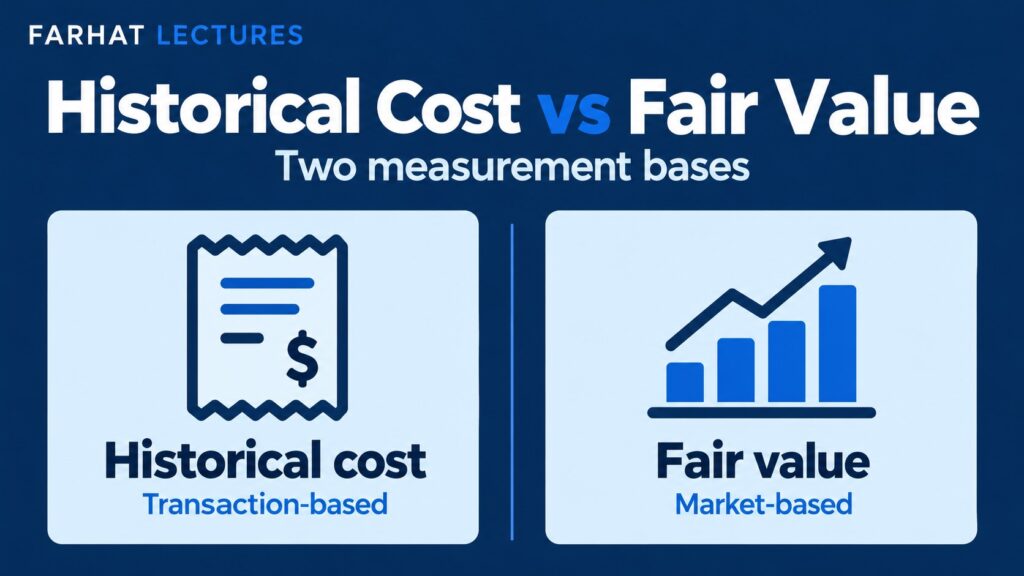
Common attributes include historical cost, fair value, net realizable value, and present value of expected cash flows. Chapter 6 of Concepts Statement 8 groups measurements into two systems: entry prices (what the entity paid or would pay) and exit prices (what the entity would receive to sell an asset or pay to transfer a liability). The specific standard tells you which attribute to use.
Is the FASB Conceptual Framework part of GAAP?
No. Concepts Statements are nonauthoritative. In 2024, FASB issued ASU 2024-02 to remove references to the Concepts Statements from the Accounting Standards Codification. The framework guides the Board when it writes standards. The Codification governs the actual accounting.
Which exams test recognition and measurement?
The CPA Exam’s FAR section and CMA Part 1 (Section A, External Financial Reporting Decisions) both test these concepts, usually through scenarios that ask whether an item should be recorded and, if so, at what amount.
Learn with Farhat Lectures
Build your understanding with clear explanations and guided practice. Explore the free sample course, then continue studying at your own pace.
Try the free sample course →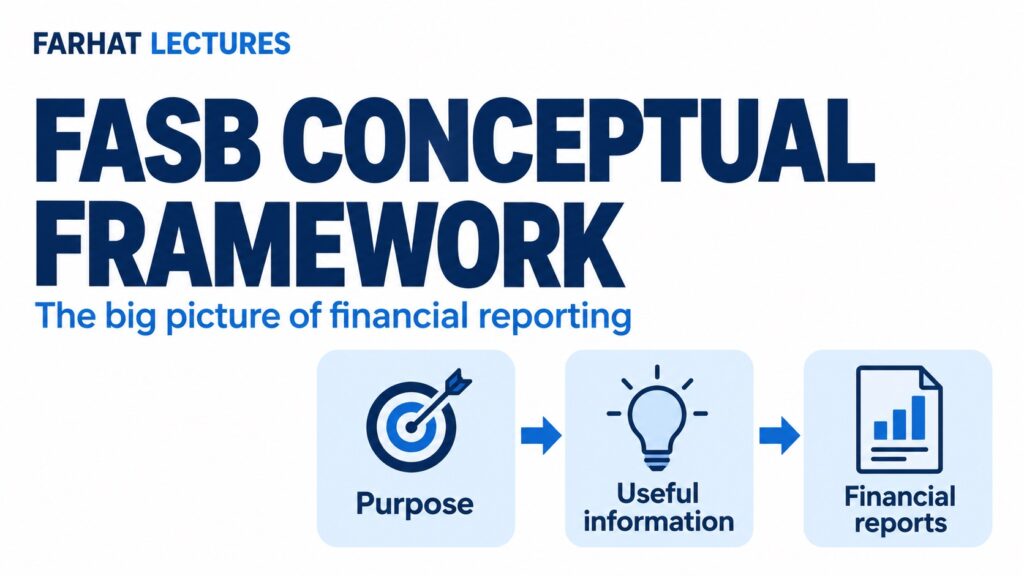


Responses