
Classified Balance Sheet

What Is a Classified Balance Sheet?
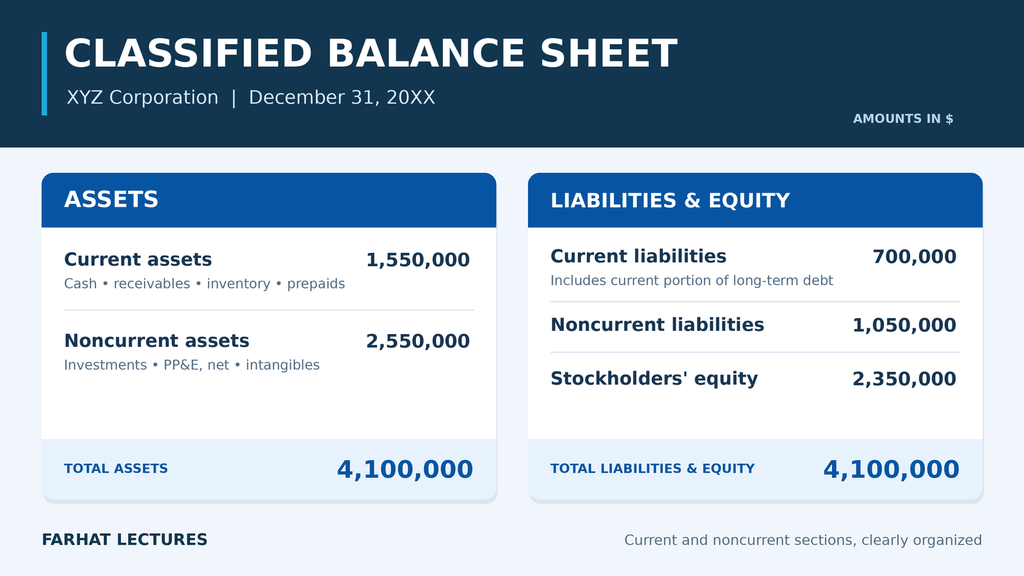
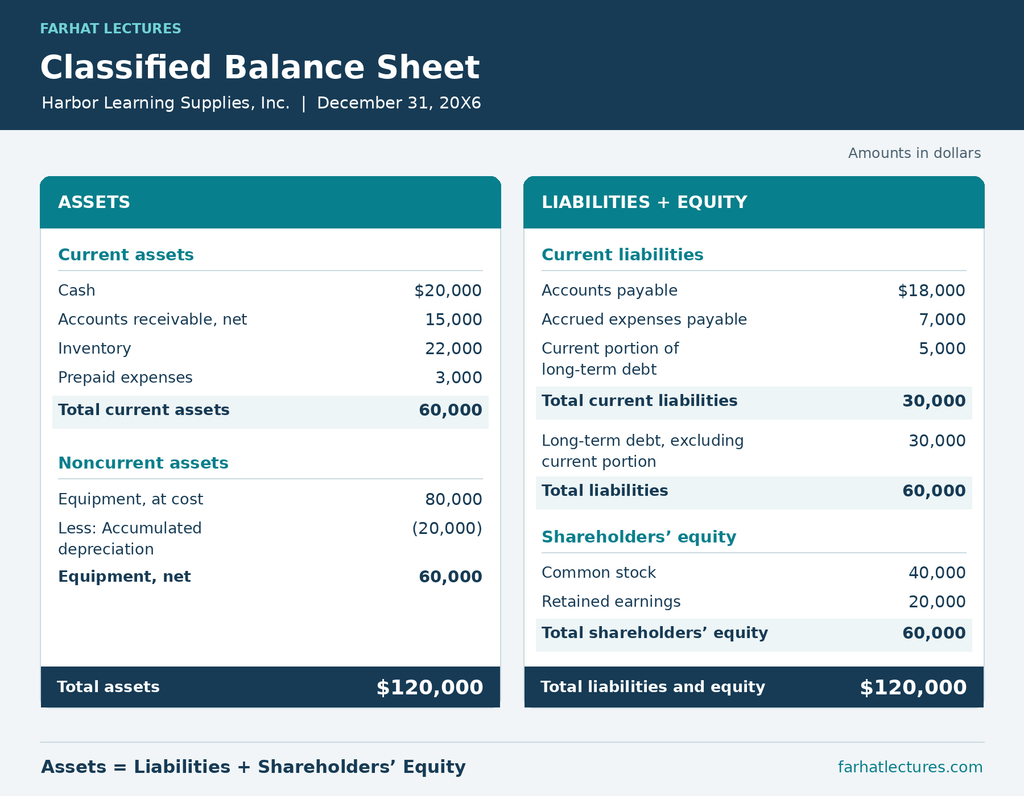
A classified balance sheet groups a company’s assets and liabilities into current and noncurrent categories, with a subtotal for each, followed by stockholders’ equity. Current items are expected to be turned into cash, used up, or paid within one year or the operating cycle, whichever is longer. This layout shows liquidity at a glance.
You’ll see this format in most corporate financial statements, and it’s a core topic in the FAR section of the CPA exam and in CMA Part 1. Below, we’ll walk through each section, build a full example for XYZ Corporation, calculate the key ratios, and cover the classification traps that trip up exam candidates.
Prefer to watch first? Jump to the short video walkthrough (4:31) or watch the full 16-minute lecture on YouTube.
Components of a Classified Balance Sheet
A classified balance sheet has three main parts: assets, liabilities, and equity. Assets and liabilities are each split into current and noncurrent groups, and each group gets its own subtotal. Equity comes last. If you need a refresher on what each element means, see our guide to the elements of financial statements.
1. Assets
An asset is a present right of a company to an economic benefit. That’s the definition in the FASB’s Conceptual Framework (Concepts Statement No. 8, Chapter 4, issued in December 2021). In plain English, it’s something the company controls today that will help it bring in cash or save cash later. Assets are divided into:
Current Assets
Current assets are those expected to be converted into cash, sold, or consumed within one year or the operating cycle, whichever is longer. Key current assets include:
- Cash and Cash Equivalents: Cash on hand and demand deposits, plus qualifying short-term, highly liquid investments readily convertible to known amounts of cash and subject to insignificant risk of changes in value. Generally, only investments with maturities of three months or less when acquired qualify. A Treasury bill or money market fund must meet the applicable criteria; its name alone does not determine classification.
- Marketable Securities: Short-term investments that can be easily sold in the market.
- Accounts Receivable: Money owed to the company by customers for goods or services delivered.
- Inventory: Goods available for sale or in the process of production for sale.
- Prepaid Expenses: Payments made in advance for goods or services to be received in the future.
Non-current Assets
Non-current assets are expected to provide economic benefits beyond one year or the operating cycle. They include:
- Property, Plant, and Equipment (PPE): Tangible assets used in operations, not intended for resale.
- Intangible Assets: Non-physical assets like patents, copyrights, and trademarks.
- Long-term Investments: Investments in securities or other assets not expected to be liquidated within the next year.
- Goodwill: The amount a buyer pays in a business combination above the fair value of the identifiable net assets it acquires. Public companies do not amortize goodwill; they test it for impairment at least once a year under ASC 350. Private companies may elect to amortize it over 10 years or less.
2. Liabilities
A liability is a present obligation of a company to transfer an economic benefit, such as paying cash or delivering a service (FASB Concepts Statement No. 8, Chapter 4). Like assets, liabilities are divided into:
Current Liabilities
Current liabilities are obligations expected to be settled within one year or the operating cycle, whichever is longer, usually by using current assets. Examples include:
- Accounts Payable: Money owed by the company to suppliers or creditors.
- Short-term Debt: Loans and borrowings due within the next year.
- Accrued Liabilities: Expenses that have been incurred but not yet paid.
- Current Portion of Long-term Debt: The part of a long-term liability that is due within the next year.
- Income Taxes Payable: Income taxes owed for the current year that haven’t been paid yet.
- Unearned Revenue: Cash received from customers before the company delivers the goods or services. Under ASC 606 this is called a contract liability.
Non-current Liabilities
These are obligations that are due beyond one year or the operating cycle. They include:
- Long-term Debt: Loans and financial obligations that are due after more than one year.
- Deferred Tax Liabilities: Income taxes the company expects to pay in future years because of temporary differences between book and tax amounts. A common cause is using faster depreciation on the tax return than in the books. Under ASC 740, all deferred tax liabilities and deferred tax assets are classified as noncurrent on a classified balance sheet, even the part expected to reverse next year.
- Pension Obligations: The amount by which a defined benefit pension plan’s projected benefit obligation exceeds the fair value of its plan assets. In other words, how underfunded the plan is (ASC 715).
Want the full lesson with lectures and practice questions? This topic is covered step by step in our Intermediate Accounting course, our CPA exam courses, and Financial Accounting Principles:
3. Equity
Equity, also called shareholders’ equity or stockholders’ equity for corporations, represents the residual interest in the company’s assets after deducting liabilities. It varies by the structure of the entity but typically includes:
- Common Stock: Equity investment in the company, representing ownership interest.
- Preferred Stock: A class of ownership in a corporation with a higher claim on assets and earnings than common stock.
- Retained Earnings: Cumulative earnings of the company not distributed as dividends to shareholders.
- Additional Paid-in Capital: The excess of amounts paid by shareholders over the par value of the stock.
- Treasury Stock: Shares the company issued and later bought back. Treasury stock is a contra-equity account, so it reduces total equity.
- Accumulated Other Comprehensive Income (AOCI): The running total of gains and losses that skip net income and are reported in other comprehensive income instead. Examples include foreign currency translation adjustments and unrealized gains and losses on available-for-sale debt securities.
The classification within a balance sheet ensures that similar items are grouped, making the financial statement easier to read and analyze. This organization helps in assessing the company’s liquidity, financial flexibility, and overall financial health, crucial for internal management decisions, investors, creditors, and other stakeholders.
Structure and Presentation
Now let’s look at how those parts are laid out on the actual statement, from the heading at the top to the final total at the bottom.
Heading
The heading of the balance sheet contains three crucial pieces of information:
- The Name of the Entity: Specifies the business or organization the balance sheet represents.
- Title of the Document: Clearly labeled as “Balance Sheet” to identify the type of financial statement.
- The Date of the Report: Indicates the specific point in time the balance sheet represents, such as “As of December 31, 20XX”. Unlike income statements which cover a period, balance sheets provide a snapshot at a particular date.
Statement Order
Under common U.S. practice, present current assets in order of liquidity, followed by noncurrent assets. Next, show current liabilities, noncurrent liabilities, and stockholders’ equity. Subtotal current assets and current liabilities so readers can assess liquidity. Present contra accounts as reductions of the related assets or equity; equity itself is not classified as current or noncurrent.
Presentation Format
The balance sheet may be presented in two formats:
- Account Form: Assets are listed on the left side, and liabilities plus equity are listed on the right, mirroring the basic accounting equation (Assets = Liabilities + Equity).
- Report Form: Assets, liabilities, and equity are presented vertically and sequentially on the same page.
Classified vs. Unclassified Balance Sheet
An unclassified balance sheet lists assets, liabilities, and equity without separating current from noncurrent items. A classified balance sheet adds those groupings and subtotals. The totals are the same either way. The difference is how much a reader can see at a glance.
| Feature | Classified balance sheet | Unclassified balance sheet |
|---|---|---|
| Current vs. noncurrent split | Yes, with subtotals | No |
| Working capital and current ratio | Can be read straight off the statement | Reader must sort the items first |
| Who typically uses it | Most commercial companies, and the lenders and investors who review them | Very small businesses for internal use; also banks and insurance companies, where a current/noncurrent split is less meaningful |
How It Looks Under IFRS
Under IFRS, the balance sheet is called the statement of financial position. IFRS doesn’t require a specific order, and many IFRS reporters list noncurrent assets first and show equity before liabilities, the reverse of the usual U.S. layout. Presentation rules currently sit in IAS 1, which IFRS 18 replaces for annual periods beginning on or after January 1, 2027.
Video: Classified Balance Sheet Walkthrough
In this segment from Farhat Lectures (8:53–13:24), Professor Farhat walks through a classified balance sheet, including current and non-current assets, liabilities, and equity. The example also explains how to separate the current portion of long-term debt from the remaining long-term balance.
Advantages and Limitations of a Classified Balance Sheet
Separating current and noncurrent assets and liabilities makes working capital and liquidity ratios easier to calculate. Consistent classifications also help readers compare periods and identify changes in near-term financing needs.
Classification still requires judgment, and the statement reports balances at one date. A strong current ratio does not guarantee timely collections or cash availability: receivables may be overdue and inventory may sell slowly. Read the statement together with the notes and statement of cash flows.
How to Prepare a Classified Balance Sheet
- Start with an adjusted trial balance, after all adjusting entries are posted.
- Tag each asset account as current or noncurrent using the one-year-or-operating-cycle test.
- Do the same for liabilities, and move the current portion of any long-term debt into current liabilities.
- List current assets in order of liquidity, starting with cash. Show contra accounts, such as accumulated depreciation and the allowance for credit losses, as reductions of the related asset. Subtotal each group.
- Build the equity section (common stock, additional paid-in capital, ending retained earnings, AOCI, less treasury stock), then confirm that total assets equal total liabilities plus equity.
Classified Balance Sheet Example: XYZ Corporation
Below is a comprehensive example of a classified balance sheet for a hypothetical company, XYZ Corporation, as of December 31, 20XX. This balance sheet is structured to reflect the organization of assets, liabilities, and equity into their respective classifications, providing a detailed view of the company’s financial position at a specific point in time.
XYZ Corporation
Classified Balance Sheet
As of December 31, 20XX
| Assets | Amount (USD) |
|---|---|
| Current Assets: | |
| Cash and Cash Equivalents | $50,000 |
| Marketable Securities | $20,000 |
| Accounts Receivable (net) | $30,000 |
| Inventory | $40,000 |
| Prepaid Expenses | $10,000 |
| Total Current Assets | $150,000 |
| Non-current Assets: | |
| Property, Plant, and Equipment (net) | $300,000 |
| Intangible Assets (Patents net) | $15,000 |
| Long-term Investments | $25,000 |
| Goodwill | $10,000 |
| Total Non-current Assets | $350,000 |
| Total Assets | $500,000 |
| Liabilities | Amount (USD) |
|---|---|
| Current Liabilities: | |
| Accounts Payable | $40,000 |
| Short-term Debt | $30,000 |
| Accrued Liabilities | $20,000 |
| Current Portion of Long-term Debt | $10,000 |
| Total Current Liabilities | $100,000 |
| Non-current Liabilities: | |
| Long-term Debt (net of current portion) | $200,000 |
| Deferred Tax Liabilities | $15,000 |
| Pension Obligations | $20,000 |
| Total Non-current Liabilities | $235,000 |
| Total Liabilities | $335,000 |
| Equity | Amount (USD) |
|---|---|
| Common Stock ($1 par value) | $50,000 |
| Additional Paid-in Capital | $70,000 |
| Retained Earnings | $45,000 |
| Total Equity | $165,000 |
| Total Liabilities and Equity | $500,000 |
Check: Total liabilities of $335,000 plus total equity of $165,000 equals $500,000, which matches total assets.
Ratios You Can Calculate From This Example
Because the balance sheet is classified, liquidity and leverage ratios take seconds to compute:
- Working capital = Current assets – Current liabilities = $150,000 – $100,000 = $50,000
- Current ratio = $150,000 / $100,000 = 1.5. XYZ has $1.50 of current assets for every $1.00 due within a year.
- Quick ratio = (Cash $50,000 + Marketable securities $20,000 + Accounts receivable $30,000) / $100,000 = $100,000 / $100,000 = 1.0. Inventory and prepaid expenses are left out because they’re harder to turn into cash quickly.
- Debt-to-equity ratio = Total liabilities / Total equity = $335,000 / $165,000 = 2.03
- Debt ratio = Total liabilities / Total assets = $335,000 / $500,000 = 67%
Exam tip: if a question hands you an unsorted list of accounts, your first job is to tag each one as current or noncurrent. Working capital, the current ratio, and the quick ratio depend on getting those classifications right; the leverage ratios use total liabilities, equity, and assets.
Selected Illustrative Notes
The following selected notes support XYZ Corporation’s teaching example. They are illustrative assumptions, not a complete set of U.S. GAAP disclosures.
Measurement Policies
Assume XYZ uses FIFO for inventory and reports inventory at the lower of cost and net realizable value. Accounts receivable are shown net of an allowance for expected credit losses. Property, plant, and equipment are shown net of accumulated depreciation; finite-lived patents are shown net of amortization. For this example, assume XYZ has not elected a private-company goodwill amortization alternative.
Debt Classification
The $10,000 current portion and $200,000 noncurrent portion belong to long-term borrowings totaling $210,000. The separate $30,000 short-term debt is also current. Assume no qualifying refinancing arrangements or covenant violations change these classifications.
Other Noncurrent Balances
The $15,000 deferred tax liability is noncurrent, regardless of the expected reversal date. Assume the $20,000 pension obligation is entirely noncurrent for this example. Actual financial statements require additional disclosures about investments, borrowing terms, accounting policies, and other material balances.
Classification Traps That Show Up on the CPA Exam
The following rules help prevent classification errors. Errors involving current assets or current liabilities can distort working capital and liquidity ratios.
- The operating cycle can be longer than a year. The cutoff is one year or the operating cycle, whichever is longer. A winery that ages wine for three years still reports that aging inventory as a current asset, because aging is part of its normal operating cycle.
- The current portion of long-term debt is current. Principal due within the next year moves to current liabilities, even if the loan started out as long-term.
Quick check: A $200,000 note is repaid at $40,000 per year, with the next payment due next June. How is it classified? Answer: $40,000 current liability and $160,000 noncurrent. - Short-term debt that will be refinanced. Under ASC 470-10-45-14, a short-term obligation can be reported as noncurrent if the company intends to refinance it on a long-term basis and shows it can. It shows that by actually refinancing after the balance sheet date but before the financial statements are issued, or by having a qualifying financing agreement in place by then. This doesn’t apply to items like accounts payable that arise in the normal course of business.
Example: A company owes a $100,000 note due next April. In February, before its December 31 statements are issued, it issues $80,000 of common stock and uses the proceeds to repay part of the note. Report $80,000 as noncurrent and $20,000 as current. - Covenant violations. Debt callable because of a covenant violation at the balance sheet date is generally current. Under U.S. GAAP, noncurrent classification may be appropriate when the creditor waives or loses the right to demand repayment for more than one year (or the operating cycle, if longer) from that date, with the waiver obtained before the financial statements are issued or available to be issued. Evaluate the waiver’s terms and whether another violation at a compliance date within the following year is probable; a waiver alone does not automatically support noncurrent classification.
- Deferred taxes are always noncurrent. Under ASC 740, deferred tax assets and liabilities are noncurrent on a classified balance sheet, no matter when they’re expected to reverse.
Quick check: A deferred tax liability of $15,000 includes $5,000 expected to reverse next year. How much is current? Answer: $0. All $15,000 is noncurrent. - Restricted cash can be noncurrent. Cash set aside for a long-term purpose, such as a sinking fund to repay bonds due in five years, is a noncurrent asset.
- Contra accounts are not liabilities. Accumulated depreciation and the allowance for credit losses reduce the related asset. Treasury stock reduces equity.
Key Takeaways
- A classified balance sheet splits assets and liabilities into current and noncurrent groups, with subtotals, and then shows equity.
- Current means within one year or the operating cycle, whichever is longer.
- Current assets are listed in order of liquidity, starting with cash.
- The current portion of long-term debt is a current liability, and deferred taxes are always noncurrent.
- The classified format lets you compute working capital, the current ratio, and the quick ratio straight from the statement.
Frequently Asked Questions
What Is the Difference Between a Classified and an Unclassified Balance Sheet?
A classified balance sheet separates current and noncurrent assets and liabilities and provides subtotals. An unclassified presentation omits those groupings; the underlying totals remain the same.
What If the Operating Cycle Exceeds One Year?
Assets realized, sold, or consumed during the normal operating cycle can remain current even when that cycle exceeds one year. Apply the relevant liability guidance when classifying obligations rather than mechanically extending every debt maturity.
Is Equity Current or Noncurrent?
Neither. Stockholders’ equity is presented separately after liabilities; current and noncurrent classifications apply to assets and liabilities.
Is the Current Portion of Long-Term Debt a Current Liability?
Generally, yes. Principal due within the applicable current classification period is current unless a specific accounting exception applies. Report the remaining qualifying balance as noncurrent.
Are Deferred Taxes Current or Noncurrent?
Under U.S. GAAP, deferred tax assets and liabilities are noncurrent on a classified balance sheet. Income taxes payable are a separate account and may be current.
Does a Current Ratio Above 1 Guarantee Adequate Cash?
No. The ratio compares reported current assets and current liabilities, but it does not show exactly when cash will arrive or payments will become due. Asset quality and cash flow timing also matter.
Keep Learning
Ready to go further? Review the elements of financial statements behind every line on this balance sheet, see how the FASB Conceptual Framework shapes them, or work through the full Classified Balance Sheet lesson in our Financial Accounting course. You can also browse all Farhat Lectures courses for CPA, CMA, and EA exam prep.
About the author: Mansour Farhat, CPA, CIA, DBA, is the professor behind Farhat Lectures, where he teaches accounting through video lectures for CPA, CMA, and EA candidates and accounting students.


Responses