
SEC Reporting Requirements: Forms 10-K, 10-Q, 8-K and Deadlines

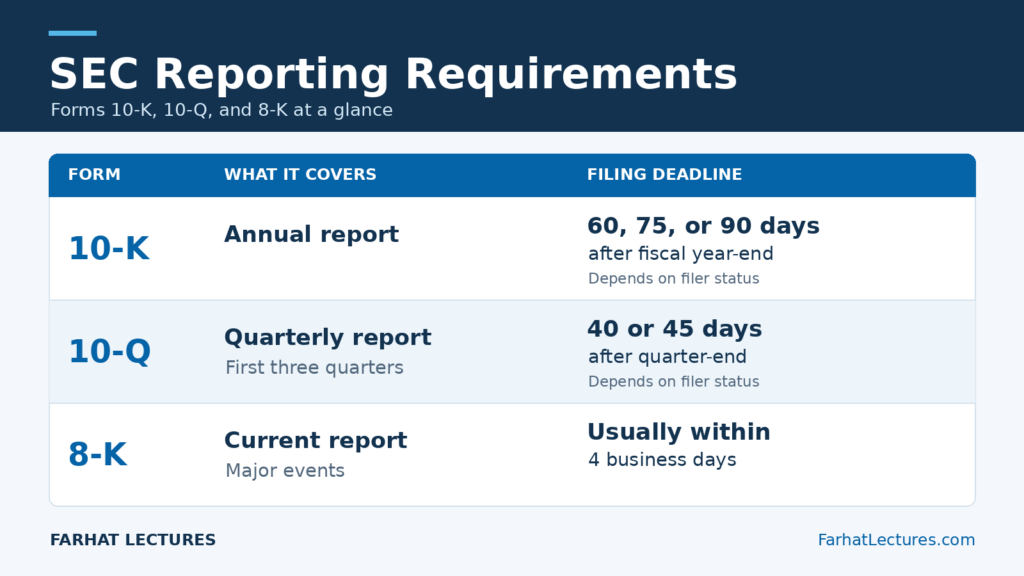
SEC reporting requirements are the disclosure rules that public companies must follow under the Securities Exchange Act of 1934. Most U.S. public companies file an annual report on Form 10-K, quarterly reports on Form 10-Q, and current reports on Form 8-K within four business days of major events. Foreign private issuers generally use Forms 20-F or 40-F and 6-K instead.
In this guide, you’ll learn what goes into each form, when each one is due, and the exam traps that trip up CPA candidates.
Watch: SEC Reporting Requirements Explained (17-Minute Lecture)
Prefer to watch? In this lecture, Professor Farhat walks through Forms 10-K, 10-Q, 8-K, 20-F, and 40-F, and explains how the Securities Act of 1933 differs from the Securities Exchange Act of 1934.
Jump to a topic:
- 0:00 Why SEC reporting matters for CPA candidates
- 0:36 Form 10-K: annual report, structure, and audit requirements
- 3:11 Form 10-Q: quarterly filings and unaudited financial statements
- 5:06 Form 8-K: triggering events like mergers and leadership changes
- 6:41 Forms 20-F and 40-F for foreign issuers
- 8:31 Securities Act of 1933 vs. Securities Exchange Act of 1934
- 12:46 How these topics show up on the CPA exam
- 16:01 Summary
Note: This lecture was recorded in 2021. Use the written explanations and linked SEC form instructions alongside the video, particularly when reviewing disclosures that have changed since the recording.
What Are SEC Reporting Requirements?
SEC reporting requirements are a set of mandatory filings that public companies, certain company insiders, and broker-dealers must submit to the U.S. Securities and Exchange Commission.
The requirements come from two federal laws. The Securities Act of 1933 governs the first sale of securities to the public, which is why a company files a registration statement, such as Form S-1, before an IPO. The Securities Exchange Act of 1934 created the SEC and requires ongoing reports once a company is public. Want the bigger picture? See our lecture on the role of the SEC.
A company must file periodic reports if it has securities registered under Section 12 of the Exchange Act. That happens when its securities are listed on a national exchange like the NYSE or Nasdaq, or when it has more than $10 million in total assets and a class of equity held of record by 2,000 or more people (or 500 or more people who are not accredited investors). Companies that sold securities in an SEC-registered offering also report under Section 15(d).
Two SEC rulebooks control what goes into the filings. Regulation S-X sets the form and content of the financial statements. Regulation S-K covers everything else, such as the business description, risk factors, and MD&A (management’s discussion and analysis).
Why Do SEC Reports Matter to Investors?
SEC reports are invaluable resources for investors. They provide a transparent view of a company’s financial status, strategic direction, and operational risks. By analyzing these reports, investors can make more informed decisions, assess investment risks, and identify opportunities.
Key SEC Filings at a Glance
Here’s how the main filings compare. Each one is explained in detail below.
| Form | What it is | When it’s due | Financial statement assurance |
|---|---|---|---|
| 10-K | Annual report with a full picture of the business and audited financial statements | 60, 75, or 90 days after fiscal year-end, depending on filer status | Audited financial statements |
| 10-Q | Quarterly report for the first three quarters | 40 or 45 days after quarter-end, depending on filer status | Unaudited; independent auditor review required |
| 8-K | Current report on major events | Usually within 4 business days of the event | Not applicable |
| 20-F | Annual report for foreign private issuers | 4 months after fiscal year-end | Audited financial statements |
| 40-F | Annual report for eligible Canadian companies | No later than when the same documents are filed in Canada | Audited financial statements |
| 6-K | Report furnished by foreign private issuers to share information made public at home | Promptly after the information is made public | Not applicable |
| 3, 4, and 5 | Ownership reports by officers, directors, and owners of more than 10% | Generally: Form 3 within 10 days of becoming a reporting person; Form 4 within 2 business days of a reportable transaction; Form 5 within 45 days after fiscal year-end, when required | Not applicable |
What Is Form 10-K? (The Annual Report)
Form 10-K is a comprehensive annual report that publicly traded companies must file with the U.S. Securities and Exchange Commission (SEC). It provides a detailed overview of the company’s financial performance, condition, and operations over the fiscal year. The 10-K is usually more detailed than the glossy annual report that many companies send to their shareholders, and it is a primary source of information for investors to understand and evaluate a company’s financial health and prospects. Form 10-K follows a fixed order set by the SEC. Part I covers the business, risk factors, cybersecurity, properties, and legal proceedings. Part II covers the market for the company’s stock, MD&A, market risk, the financial statements, and controls and procedures. Part III covers directors, executive pay, stock ownership, related party transactions, and auditor fees. Part IV lists the exhibits and financial statement schedules. Here’s a closer look at the sections students see most often:
1. Business Overview
- Description: It provides a detailed description of the company’s main operations, including its products or services, markets, distribution channels, and competitive conditions. It may also discuss recent developments, such as mergers, acquisitions, or divestitures, and the company’s strategy for growth.
- Purpose: It helps investors understand the company’s business model, the markets it operates in, and its competitive landscape.
2. Risk Factors
- Description: Describes the material risks that make an investment in the company speculative or risky, grouped under relevant headings. These risks can be economic, industry-specific, or company-specific. The SEC discourages generic risks that could apply to any company, and if this section runs longer than 15 pages, the company must add a short summary at the front.
- Purpose: Provides a transparent view of the challenges and uncertainties the company might encounter, allowing investors to make informed decisions.
Related item, Cybersecurity (Item 1C): For fiscal years ending on or after December 15, 2023, the 10-K also describes how the company assesses, identifies, and manages material cybersecurity risks, and how its board oversees those risks.
3. Selected Financial Data (No Longer Required)
- Description: Older 10-Ks included a five-year table of key numbers here. The SEC eliminated this requirement (Item 301 of Regulation S-K) in November 2020, and compliance became mandatory on August 9, 2021. Today, Item 6 of Form 10-K is simply marked ‘Reserved.’
- Purpose: If an older 10-K or textbook still shows Selected Financial Data, that is why. Trend information now lives in MD&A and in the financial statements themselves.
4. Management’s Discussion and Analysis of Financial Condition and Results of Operations (MD&A)
- Description: Provides management’s perspective on the financial results and condition of the company. It includes discussions on liquidity, capital resources, operating results, off-balance sheet arrangements, and any known trends or uncertainties that could impact the company’s future performance.
- Purpose: Gives investors insight into how the management views the company’s performance and prospects, including explanations of the factors that have impacted past performance and expectations for the future.
5. Financial Statements and Supplementary Data
- Description: Includes the audited financial statements (balance sheets, income statements, statements of comprehensive income, statements of cash flows, and statements of shareholders’ equity) along with the independent auditor’s report. Most companies present two years of balance sheets and three years of the other statements, while smaller reporting companies present two years of each. Notes to the financial statements provide additional details on accounting policies, financial commitments, contingencies, and other financial information.
- Purpose: Forms the core of the financial disclosure, allowing investors to assess the company’s financial health, profitability, and cash flow situation in detail.
6. Controls and Procedures
- Description: Describes the company’s internal control over financial reporting and the effectiveness of these controls. It also includes management’s evaluation of the company’s disclosure controls and procedures.
- Purpose: Ensures that the company has adequate controls in place to provide reliable financial reports and that it has effective processes to identify and disclose material information timely.
Exam note: The CEO and CFO must personally certify the 10-K under Sections 302 and 906 of the Sarbanes-Oxley Act (SOX). Large accelerated and accelerated filers also need their auditor to attest to internal control over financial reporting under SOX Section 404(b). Non-accelerated filers and emerging growth companies are exempt from that auditor attestation.
7. Corporate Governance
- Description: Part III of the 10-K covers directors, executive officers and corporate governance, executive compensation, security ownership, related party transactions and director independence, and the fees paid to the outside auditor. Many companies incorporate this information by reference from their proxy statement, which the SEC allows if the proxy is filed within 120 days after fiscal year-end.
- Purpose: Offers insight into the company’s governance structure, practices, and the board’s role in overseeing the company.
8. Exhibits
- Description: Includes legal documents such as articles of incorporation, bylaws, contracts, agreements, and other documents referenced in the report.
- Purpose: Provides legal and regulatory context and details about the company’s operations, agreements, and governance documents.
Want to see the official item list? The SEC’s Form 10-K instructions show every item in order, and you can pull any company’s real 10-K from EDGAR.
For further study, explore Farhat Lectures’ Intermediate Accounting course and our CPA exam review courses.
What Is Form 10-Q? (The Quarterly Report)
Form 10-Q is a quarterly report filed by publicly traded companies with the U.S. Securities and Exchange Commission (SEC). It provides a continuous view of a company’s financial position and operations during its fiscal year. Unlike the annual Form 10-K, which offers a comprehensive overview of the company’s performance over the entire year, the 10-Q provides updates on the company’s financial and operational progress for each of the first three quarters of its fiscal year. Here’s a detailed breakdown of the key sections and components of Form 10-Q:
1. Financial Statements
- Description: Condensed financial statements that include the balance sheet, income statement, statement of comprehensive income, statement of cash flows, and an analysis of changes in stockholders’ equity. They are unaudited, but the company’s independent auditor must review them before the 10-Q is filed. A review is much narrower than an audit and gives only limited assurance.
- Purpose: Enables investors to monitor the company’s financial performance and condition quarterly, providing a more timely view than annual reports.
2. Management’s Discussion and Analysis of Financial Condition and Results of Operations (MD&A)
- Description: This section provides management’s narrative analysis of the financial condition and operational results for the quarter. It covers aspects such as significant changes in revenues or expenses, liquidity, capital resources, and any known trends or uncertainties that the company may face.
- Purpose: Gives investors insight into the company’s performance from management’s perspective, including explanations for changes in financial results and potential future risks and opportunities.
3. Quantitative and Qualitative Disclosures About Market Risk
- Description: Discusses exposure to market risk, such as interest rate, foreign currency exchange rate, commodity price risks, and how the company manages these risks. This may include the use of financial instruments and hedging activities.
- Purpose: Provides information on how market risks could affect the company’s financial position or operations and what measures are being taken to mitigate those risks.
4. Controls and Procedures
- Description: Reports management’s conclusion on whether the company’s disclosure controls and procedures were effective at the end of the quarter. This includes any changes in internal control over financial reporting that have materially affected or are reasonably likely to materially affect, the company’s internal control over financial reporting.
- Purpose: Ensures that the information reported is accurate and that the company has adequate controls in place for financial reporting and disclosure.
5. Legal Proceedings
- Description: A brief description of any significant legal proceedings to which the company or its subsidiaries are a party, or of which any of their property is the subject.
- Purpose: Inform investors about potential or ongoing legal issues that could have a significant impact on the company’s financial health or operations.
6. Risk Factors (Material Changes Only)
- Description: Companies must disclose any material changes to the risk factors in their most recent 10-K. If nothing material has changed, they can say so instead of repeating the full list. Smaller reporting companies are not required to provide this item.
- Purpose: Keep investors informed of any new or evolving risks that could affect the company’s performance or financial condition.
Good to know: There is no 10-Q for the fourth quarter. Fourth-quarter results are covered by the annual 10-K.
What Is Form 8-K? (The Current Report)
Form 8-K is a crucial document filed by publicly traded companies in the United States to announce significant events that shareholders and the Securities and Exchange Commission (SEC) should be aware of. This form is known as a “current report” and it is used to communicate events that could affect the company’s financial situation and could be of interest to investors or require immediate disclosure. Unlike the annual 10-K or the quarterly 10-Q reports, Form 8-K is filed on an as-needed basis, providing timely information about major corporate events. Here’s a deeper look into Form 8-K and its key components:
Video: Form 8-K In The Full Lecture
Want to hear Form 8-K explained? In the full lecture near the top of this page, Professor Farhat covers Form 8-K starting at 5:06, including triggering events like mergers and leadership changes. You can also jump straight to that part on YouTube.
1. Purpose and Importance
Form 8-K serves to keep the public informed on a timely basis of significant corporate events. The purpose is transparency, ensuring that all investors have access to important information simultaneously, which is crucial for fair trading. Events reported in an 8-K can significantly impact the company’s stock price, investor perception, and market position.
2. Triggering Events
The SEC has outlined specific events that necessitate the filing of Form 8-K. These events are categorized into several items, reflecting the diverse nature of information that can affect a company’s financial status or operational outlook. Some of the key triggering events include, but are not limited to:
- Item 1.01, Entry into a Material Definitive Agreement: The company signs a material contract (one a reasonable investor would consider important) outside the ordinary course of business. Item 1.02 covers terminating one.
- Item 1.03, Bankruptcy or Receivership: The company files for bankruptcy or a receiver is appointed.
- Item 1.05, Material Cybersecurity Incidents: The company determines that a cybersecurity incident is material.
- Item 2.01, Completion of Acquisition or Disposition of Assets: The company closes a significant purchase or sale of assets outside the ordinary course of business. Signing the deal is reported separately under Item 1.01 if the agreement is material.
- Item 2.02, Results of Operations and Financial Condition: The company publicly releases results for a completed quarter or year, such as its regular earnings press release.
- Item 2.06, Material Impairments: The company concludes that a material impairment charge is required under U.S. GAAP.
- Item 4.01, Changes in Registrant’s Certifying Accountant: The company’s outside auditor resigns, declines to stand for reelection, or is dismissed.
- Item 4.02, Non-Reliance on Previously Issued Financial Statements: The company or its auditor concludes that previously issued financial statements should no longer be relied on, which usually signals a restatement.
- Item 5.01, Changes in Control of Registrant: A change in control of the company occurs.
- Item 5.02, Departure or Appointment of Directors and Certain Officers: A director leaves or is elected, or a principal officer such as the CEO or CFO leaves or is appointed. This item also covers certain compensation arrangements.
- Item 5.03, Amendments to Articles of Incorporation or Bylaws; Change in Fiscal Year: The company changes its governing documents or its fiscal year.
- Item 5.07, Submission of Matters to a Vote of Security Holders: The company reports the voting results from a shareholder meeting.
- Item 7.01, Regulation FD Disclosure: The company uses an 8-K to share material information publicly under Regulation Fair Disclosure (Regulation FD), the rule that bans sharing material nonpublic information with only select investors or analysts.
- Item 8.01, Other Events: Any other event the company chooses to report because it considers it important to shareholders.
- Item 9.01, Financial Statements and Exhibits: Financial statements and exhibits that go with other items, such as the financial statements of an acquired business.
3. Filing Deadlines
Most Form 8-K items are due within four business days after the triggering event. If the event happens on a weekend or holiday when the SEC is closed, the four-day count starts on the next business day. A few items work differently. A material cybersecurity incident (Item 1.05) is due four business days after the company determines the incident is material, not four days after it happens. When a company completes a significant acquisition, the 8-K is still due in four business days, but the acquired business’s financial statements can be filed later by amendment, up to 71 calendar days after the original 8-K was due. Regulation FD disclosures can be due even sooner, because Regulation FD requires public disclosure at the same time as, or promptly after, a selective disclosure.
4. Sections and Items
Form 8-K is organized into nine numbered sections, and each section contains specific items. For example, Section 1 covers the company’s business and operations (Items 1.01 to 1.05), Section 2 covers financial information (Items 2.01 to 2.06), and Section 9 covers financial statements and exhibits (Item 9.01). Each item has its own disclosure requirements, so what goes into an 8-K depends on which item is triggered. The company lists every item that applies and attaches any required exhibits, such as the press release for an earnings announcement. You can see the full item list in the SEC’s Form 8-K instructions.
5. Amendments and Updates
Companies may amend a previously filed 8-K to update information or correct inaccuracies. Amendments are filed as a new 8-K, designated as an amendment (e.g., Form 8-K/A), to provide the updated information.
What Are Forms 20-F, 40-F, and 6-K? (Foreign Companies)
- Purpose: Foreign private issuers (non-U.S. companies that meet SEC tests on U.S. ownership and U.S. business ties) file an annual report on Form 20-F or Form 40-F instead of Form 10-K. Form 20-F is available to any foreign private issuer, including Canadian companies. Form 40-F is limited to eligible Canadian companies under the Multijurisdictional Disclosure System (MJDS), a U.S.-Canada arrangement that generally requires at least 12 months of reporting in Canada and a public float of at least US$75 million.
- Contents: Form 20-F includes audited financial statements, an operating and financial review (similar to MD&A), risk factors, and governance disclosures, and it is due four months after fiscal year-end. The financial statements can follow U.S. GAAP, IFRS as issued by the IASB (with no reconciliation to U.S. GAAP), or home-country GAAP with a reconciliation to U.S. GAAP. Form 40-F mostly wraps the company’s Canadian documents, such as its annual information form, audited financial statements, and MD&A.
Interim and current reports: Foreign private issuers do not file Forms 10-Q or 8-K. Instead, they furnish Form 6-K to share information they make public in their home country, such as interim results.
SEC Filing Deadlines by Filer Status
How fast a company must file its 10-K and 10-Q depends on its filer status, which is based mostly on public float. Public float is the market value of the company’s common stock held by non-affiliates (investors other than officers, directors, and controlling shareholders), measured on the last business day of its second fiscal quarter.
| Filer status | General public-float entry thresholds* | Form 10-K due | Form 10-Q due |
|---|---|---|---|
| Large accelerated filer | $700 million or more | 60 days after fiscal year-end | 40 days after quarter-end |
| Accelerated filer | $75 million to under $700 million | 75 days after fiscal year-end | 40 days after quarter-end |
| Non-accelerated filer | Generally under $75 million, or otherwise excluded from accelerated filer status* | 90 days after fiscal year-end | 45 days after quarter-end |
*The table summarizes general entry thresholds; public float alone does not determine filer status. Reporting history, smaller reporting company eligibility, revenue tests, and separate transition and exit thresholds also matter. An accelerated or large accelerated filer generally must have been reporting for at least 12 months and filed at least one annual report. An issuer eligible to be a smaller reporting company under the revenue test is excluded from accelerated and large accelerated filer status. Consult Exchange Act Rule 12b-2 when classifying an actual issuer.
Worked example: Maple Corp. is an accelerated filer with a December 31 fiscal year-end. Its 10-K is due 75 days after December 31. January has 31 days and February has 28 in a non-leap year, so day 59 is February 28 and day 75 is March 16. Its first-quarter 10-Q is due 40 days after March 31. April has 30 days, so day 40 is May 10. If a due date falls on a weekend or federal holiday, it moves to the next business day.
Other deadlines to know:
- Form 8-K: usually within 4 business days of the triggering event.
- Form 20-F: 4 months after fiscal year-end.
- Forms 3, 4, and 5: generally, Form 3 is due within 10 days of becoming a reporting person (or by the effective date of registration when applicable); Form 4 is due within 2 business days of a reportable transaction; and Form 5 is due within 45 days after fiscal year-end only when required. Exemptions and special reporting rules apply.
- Late filings: Form 12b-25 generally must be filed no later than one business day after the original deadline. A report may be deemed timely if the registrant satisfies Rule 12b-25 and files within 15 calendar days after the original 10-K deadline or 5 calendar days after the original 10-Q deadline. Filing the notification alone does not provide an unconditional extension. The registrant must explain why timely filing could not be accomplished without unreasonable effort or expense and satisfy the other applicable conditions. See the Form 12b-25 instructions.
Exam Traps and Common Student Mistakes
On the CPA exam, SEC reporting requirements are tested mainly in the BAR (Business Analysis and Reporting) discipline section, which covers select FASB and SEC reporting requirements. These are the mistakes students make most often:
- Giving accelerated filers 45 days for a 10-Q. Large accelerated and accelerated filers both get 40 days. Only non-accelerated filers get 45.
- Calling 10-Q financial statements audited. They are reviewed by the auditor, not audited.
- Looking for a fourth-quarter 10-Q. There isn’t one. Fourth-quarter results are covered by the 10-K.
- Counting 8-K deadlines in calendar days. The standard deadline is four business days.
- Mixing up ‘filed’ and ‘furnished.’ Earnings releases under Item 2.02 and Regulation FD disclosures under Item 7.01 are furnished, so they don’t carry the same liability under Section 18 of the Exchange Act as filed documents.
- Memorizing Selected Financial Data as a 10-K item. The SEC eliminated it, and Item 6 is now reserved.
- Assuming foreign companies file 10-Qs and 8-Ks. Foreign private issuers file an annual Form 20-F or 40-F and furnish Form 6-K for other information.
Practice question: Northfield Inc., a large accelerated filer, learns on a Tuesday that its outside auditor has resigned. What must Northfield file, and when is it due?
Answer: Northfield must file a Form 8-K under Item 4.01, Changes in Registrant’s Certifying Accountant, within four business days. Counting Wednesday, Thursday, Friday, and Monday, it is due the following Monday, assuming no federal holidays that week. General Instruction B.3 of Form 8-K permits certain events occurring within four business days before a periodic report is filed to be disclosed in that report instead. That substitution is not available for Items 4.01 and 4.02. Therefore, Northfield must report this auditor change on Form 8-K even if it files its 10-Q or 10-K during that interval.
Key Takeaways
- SEC reporting requirements come mainly from the Securities Exchange Act of 1934. The Securities Act of 1933 covers registering new offerings.
- Form 10-K is the audited annual report, due 60, 75, or 90 days after fiscal year-end depending on filer status.
- Form 10-Q covers the first three quarters. Its financial statements are reviewed, not audited, and it is due 40 or 45 days after quarter-end.
- Form 8-K reports major events, usually within four business days.
- Foreign private issuers file Form 20-F or 40-F each year and furnish Form 6-K for other information.
- Selected Financial Data is no longer a required Form 10-K item. Use SEC form instructions to distinguish required disclosures from material in older lectures and textbooks.
Frequently Asked Questions About SEC Reporting Requirements
When is Form 10-K due?
The general deadlines are 60 days for large accelerated filers, 75 days for accelerated filers, and 90 days for non-accelerated filers after fiscal year-end. Public float alone does not establish filer status; see the qualifications below the deadline table.
Does Form 12b-25 automatically extend a filing deadline?
No. A timely notification and satisfaction of Rule 12b-25’s other conditions may allow a 10-K filed within 15 calendar days, or a 10-Q filed within 5 calendar days, after its original deadline to be deemed timely.
Is Form 10-Q audited?
No. Its interim financial statements are unaudited, but an independent auditor must review them before filing. A review provides limited assurance and is narrower in scope than an audit.
Is there a 10-Q for the fourth quarter?
No. Form 10-Q covers the first three fiscal quarters. Fourth-quarter results are covered by the annual Form 10-K.
Are all Form 8-K disclosures due within four business days?
No. Four business days is the usual deadline, but some items have different triggers or timing. For example, Item 1.05 generally runs from the determination that a cybersecurity incident is material, and Regulation FD may require earlier public disclosure.
Must every insider file Form 5 each year?
No. Form 5 is required only when the person has transactions or holdings that must be reported on that form. When required, its general deadline is 45 days after fiscal year-end. Forms 3 and 4 have separate reporting rules.
What is the difference between Regulation S-X and Regulation S-K?
Regulation S-X addresses the form and content of financial statements. Regulation S-K addresses other required disclosures, including the business, risk factors, MD&A, and executive compensation.
Where can students find actual SEC reports?
Search the SEC’s free EDGAR database by company name or ticker, then compare a company’s 10-K, 10-Q, and 8-K filings with the forms described above.
Keep Learning With Farhat Lectures
If you’re studying for the BAR section of the CPA exam, these lessons go deeper:
- Regulation S-X lesson, covering the form and content of SEC financial statements
- The role of the SEC and how it oversees public companies
- The SEC’s role in auditing, for AUD candidates
- Practice test: interim reporting, SEC, and reportable segments
New to Farhat Lectures? Try the free sample course to see how the lessons work before you commit.
About the Author
Mansour Farhat, CPA, CIA, DBA, is an accounting professor who teaches financial accounting, auditing, and CPA exam topics through Farhat Lectures and its YouTube channel. Official SEC form instructions are linked throughout the article for further study.




Responses