
Long-Term Contract Losses: Current-Period Loss vs. Unprofitable Contract

Last updated: 20 November 2026
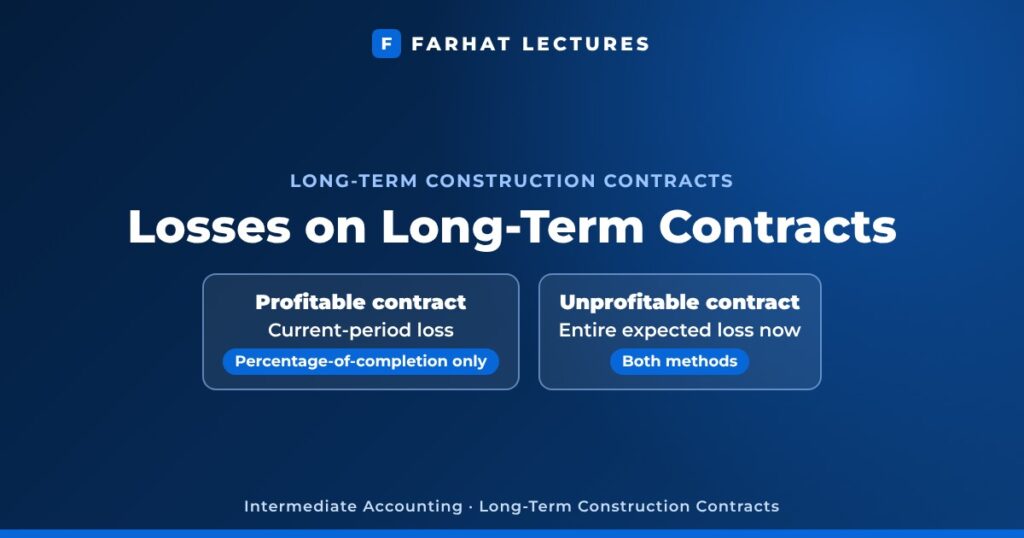
A profitable long-term construction contract can show a current-period loss under percentage-of-completion when revised cumulative gross profit falls below the gross profit already recognized. The loss is the difference between those two amounts. When a construction contract within the scope of ASC 605-35 is expected to be unprofitable overall, both percentage-of-completion and cost-recovery recognize the entire expected contract loss as soon as it becomes evident, as ASC 605-35-25-46 requires.
Why does this matter? This lesson supports the revenue recognition topic in FAR Area III, Select Transactions, of the AICPA CPA Exam Blueprints. Knowing which type of loss you are looking at tells you what to calculate and record in the current period.
This guide follows Appendix 17A, Long-Term Construction Contracts, in Kieso, Weygandt and Warfield’s Intermediate Accounting, 18th edition. If you are using the 17th edition, the same material is Appendix 18A. It assumes you already know the percentage-of-completion method and the cost-recovery method.
Watch: Percentage of Completion Method: Losses Scenarios
Watch this Farhat lesson on YouTube
This video starts at 0:33, where Professor Farhat separates a loss in the current period on a profitable contract from a loss on an unprofitable contract, then works through journal entries and Construction in Process adjustments for each.
The two types of long-term contract losses
| Feature | Loss in current period (profitable contract) | Loss on an unprofitable contract |
|---|---|---|
| What happened | The contract remains profitable overall, but revised cumulative gross profit is below the gross profit already recognized | Estimated total costs now exceed the contract price |
| Percentage-of-completion | Record the difference as a current-period loss to bring cumulative gross profit in line with the revised estimate | Reverse all prior profit and recognize the entire expected loss now |
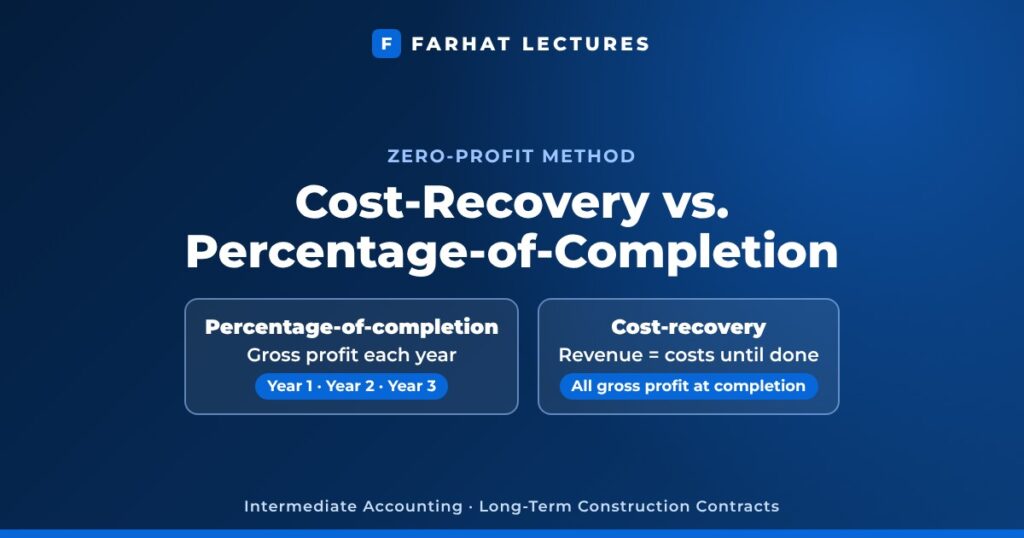
| Cost-recovery (also called the zero-profit method; see also the completed contract method) | No loss, because no profit was recognized earlier | Recognize the entire expected loss now |
| Why | Change in accounting estimate, handled in the current period | Foreseeable losses are recognized as soon as they are evident |
The rule for unprofitable contracts sits in FASB ASC 605-35-25-46, which says that when current estimates of consideration and contract cost indicate a loss, a provision for the entire loss on the contract shall be made. ASC 606 itself has no loss contract guidance. When the FASB issued ASC 606 it deliberately kept the old loss provision rule for construction-type and production-type contracts in Subtopic 605-35, a decision it explained in Accounting Standards Update 2016-20. One detail worth knowing for the exam: ASC 605-35 lets a company elect whether to measure the loss at the contract level or at the performance obligation level.
The starting point: Year 1 results
Hypothetical example. Harbor Point Builders has a $6,000,000 contract to build a parking garage. At the end of Year 1, it had incurred $1,440,000 of costs against an estimated total of $4,800,000. The contract was 30% complete, so it recognized $1,800,000 of revenue and $360,000 of gross profit. Both scenarios below change only the Year 2 facts.
Loss in the current period on a profitable contract
Suppose that at the end of Year 2, costs to date are $3,420,000 and estimated costs to complete are $2,280,000. Total estimated costs rise to $5,700,000, which is still below the $6,000,000 price, so the contract remains profitable.
| Step | Amount |
|---|---|
| Percent complete ($3,420,000 ÷ $5,700,000) | 60% |
| Revenue to date (60% × $6,000,000) | $3,600,000 |
| Less: revenue recognized in Year 1 | ($1,800,000) |
| Revenue recognized in Year 2 | $1,800,000 |
| Costs incurred in Year 2 | ($1,980,000) |
| Loss recognized in Year 2 | ($180,000) |
Year 1 recognized $360,000 of profit, but with the new estimate the profit earned through Year 2 is only $180,000. The $180,000 loss in Year 2 corrects that difference in the current period rather than restating Year 1.
The journal entries in these worked examples use the textbook’s Construction in Process account to illustrate how the loss is recorded.
| Account | Debit | Credit |
|---|---|---|
| Construction Expenses | $1,980,000 | |
| Construction in Process (loss) | $180,000 | |
| Revenue from Long-Term Contracts | $1,800,000 |
Under the cost-recovery method, no loss is recorded in Year 2. The company never recognized the Year 1 profit, and it still expects an overall profit of $300,000.
There is still a Year 2 entry under cost-recovery, it just shows nothing on the bottom line. Revenue equals the $1,980,000 of costs incurred during the year, construction expense equals the same $1,980,000, and the profit for the year is zero.
Loss on an unprofitable contract
Now suppose instead that at the end of Year 2, costs to date are $3,520,000 and estimated costs to complete are $2,880,000. Total estimated costs are $6,400,000, which exceeds the contract price by $400,000. The contract will lose money.
Under percentage-of-completion, Harbor Point must recognize a total loss in Year 2 of $760,000: the reversal of the $360,000 Year 1 profit plus the $400,000 expected loss on the whole contract.
| Step | Amount |
|---|---|
| Percent complete ($3,520,000 ÷ $6,400,000) | 55% |
| Revenue to date (55% × $6,000,000) | $3,300,000 |
| Less: revenue recognized in Year 1 | ($1,800,000) |
| Revenue recognized in Year 2 | $1,500,000 |
| Add: total loss recognized in Year 2 | $760,000 |
| Construction expense for Year 2 | $2,260,000 |
Notice that construction expense is no longer equal to the costs incurred in Year 2. Harbor Point actually spent $2,080,000 in Year 2, which is the $3,520,000 of costs to date less the $1,440,000 spent in Year 1. The expense on the income statement is $2,260,000 instead. The extra $180,000 is a provision for the loss on the work that is not finished yet, which is 45% of the $400,000 total loss. In other words, expense is worked out backwards from revenue plus the loss you have to show, rather than forwards from what you spent.
| Account | Debit | Credit |
|---|---|---|
| Construction Expenses | $2,260,000 | |
| Construction in Process (loss) | $760,000 | |
| Revenue from Long-Term Contracts | $1,500,000 |
After this entry, Construction in Process is $3,120,000: total costs of $3,520,000 less the $400,000 cumulative loss. Under the cost-recovery method, the company also recognizes the $400,000 expected loss in Year 2:
| Account | Debit | Credit |
|---|---|---|
| Loss from Long-Term Contracts | $400,000 | |
| Construction in Process (loss) | $400,000 |
If the remaining costs come in as estimated, Year 3 shows no further loss. Harbor Point spends the last $2,880,000, bringing total costs to $6,400,000, and recognizes the remaining $2,700,000 of revenue to reach the full $6,000,000 contract price. The whole $400,000 loss was already on the books in Year 2, so Year 3 adds nothing to it. That is the point of recognizing the full loss as soon as you can see it coming.
Where the loss appears on the balance sheet
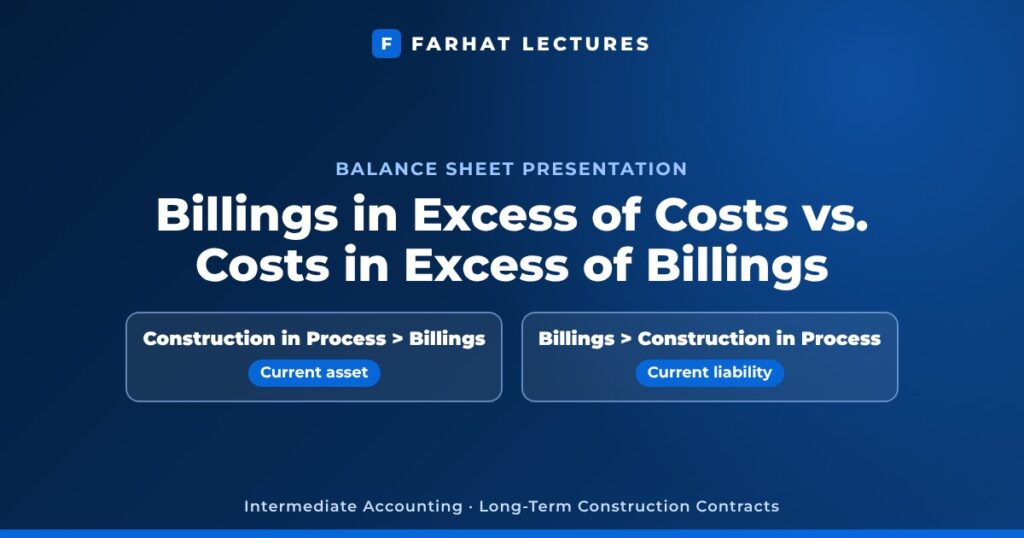
For financial statement presentation, a significant contract loss provision is generally reported separately as a current liability. If the contractor has accumulated costs on the balance sheet for the same contract or performance obligation, it may present the provision as a reduction of those accumulated costs under ASC 605-35-45-2. For more on these positions, see billings in excess of costs vs. costs in excess of billings. If you are working in ASC 606 language rather than textbook language, our guide to contract assets, contract liabilities and receivables covers how the same balances get presented.
Key takeaways
- There are two different long-term contract losses, and the first thing to do is work out which one you have.
- A profitable contract shows a current-period loss under percentage-of-completion only when revised cumulative gross profit is below gross profit already recognized. The loss equals gross profit already recognized minus revised cumulative gross profit.
- A contract that is now expected to lose money produces an immediate loss under both methods.
- Under percentage-of-completion, the loss on an unprofitable contract equals all prior profit recognized plus the total expected loss on the contract.
- On an unprofitable contract, construction expense equals revenue recognized plus the loss recognized, not the costs incurred during the year.
- A revised cost estimate is a change in accounting estimate. You handle it in the current period, and you never restate prior years.
Common mistakes
- Recognizing only a percentage of the expected loss. On an unprofitable contract, the full expected loss is recognized at once.
- Forgetting to reverse prior profit. The total Year 2 loss is prior profit plus the expected loss.
- Recording a current-period loss under cost-recovery when the contract is still profitable. There is no prior profit to reverse, so there is nothing to record. On an unprofitable contract, cost-recovery does record the full expected loss.
- Setting expense equal to costs incurred. On an unprofitable contract, expense equals revenue plus the loss.
Long-Term Contract Losses Practice Quiz
When Are Losses on Long-Term Construction Contracts Recognized?
Compare how the percentage-of-completion and cost-recovery methods treat revised cost estimates when a construction contract remains profitable or is expected to result in an overall loss. Select one answer per scenario, then check your work before moving to the worked practice questions below.
Practice questions with answers
1. A $1,000,000 contract recognized $50,000 of gross profit in Year 1. In Year 2, estimated total costs rise to $1,040,000. What loss is recognized in Year 2 under percentage-of-completion?
Answer: $90,000. Reverse the $50,000 Year 1 profit and recognize the $40,000 expected loss on the contract.
2. Under percentage-of-completion, cumulative gross profit was $80,000 at the end of Year 1. With revised estimates, cumulative gross profit through Year 2 is $60,000, and the contract is still profitable. What is reported for Year 2 under each method?
Answer: A $20,000 loss under percentage-of-completion and no gross profit or loss under cost-recovery.
3. A company using cost-recovery learns that a contract will lose $25,000 overall. When is the loss recognized?
Answer: Immediately, in the current period. The full $25,000 expected loss is recognized under both methods.
Frequently asked questions
How do you account for a loss on a long-term contract?
A profitable contract shows a current-period loss under percentage-of-completion only if revised cumulative gross profit is below the gross profit already recognized. If a construction contract within the scope of ASC 605-35 is expected to be unprofitable overall, both methods recognize the entire expected contract loss as soon as it becomes evident.
Why is the entire expected loss recognized immediately?
Accounting anticipates foreseeable losses so that current and future income are not overstated. The rule for construction-type contracts is in ASC 605-35.
Does the cost-recovery method ever show a current-period loss on a profitable contract?
No. Because no profit was recognized in earlier years, there is nothing to reverse.
Is a cost estimate revision a change in accounting estimate?
Yes. It is handled in the current and future periods through a cumulative catch-up, not by restating prior years.
Where is an estimated contract loss reported?
A significant contract loss provision is generally reported separately as a current liability. If related contract costs are accumulated on the balance sheet, the provision may be presented as a reduction of those costs.
What is the journal entry for a loss on an unprofitable contract?
Under percentage-of-completion in the example above, debit Construction Expenses $2,260,000, credit Construction in Process $760,000, and credit Revenue from Long-Term Contracts $1,500,000. Under cost-recovery, debit Loss from Long-Term Contracts $400,000 and credit Construction in Process $400,000.
Does ASC 606 contain the rule for loss contracts?
No. ASC 606 has no loss contract guidance. The FASB kept the old rule for construction-type and production-type contracts in Subtopic 605-35, at ASC 605-35-25-46, when it issued ASC 606.
Why is construction expense not equal to the costs incurred in the loss year?
Because expense is set equal to revenue plus the loss you have to show. In the example, $1,500,000 of revenue plus the $760,000 loss gives $2,260,000 of expense, while actual Year 2 costs were only $2,080,000. The extra $180,000 is the loss on work not yet done.
Continue learning with Farhat Lectures
Contract losses are one of those topics that click once you have watched someone work the entries out loud a few times. The free sample course walks through percentage-of-completion, cost-recovery and the loss scenarios step by step, with practice you can check your work against.
Explore the free sample course
Responses