
Billings in Excess of Costs vs. Costs in Excess of Billings: Balance Sheet Presentation

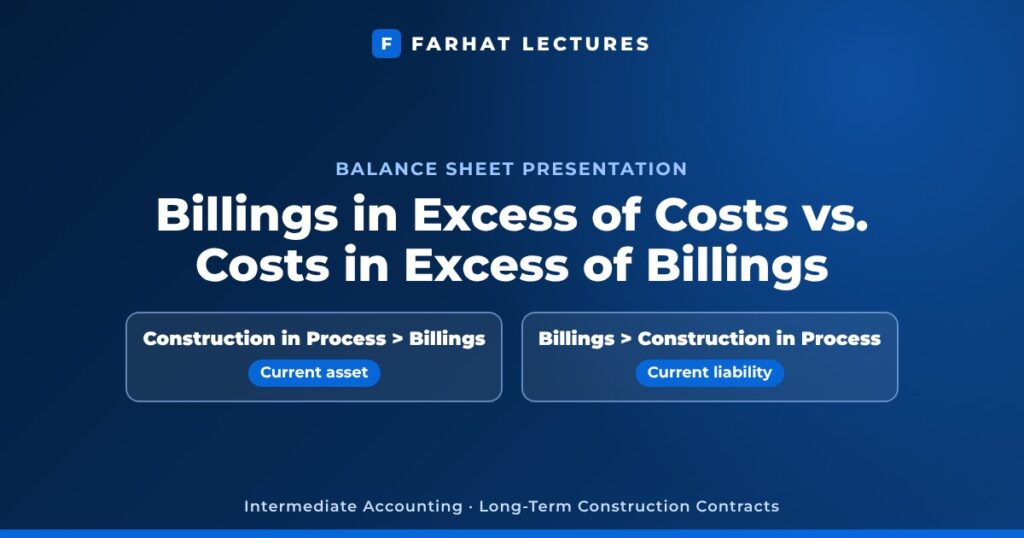
Billings in excess of costs is a current liability. It arises when a contractor has billed a customer more than the costs and gross profit it has recognized on that contract. Costs in excess of billings is the reverse, a current asset. You find both by comparing Construction in Process with Billings on Construction in Process, contract by contract.
Why does this matter? These two lines tell readers whether a contractor is ahead of or behind on invoicing its customers. They are also a frequent exam trap, because students try to report Construction in Process and Billings as two separate balance sheet items.
This guide supports Appendix 17A, Long-Term Construction Contracts, in Kieso’s Intermediate Accounting. It uses the numbers from the percentage-of-completion method example.
Watch: Contract Asset vs. Contract Liability vs. Receivable
Watch this Farhat lesson on YouTube
In this lesson, Professor Farhat explains the ASC 606 names for these balances. He explains how traditional construction billing balances relate to contract assets and contract liabilities, and when a right to payment becomes a receivable.
Why Construction in Process and Billings are netted
In a normal sale, a company records a receivable and removes the inventory. On a long-term contract, the builder keeps the project in Construction in Process until the customer accepts it, even though it has already billed part of the price. Reporting both the full inventory and the billed amount would count the same project twice.
To avoid that double-counting, Billings on Construction in Process is a contra account. Only the difference between the two balances is reported. Accounts Receivable is still reported separately, because it reflects billed amounts the customer has not yet paid.
One more thing worth knowing: overbilling is normal, not a warning sign. Most contractors set up a billing schedule that runs slightly ahead of the work so that incoming cash covers payroll and materials. A billings in excess of costs balance usually means the billing schedule is doing its job, not that something has gone wrong.
Costs in excess of billings vs. billings in excess of costs
| Situation | Balance sheet line | Classification | Plain-English meaning |
|---|---|---|---|
| Construction in Process > Billings | Costs and recognized profit in excess of billings | Current asset | The contractor has earned more than it has invoiced (unbilled revenue, or underbilling) |
| Billings > Construction in Process | Billings in excess of costs and recognized profit | Current liability | The contractor has invoiced more than it has earned (overbilling) |
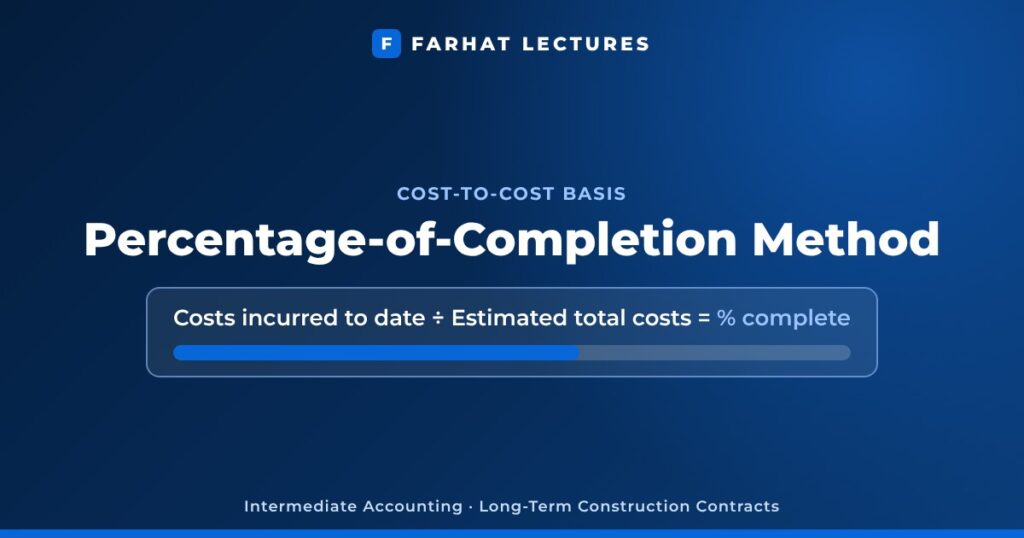
Under percentage-of-completion, Construction in Process equals revenue recognized to date, because it holds costs plus recognized gross profit. So a quick check is: revenue recognized to date minus billings to date.
Example: Harbor Point at the end of Years 1 and 2
Hypothetical example. Harbor Point Builders is building a $6,000,000 parking garage under the percentage-of-completion method. Revenue recognized to date is $1,800,000 at the end of Year 1 and $4,680,000 at the end of Year 2. Billings to date are $1,500,000 and $4,800,000, and cash collected to date is $1,200,000 and $4,200,000. Assume billings are due when issued and any right to payment for unbilled work remains conditional.
| Item | End of Year 1 | End of Year 2 |
|---|---|---|
| Construction in Process (costs + gross profit) | $1,800,000 | $4,680,000 |
| Less: Billings on Construction in Process | ($1,500,000) | ($4,800,000) |
| Net position | $300,000 asset | $120,000 liability |
| Accounts receivable (billed but not collected) | $300,000 | $600,000 |
At the end of Year 1, Harbor Point reports two current assets: accounts receivable of $300,000 and costs and recognized profit in excess of billings of $300,000. At the end of Year 2, it reports accounts receivable of $600,000 as a current asset and billings in excess of costs and recognized profit of $120,000 as a current liability.
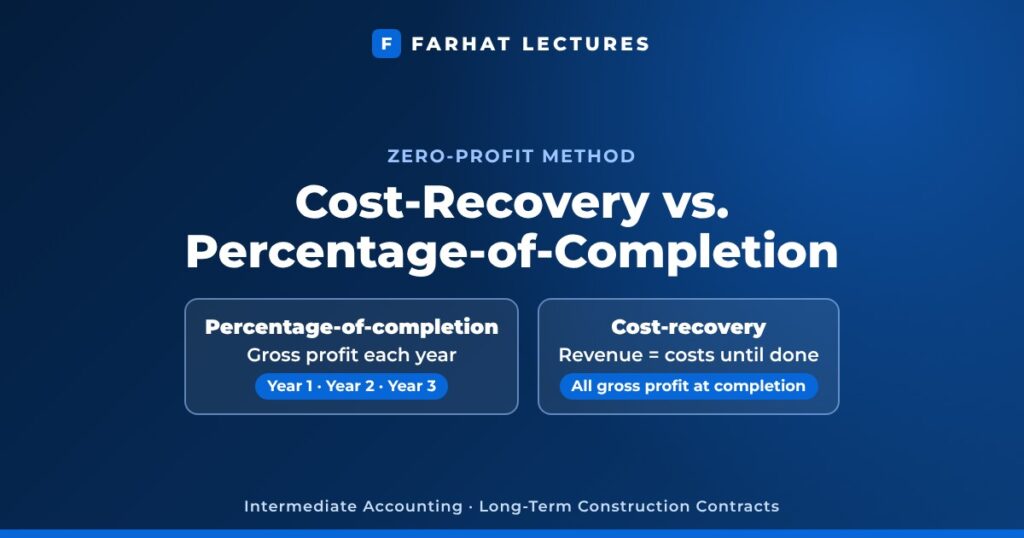
When the contract is complete and fully billed, the contractor closes Construction in Process and Billings against each other. Any amount still owed by the customer remains a receivable. Under ASC 606-10-25-37, if the contractor cannot reasonably measure progress on a performance obligation satisfied over time but expects to recover the costs incurred, it recognizes revenue only up to those costs. Once the contractor can reasonably measure progress, it applies the appropriate measure of progress and recognizes any resulting margin. This can happen before the job is complete. See the cost-recovery method lesson.
Presenting several contracts at once
Most contractors have many projects in progress. The net position is determined contract by contract. Contracts in an asset position are added together and reported as a current asset. Contracts in a liability position are added together and reported as a current liability. An asset on one contract is not offset against a liability on another.
| Contract | Net position | Reported in |
|---|---|---|
| Contract A | $300,000 asset | Current assets |
| Contract B | $120,000 liability | Current liabilities |
| Contract C | $50,000 asset | Current assets |
| Balance sheet | $350,000 asset and $120,000 liability | Not netted to $230,000 |
Showing separate totals for billings and costs in the notes is more informative than reporting only the net difference.
ASC 606 also asks companies to disclose the opening and closing balances of contract assets and contract liabilities, and how much of the revenue for the period came out of the opening contract liability balance. See the ASC 606 disclosure requirements lesson for the full list.
The ASC 606 names: contract asset and contract liability
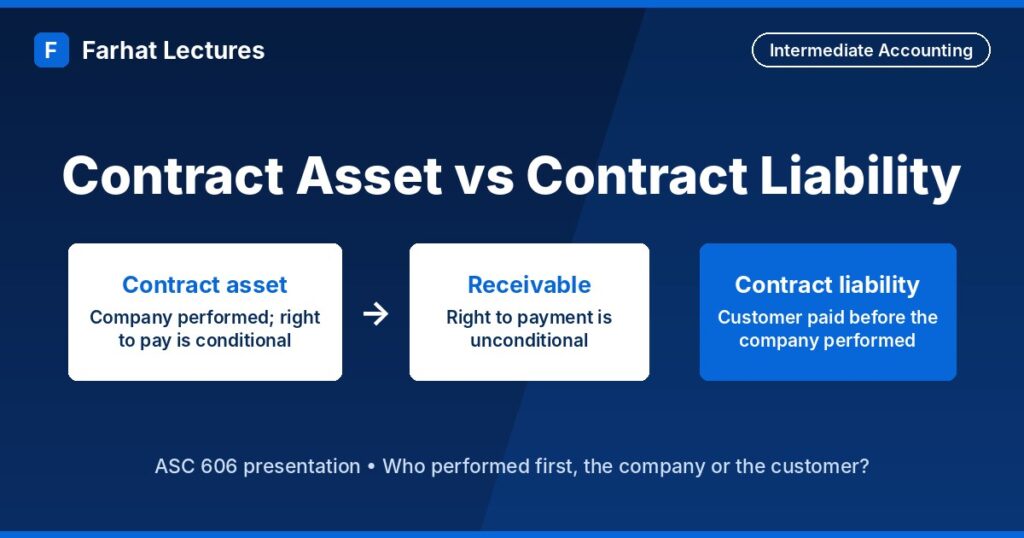
The Financial Accounting Standards Board (FASB), the body that writes U.S. accounting rules, uses broader terms in ASC 606. A contract asset is a right to payment for goods or services already transferred when that right still depends on something other than the passage of time. A receivable is an unconditional right to payment, even if the company has yet to issue the invoice. A contract liability arises when payment is received or becomes due before the company transfers the related goods or services. ASC 606-10-45-1 (free access via the FASB Codification) requires one net contract position and separate presentation of unconditional receivables, and implementation guidance confirms that positions on different contracts are not netted against each other. Construction companies often still use the traditional “costs in excess of billings” labels. For the general ASC 606 rules, including when a contract asset becomes a receivable, see contract asset vs. contract liability vs. receivable.
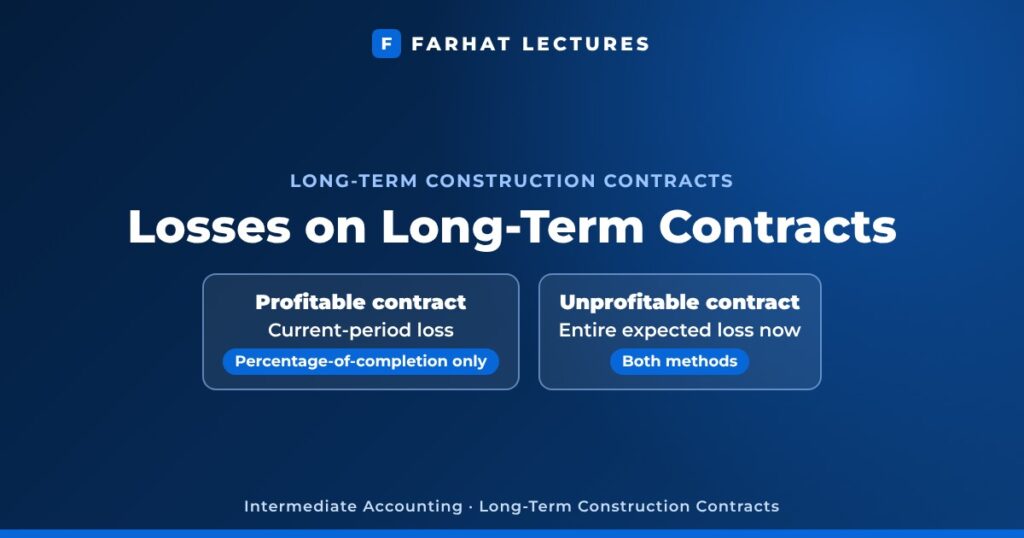
For a construction contract within ASC 605-35, the contractor recognizes the entire anticipated loss as soon as it becomes evident. Billings do not determine when the contractor recognizes that loss. See long-term contract losses.
What about retainage?
Retainage, sometimes called retention, is a portion of a progress payment the customer withholds under the contract. The contract may require the contractor to finish the work or obtain customer acceptance before payment becomes due.
If only the passage of time is required before payment is due, the right is unconditional and the retainage is a receivable. If payment still depends on completion, acceptance, or another condition, the retainage remains part of the net contract position. That position can be a contract asset or a contract liability.
Common mistakes
- Reporting Billings as a liability by itself. Billings is a contra account. Only the net difference is reported.
- Netting all contracts together. Determine the position for each contract, then total assets and liabilities separately.
- Confusing billings with collections. In the Harbor Point example, billings less collections gives accounts receivable. Comparing billings with cumulative recognized revenue gives the net contract position.
- Assuming all unbilled amounts are contract assets. A right to payment is a receivable once it becomes unconditional, even before invoicing.
- Treating retainage as automatically a receivable. Retainage is a receivable once the right to payment is unconditional. Until then it is part of the net contract position.
Interactive practice: classify the contract balances
How do contractors classify construction contract balances on the balance sheet? Compare billings to date with costs incurred plus recognized gross profit to date for each project. Then select the appropriate classification and presentation.
Use the dropdowns for the two classifications, then select one answer for each multiple-choice question.
Practice questions with answers
1. Construction in Process is $900,000 and Billings on Construction in Process is $750,000. What is reported?
Answer: A current asset of $150,000, costs and recognized profit in excess of billings.
2. Under percentage-of-completion, revenue recognized to date is $1,000,000 and billings to date are $1,100,000. What is reported?
Answer: A current liability of $100,000, billings in excess of costs and recognized profit.
3. A contractor has one contract in an $80,000 asset position and another in a $30,000 liability position. What appears on the balance sheet?
Answer: An $80,000 current asset and a $30,000 current liability. They are not netted to $50,000.
Key takeaways
- Billings in excess of costs is a current liability. The contractor has invoiced more than it has earned.
- Costs in excess of billings is a current asset. The contractor has earned more than it has invoiced.
- Compare Construction in Process with Billings on Construction in Process. Report only the difference.
- Under percentage-of-completion, Construction in Process equals revenue recognized to date, so revenue to date minus billings to date gives you the same answer.
- Work out the position one contract at a time. Add the assets together, add the liabilities together, and never offset one contract against another.
- Report unconditional rights to payment separately as receivables. In the Harbor Point example, receivables equal billings less collections.
How this shows up on the CPA exam
This topic sits in the Financial Accounting and Reporting (FAR) section of the CPA exam, under revenue recognition. Questions usually give you costs incurred, estimated total costs, billings, and collections, then ask for one number: the balance sheet amount and its classification. The trap is almost always the same. The question hands you a collections figure you do not need for the asset or liability answer, and needs only for accounts receivable. Work out the net position from billings, and use collections only when the question asks for receivables.
Want to practice this under exam conditions? Work through the FAR CPA test bank, or review the wider topic in the revenue recognition lesson.
Frequently asked questions
What does billings in excess of costs mean?
It means a contractor has billed its customer for more than the costs and gross profit it has recognized on the contract so far. It is reported as a current liability.
Is costs in excess of billings an asset or a liability?
In the construction example, it is a current asset because recognized revenue exceeds billings. Under ASC 606, a right to payment for work already performed is a contract asset when the right remains conditional. An unconditional right is a receivable, even before invoicing.
Is Billings on Construction in Process a liability?
No. It is a contra account to Construction in Process. Only the net difference between the two accounts is reported.
Can a company net asset and liability positions on different contracts?
No. Each contract is evaluated separately, and asset positions and liability positions are reported in separate totals.
What are these balances called under ASC 606?
In the Harbor Point example, costs in excess of billings correspond to a contract asset and billings in excess of costs correspond to a contract liability. ASC 606 presents unconditional rights to payment separately as receivables.
How do you calculate billings in excess of costs?
Take billings to date on the contract and subtract costs incurred plus gross profit recognized to date. If the answer is positive, that is your billings in excess of costs, reported as a current liability. Under percentage-of-completion you can get there faster: billings to date minus revenue recognized to date.
Is billings in excess of costs the same as deferred revenue?
Both terms can describe a contract liability. Under ASC 606, a contract liability can arise when the customer pays or when payment becomes due before the company transfers the related goods or services, whichever happens first.
Where does retainage go on the balance sheet?
Report retainage as a receivable once the right to payment is unconditional. If payment still depends on completion, acceptance, or another condition, include it in the net contract position, which can be a contract asset or a contract liability.
Is billings in excess of costs tested on the CPA exam?
Yes, in the Financial Accounting and Reporting (FAR) section under revenue recognition. Expect a question that gives you costs, billings, and collections and asks for the balance sheet amount and whether it is an asset or a liability.
Continue learning with Farhat Lectures
Strengthen your accounting understanding with clear explanations and guided practice.
Explore the free sample courseRelated lessons
About the author
Mansour Farhat, CPA, CIA, DBA, teaches accounting and CPA and CMA exam preparation at Farhat Lectures. He covers financial, intermediate, advanced, cost, governmental, and international accounting, and he works through exam-style problems step by step so students can see how an answer is built rather than just what it is.


Responses