
Disclosure Techniques in Accounting: 5 Ways to Explain Financial Statements

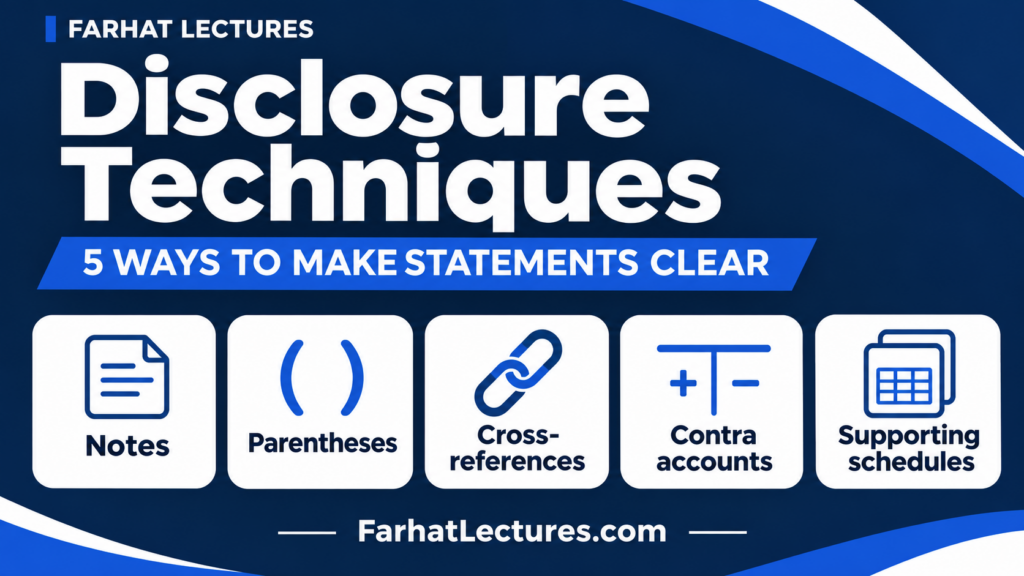
Disclosure techniques are the ways a company presents extra information that explains the amounts on its financial statements, mainly the balance sheet. The five techniques are notes, parenthetical explanations, cross-references, contra accounts, and supporting schedules. Each one fits a different need, depending on how long the explanation is and where readers will look for it.
Accounting textbooks also call these techniques of disclosure. Some textbooks combine cross-references and contra items into one technique, so you may see four listed instead of five. The ideas are the same either way.
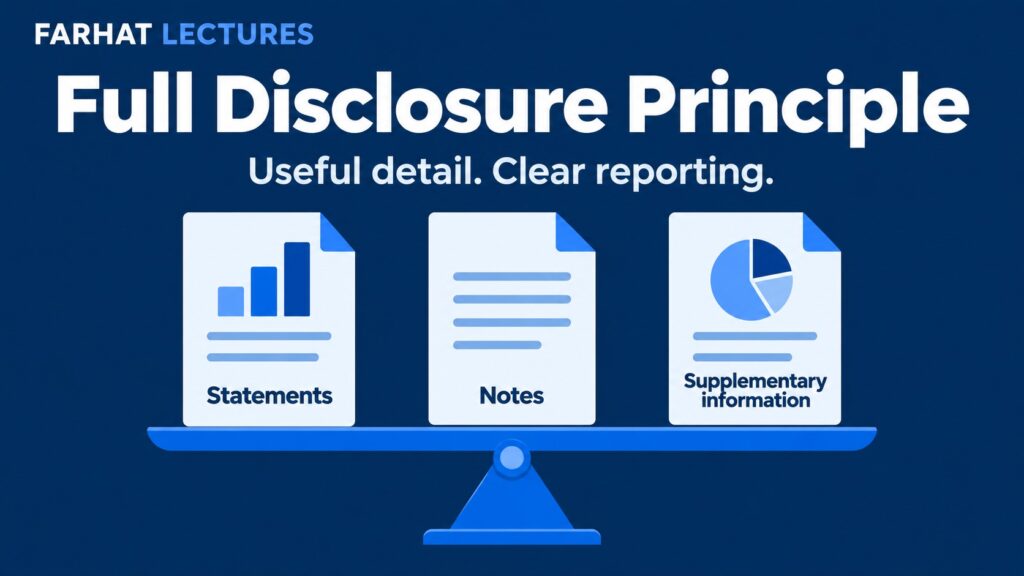
These techniques put the full disclosure principle into practice. The principle tells a company what to report. The techniques are how and where the company reports it.
These methods matter because a correct total can still be difficult to interpret. A reader may need a method description, a connection between balances, or a reconciliation.
Watch Professor Farhat explain the concept
This short clip (3:37 to 4:31) comes from Professor Farhat’s lecture on the full disclosure principle. It explains how disclosure happens through the statements and their notes. Keep that idea in mind as you read about the five techniques below.
What are the five disclosure techniques?
| Technique | Main purpose | Illustrative use |
|---|---|---|
| 1. Notes | Explain policies, conditions, or detailed information | Describe a depreciation policy or contractual restriction. |
| 2. Parentheses | Add a short fact beside a line item | Show shares issued beside common stock. |
| 3. Cross-references | Connect related balances or explanations | Refer from pledged equipment to the secured-loan note. |
| 4. Contra accounts | Show a deduction from a related gross balance | Deduct accumulated depreciation from equipment cost. |
| 5. Supporting schedules | Organize detail or reconcile a total | Reconcile equipment cost and accumulated depreciation. |
The methods can work together. A balance sheet can show a net amount, use a parenthetical reference to a note, and rely on a schedule within that note. The goal is clear communication, not a rule that every fact must appear in only one format.
What information do these techniques communicate?
A balance sheet is more than a list of accounts and totals. Readers usually need four kinds of extra information:
- Contingencies. These are uncertain situations, such as a pending lawsuit, that could lead to a gain or a loss.
- Accounting policies. These are the methods the company chose, such as how it values inventory or depreciates equipment.
- Contractual situations. These are commitments and restrictions that come from contracts, such as assets pledged as collateral or limits in a loan agreement.
- Fair values. Fair value is the price a company would receive to sell an asset, or pay to transfer a liability, in an orderly transaction between market participants.
The five techniques are simply different ways to get this information in front of the reader.
Notes and parenthetical explanations
1. Use notes when the explanation needs space
Notes can combine narrative and numerical information. A policy description or a material loan restriction usually needs more context than a short balance-sheet label. Read the guide to notes to financial statements for policies, estimates, commitments, and contingencies.
2. Use parentheses for a short, immediate explanation
Hypothetical example: “Common stock, $1 par value (40,000 shares issued), $40,000.” Par value is the nominal amount assigned to each share. The parentheses tell you how many shares sit behind the dollar amount: 40,000 shares × $1 = $40,000. A real balance sheet would usually show more, such as the shares authorized and outstanding.
Parenthetical information is easy to notice because it appears with the balance. However, a long paragraph in parentheses can interrupt reading. Move a lengthy explanation into an appropriately referenced note instead of shrinking the text or using unexplained abbreviations.
Cross-references versus contra accounts
3. A cross-reference points to related information
Hypothetical example. Pine Manufacturing has $210,000 of cash set aside with a trustee to repay $600,000 of bonds due next year. A trustee is an independent party, often a bank, that holds the cash on behalf of the bondholders. Because the bonds come due within a year, assume both the deposit and the bonds are classified as current. A reference beside the restricted deposit directs the reader to the bond disclosure, and the bond note identifies the deposit.
The uncovered amount is $600,000 − $210,000 = $390,000. Think of the $390,000 as a funding gap. It is the part of the bonds that the deposit does not cover. It is not the liability Pine reports. Pine still reports the full $600,000.
A relationship between an asset and a liability does not by itself give a company the right to offset them. Offsetting means showing only the net amount. Under FASB ASC 210-20-45-1, a right of setoff exists only when all four conditions are met: each of two parties owes the other a determinable amount, the reporting company has the right to set off, it intends to set off, and the right is enforceable at law. Here, the bondholders owe Pine nothing, so there is nothing to set off.
4. A contra account reduces a related gross balance
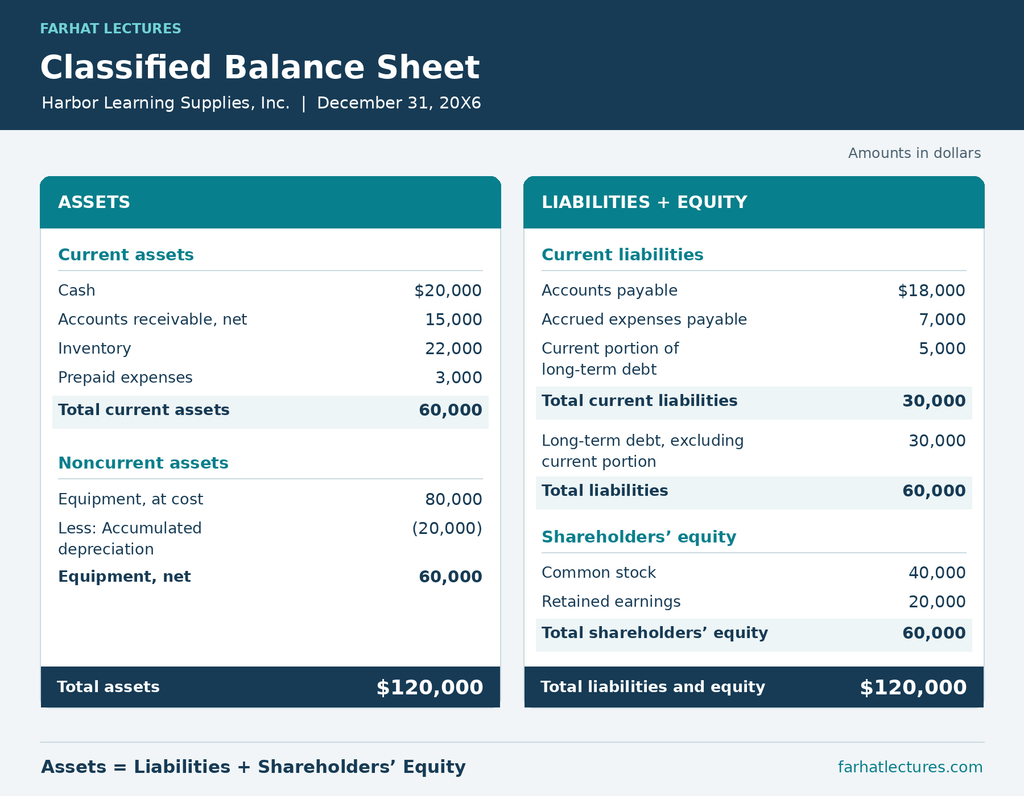
Accumulated depreciation is a contra-asset account. It reduces the carrying amount of the related depreciable asset. The carrying amount, also called book value, is the net amount shown on the balance sheet. Equipment costing $80,000 with $26,000 of accumulated depreciation has a $54,000 carrying amount. Unlike the trustee-deposit example, this presentation shows a valuation deduction from the related asset.
An allowance for credit losses similarly reduces the related receivable balance. Neither accumulated depreciation nor an allowance is a separate cash fund. Confusing a valuation account with cash set aside is a common student mistake.
Contra accounts are not only for assets. A contra account can reduce an asset, a liability, or an equity account. A discount on bonds payable is a contra-liability account, which means it is subtracted from the face amount of the bonds. Treasury stock, which is a company’s own shares that it has bought back, is a contra-equity account.
The opposite of a contra account is an adjunct account. An adjunct account adds to the related balance instead of reducing it. A premium on bonds payable is the classic example. If bonds with a $100,000 face amount carry a $4,000 premium, the carrying amount is $100,000 + $4,000 = $104,000. If they carry a $3,000 discount instead, the carrying amount is $100,000 − $3,000 = $97,000.
Supporting schedule example: Birch Studio
5. A supporting schedule explains how the total was built
Hypothetical example. Birch Studio reports equipment, net, at December 31, 20X8. During the year, it buys additional equipment and disposes of an older asset. The schedule below reconciles the equipment balance. That means it shows how the beginning balance became the ending balance.
| Movement | Equipment cost | Accumulated depreciation |
|---|---|---|
| Beginning balance | $100,000 | $30,000 |
| Additions / current-year depreciation | + $24,000 | + $12,000 |
| Disposed asset amounts removed | − $10,000 | − $6,000 |
| Ending balance | $114,000 | $36,000 |
Ending cost is $100,000 + $24,000 − $10,000 = $114,000. Ending accumulated depreciation is $30,000 + $12,000 − $6,000 = $36,000. The balance-sheet amount is $114,000 − $36,000 = $78,000, equipment, net.
Remove both the disposed asset’s cost and its associated accumulated depreciation. The example supplies no selling proceeds, so it does not determine a disposal gain or loss. Also, accumulated depreciation is not cash available to replace equipment.
A useful supporting schedule agrees with the financial statement, uses consistent dates and units, and explains its columns. A fair value disclosure table is another example of organized numerical detail, although its columns classify measurement inputs rather than reconcile equipment movements.
Under FASB ASC 360-10-50-1, a company discloses depreciation expense for the period, the balances of major classes of depreciable assets, accumulated depreciation, and a general description of its depreciation methods. A schedule like Birch’s is one clear way to organize that kind of detail.
See all five techniques side by side
Here is how the techniques look when they sit together. The lines below reuse the numbers from Pine, Birch, and the common stock example. Treat them as an illustration, not as one company’s complete balance sheet.
| Balance sheet line | Amount | Technique at work |
|---|---|---|
| Cash on deposit with trustee to repay bonds (see Current liabilities) | $210,000 | Cross-reference |
| Equipment | $114,000 | Gross balance |
| Less: Accumulated depreciation | (36,000) | Contra account |
| Equipment, net (Note 4) | $78,000 | Note reference. The note holds the supporting schedule. |
| Bonds payable due next year (see Current assets) | $600,000 | Cross-reference |
| Common stock, $1 par value (40,000 shares issued) | $40,000 | Parenthetical explanation |
Use clear financial statement terminology
Account names designed for an internal ledger may confuse outside readers. “Reserve” has been used for several different ideas, including valuation deductions, estimated liabilities, and appropriated retained earnings. Prefer a precise label such as “allowance for credit losses,” “warranty liability,” or “appropriated retained earnings,” as appropriate.
Appropriating retained earnings identifies a purpose or restriction within equity; it does not by itself establish a separate cash fund. Similarly, describe the relevant equity component clearly instead of relying on ambiguous older labels such as “earned surplus.” Terminology must also fit the reporting framework and industry.
The common mistakes are therefore practical: writing overly long parentheses, treating a cross-reference as permission to net balances, calling accumulated depreciation cash, and presenting a supporting schedule that does not reconcile.
Key takeaways
- Disclosure techniques are the ways a company presents extra information that explains its financial statement amounts.
- The five techniques are notes, parenthetical explanations, cross-references, contra accounts, and supporting schedules.
- Use a parenthetical explanation for a short fact. Use a note when the explanation needs room.
- A cross-reference connects related items. It never allows a company to net an asset against a liability.
- A contra account is subtracted from a related balance. Accumulated depreciation and the allowance for credit losses are contra-asset accounts.
- A supporting schedule must agree with the amount on the financial statement. Birch’s schedule ties to equipment, net, of $78,000.
Want to go deeper? Professor Farhat covers this topic in the Supplemental Disclosures: Balance Sheet lesson.
Disclosure Techniques: Interactive Practice Quiz
Test your understanding with six multiple-choice questions on the five disclosure techniques. Two of them use the Pine and Birch examples from this guide.
Select one answer for each question, then choose Check answers. Each question is worth one point. You may change your answers and check again.
Study notes and answers
- What information should companies disclose?
- Companies may need to disclose material information about contingencies, valuation methods for assets and liabilities, and contracts and agreements, applying the relevant accounting requirements and materiality judgments.
- What disclosure techniques can companies use?
- Parenthetical explanations, notes, cross-references, contra accounts, and supporting schedules.
- What bond liability does Pine Manufacturing report?
- Pine reports the full $600,000, with a cross-reference to the $210,000 trustee deposit. The $390,000 funding gap does not replace the recorded bond liability.
- Why are parenthetical explanations useful?
- They add clarity and completeness. Compared with a note, they place information where readers are less likely to overlook it.
- What is Birch Studio’s equipment, net?
- Equipment cost of $114,000 less accumulated depreciation of $36,000 equals $78,000. Accumulated depreciation is a contra-asset account.
- What limitation should companies keep in mind?
- Lengthy parenthetical explanations might be distracting.
Practice questions and explained answers
1. Which technique fits a brief share-count explanation beside common stock?
Answer: a parenthetical explanation. It supplies a short relevant fact directly with the line item. Longer share-rights information may require a note.
2. May Pine report only a $390,000 bond liability because $210,000 is set aside?
Answer: no, based solely on these facts. The $390,000 calculation describes an uncovered funding amount. The cross-reference does not authorize offsetting the $600,000 liability.
3. What equipment amount should Birch’s schedule support?
Answer: $78,000. Ending cost of $114,000 less ending accumulated depreciation of $36,000 equals the net balance. Both columns must reflect the disposal.
Frequently asked questions
What are the five disclosure techniques in accounting?
The five disclosure techniques are notes, parenthetical explanations, cross-references, contra accounts, and supporting schedules. Some textbooks combine cross-references and contra items and list four.
What is a parenthetical explanation?
A parenthetical explanation is a short piece of extra information placed in parentheses right beside a line item on a financial statement. An example is showing the number of shares issued beside common stock.
What is the difference between a note and a parenthetical explanation?
A parenthetical explanation is short and sits in the body of the statement, right next to the amount. A note has more room. It follows the statements and can combine words and numbers.
Does a cross-reference let a company net an asset against a liability?
No. A cross-reference only points the reader from one related item to another. Netting, also called offsetting, requires a right of setoff under FASB ASC 210-20.
Are disclosure techniques the same as the full disclosure principle?
No. The full disclosure principle is about what to report, which is any information important enough to affect a reader’s decisions. Disclosure techniques are about how and where a company presents that information.
Can a supporting schedule appear in a note?
Yes. A schedule is a presentation format; a note can contain the schedule and the explanatory narrative.
Is accumulated depreciation a liability?
No. It is a contra-asset account associated with the related depreciable assets, not an obligation owed to another party.
Does more disclosure always mean better disclosure?
No. Relevant, clear information helps readers. Repetition, vague labels, and immaterial detail can obscure the explanation they need.
Sources
FASB Concepts Statement No. 8, Chapter 8, Notes to Financial Statements, issued in August 2018, explains how notes supplement and explain the amounts on the face of the financial statements. The offsetting and depreciation disclosure rules mentioned in this guide come from FASB ASC 210-20 and ASC 360-10-50. For the bigger picture, see our guide to the FASB Conceptual Framework. The SEC financial statement guide provides reader-oriented background. Apply the relevant FASB Accounting Standards Codification requirements to actual reporting.
Explore the connected lessons
- Notes to Financial Statements: A Simple Reading Guide — Read policies, estimates, contractual restrictions, and uncertainties.
- Fair Value Disclosures: A Simple Guide to Reading the Table — Interpret the hierarchy columns and the information behind each valuation.
Learn with Farhat Lectures
Explore the free sample courseShare this article
Know someone studying this topic? Send it their way.
Open YouTube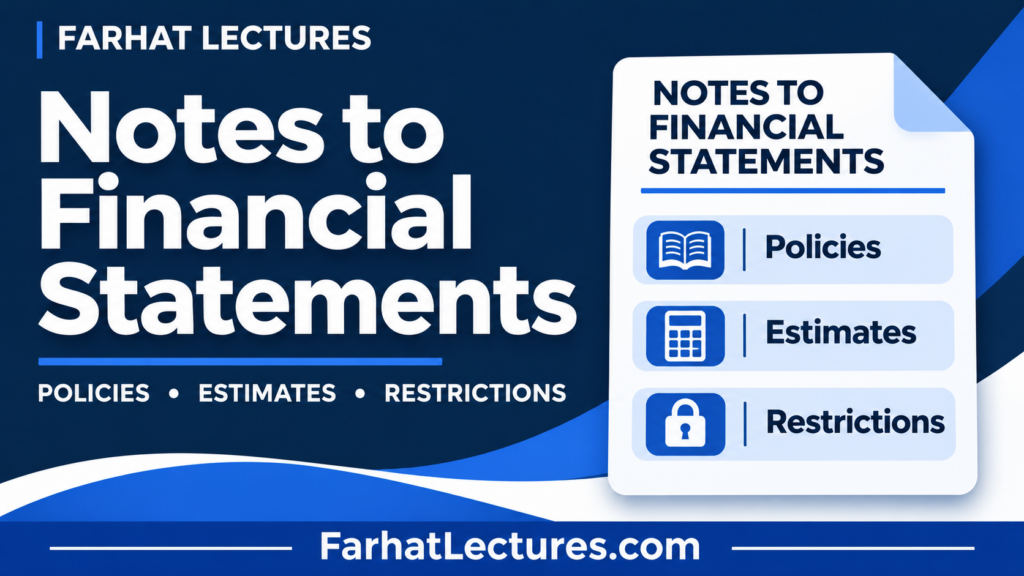


Responses