
Change in Reporting Entity: Definition, Examples, and Retrospective Reporting

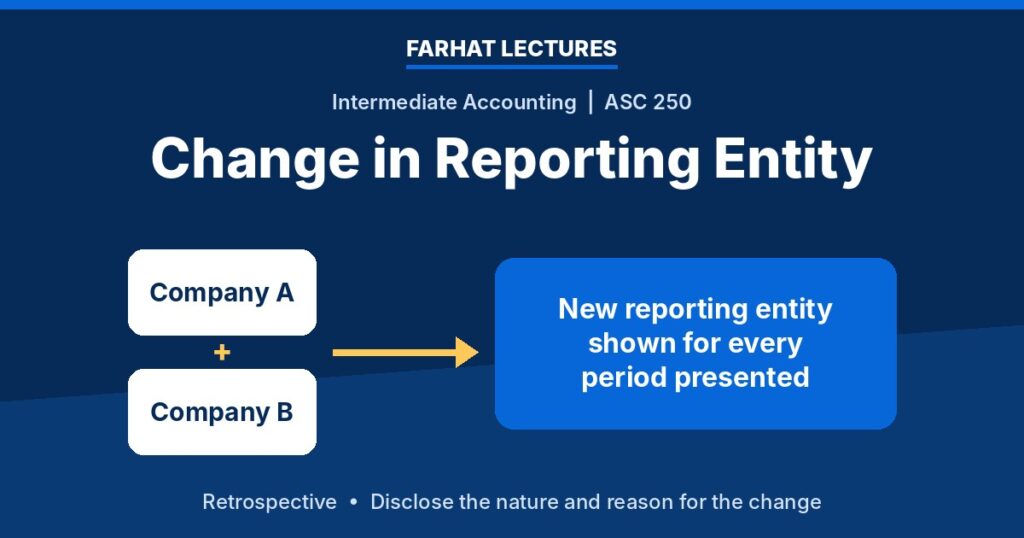
A change in reporting entity is an accounting change that turns a company’s financial statements into, in effect, the statements of a different entity. Common examples are switching to consolidated or combined statements, or changing which companies are in the group. Under ASC 250, it is reported retrospectively: every prior period presented is adjusted to show the new entity.
This matters because comparative statements are only useful when each year describes the same set of companies. If last year covered two companies and this year covers three, a reader would see growth that is really just a change in scope. Retrospective reporting keeps the years comparable.
A change in reporting entity is one of three types of accounting changes. The other two are a change in accounting principle and a change in accounting estimate.
For CPA candidates, accounting changes and error corrections are tested in the Financial Accounting and Reporting (FAR) section, and this topic is also a staple of intermediate accounting courses. Questions usually test two skills: spotting whether an event is a change in reporting entity at all, and knowing that it is reported retrospectively with disclosures in the year of change.
Watch Professor Farhat explain it. This lecture starts at the segment on change in reporting entity and consolidation (2:06).
Watch “Change in Reporting Entity | FAR CPA Exam” on YouTube
What counts as a change in reporting entity?
The Financial Accounting Standards Board (FASB) defines a change in reporting entity in Accounting Standards Codification (ASC) 250-10-20 as a change that produces statements that are, in effect, those of a different reporting entity. The definition says it is limited mainly to:
- Presenting consolidated or combined statements in place of individual company statements. Consolidated statements combine a parent and the subsidiaries it controls. Combined statements put together companies under common ownership or control, such as sister companies owned by the same person, without a parent at the top.
- Changing the specific subsidiaries in the consolidated group.
- Changing the companies included in combined statements.
The same definition also names two events that are not changes in reporting entity: a business combination accounted for by the acquisition method, and the consolidation of a variable interest entity (VIE) under ASC 810.
A transfer of a business between companies under common control, such as a parent moving one subsidiary underneath another, can also create a change in reporting entity for the company that receives it. The guidance is in ASC 805-50. If the assets transferred are not a business, the receiving company generally reports them only from the transfer date, not retrospectively.
What is not a change in reporting entity?
The key test is that the scope of the reporting changes, not that a company buys or sells something. These events are handled under their own rules:
Events that are not changes in reporting entity
| Event | How it is reported |
|---|---|
| Buying a company in a business combination | Acquisition method (ASC 805). The new subsidiary is included from the acquisition date. Prior years are not adjusted. |
| Consolidating a variable interest entity (VIE) | Consolidation guidance in ASC 810, not ASC 250. |
| An investment that rises to significant influence | Equity method from the date it qualifies (ASC 323). Since ASU 2016-07, there is no retrospective adjustment. |
Textbook note. Some textbooks also list switching between the cost, equity, and consolidation methods as a change in reporting entity. That reflects older rules. Under current GAAP, the common switches in the table above are handled prospectively, so check the specific event before you assume retrospective treatment.
How is a change in reporting entity reported?
The company applies the change retrospectively to all prior periods presented. In practice, that means:
- Rebuild each comparative year as if the new group had been reported together all along.
- Adjust the opening equity of the earliest period presented for amounts that belong to earlier years.
- Present the current year on the new basis as well, so every column describes the same entity.
There is usually no single “catch-up” journal entry in the books of each company. The adjustment happens in how the reporting group’s statements are prepared and presented.
Example: adding a sister company to combined statements
Hypothetical example. Maya Ortiz has owned 100% of three companies since 2019: Ortiz Bakery, Ortiz Café, and Ortiz Catering. For 2027, she issued combined statements for the bakery and café only. For 2028, her lender asks for combined statements that include all three. Assume no transactions between the companies.
Changing the companies in combined statements is a change in reporting entity. The 2028 report must show the 2027 comparative figures for all three companies.
2027 comparative figures, before and after the change
| Item | 2027 as originally reported (bakery + café) | Ortiz Catering 2027 | 2027 as adjusted (new entity) |
|---|---|---|---|
| Revenue | $900,000 | $300,000 | $1,200,000 |
| Net income | $120,000 | $45,000 | $165,000 |
| Total assets | $1,400,000 | $380,000 | $1,780,000 |
The 2028 notes would disclose that the combined group now includes Ortiz Catering and explain why: the lender asked for it. They would also show the effect of the change on income for every period presented. For 2027, it increased net income by $45,000, and the notes would show Catering’s contribution to 2028 income the same way. Because these are private companies, there are no per-share amounts to report. Catering’s results from 2019 through 2026 are reflected in the opening combined equity for 2027.
One more pattern is worth knowing. Suppose a parent used to issue parent-only statements, with its subsidiaries carried under the equity method, and now issues consolidated statements for all periods. Net income attributable to the parent usually does not change, because the equity method already included the parent’s share of each subsidiary’s income. What changes is the presentation: assets, liabilities, revenues, and expenses are now shown line by line. If a subsidiary is not wholly owned, consolidated net income also includes the noncontrolling interest’s share, shown separately.
This is different from an investor gaining control of a company it already holds under the equity method by buying more shares. That is a business combination, reported from the date control is obtained, not a change in reporting entity.
How is it different from other accounting changes?
Accounting changes and error corrections at a glance
| Type | What changes | Reporting approach |
|---|---|---|
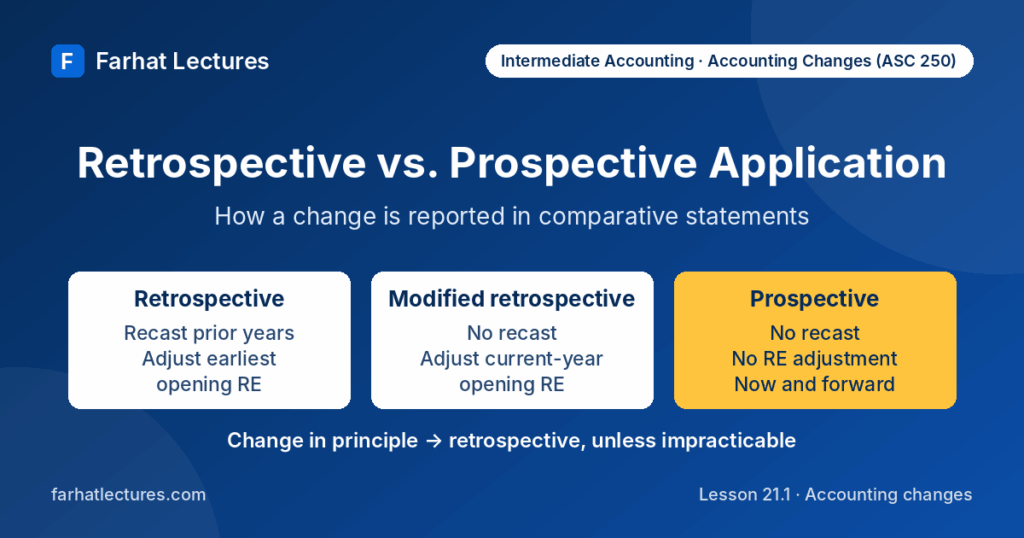
| Change in accounting principle | The method used, such as FIFO to weighted-average | Retrospective application |
| Change in accounting estimate | A judgment, such as useful life or bad debts | Prospective |
| Change in reporting entity | Which companies the statements cover | Retrospective application |
| Correction of an error | A mistake in prior statements (not an accounting change) | Restatement through prior period adjustment |
A related case sits between estimates and principles: switching depreciation methods. See change in depreciation method to learn why it is handled prospectively. For a side-by-side review of all three accounting changes plus error corrections, see our accounting changes and error corrections guide.
What must be disclosed?
Under ASC 250-10-50-6, the statements for the period of the change should disclose:
- The nature of the change and the reason for it.
- The effect on income from continuing operations, net income, other comprehensive income, and related per-share amounts, for all periods presented.
Later periods do not need to repeat these disclosures.
One more rule: if the change has no material effect in the year it happens but is reasonably certain to have a material effect later, the company still discloses the nature of and reason for the change whenever the statements for the year of change are presented.
Common mistakes
- Calling every acquisition a change in reporting entity. Business combinations use the acquisition method and are reported from the acquisition date.
- Adjusting only the current year. Every period presented must show the new entity.
- Calling it a restatement. Restatement is the term for correcting errors. A change in reporting entity is a legitimate accounting change.
- Applying old textbook rules to equity method changes. An investment that reaches significant influence is accounted for prospectively.
Exam tip: when a question says the group got bigger, don’t jump straight to “change in reporting entity.” Ask one question first: did the company buy control from an outside party? If yes, it’s a business combination, reported from the acquisition date. If the same owner simply changed which companies are presented together, it’s a change in reporting entity, and every period presented is adjusted.
Key takeaways
- A change in reporting entity changes which companies the statements describe, not just what a company owns.
- It is reported retrospectively: every period presented shows the new entity.
- Business combinations and VIE consolidations are not changes in reporting entity. They are reported from the date control is obtained.
- In the year of change, disclose the nature of and reason for the change, plus its effect on income from continuing operations, net income, other comprehensive income, and per-share amounts for all periods presented.
- Later periods generally need not repeat the disclosures. If the change was immaterial in the year of change but is reasonably certain to have a material effect later, disclose its nature and reason whenever the year-of-change statements are presented.
Practice questions
Question 1
On July 1, 2028, Parent Co. acquires 80% of Delta Inc. in a business combination. Is this a change in reporting entity that requires adjusting Parent’s 2027 comparative statements?
Show answer
Answer: No.
A business combination under the acquisition method is not a change in reporting entity. Parent consolidates Delta from July 1, 2028, forward. The 2027 figures are not changed.
Question 2
Two companies owned by the same family have issued combined statements for years. This year, the family adds a third company it has owned for a decade. What happens to the prior-year combined statements shown for comparison?
Show answer
Answer: They are retrospectively adjusted to include the third company.
Changing the companies included in combined statements is a change in reporting entity. Every period presented must show all three companies, and the notes disclose the nature, reason, and effect of the change.
Question 3
An investor raises its stake in an investee from 12% to 30% and now has significant influence. Does it adjust prior years as if it had used the equity method all along?
Show answer
Answer: No.
Since ASU 2016-07, the investor starts the equity method on the date it gains significant influence, using its current basis in the investment. There is no retrospective adjustment, and it is not treated as a change in reporting entity.
Change in Reporting Entity Exercise on Retrospective Reporting and Disclosures
In 20X6, Harbor Group begins presenting consolidated financial statements for itself and its existing subsidiaries in place of the separate financial statements previously presented for the individual companies. The group had the same members throughout 20X4, 20X5, and 20X6. The 20X6 financial statements include comparative information for 20X4 and 20X5. Choose one answer for each question.
Frequently asked questions
Is a change in reporting entity applied retrospectively or prospectively?
Retrospectively. The financial statements of all prior periods presented are changed so they show the new reporting entity, as if it had existed in its current form all along.
Is buying a subsidiary a change in reporting entity?
No. A business combination accounted for under the acquisition method is not a change in reporting entity. The acquirer includes the new subsidiary only from the acquisition date, and prior periods are not adjusted.
What is the difference between a change in reporting entity and a restatement?
In ASC 250, a restatement corrects an error in previously issued statements. A change in reporting entity is not an error. It is a legitimate change in which companies the statements cover, so the prior periods are retrospectively adjusted rather than “restated” for a mistake.
Do the disclosures repeat in later years?
Generally, no. The company discloses the nature, reason, and financial effects in the period of change. If the change was immaterial in that period but is reasonably certain to have a material effect later, the company must disclose its nature and reason whenever it presents the financial statements for the period of change.
Is a transfer between companies under common control a change in reporting entity?
It can be. When a business moves between entities with the same parent, the receiving entity generally reports it retrospectively for the periods of common control, and the change often meets the definition of a change in reporting entity.
What are the three types of accounting changes?
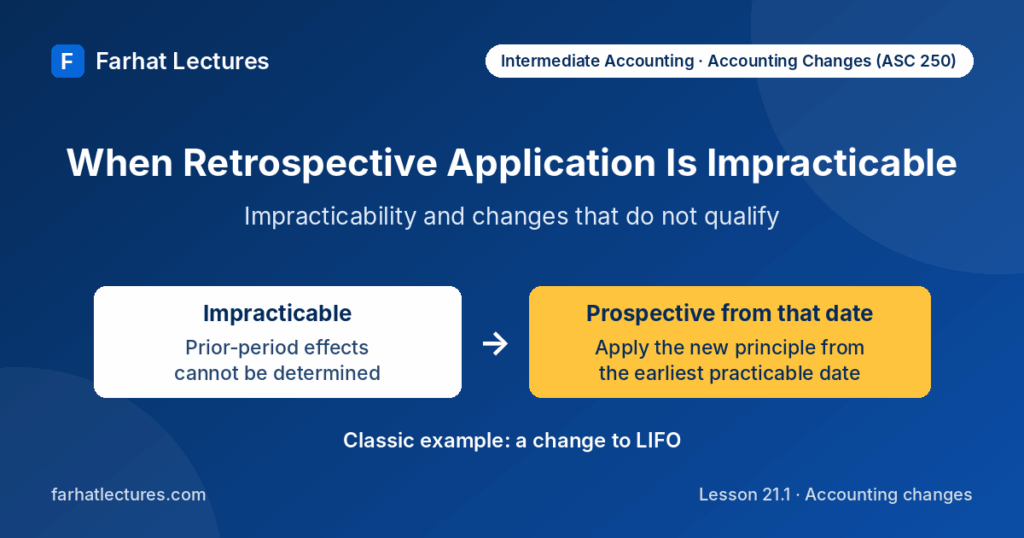
A change in accounting principle, a change in accounting estimate, and a change in reporting entity. A change in accounting principle generally uses retrospective application unless specific transition guidance applies or retrospective application is impracticable. A change in reporting entity is applied retrospectively. A change in accounting estimate is applied prospectively. Correcting an error is not an accounting change. It is a restatement.
What are examples of a change in reporting entity?
Presenting consolidated or combined statements in place of individual company statements, changing the subsidiaries in a consolidated group, and changing the companies in combined statements. A transfer of a business between companies under common control can also be one for the company that receives it.
Sources
- FASB Accounting Standards Codification, Topic 250 (ASC 250-10-20, 250-10-45-21, and 250-10-50-6)
- PwC Viewpoint: Change in reporting entity
- Deloitte Roadmap: Common-control transactions and change in reporting entity
- Journal of Accountancy: FASB simplifies transition to the equity method (ASU 2016-07)
- SEC Financial Reporting Manual, Topic 13 (retrospective application for changes in reporting entity)
Mansour Farhat, CPA, CIA, DBA, teaches accounting through Farhat Lectures, an online platform for CPA, CMA, and EA candidates and accounting students, and on the Farhat Lectures YouTube channel. Read more about Professor Farhat.
Continue learning with Farhat Lectures
Strengthen your accounting understanding with clear explanations and guided practice.
Explore the free sample course
Responses