
Sales-Type vs Direct Financing Lease: Key Differences for Lessors

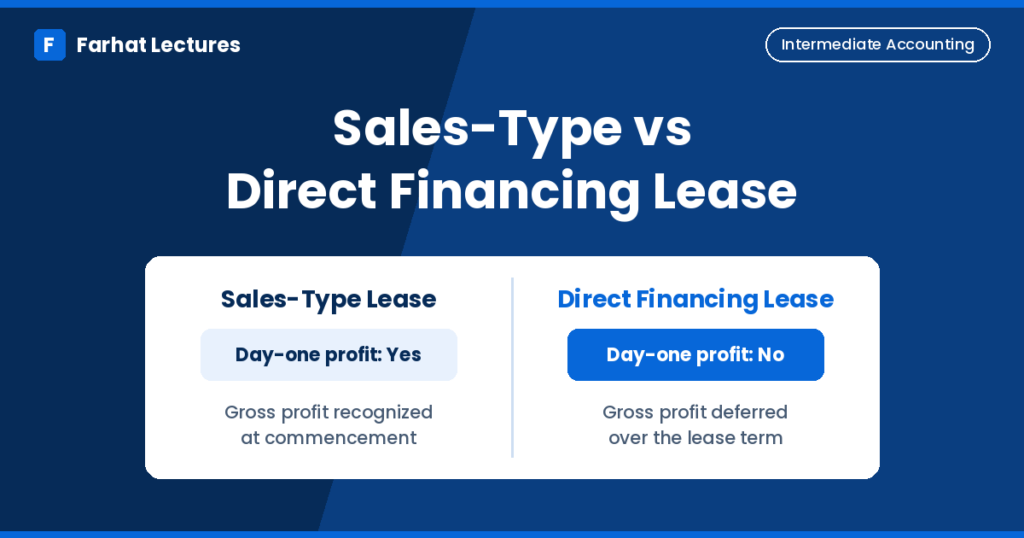
The difference between a sales-type lease and a direct financing lease is when the lessor recognizes its selling profit. In a sales-type lease, the lessee obtains control, so the profit is recognized at commencement. In a direct financing lease, the lessee lacks control and an unrelated third party guarantees the residual, so the profit is deferred over the lease term.
Cash flows and total income are the same under both. Only the timing changes.
Why it matters: classification can shift thousands of dollars of income between years without changing a single payment. Investors comparing lessors, and exam graders checking your entries, both care which year the profit lands in. Selling profit is the asset’s fair value minus its carrying amount on the lessor’s books. For the full sales-type walkthrough, see sales-type lease accounting.
If you have not yet seen how a lease becomes a direct financing lease, start with what a direct financing lease is. For the full year-by-year bookkeeping, see direct financing lease journal entries. Numbers below are hypothetical.
Watch: Direct Financing lease : Accounting for Lessor
Professor Farhat compares the direct financing lease with the sales-type lease and shows how the journal entries and amortization schedule differ.
Sales-type vs direct financing lease: what is the difference?
| Feature | Sales-type lease | Direct financing lease |
|---|---|---|
| What triggers it | At least one of the five transfer tests is met. | No transfer test is met, but lease payments plus a third-party residual guarantee cover substantially all of fair value, and collection is probable. |
| Typical residual guarantor | The lessee, or no guarantee needed | A party unrelated to the lessor, such as an insurer |
| Who obtains control | The lessee | Not the lessee. The lessor still gives up control because the guarantor takes on the residual value risk. |
| Selling profit | Recognized at commencement | Deferred and earned over the lease term |
| Selling loss | Recognized at commencement | Recognized at commencement |
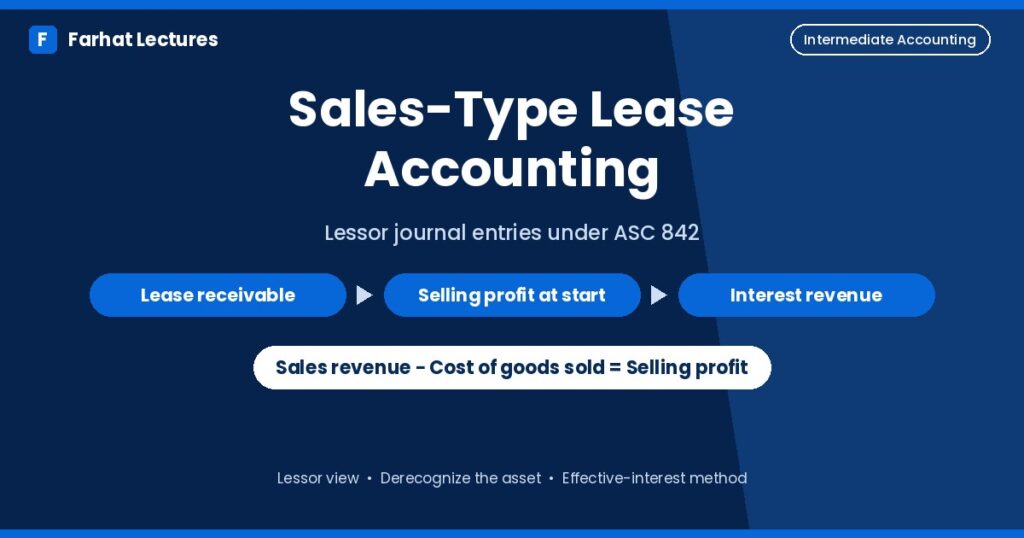
| Commencement accounts | Lease Receivable, Sales Revenue, Cost of Goods Sold, Inventory | Lease Receivable, Deferred Gross Profit, Inventory |
| Annual income account | Interest Revenue | Interest income on the net investment, often booked as Lease Revenue (interest plus deferred profit earned) |
| Rate applied each year | The rate implicit in the lease, on the lease receivable | In this example, deferring the $2,000 selling profit reduces the opening net investment to $58,000, so the same recoveries produce a higher yield. |
| Initial direct costs | Expensed at commencement when fair value differs from carrying amount; deferred when the two are equal | Deferred and recognized over the lease term |
| Total income over the lease | Same | Same |
How does a lessor classify a lease?
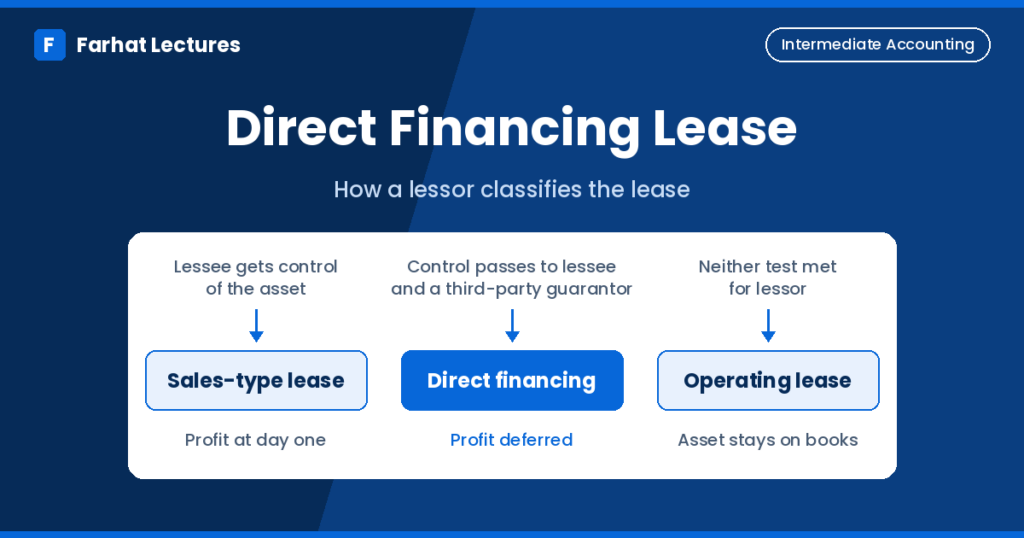
A lessor works through three questions, in this order.
- Does the lease pass any of the five sales-type tests? Ownership transfers to the lessee by the end of the term; the lessee has a purchase option it is reasonably certain to exercise; the lease term is a major part of the asset’s remaining economic life; the present value of the lease payments plus any residual value guaranteed by the lessee equals or exceeds substantially all of the asset’s fair value; or the asset is so specialized that the lessor has no other use for it afterward. If any one is met, it is a sales-type lease.
- If not, does it pass the direct financing test? Two conditions must both hold. The present value of the lease payments plus any residual value guaranteed by the lessee or an unrelated third party equals or exceeds substantially all of fair value, and collection of the payments plus any guarantee amount is probable. If both hold, it is a direct financing lease.
- If neither, it is an operating lease. The lessor keeps the asset on its books and records rental income. See lessor accounting for operating leases.
Many companies and exam questions use 75% for “major part” and 90% for “substantially all.” Those are benchmarks from the implementation guidance, not hard rules. For a closer look at the fourth test, see the present value test for leases, and for how guarantees count, see guaranteed residual value.
One exception to know: under ASU 2021-05, a lease with variable payments that do not depend on an index or a rate is classified as an operating lease if calling it sales-type or direct financing would create a selling loss at commencement.
Same lease, two classifications
Hypothetical example. Northline Equipment leases a floor scrubber to Brightway Logistics on January 1, Year 1. Fair value is $60,000 and Northline’s carrying amount is $58,000, so there is $2,000 of selling profit. Brightway pays $15,461.40 at the end of each year for four years, Northline’s implicit rate is 7%, and the scrubber should be worth $10,000 when it comes back. Title stays with Northline, there is no purchase option, and the scrubber is a standard model with a 10-year economic life, so the only sales-type test in play is the present value test.
- Version 1: Brightway guarantees the $10,000 residual. The sales-type present value test reaches 100%, so it is a sales-type lease.
- Version 2: an unrelated insurer guarantees it. Without the insurer’s guarantee the payments cover only 87.3% of fair value, below the usual 90% benchmark, and the lease runs only 4 of the scrubber’s 10 years, so no sales-type test is met. With it, the total reaches 100%, and collection is probable, so it is a direct financing lease.
Commencement entries
Sales-type lease:
| Account | Debit | Credit |
|---|---|---|
| Lease Receivable | 60,000 | |
| Cost of Goods Sold | 58,000 | |
| Sales Revenue | 60,000 | |
| Inventory | 58,000 |
Direct financing lease:
| Account | Debit | Credit |
|---|---|---|
| Lease Receivable | 60,000 | |
| Deferred Gross Profit | 2,000 | |
| Inventory | 58,000 |
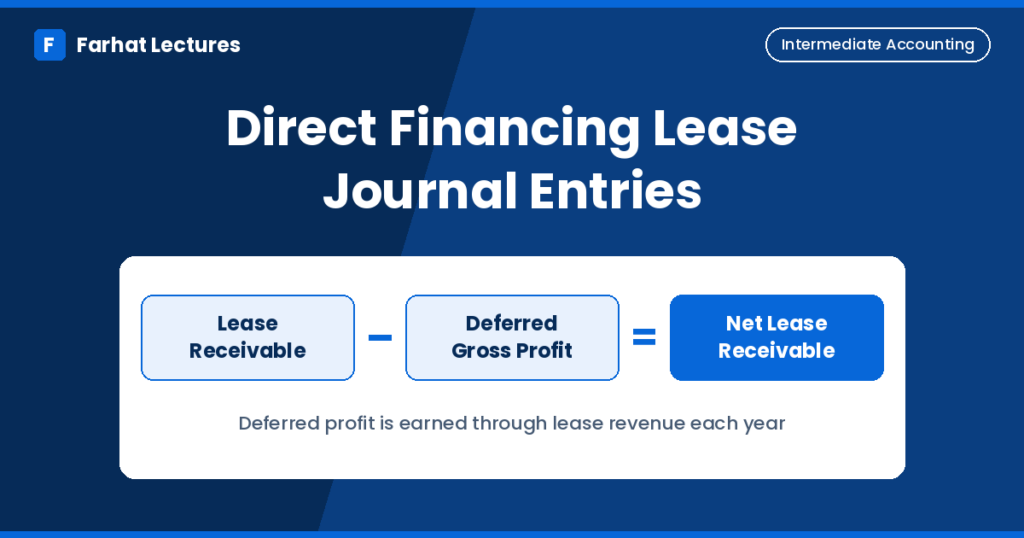
Both entries remove the scrubber and record a $60,000 receivable. The sales-type lease reports $2,000 of gross profit today. The direct financing lease holds that $2,000 in a contra account, leaving a net lease receivable of $58,000. That $58,000 is what ASC 842 calls the net investment in the lease. A contra account is simply an account that reduces another one, so Deferred Gross Profit sits under Lease Receivable and shrinks it on the balance sheet.
Year 1 payment entries
Sales-type lease (7% × $60,000 = $4,200 of interest):
| Account | Debit | Credit |
|---|---|---|
| Cash | 15,461.40 | |
| Interest Revenue | 4,200.00 | |
| Lease Receivable | 11,261.40 |
Direct financing lease. The illustration uses a rounded annual yield of 8.4% and adjusts the final year for rounding. First-year interest income is 8.4% × $58,000 = $4,872.
| Account | Debit | Credit |
|---|---|---|
| Cash | 15,461.40 | |
| Deferred Gross Profit | 672.00 | |
| Lease Revenue | 4,872.00 | |
| Lease Receivable | 11,261.40 |
The Lease Receivable account falls by the same $11,261.40 in both cases. The difference is the $672 of deferred gross profit that the direct financing lease earns this year: $4,872 − $4,200. ASC 842 treats the whole $4,872 as interest income on the net investment. Splitting it into interest and deferred profit earned is a bookkeeping step that makes the pattern easy to see, which is why many textbooks label the total Lease Revenue.
Why the direct financing lease uses a higher rate
In both versions, Northline receives four rent payments of $15,461.40 and gets the scrubber back at the end of Year 4. If the scrubber is worth $10,000 when returned, the guarantor owes nothing. The rent and residual value together yield 7% on the $60,000 sales-type lease receivable. The same recoveries yield about 8.4% on the $58,000 opening net investment in the direct financing lease.
That higher rate does two jobs at once. It earns normal interest on the receivable, and it releases the deferred gross profit a little each year until the balance reaches zero. The journal entries lesson shows how to find the rate with a financial calculator or Excel. If present value math feels rusty, review the present value of an ordinary annuity first.
Does classification change total income?
| Period | Sales-type lease income | Direct financing lease income |
|---|---|---|
| Commencement | $2,000.00 gross profit | $0.00 |
| Year 1 | $4,200.00 | $4,872.00 |
| Year 2 | $3,411.70 | $3,982.49 |
| Year 3 | $2,568.22 | $3,018.26 |
| Year 4 | $1,665.68 | $1,972.85 |
| Total | $13,845.60 | $13,845.60 |
Northline recovers $61,845.60 in rent and $10,000 in residual value. After subtracting the $58,000 carrying amount, total income is $13,845.60 under either classification. Only the timing differs. Final-year amounts include small rounding adjustments.
Common mistakes
- Deciding by profit alone. Under the old ASC 840 rules, a capital lease with no dealer’s profit was a direct financing lease. Under ASC 842, the deciding factor is who guarantees the residual and whether the lessee alone obtains control.
- Recording Sales Revenue in a direct financing lease. No sales revenue or cost of goods sold appears at commencement. The profit sits in Deferred Gross Profit.
- Using the implicit rate on the net receivable. Applying 7% to $58,000 would leave the balance at about $7,378 after the last payment instead of the guaranteed $10,000. The direct financing lease needs its own higher rate.
- Deferring a selling loss. Losses are recognized at commencement under both classifications.
- Assuming different total income. Classification changes timing only.
Practice questions
Lessor Lease Classification: Sales-Type, Direct Financing, and Operating Leases
Apply ASC 842 to four equipment lease scenarios. Compare how residual value guarantees from the lessee and an unrelated insurer affect the lessor’s present-value tests.
Practice question 1
A lessor leases equipment with a fair value of $90,000 and a carrying amount of $84,000. How much gross profit does it recognize at commencement if (a) the lessee guarantees the residual and the lease is a sales-type lease, and (b) an unrelated insurer guarantees the residual and the lease is a direct financing lease?
Show answer and explanation
(a) $6,000; (b) $0. In the sales-type lease, Sales Revenue of $90,000 less Cost of Goods Sold of $84,000 gives $6,000 of gross profit at commencement. In the direct financing lease, the $6,000 is credited to Deferred Gross Profit, leaving a net lease receivable of $84,000.
Practice question 2
Continuing the same lease, the lease payments plus the guaranteed residual total $110,000. What is total income over the life of the lease under each classification?
Show answer and explanation
$26,000 under both. Sales-type: $6,000 gross profit plus interest of $110,000 − $90,000 = $20,000. Direct financing: lease revenue of $110,000 − $84,000 = $26,000, which includes the $6,000 of deferred profit earned over the term.
Practice question 3
A lease qualifies as a direct financing lease. The asset’s fair value is $48,500 and its carrying amount is $50,000. How does the lessor handle the $1,500 difference?
Show answer and explanation
Recognize a $1,500 selling loss at commencement. Only selling profit is deferred in a direct financing lease. A selling loss is recognized immediately, the same as in a sales-type lease.
FAQ
Is total income different between a sales-type and a direct financing lease?
No. With the same cash flows, total income over the life of the lease is identical. A sales-type lease reports part of it as gross profit at commencement and the rest as interest revenue. A direct financing lease reports all of it as lease revenue spread over the term.
If there is no selling profit, does the classification still matter?
Much less. When fair value equals the carrying amount, there is no profit to defer, so the commencement entry and the interest pattern look almost the same under both classifications. Initial direct costs are deferred in both cases.
Why does a direct financing lease use a higher rate?
The lessor collects the same cash but starts from a smaller net receivable (fair value minus deferred profit). A smaller starting balance with the same cash flows means a higher yield, and the extra yield is exactly the deferred profit being earned.
Does the lessee account for the lease differently?
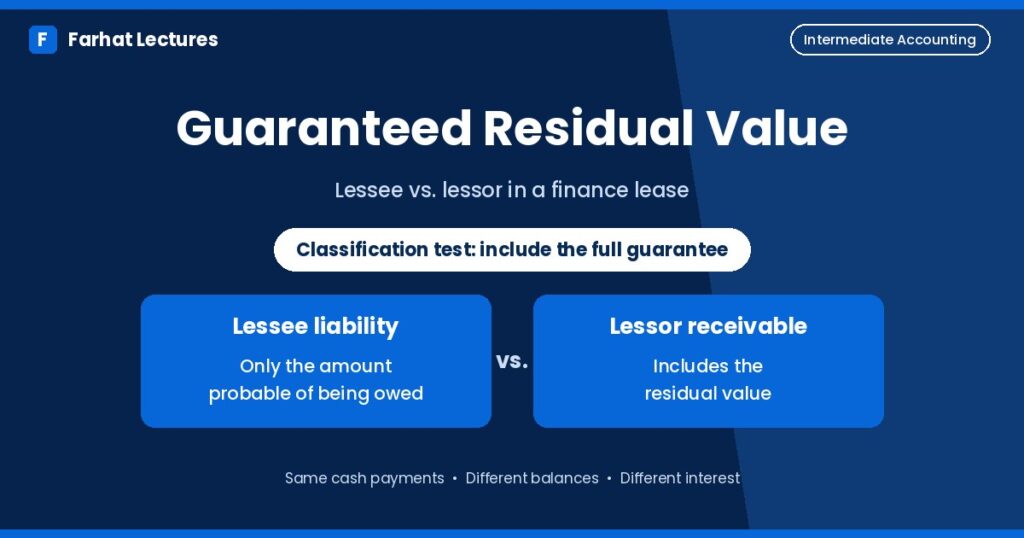
Not because of the lessor’s choice. The lessee runs its own classification tests and does not count a residual value guarantee made by a third party, so the lessee often has an operating lease when the lessor has a direct financing lease. See finance lease vs operating lease for the lessee’s five tests.
Is lessor lease accounting on FAR or BAR?
Under the current CPA exam blueprints, FAR tests lessee accounting, while lessor accounting, including sales-type, direct financing, and operating leases, sits in BAR (Business Analysis and Reporting). BAR asks you to classify a lessor’s lease, prepare its journal entries, and calculate lease income. If you are taking FAR, focus on the lessee side.
Does IFRS 16 have direct financing leases?
No. IFRS 16 classifies a lessor’s leases as finance leases or operating leases only. A manufacturer or dealer lessor recognizes selling profit at commencement on a finance lease, so the US GAAP split between sales-type and direct financing does not exist there. See IFRS 16 lease accounting for the full model.
What happens if collection is not probable?
The lease cannot be a direct financing lease, because probable collection is one of its two conditions. If a sales-type test is still met, the lessor keeps the asset on its books and records cash received as a deposit liability until collection becomes probable or another trigger in ASC 842 is met. If no sales-type test is met, it is an operating lease.
Sources
The recognition rules come from FASB ASC 842-30-25-1 (sales-type leases) and 842-30-25-7 through 25-9 (direct financing leases), and the interest method from 842-30-35-1.
- FASB Accounting Standards Update 2016-02, Leases (Topic 842)
- Deloitte Roadmap: Leasing, Section 9.3 Recognition and Measurement
- PwC Viewpoint: Leases Guide, 4.3.2 Direct financing lease
- Deloitte Roadmap: Leasing, Appendix C, Differences Between ASC 842 and ASC 840
About the author
Mansour Farhat, CPA, CIA, DBA, teaches accounting students and CPA, CMA, and EA candidates through Farhat Lectures, where his video lessons walk through topics like lease accounting step by step. Read more about Professor Farhat.
Continue learning with Farhat Lectures
Lease accounting clicks faster when you see it worked live. Start with clear video explanations and guided practice in the free sample course.
Responses